




- Oil & Gas
- Natural Gas Filter Market
Natural Gas Filter Market Size, Share, and Growth Forecast 2026–2033
Natural Gas Filter Market by Filter Type (Coalescing, Particulate, Activated Carbon Filters), Filtration Technology (Mechanical Filtration, Coalescence Filtration), End-User Industry (Oil & Gas, Power Generation, Chemical & Petrochemical), and Regional Analysis, 2026–2033

Natural Gas Filter Market Size and Trend Analysis
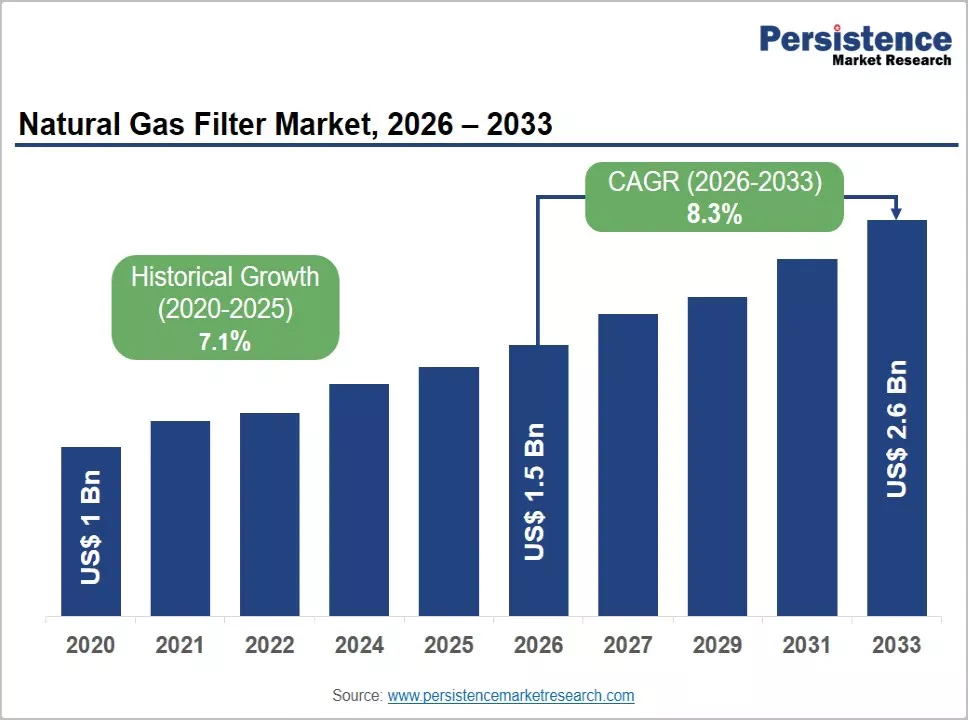
The global natural gas filter market size is likely to be valued at US$ 1.5 billion in 2026 and is projected to reach US$ 2.6 billion by 2033, growing at a CAGR of 8.3% during the forecast period between 2026 and 2033.
Natural gas filters have moved from commodity protection hardware to engineered assets that decide the uptime of compressors, turbines, engines, and fueling equipment. The forecast period is shaped by new liquefied natural gas capacity, rising gas-fired power generation, tighter methane and emissions rules, and the arrival of biomethane and hydrogen-blended streams that carry different contaminants from conventional pipeline gas. Operators, equipment makers, and filter suppliers should read this as a reliability-led category in which coalescing efficiency, element life, and compact vessel design determine vendor selection.
Key Industry Highlights
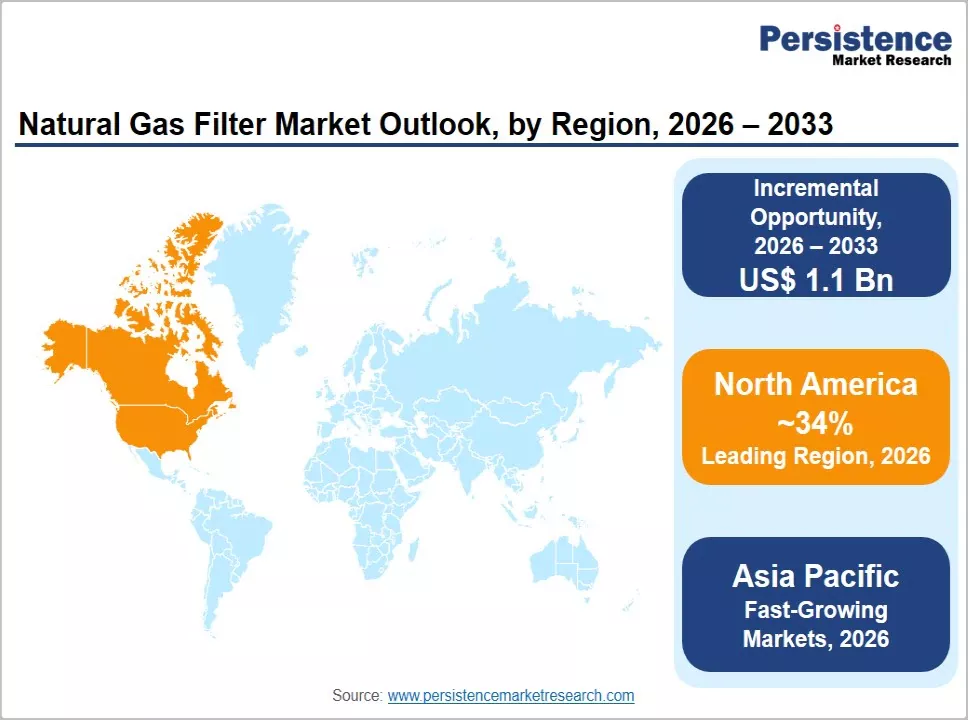
- Dominant Region: North America holds 34% of the natural gas filter market in 2026, reflecting shale gas processing, a dense pipeline and compression network, fast-growing LNG export capacity, and heavy spending on gas-fired power. The preference of U.S. operators for high-efficiency coalescers shapes product specifications worldwide.
- Fastest-growing Region: Asia Pacific is projected to grow at an estimated 9.7% CAGR through 2033, as China, India, and Southeast Asia expand gas pipelines, city gas distribution, LNG import terminals, and gas-fired generation. New infrastructure creates demand for both original-fit and replacement elements.
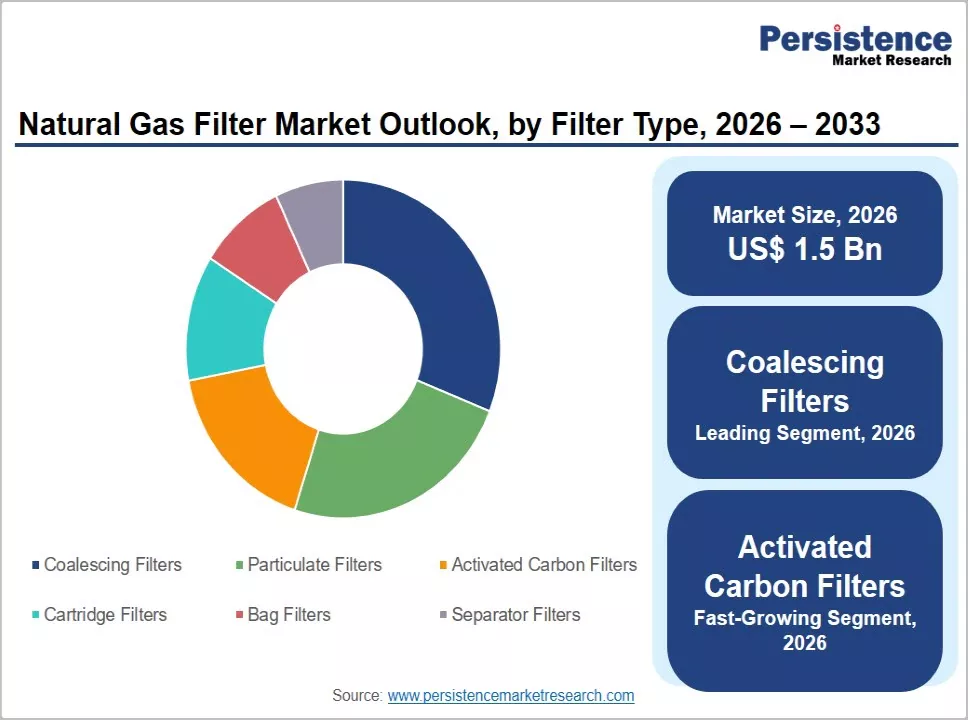
- Leading Filter Type: Coalescing filters command about 31% of 2026 revenue, supported by the need to remove liquid aerosols, compressor oil, and water mist from process gas ahead of compressors, turbines, and dehydration units. Parker Hannifin Corporation, Pall Corporation, and Eaton Corporation anchor this segment.
- Fastest-growing Filter Type and Emerging Opportunity: Activated carbon filters are the fastest-growing type, as biomethane upgrading, removal of odorants and sulfur compounds, and stricter fuel quality limits for engines and fuel cells lift demand for adsorption media. Suppliers that combine carbon beds with coalescing stages are best placed to capture this demand.
DRO Analysis
Driver- LNG Build-Out, Gas-Fired Power Growth, and Tighter Equipment Protection Requirements
Gas infrastructure growth is the strongest driver. New LNG export and import capacity, expanding pipeline networks, and a rising fleet of gas turbines and reciprocating engines all depend on clean fuel gas, because liquid carryover and fine solids damage injectors, burners, valves, and compressor seals.
Pall Corporation noted in February 2026 that capital constraints are pushing operators to deliver higher throughput with less investment, a trend that favors advanced coalescers and high-flow particulate elements in smaller vessels. The EU Methane Regulation, adopted in 2024, and operator emission targets add pressure to limit leaks, venting, and unplanned shutdowns, which keeps filtration inside maintenance and reliability budgets.
Restraint- Volatile Capital Spending, Maintenance Burden, and Material Compliance Costs
Filter demand follows upstream and midstream investment cycles, so volatile gas prices and project deferrals can delay orders for new vessels and elements. Coalescers and carbon beds need regular replacement and differential pressure monitoring, and poorly maintained filters can raise pressure drop and energy use instead of reducing risk.
Suppliers also face rising costs from certifications such as ASME and the European Pressure Equipment Directive, from hazardous-area requirements, and from the shift towards PFAS-free coalescing media, which requires reformulation and fresh qualification with customers. Price-focused buyers in smaller markets often defer element changes, which limits aftermarket volumes.
Opportunity- Biomethane, Hydrogen Blending, and Compact High-Flow Vessel Designs
Biomethane upgrading and hydrogen-ready pipelines create the largest white space, because these gas streams carry siloxanes, hydrogen sulfide, moisture, and lubricant aerosols that call for adsorption and coalescing stages. Product launches reflect this direction.
Pall Corporation introduced its SepraSol Plus Horizontal Liquid/Gas Coalescer and High Flow Gas particle filtration solution in February 2026 to shrink vessel size and element counts, while Eaton Corporation released TOPCART HF housings in July 2025 with flow capacity above 4,400 GPM for demanding industrial duties. Suppliers that pair compact vessels, longer-life media, and condition-monitoring services can win both new-build and replacement demand.
Category-wise Analysis
Why Do Coalescing Filters Lead the Global Natural Gas Filter Market?
Coalescing filters are projected to lead the segment, holding nearly 31% of market share in 2026. Liquid aerosols from compressors, wellheads, and dehydration units are the main threat to downstream equipment, and coalescing elements capture fine droplets at sub-micron levels before they reach turbines, engines, or regulators. Parker Hannifin Corporation, Pall Corporation, and Eaton Corporation offer high-efficiency coalescers and duplex housings for pipeline, compression, and engine fuel applications, while Donaldson Company, Inc. and MANN+HUMMEL Group supply gas filtration for engines and power equipment. Particulate, cartridge, bag, and separator filters complete the staged filtration trains used at most gas facilities.
Activated carbon filters are likely to be the fastest-growing segment, driven by biomethane upgrading, removal of odorants, volatile organic compounds, and sulfur compounds, and by stricter fuel quality requirements for engines and fuel cells. Camfil AB and AAF International, both established in carbon-based molecular filtration for air, are extending that experience into gas-phase applications, while Alfa Laval AB supplies separators that remove liquids and solids upstream of adsorption beds. Suppliers are also developing longer-life media and regenerable beds to reduce replacement frequency and disposal costs.
Filtration Technology Insights
What Is Driving Mechanical Filtration Dominance Across the Natural Gas Filter Industry?
Mechanical filtration is expected to lead the segment, holding about 41% of market share in 2026. Screens, pleated media, and bag and cartridge elements remove solids at low cost and are required upstream of almost every other stage, from wellhead gathering to city gate stations. Their simplicity, wide availability of replacement elements, and compatibility with existing housings create a large installed base. Donaldson Company, Inc., Eaton Corporation, Parker Hannifin Corporation, MANN+HUMMEL Group, and HYDAC International supply pleated and depth media across many pressure classes.
Membrane filtration is likely to be the fastest-growing technology, driven by gas dehydration, carbon dioxide and hydrogen sulfide removal, and hydrogen-blend handling, where selective membranes offer compact, low-maintenance performance. Adoption is rising in biogas upgrading, remote wellsites, and pipeline conditioning. Coalescence and adsorption filtration remain essential partners, because membranes need clean, aerosol-free feed gas to keep their service life, which protects demand for upstream coalescers from Pall Corporation, Parker Hannifin Corporation, and MAHLE GmbH.
End-User Industry Insights
Why Does Oil & Gas Hold the Largest Share of the Natural Gas Filter Market?
Oil & gas is projected to lead the end-user segment, accounting for around 44% of market share in 2026. Wellsite separation, gathering, gas processing, compression, storage, and LNG liquefaction and regasification all require filtration to protect compressors, dehydration units, and metering. Capital discipline is encouraging operators to specify smaller vessels and standardized elements, which supports suppliers of engineered filtration packages and aftermarket elements such as Pall Corporation, Parker Hannifin Corporation, and Eaton Corporation.
Power generation is likely to be the fastest-growing end-user, as utilities, independent producers, and data-centre developers add gas turbines and reciprocating engines to meet rising electricity demand and to back up variable renewable output. Turbines and engines tolerate very little liquid or particulate carryover, which makes fuel gas conditioning a standard part of plant design. Chemical and petrochemical plants, manufacturing, residential and commercial distribution, and transportation, including compressed natural gas fueling stations and vehicle engines, form a diversified base for replacement demand.
Regional Insights
North America Natural Gas Filter Market Trends and Insights
North America is forecast to dominate the regional market, accounting for around 34% of the natural gas filter market share in 2026. The region combines large-scale shale production, a dense pipeline and compression network, growing LNG export capacity, and an extensive fleet of gas-fired power plants. Strong aftermarket demand for replacement elements and the presence of major filtration suppliers reinforce local supply.
U.S. Natural Gas Filter Market Size
The U.S. is estimated to hold around 88% of the North America regional market in 2026. Gas processing plants, compression stations, LNG terminals, and the expanding power sector's use of gas turbines drive filtration demand, while methane emission controls encourage better maintenance of gas handling equipment.
Canada Natural Gas Filter Market Size
Canada is expected to account for over 12% of the North America regional market in 2026. Gas production in Western Canada, LNG export projects on the Pacific coast, which began shipping cargoes in 2025, and the need for cold-climate, high-reliability filtration at remote compression sites support steady demand.
Europe Natural Gas Filter Market Trends and Insights
Europe is anticipated to command around 24% of the natural gas filter market in 2026. LNG import terminals built after 2022, a dense gas distribution network, biomethane growth, and strict methane and pressure equipment rules shape demand. Germany-based suppliers such as MANN+HUMMEL Group, MAHLE GmbH, and HYDAC International strengthen local supply of filtration technology.
Germany Natural Gas Filter Market Size
Germany is projected to account for around 22% of the Europe regional market in 2026. The country added floating LNG import terminals after 2022, operates a large industrial gas user base, and has one of Europe's largest biogas and biomethane sectors, all of which need gas conditioning and filtration.
U.K. Natural Gas Filter Market Size
The U.K. is estimated to account for nearly 13% of the Europe regional market in 2026. North Sea gas processing, LNG import terminals, gas-fired power stations, and growing interest in hydrogen blending and carbon capture clusters sustain demand for gas filtration and separation equipment.
Which Region Will Drive the Fastest Natural Gas Filter Growth Through 2033?
Asia Pacific is forecast to be the fastest-growing region, capturing around 28% of market share in 2026 and expanding at an estimated 9.7% CAGR through 2033. Pipeline expansion, city gas distribution, new LNG import terminals, and gas-fired power additions are lifting filtration demand across the region. International suppliers are partnering with local manufacturers to supply elements and housings that meet regional standards at competitive prices.
China Natural Gas Filter Market Size
China is projected to hold 41% of the Asia Pacific regional market in 2026. Growth in domestic gas production, pipeline interconnection, LNG receiving terminals, and the use of natural gas in industry and heavy transport supports large volumes, while local filter manufacturers compete strongly on price.
India Natural Gas Filter Market Size
India is expected to account for around 17% of the Asia Pacific regional market in 2026. The government's goal of raising the share of gas in the energy mix, expansion of city gas distribution networks and CNG stations, and new LNG terminals and pipelines are creating opportunities for filtration suppliers.
Competitive Landscape
The global natural gas filter market is moderately fragmented, with diversified filtration groups and specialist separation suppliers competing for pipeline, processing, power, and engine fuel contracts. Parker Hannifin Corporation, Pall Corporation, Eaton Corporation, and Donaldson Company, Inc. lead on portfolio breadth, engineering support, and global service networks.
MANN+HUMMEL Group, Alfa Laval AB, HYDAC International, MAHLE GmbH, Camfil AB, and AAF International compete with specialized media, separators, and gas-phase filtration offerings. Competitive intensity is rising as operators demand smaller vessels, longer element life, PFAS-free media, and condition monitoring, and as regional manufacturers in Asia price aggressively. Winning requires proven coalescing efficiency, pressure equipment certifications, rapid aftermarket supply, and the ability to support biomethane and hydrogen-ready applications.
Key Industry Developments
- In February 2026, Pall Corporation introduced the SepraSol Plus Horizontal Liquid/Gas (HLG) Coalescer and High Flow Gas (HFG) particle filtration solution for oil and gas processing. Both products are designed to reduce capital expenditure and total cost of ownership by using significantly smaller vessels with fewer filter elements while maintaining filtration quality. The coalescer delivers high-efficiency aerosol removal in a new horizontal configuration, and the two solutions can be deployed independently or together.
- In July 2025, Eaton Corporation launched its TOPCART HF filter cartridge housings, designed for use with LOFPLEAT HF filter cartridges in high-flow industrial applications, including oil and gas. The single and multi-cartridge housings support flow capacities above 4,400 GPM (1,000 m³/h) and are available with ASME and Pressure Equipment Directive documentation where required, combining cartridge-grade precision with the efficiency of bag-style systems.
Companies Covered in Natural Gas Filter Market
- AAF International
- Alfa Laval AB
- Camfil AB
- Donaldson Company, Inc.
- Eaton Corporation
- HYDAC International
- MAHLE GmbH
- MANN+HUMMEL Group
- Pall Corporation
- Parker Hannifin Corporation
Frequently Asked Questions
The global natural gas filter market is valued at US$ 1.5 billion in 2026.
LNG and pipeline expansion, rising gas-fired power generation, tighter methane and equipment protection requirements, and demand for smaller, higher-efficiency vessels, partly offset by volatile capital spending, maintenance burden, and certification costs.
Coalescing filters hold around 31% of the market. They remove liquid aerosols and oil mist that damage compressors, turbines, and engines, which makes them the central stage in most gas filtration trains.
North America lead with a 34% share in 2026, driven by shale gas production, a dense pipeline and compression network, LNG export growth, and a large gas-fired power fleet.
The largest opportunities are biomethane upgrading, hydrogen-ready pipelines, compact high-flow vessels, PFAS-free media, and condition-monitoring services for replacement demand.
Leading companies include Parker Hannifin Corporation, Pall Corporation, Eaton Corporation, Donaldson Company, Inc., and MANN+HUMMEL Group. The market is moderately fragmented, with diversified filtration groups and specialist suppliers competing on efficiency, service, and certifications.


