




- Oil & Gas
- Steam Methane Reforming Market
Steam Methane Reforming Market Size, Share, and Growth Forecast, 2026 - 2033
Steam Methane Reforming Market by Application (Hydrogen Production, Methanol Production), Technology (Conventional SMR, Advanced SMR), End-User Industry and Regional Analysis for 2026 - 2033

Steam Methane Reforming Market Size and Trends Analysis
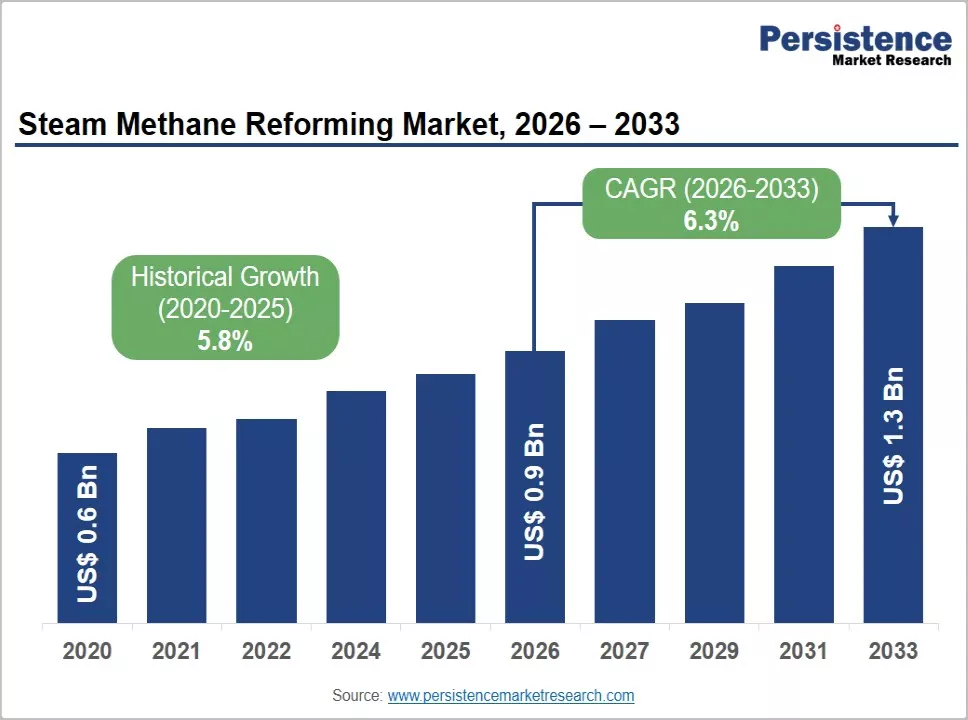
The global steam methane reforming market size is likely to be valued at US$ 0.9 billion in 2026 and is expected to reach US$ 1.3 billion by 2033, growing at a CAGR of 6.3% between 2026 and 2033, driven by steady hydrogen demand from refining and chemical production and rising investment in carbon capture-integrated reformers. Operators are upgrading existing units with heat recovery and carbon capture to meet emission requirements.
Key Industry Highlights
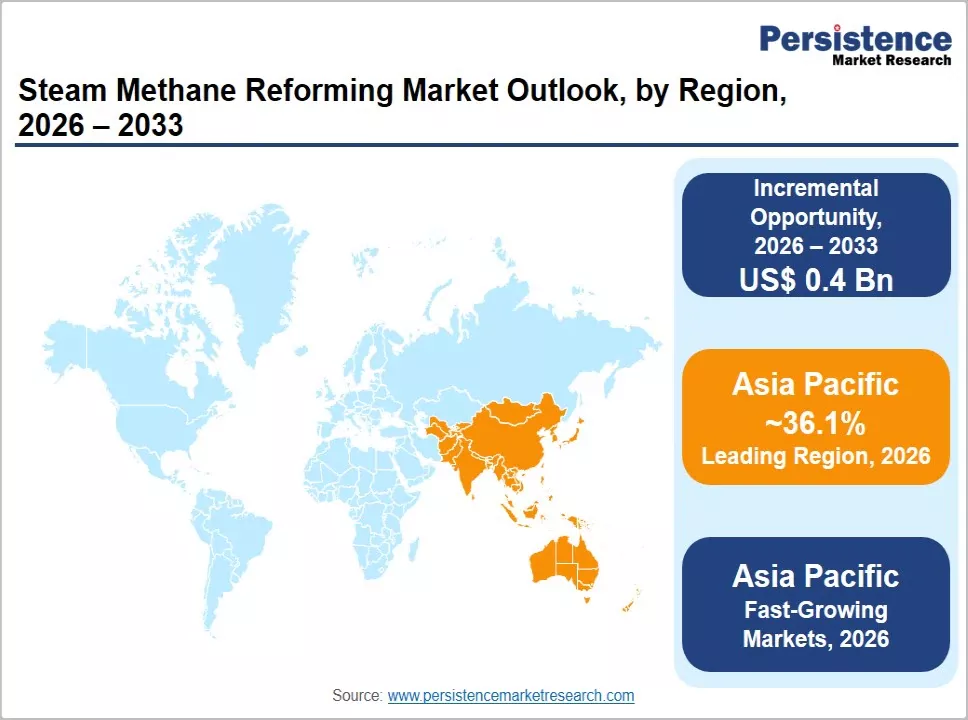
- Leading and Fastest-growing Region: Asia Pacific, anticipated to account for 36.1% of the market share, supported by large refining, fertilizer, and chemical capacity and expanding natural gas-based hydrogen production.
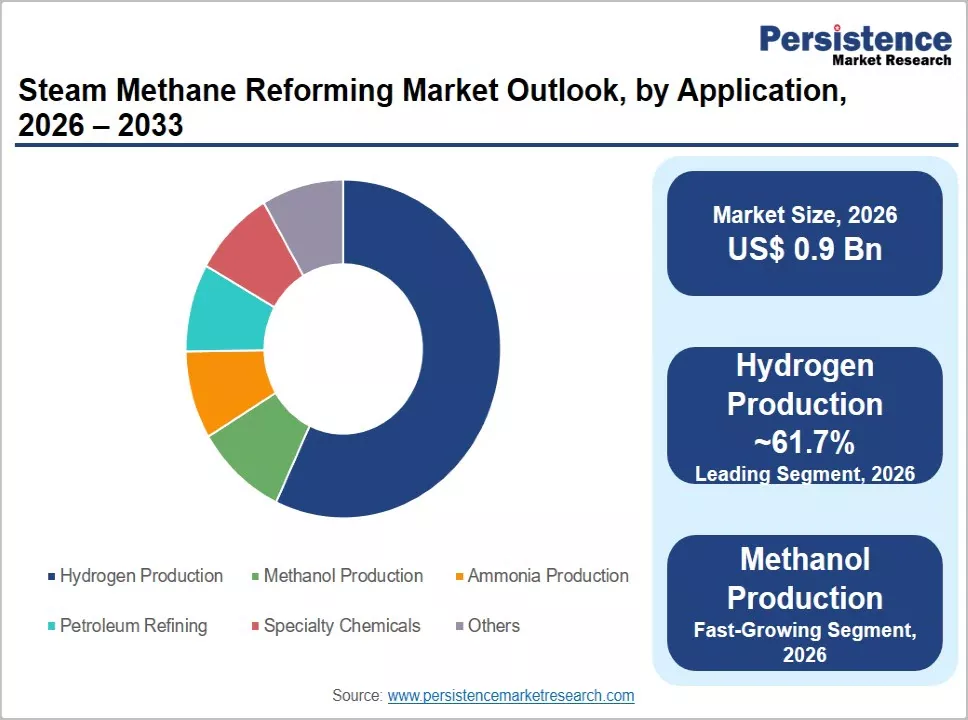
- Dominant Application: Hydrogen production, anticipated to hold 61.7% of the market, driven by captive and merchant hydrogen supply to refineries, ammonia plants, and chemical complexes.
- Leading Technology: Conventional SMR, anticipated to account for approximately 71.2% of the market share, supported by proven designs, scalable unit sizes, and a large installed base.
DRO Analysis
Drivers - Rising Hydrogen Demand from Refining and Chemicals Sustains Reformer Installations
Global hydrogen demand reached almost 100 million tonnes in 2024, up 2% from 2023, according to the IEA, with growth concentrated in refining and industrial uses. Hydrogen production consumed 290 billion cubic meters of natural gas in 2024, which confirms natural gas reforming as the leading supply route.
Refineries use hydrogen for hydrocracking and desulfurization, while ammonia and methanol producers use it as a feedstock. These applications require continuous, high-volume supply, which favors steam methane reforming units because of their established design, scalability, and operating record. Demand for new units, revamps, and catalyst replacement follows these consumption patterns.
Carbon Capture Integration and Policy Support Are Extending the Role of Reforming Assets
Low-emissions hydrogen production grew by 10% in 2024 but remained below 1% of global production, according to the IEA, which keeps reforming units central to supply while operators add carbon capture. In France, Air Liquide operates its Port-Jérôme facility using steam methane reforming with cryogenic CO2 capture.
Policy instruments support this shift. In the U.S., the One Big Beautiful Bill Act, signed in July 2025, retained the Section 45V clean hydrogen credit for facilities that begin construction before January 1, 2028. In the U.K., the HyNet cluster receives government support for low-carbon hydrogen production. These measures link reformer demand to emission performance as well as capacity.
Restraint - High Carbon Intensity and Carbon Capture Economics Constrain Investment Decisions
Unabated steam methane reforming emits roughly 9-11 kilograms of CO2 per kilogram of hydrogen, exposing operators to emission rules and carbon pricing. Carbon capture lowers this footprint but raises capital and operating costs and depends on CO2 transport and storage access.
Project outcomes illustrate the risk. On June 30, 2026, Air Products announced that it is not proceeding with its Louisiana Clean Energy Complex and flagged pre-tax charges of up to US$2.9 billion. The IEA also lowered the 2030 potential for low-emissions hydrogen from announced projects to 37 million tons per year from 49 million tons a year earlier.
Opportunities - Retrofits of Existing Reformers Create a Lower-Risk Path to Emission Reduction
Refiners and chemical producers operate large reforming fleets that supply hydrogen continuously. Adding heat recovery and carbon capture to these units lowers emissions while limiting the scope of new construction, which is a practical route for operators with existing hydrogen infrastructure and established feedstock contracts.
IEA data shows that low-emissions hydrogen projects that are operating, under construction, or backed by final investment decisions are on track to raise output more than fivefold from 2024 levels, to over 4 million tons per year by 2030. This pipeline sustains demand for reformer technology, catalysts, and capture systems, and gives technology licensors recurring revenue from upgrades and catalyst supply.
On-Site Hydrogen for Sustainable Fuels and Data Center Power Opens New Demand Channels
The IEA reports that hydrogen demand from new applications remained below 1% of the total in 2024 and was concentrated almost entirely in biofuel production. In February 2026, Technip Energies received a substantial EPCC contract from SkyNRG for the DSL-01 sustainable aviation fuel facility in Delfzijl, the Netherlands, which includes an on-site hydrogen plant based on Technip Energies' proprietary steam methane reforming technology.
Power applications add another channel. In October 2026, Topsoe and HDF Energy signed a licensing agreement for the 250 MW BaseBlue project in Texas, which converts Permian Basin natural gas into low-carbon hydrogen for data center power, targeting commercial operation from 2030.
Category-wise Analysis
Application Insights
Hydrogen production is anticipated to account for 61.7% of the market share. The segment covers reforming units that supply hydrogen to refineries, ammonia plants, and chemical complexes, either as captive units or through merchant supply.
Natural gas remains the main feedstock, and the IEA reports that global hydrogen demand reached almost 100 million tons in 2024. For example, India consumes about 5.6 million tons of grey hydrogen annually, nearly 6% of global demand, according to the Council on Energy, Environment and Water (CEEW), largely for captive use in refineries and fertilizer plants. Continued refinery hydrogen demand supports new units, revamps, and catalyst replacement. Hydrogen production units are typically sized to match the continuous throughput of the host facility, which keeps long-term service and catalyst contracts attached to installed capacity.
Methanol production is anticipated to be the fastest-growing application, at a CAGR of 6.7%, driven by new capacity for chemicals, fuels, and low-carbon methanol. Methanol plants reform natural gas into synthesis gas before conversion to methanol, so each new plant requires reforming capacity. For example, Sandpiper Chemicals plans a blue methanol plant in Texas designed for 3,000 tons per day, beginning in 2030, under a license for Topsoe's SynCOR technology.
Growing interest in lower-carbon methanol is also encouraging the integration of carbon capture with reforming units. Ammonia production, petroleum refining, and specialty chemicals add further demand, as each consumes hydrogen or synthesis gas at industrial scale.
Technology Insights
Conventional SMR is anticipated to account for 71.2% of the market share. The process reacts natural gas with steam over a nickel catalyst at roughly 700-1,000 degrees Celsius in a fired reformer, followed by shift conversion and purification, commonly using pressure swing adsorption to produce high-purity hydrogen.
The technology benefits from decades of operating experience, a large installed base, and scalable unit sizes. Fired reformer designs also allow flexibility in feedstock composition and heat integration, which supports use across refinery and chemical applications. For example, Technip Energies' proprietary steam methane reforming technology supplies the on-site hydrogen plant in SkyNRG's DSL-01 sustainable aviation fuel facility in the Netherlands, showing continued selection of this design for new hydrogen units.
Advanced SMR is anticipated to be the fastest-growing technology, at a CAGR of 9.3%, as operators seek lower emissions from natural gas-based hydrogen. This category includes heat-integrated reformers and configurations paired with carbon capture. For example, Air Liquide's Port-Jérôme facility in France combines steam methane reforming with cryogenic CO2 capture. In July 2026, Honeywell completed its acquisition of Johnson Matthey's Catalyst Technologies business for £1.325 billion, adding catalyst and process technologies to its portfolio.
Topsoe is also licensing its SynCOR autothermal reforming technology for blue hydrogen projects in Texas, including the 250 MW BaseBlue power project, which indicates growing selection of advanced reforming for large-scale, carbon capture-enabled supply.
Regional Insights
North America Steam Methane Reforming Market Trends
North America has an established base of refineries, ammonia plants, and chemical complexes that rely on natural gas reforming. The IEA notes that cheaper natural gas in the U.S. widens the cost gap with electrolysis-based hydrogen, which makes carbon capture a more competitive near-term option for low-emissions supply. Policy incentives for hydrogen production and carbon capture shape new investment decisions, with growth concentrated in retrofits and carbon capture-enabled projects.
U.S. Steam Methane Reforming Market Trends
The U.S. anchors regional demand due to its refining and chemical base along the Gulf Coast, where Air Products operates a hydrogen pipeline network serving refineries and chemical plants. The One Big Beautiful Bill Act, signed on July 4, 2025, moved the Section 45V clean hydrogen credit construction deadline to January 1, 2028, from January 1, 2033, which compresses the timeline for qualifying projects. The Section 45Q carbon capture credit remains the main support for carbon capture-based hydrogen, although reliance on it adds financial risk to project economics.
On June 30, 2026, Air Products announced that it is not proceeding with the Louisiana Clean Energy Complex, while finalizing a marketing and distribution agreement with Yara for renewable ammonia from the NEOM Green Hydrogen Project in Saudi Arabia. In October 2026, Topsoe and HDF Energy signed a licensing agreement for the BaseBlue project in Texas. These developments show investment moving toward projects with defined on-site or industrial demand.
Europe Steam Methane Reforming Market Trends
Europe is a mature market where reformer demand is shaped by refinery hydrogen needs, chemical production, and decarbonization regulation, and chemical and refining clusters, including ammonia plants, remain the main buyers of reformer-based hydrogen. The EU Renewable Energy Directive sets renewable hydrogen targets for industry and transport, while carbon pricing raises the cost of unabated reforming. These measures are encouraging operators to adopt carbon capture-enabled and lower-emission configurations.
Germany Steam Methane Reforming Market Trends
Germany's hydrogen demand is concentrated in its chemical and refining sectors, with approximately 55 TWh consumed annually, mainly for ammonia production, according to Germany Trade & Invest. The Federal Network Agency approved a 9,040-kilometer hydrogen core network on October 22, 2024, with expected investment of €18.9 billion, and about 60% of the network consists of converted natural gas pipelines. The network is planned with feed-in and exit capacities of around 101 GW and 87 GW respectively, and the reservation phase for transport capacity started on March 19, 2026.
These developments support integration of hydrogen supply for existing industrial sites, while renewable hydrogen quotas for refineries are likely to shift part of refinery supply toward electrolysis-based sources. Reformers at refineries and chemical plants are expected to continue serving baseload demand during this transition.
U.K. Steam Methane Reforming Market Trends
The U.K. is advancing low-carbon hydrogen through the HyNet cluster, which received confirmed government support in October 2024. The cluster includes EET Hydrogen's 350 MW HPP1 plant at the Stanlow refinery, designed to capture about 600,000 tons of CO2 annually using Johnson Matthey's low-carbon hydrogen technology, which combines gas-heated reforming and autothermal reforming. Production at HPP1 is planned to begin in 2028, with hydrogen supplied to the Stanlow refinery and regional customers such as glass and chemical manufacturers.
In August 2026, Essar committed £4.3 billion to low-carbon energy projects in the UK, with the bulk planned for Stanlow, and reported that it is close to a final investment decision on a further £1 billion of spending. These plans show the shift in Europe toward reforming configurations integrated with carbon capture.
Asia Pacific Steam Methane Reforming Market Trends
Asia Pacific is anticipated to account for 36.1% of the market share, making it the leading region, and is also the fastest-growing regional market. The region combines large refining, fertilizer, and chemical capacity with expanding natural gas use and government hydrogen programs, while refining capacity additions and fertilizer production anchor demand for reformer capacity. According to the IEA, hydrogen demand in Southeast Asia reached 4 million tons in 2024, indicating additional demand growth beyond the largest producers.
India Steam Methane Reforming Market Trends
India consumes about 5.6 million tons of grey hydrogen annually, nearly 6% of global consumption, according to CEEW, with refineries and fertilizer plants as the main users. The National Green Hydrogen Mission, approved in January 2023 with an outlay of INR 19,744 crores, targets at least 5 million tons of green hydrogen capacity by 2030 and focuses first on replacing grey hydrogen at refineries and fertilizer plants. A government proposal seeks to replace 10% of grey hydrogen consumption at refineries with green hydrogen by 2030.
Green hydrogen currently costs more than hydrogen from steam reforming of natural gas, which keeps existing reformers in service as the baseline supply through the forecast period. Refining and fertilizer capacity additions continue to require reforming units, with gradual blending of low-carbon hydrogen expected over time.
China Steam Methane Reforming Market Trends
China is the world's largest hydrogen producer, with output exceeding 39 million tons and production capacity above 51 million tons in 2025, according to the 2026 China Hydrogen Development Report. Coal-based hydrogen accounted for about 23 million tons, natural gas for about 7.9 million tons, and industrial by-product hydrogen for about 7.7 million tons, which places natural gas reforming at roughly one-fifth of output.
The chemical sector remains the largest consumer of hydrogen in the country. Operating renewable hydrogen capacity exceeded 250,000 tons per year in 2025, more than doubling from the previous year, according to the China Hydrogen Alliance. Natural gas-based reforming continues to supply refinery and chemical demand while renewable hydrogen scales, and policy support continues under the 15th Five-Year Plan cycle.
Competitive Landscape
The global steam methane reforming market is moderately consolidated, with competition among industrial gas companies, engineering and technology licensors, and catalyst and process technology providers. Major companies compete based on proprietary reformer designs, catalyst performance, carbon capture integration, project execution capability, and long-term supply agreements. The market includes both integrated industrial gas suppliers that own and operate hydrogen plants and technology providers that license designs and supply proprietary equipment.
Leading companies are focusing on low-carbon reforming configurations, expansion of catalyst and process technology portfolios, and project execution for refinery, fuel, and chemical customers. Competitive differentiation increasingly depends on the ability to combine reforming with carbon capture in a single integrated offering. Companies are also pursuing acquisitions and licensing agreements to widen technology portfolios.
Key Industry Developments
- In July 2026, Honeywell completed its acquisition of Johnson Matthey's Catalyst Technologies business for £1.325 billion in an all-cash transaction, broadening its catalyst and process technology portfolio across refining, petrochemicals, and renewable fuels.
- In October 2026, Topsoe signed a licensing agreement with HDF Energy for the 250 MW BaseBlue power project in Texas, supplying SynCOR autothermal reforming technology, proprietary equipment, and catalysts for hydrogen production and CO2 capture.
- In June 2026, Air Products announced that it is not proceeding with the Louisiana Clean Energy Complex and flagged pre-tax charges of up to US$2.9 billion, while finalizing a marketing and distribution agreement with Yara for renewable ammonia from the NEOM Green Hydrogen Project.
Companies Covered in Steam Methane Reforming Market
- Air Liquide S.A.
- Linde plc
- Air Products and Chemicals, Inc.
- Technip Energies N.V.
- Topsoe A/S
- Honeywell UOP
- KBR, Inc.
- Casale SA
- Lummus Technology
- thyssenkrupp Uhde GmbH
- Maire S.p.A. (Kinetics Technology)
- Chiyoda Corporation
Frequently Asked Questions
The global steam methane reforming market is projected to be valued at US$ 0.9 billion in 2026.
The market is expected to reach US$ 1.3 billion by 2033.
Key trends include the integration of carbon capture with reforming units, adoption of advanced and heat-integrated reformers, on-site hydrogen supply for sustainable aviation fuel and data center power, and retrofits of existing refinery and chemical plant hydrogen units.
Hydrogen production is anticipated to remain the leading application segment, accounting for approximately 61.7% of the market, while conventional SMR leads the technology segment with a 71.2% share.
The market is projected to expand at a CAGR of 6.3% between 2026 and 2033.
Major companies include Air Liquide, Linde, Air Products, Technip Energies, and Topsoe.


