




- Healthcare
- Nanobots Market
Nanobots Market Size, Share, and Growth Forecast 2026 – 2033
Nanobots Market by Product Type (Nanomanipulators, Bio-Nanorobotics, Magnetically Guided Nanobots/Nanorobots), Type of Manufacturing (Biochips, Nubots), Application (Biomedical, Nanomedicine), and Regional Analysis, 2026 – 2033

Nanobots Market Size and Trends Analysis
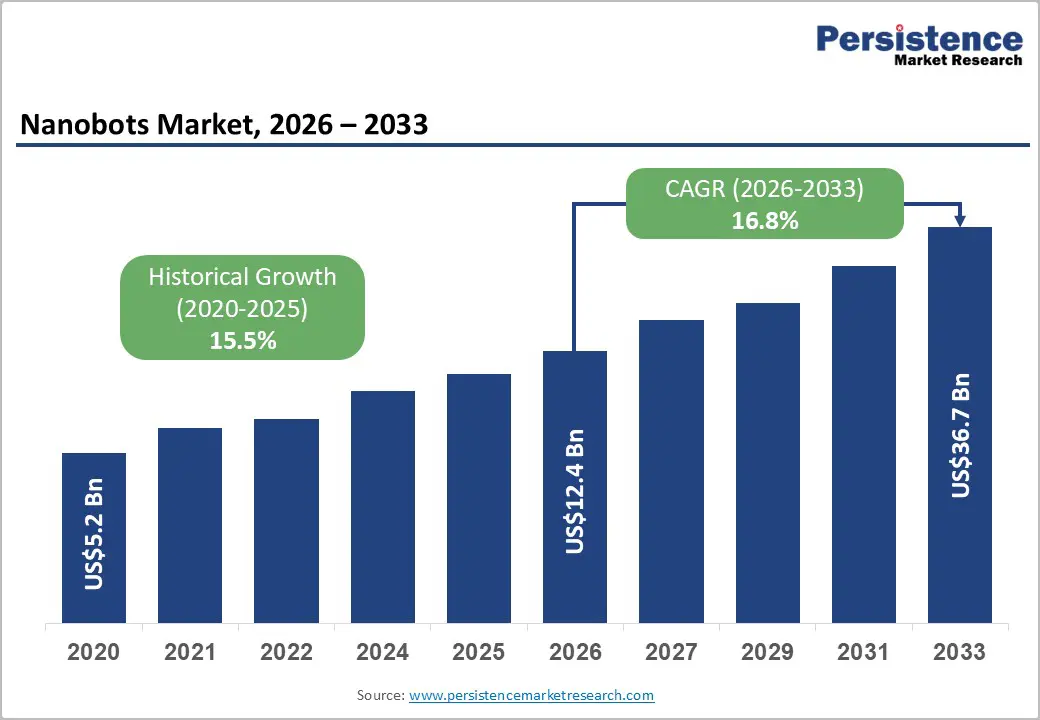
The global nanobots market size is likely to be valued at US$12.4 billion in 2026 and is expected to reach US$36.7 billion by 2033, growing at a CAGR of 16.8% during the forecast period from 2026 to 2033, driven by rising demand for targeted drug delivery and precision medicine, especially in cancer and neurological treatments. Growth is further supported by increasing investments from governments and agencies such as the National Nanotechnology Initiative in nanoscale research and commercialization.
Key Industry Highlights:
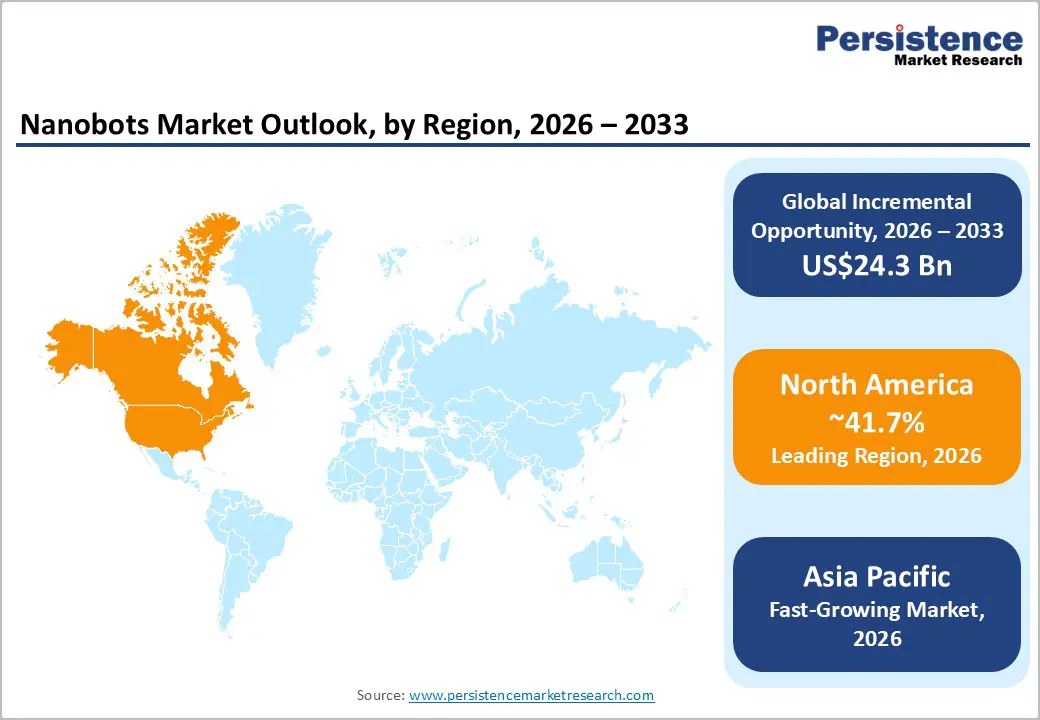
- Leading Region: North America, with about 41.7% share in 2026, fueled by its strong federal funding ecosystem and advanced biomedical research infrastructure.
- Fast-growing Region: Asia Pacific, fostered by rapid expansion of nanotechnology research hubs and integration of AI with nanomedicine.
- New Study: In August 2025, a team led by Dr. Zhilu Yang, Dr. Xing Ma, and Dr. Ning Liu in China published magnetically powered spiky nanorobots in Research that improve chemotherapy drug uptake by piercing tumor cells. The study showed a 61% reduction in tumor growth and 100% survival in mice, with minimal side effects.
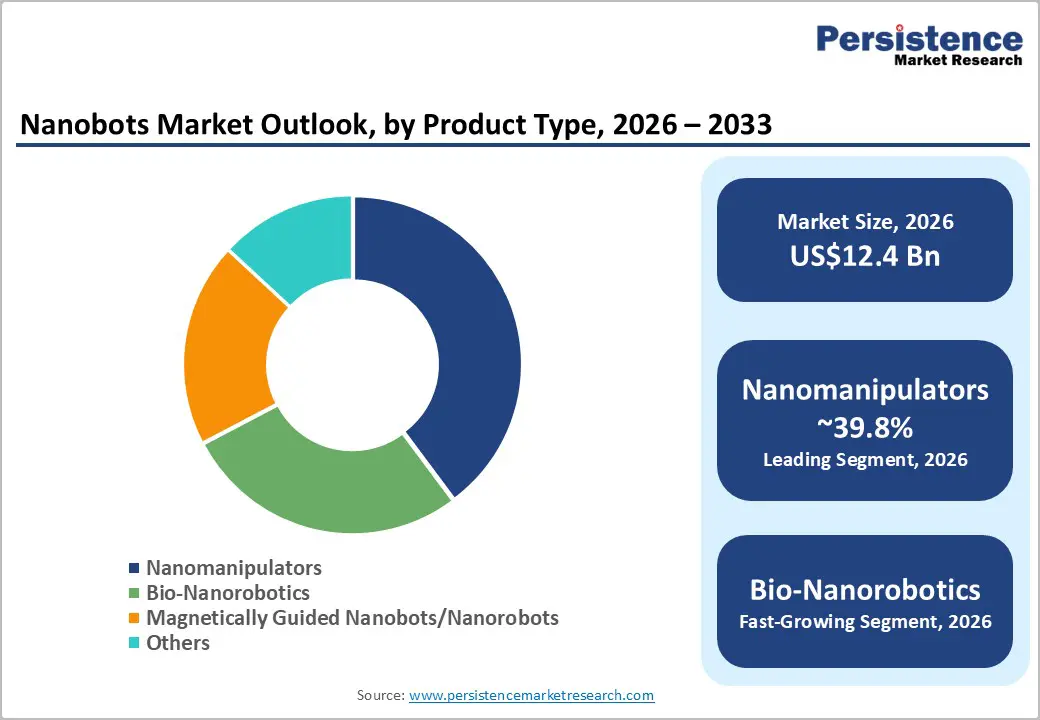
- Leading Product Type: Nanomanipulators, approximately 39.8% share in 2026, as they are already widely deployed in nanoscale research.
- Dominant Application: Nanomedicine, nearly 41.2% in 2026, as it enables targeted drug delivery and precision treatment.
DRO Analysis
Driver - Need for Precision Drug Delivery Directly to Disease Sites
Standard chemotherapy floods the entire body with toxic agents, damaging healthy tissue along with tumors. Nanobots change this by delivering drugs straight to the target. A 2025 study published in Frontiers in Robotics and AI confirmed that urease-powered nanobots loaded with radioiodine reduced bladder tumors by 90% in mice at minimal dose levels. Beyond cancer, ETH Zurich researchers published a study in Science introducing the Navion system.
It is a complete platform combining magnetic navigation, drug release, and real-time imaging into one. The system successfully guided biodegradable microcapsule-carrying microrobots to precise locations in both animal models and lab-based human vasculature models, which was a key step toward practical clinical use. Unlike chemotherapy, which is responsible for several drug failures in clinical trials due to systemic side effects, nanobots release their payload only at the intended site, protecting surrounding tissue.
Urgent Need for Early Detection and Monitoring of Tumors
One of the strongest use cases for nanotechnology is catching disease before it becomes critical. Nanosensors can detect abnormal biomarkers such as proteins, genetic fragments, or tumor cells circulating in the blood at concentrations too low for standard tests to flag. A 2025 review in RSC Pharmaceutics highlighted how nanosensors are transforming real-time monitoring and disease management through cutting-edge nanotechnology in clinical settings.
For leukemia specifically, a 2025 Nano Select study showed that biosensors integrating quantum dots, liposomes, and polymeric nanoparticles hold strong promise for noninvasive and real-time monitoring of cancer progression. These are anticipated to enable prompt intervention and personalized treatment. Since several cancers remain undiagnosed until advanced stages, this early-warning capability helps improve survival odds.
Restraint - Risk of Malfunction and Uncontrolled Behavior
The most prominent technical worry in nanobot development is not whether they will work, but it is what happens if they stop working correctly. A single programming flaw in a self-replicating nanobot could trigger uncontrolled multiplication. The ‘grey goo’ concept, first raised by Eric Drexler in Engines of Creation (1986), describes a scenario where nanobots programmed without a termination switch replicate without limit, consuming all available matter.
While full-scale grey goo remains theoretical, the underlying concern, i.e., loss of control, is taken seriously by researchers. A more immediate risk lies in synthetic biology, where engineered pathogens and metabolic disruptors are actively being developed. ‘Green Goo’ maturity is estimated between 2025 and 2035 based on DARPA Living Foundries progress. Without reliable kill-switch mechanisms built into nanobot design from the start, regulators are unlikely to approve clinical deployment, which limits how fast the field can move forward.
Opportunity- Self-Folding Nanobots That Activate Only Inside Tumors
Most cancer drugs cannot tell the difference between a tumor and healthy tissue. DNA origami nanobots solve this by staying inactive until they reach the right environment. Researchers at Karolinska Institutet built nanobots that carry cytotoxic peptides hidden inside a folded DNA shell. The shell opens only when the pH drops to the acidic level typical of tumor microenvironments, around 6.5, at which point the peptides are exposed and trigger cancer cell death.
When tested in mice bearing human breast cancer xenografts, the nanodevice reduced tumor growth by up to 70%, as published in Nature Nanotechnology. Professor Björn Högberg, who led the study, noted that the goal was to hide the weapon so it could only be activated in the tumor environment. Hence, the team created a nanorobot that specifically targets and kills cancer cells while leaving healthy tissue untouched.
Magnetic Nanobots That Dissolve Clots and Can Be Safely Retrieved
Stroke treatment has a narrow time window. Current clot-dissolving drugs such as tPA work slowly and carry bleeding risks at high doses. Chinese University of Hong Kong’s (CUHK) cross-disciplinary team developed a smart alternative. Their magnetic tPA-anchored nanorobots (tPA-nbots) achieve a thrombolysis rate 5 to 20 times faster than traditional treatment. They can reach more distal, smaller vessel branches that standard methods cannot access. What makes this unique is the retrieval mechanism, meaning the bots do not stay in the body.
In lab testing, tPA-nbots dissolved an artificial blood clot 6.5 mm in length within 18 minutes using a 42-fold lower tPA dose than conventional treatment, with a retrieval rate of approximately 80%. The results were published in Science Advances and Science Robotics, and the team used laser speckle contrast imaging for real-time nanorobot tracking in the bloodstream. It was a novel approach for endovascular intervention therapy.
Category-wise Analysis
Product Type Insights
Nanomanipulators are predicted to lead with a share of approximately 39.8% in 2026, as they are already widely used in commercial and research settings, unlike multiple autonomous nanobots that are still in experimental stages. These systems allow scientists to move, position, and modify materials at the nanometer scale with extremely high precision. They are essential tools in semiconductor manufacturing, nanomaterial development, electron microscopy, and biotechnology research.
The bio-nanorobotics segment is estimated to be the fastest-growing segment over the forecast period, owing to the shift toward precision medicine. Modern healthcare aims to deliver treatment directly to diseased cells while minimizing damage to healthy tissues. Bio-nanorobots are designed specifically for this purpose. Recent studies published in Frontiers in Robotics and AI highlighted their ability to transport drugs to targeted locations and release them only when specific biological signals are detected.
Application Insights
Nanomedicine is anticipated to dominate with a share of nearly 41.2% in 2026, as healthcare represents the most practical and commercially attractive use of nanobot technologies. The ability to deliver drugs precisely to diseased tissues addresses one of the biggest challenges in medicine, i.e., reducing side effects while improving treatment effectiveness. Cancer treatment is a key example. Conventional chemotherapy often affects healthy cells along with cancer cells. Nanomedicine platforms are being developed to transport therapeutic agents directly to tumors.
The biomedical segment is expected to remain in the second position in 2026, as nanorobots can operate at the cellular and subcellular level. This capability opens opportunities that traditional medical devices cannot achieve. Researchers are investigating nanorobots for cell repair, tissue engineering, microsurgery, biosensing, and disease monitoring. One prominent growth area is minimally invasive treatment. Scientists are developing nanorobots that can travel through blood vessels and biological fluids to reach locations that are difficult to access through conventional surgery.
Regional Insights
North America Nanobots Market Trends
North America is predicted to dominate in 2026 with a share of approximately 41.7%, as it has the world's strongest hub for nanotechnology commercialization. The region combines advanced research universities, federal funding programs, biotechnology companies, and pharmaceutical giants under one innovation network. This allows discoveries to move from laboratories to clinical testing faster than in most other regions. The U.S. has invested in nanotechnology for more than two decades through the National Nanotechnology Initiative. The initiative has supported research across medicine, electronics, materials science, and robotics. In healthcare, institutions supported by the National Institutes of Health continue to fund nanomedicine and nanoscale therapeutic research, creating a superior foundation for future nanorobotic applications.
U.S. Nanobots Market Trends
A share of nearly 63.2% is expected to be held by the U.S. in 2026, attributed to increasing research in DNA nanorobots, smart drug delivery systems, and AI-integrated nanomedical devices. A key strength is the country's extensive biomedical research infrastructure. The National Institutes of Health (NIH) continues to support nanomedicine projects focused on diseases such as cancer, neurological disorders, and immune-related conditions. This creates a superior pipeline of technologies that can eventually transition into commercial healthcare products.
The U.S. is also benefiting from developments in DNA-based nanorobotics. Recent studies published in Nature demonstrated new DNA nanorobots capable of autonomous movement and cargo-search functions. Such developments indicate that nanorobots are moving beyond laboratory concepts toward more sophisticated real-world applications.
Asia Pacific Nanobots Market Trends
Asia Pacific is anticipated to be the fastest-growing region in 2026 with a share of nearly 29.1%, as governments are constantly investing in nanotechnology, semiconductor manufacturing, advanced healthcare, and precision medicine. Unlike mature markets, various countries in the region are still expanding their research infrastructure, creating strong growth momentum. China, Japan, South Korea, and Singapore have established dedicated nanotechnology programs and innovation clusters. The region also benefits from a large manufacturing base, which can support future large-scale production of nanomaterials and nanodevices.
China Nanobots Market Trends
China will likely lead Asia Pacific in 2026 with a share of around 33.7%. The country has made nanotechnology a strategic research priority and has built extensive capabilities in nanomaterials, semiconductors, and biomedicine. According to the 2025 China Nanotechnology Industry White Paper, the country accounts for approximately 43% of all authorized nanotechnology patents worldwide over the past 25 years. The report also notes that China’s nanotechnology patents exceed the combined total of the U.S., Japan, and South Korea.
Biomedical innovation is one of the country's key focus areas. China's growth is further supported by rising government funding, research institutes, and industrial parks dedicated to advanced technologies. Cities such as Beijing, Shanghai, Shenzhen, and Suzhou have emerged as prominent centers for nanotechnology and biomedical research.
Japan Nanobots Market Trends
In 2026, Japan is projected to account for a share of approximately 15.4%. It remains one of the most technologically advanced nanotechnology markets. While its growth rate may not match China's, the country continues to play a key role in high-value development. Japan's strength lies in precision engineering, robotics, and advanced healthcare technologies. Researchers are now combining nanotechnology with imaging systems, targeted therapies, and robotic automation.
For example, a 2025 study published in the Japanese Journal of Radiology demonstrated targeted theranostic nanomedicine systems designed for both imaging and treatment applications. The country is also investing heavily in research automation. Advanced robotic laboratories and AI-assisted experimentation platforms are helping accelerate biomedical discoveries. This expertise in robotics provides Japan with a natural advantage as nanorobotics moves closer to commercialization.
Europe Nanobots Market Trends
Europe will likely see decent growth over the forecast period with a share of nearly 15.2% in 2026, as it has built a strong research-based nanotechnology hub supported by universities, public funding programs, and cross-border collaborations. Various countries in the continent have placed increasing emphasis on precision medicine, advanced diagnostics, and targeted therapies. These areas align closely with nanomedicine and nanorobotics development.
The region is particularly strong in translational research, where laboratory discoveries are converted into practical healthcare solutions. Another factor supporting growth is Europe's regulatory focus on safety and clinical validation. Although this sometimes slows commercialization, it helps build trust and supports long-term adoption of nanomedical technologies.
Germany Nanobots Market Trends
Germany will likely register a substantial share of approximately 37.5% in 2026. It is anticipated to remain one of Europe's leading nanotechnology hubs due to its superior engineering base and extensive healthcare research network. The country has a unique advantage as it combines expertise in advanced manufacturing with biomedical research. Local institutions are actively involved in developing nanomaterials, nanosensors, and targeted therapeutic systems. These capabilities create opportunities for future nanorobotic applications in both healthcare and industrial settings.
U.K. Nanobots Market Trends
A share of around 18.9% is predicted to be held by the U.K. in 2026, due to its well-established life sciences sector and increasing investment in advanced research. Universities such as those in Oxford, Cambridge, London, and Manchester are globally recognized for nanotechnology and biomedical engineering research. The country is also strengthening development funding through national research programs and commercialization initiatives. Increased support for emerging technologies, including AI, biotechnology, and advanced materials, is creating a favorable environment for nanorobotics research and start-up formation.
Competitive Landscape
The global nanobots market is highly fragmented and research-driven, with no single company holding a dominant commercial position. Companies such as Bionaut Labs, Microbot Medical, Nanobiotix, and DNA Nanobots, Inc. are focusing on programmable nanomachines, targeted therapeutics, and minimally invasive treatment platforms. Recent funding activity highlights investor confidence in the market. For example, DNA Nanobots secured US$3.5 million in funding in late 2025 to accelerate its non-viral gene therapy platform.
Large healthcare and life sciences companies are also strengthening their presence through nanomedicine investments rather than standalone nanobot products. Firms such as Johnson & Johnson, Pfizer, Merck & Co., and Abbott Laboratories are investing in nanoparticle-based drug delivery, precision medicine, and advanced diagnostics. Their extensive clinical development capabilities position them well to commercialize future nanobot-enabled therapies once regulatory approvals become available.
Key Industry Developments:
- In April 2025, MIT researchers unveiled autonomous nanorobots capable of identifying and eliminating cancer cells with surgical precision. The nanorobots, around one-thousandth the width of a human hair, autonomously detect cancer cell markers using a selective targeting mechanism and deliver localized therapeutic payloads that cause cancer cells to self-destruct while leaving surrounding healthy cells untouched.
- In March 2025, researchers at the Indian Institute of Science (IISc), in collaboration with deep-tech start-up Theranautilus, developed magnetic nanobots named CalBots to treat tooth sensitivity. These 400-nanometer-sized magnetic particles, loaded with calcium silicate-based bioceramic formula, are guided by an external magnetic field deep into dentinal tubules, where they self-assemble into stable cement-like plugs that seal exposed areas.
- In February 2025, a study introduced hybrid magnetically and electrically powered Janus microrobots with improved motion control. Published on arXiv, these robots can operate beyond traditional planar limits through magnetic levitation and electrostatic trapping, enabling 2.5D trajectories and dynamic interventions in microfluidic systems and biomedical applications.
Companies Covered in Nanobots Market
- Oxford Instruments
- Bruker Corporation
- JEOL Ltd.
- Agilent Technologies, Inc.
- EV Group (EVG)
- Park Systems
- AIXTRON
- NT-MDT SI
- Cavendish Kinetics, Inc.
- Nanonics Imaging Ltd.
- Angstrom Advanced Inc.
- WITec Wissenschaftliche Instrumente und Technologie GmbH
- ZYMERGEN INC.
- Ginkgo Bioworks
- Synthace
- Imina Technologies SA
- Kleindiek Nanotechnik GmbH
- Others
Frequently Asked Questions
The global nanobots market is projected to be valued at US$12.4 billion in 2026.
The market is expected to reach US$36.7 billion by 2033.
Key market trends include rising focus on DNA-based nanorobots and increasing use of AI in nanosystems design.
Nanomanipulators are expected to be the leading product type with a share of nearly 39.8% in 2026, owing to their versatility across multiple fields such as biotechnology and electron microscopy.
The nanobots market is expected to grow at a CAGR of 16.8% from 2026 to 2033.
Oxford Instruments, Bruker Corporation, and JEOL Ltd. are a few key market players.


