




- Healthcare
- Enzyme Indicators Market
Enzyme Indicators Market Size, Share, Trends, Growth, Regional Forecasts, 2026 to 2033
Enzyme Indicators Market by Application (Bio-decontamination, Drug Development, Pesticide Synthesis), End-User (Hospitals, Biopharma Companies, Ambulatory Surgical Centers (ASCs), Diagnostic Labs), Form (Liquid, Powder, Granules), and Regional Analysis for 2026-2033

Enzyme Indicators Market Share and Trends Analysis
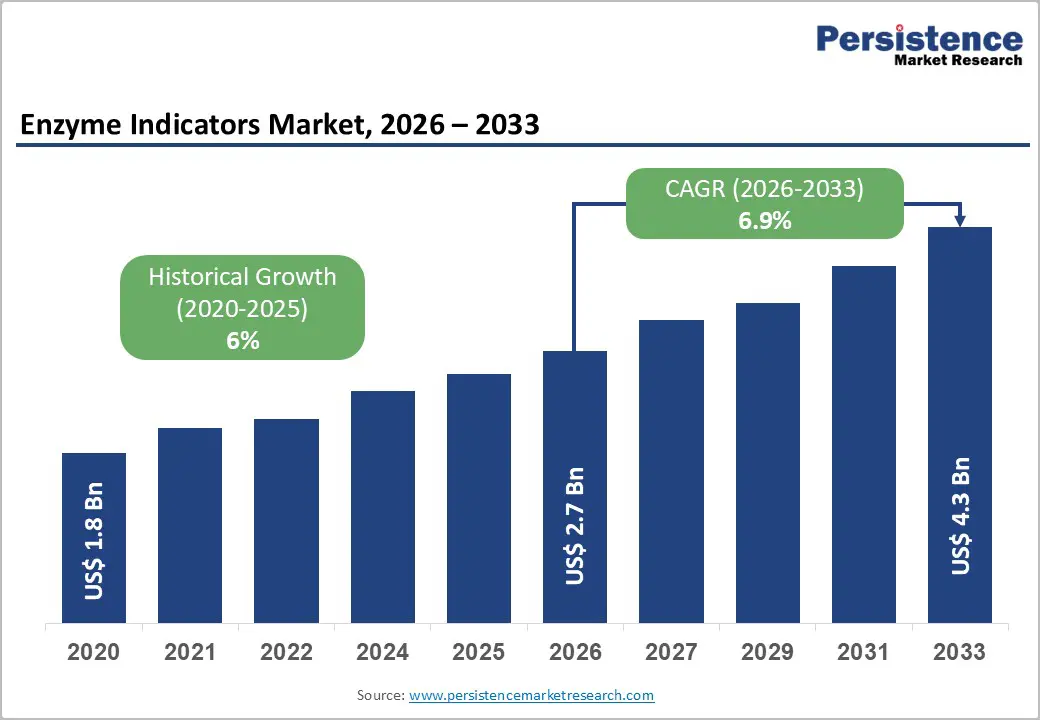
The global enzyme indicators market size is likely to be valued at US$ 2.7 billion in 2026, and is projected to reach US$ 4.3 billion by 2033, growing at a CAGR of 6.9% during the forecast period 2026−2033. The market is undergoing steady and significant expansion in recent years, supported by growing demand for precise and dependable diagnostic solutions across sectors such as healthcare, food safety, and environmental monitoring. These indicators function as biocatalysts that identify specific substances or changes in conditions such as shifts in pH or temperature by producing a detectable signal. Market growth is being driven by heightened awareness of sustainable and efficient testing methods, along with continuous advancements in biotechnology.
Key Industry Highlights
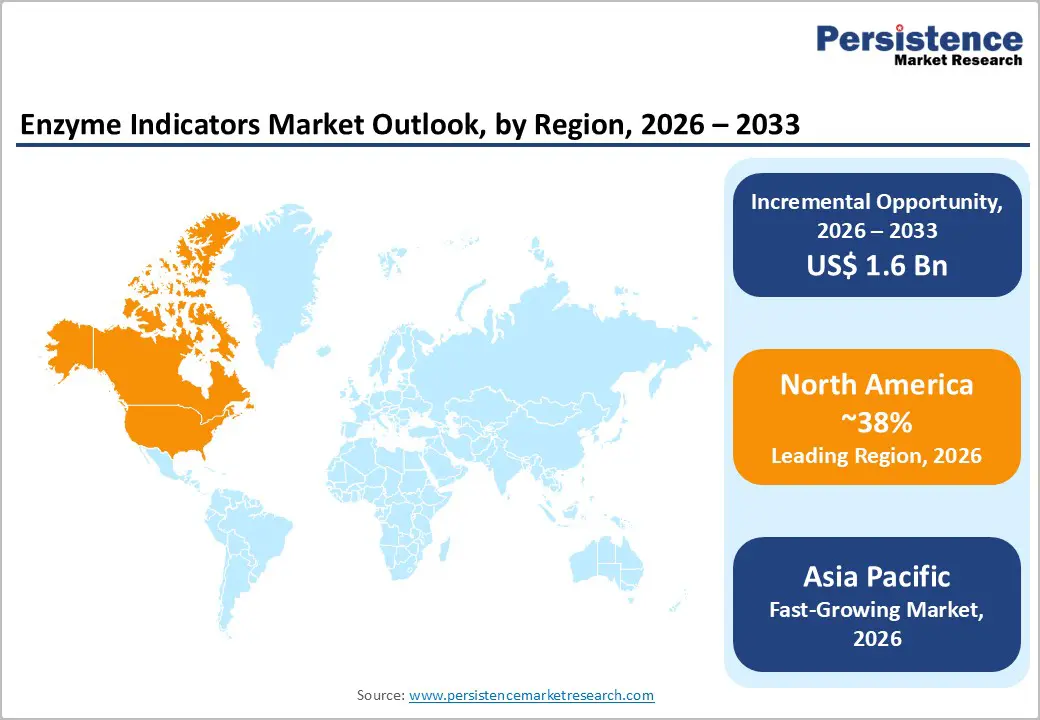
- Dominant Region: North America is expected to secure about 38% market share in 2026, supported by a highly developed healthcare ecosystem and strong regulatory enforcement.
- Fastest-growing Regional Market: Asia Pacific is likely to be the fastest-growing market during the 2026-2033 forecast period, powered by rapid expansion in healthcare infrastructure and industrial capabilities.
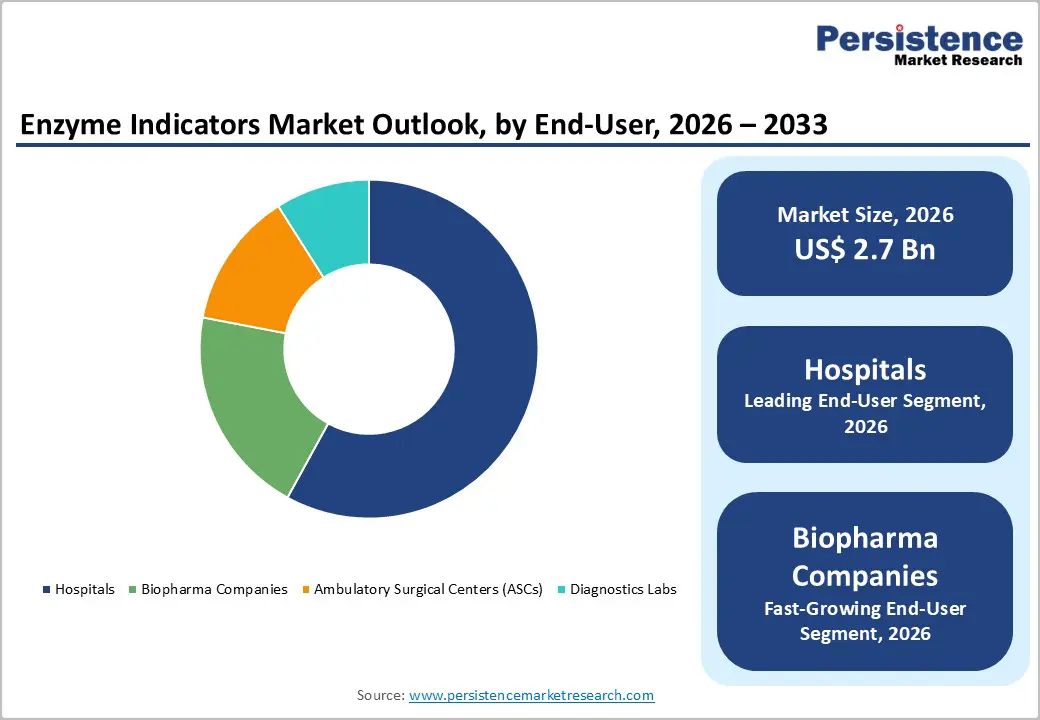
- Leading & Fastest-growing End-User: Hospitals are slated to lead with approximately 58% of the revenue share in 2026, while biopharma companies are set to be the fastest-growing end-users through 2033.
- Leading & Fastest-growing Application: Drug development is expected to command around 52% of the market revenue share in 2026, with bio-decontamination registering the highest 2026-2033 CAGR.
| Key Insights | Details |
|---|---|
| Enzyme Indicators Market Size (2026E) | US$ 2.7 Bn |
| Market Value Forecast (2033F) | US$ 4.3 Bn |
| Projected Growth (CAGR 2026 to 2033) | 6.9% |
| Historical Market Growth (CAGR 2020 to 2025) | 6% |
DRO Analysis
Stringent Regulatory Sterilization Mandates in Healthcare
Regulatory authorities such as the United States Food and Drug Administration (FDA), the European Medicines Agency (EMA), and the World Health Organization (WHO) are continuously tightening sterility assurance requirements for medical devices and pharmaceutical products. These institutions are enforcing stricter sterility assurance level (SAL) protocols to ensure consistent product safety and clinical reliability. Compliance frameworks, including Title 21 of the Code of Federal Regulations Part 211 (21 CFR Part 211) and International Organization for Standardization standards ISO 11135 and ISO 11138, are requiring the use of certified enzyme indicators for sterilization validation. Manufacturers and healthcare providers are aligning their processes with these evolving standards, ensuring that each sterilization cycle is being verified through dependable and reproducible methods.
Growing concerns surrounding healthcare-associated infections (HAIs) are increasing the focus on more advanced sterilization monitoring approaches. Healthcare facilities and pharmaceutical companies are adopting systems that are delivering faster and more accurate validation results. Enzyme indicator technologies, particularly biological indicators that are using enzymatic fluorescence or colorimetric readouts, are improving detection sensitivity and response time. These solutions are supporting quicker release decisions and are enhancing workflow efficiency in critical environments. Continuous innovation in biotechnology is enabling the development of automated and digitally connected monitoring platforms that are improving traceability, reducing manual intervention, and supporting stronger infection prevention strategies across healthcare and life sciences settings.
Adoption of Rapid Readout Technologies and Digital Integration
Advancements in enzyme indicator technologies are transforming how sterilization processes are being monitored across healthcare and life sciences environments. The shift from conventional spore-based biological indicators to enzyme-based rapid readout systems is improving both speed and reliability of validation. These modern indicators are delivering results within a much shorter timeframe, allowing technicians to confirm sterilization outcomes without extended waiting periods. Healthcare facilities and pharmaceutical manufacturers are increasingly adopting these solutions to streamline sterilization workflows and reduce operational delays. Faster validation is supporting timely equipment release, which is critical in high-demand clinical and production settings.
Adoption is further accelerating as organizations are integrating enzyme indicators with connected technologies such as Internet of Things (IoT)-enabled monitoring platforms and cloud-based data systems. These integrated solutions are allowing real-time tracking of sterilization cycles and are automatically recording validation results for audit and compliance purposes. Digital connectivity is improving transparency and reducing dependence on manual documentation, which often introduces errors. Hospitals and manufacturing facilities are moving toward fully automated monitoring ecosystems that are enhancing traceability and ensuring adherence to regulatory standards. Continuous innovation in digital health infrastructure is supporting the development of smarter sterilization systems that are increasing efficiency while maintaining high levels of safety and compliance.
Stringent Regulatory Compliance and Validation Requirements
Enzyme indicator manufacturers are navigating highly complex regulatory pathways across multiple regions, which are shaping product development and commercialization strategies. Approval processes such as the U.S. FDA premarket notification clearance (FDA 510(k)), International Organization for Standardization certification (ISO 11138), and Conformité Européenne marking (CE) for European Union (EU) market access are requiring strict compliance with defined performance and safety standards. Each regulatory system is demanding detailed technical documentation, validated testing procedures, and consistent quality assurance practices. Companies are aligning their development pipelines with these requirements to ensure smooth approvals across different jurisdictions. This environment is increasing the need for specialized regulatory expertise, as even minor deviations can delay product entry.
The validation process itself is becoming more resource intensive, as it involves comprehensive activities such as lot-release testing, shelf-life evaluation, and performance qualification studies. These requirements are extending development timelines and increasing research and development investments. Regulatory bodies are also updating standards periodically, including revisions to the ISO 11138 certification, which are requiring manufacturers to reassess and revalidate existing products. Continuous revalidation is adding operational pressure and is redirecting resources away from innovation initiatives. Companies are responding by adopting more efficient validation strategies and digital documentation systems to streamline compliance processes.
Supply Chain Vulnerabilities and Raw Material Dependencies
Enzyme indicator manufacturing is relying on a highly specialized and limited supply base, which is creating structural vulnerabilities across the value chain. Critical inputs such as high-purity biological substrates, thermophilic bacterial spores, and fluorogenic enzyme materials are sourced from a small group of qualified suppliers. This concentration is increasing dependency and is reducing flexibility in procurement strategies. Disruptions experienced during recent global events have already highlighted how sensitive this ecosystem is to external shocks. Manufacturers are facing delays in sourcing essential materials, which is affecting production planning and inventory management. Supply continuity is also being influenced by geopolitical developments, as trade restrictions and export controls on biological materials are becoming more common.
Logistics requirements are further adding complexity to the overall supply framework, particularly due to strict storage and transportation conditions. Many enzyme indicators are requiring temperature-controlled environments to maintain stability and performance integrity. Cold-chain logistics systems are therefore becoming essential, especially for international distribution. These requirements are increasing operational costs and are complicating delivery processes in regions with limited infrastructure. Tropical and resource-constrained markets are facing additional challenges, as maintaining consistent temperature conditions during transit is often difficult. Manufacturers are investing in improved packaging technologies and monitoring systems to ensure product quality throughout the distribution cycle.
Expansion into Food and Beverage Processing Applications
The use of enzyme indicators in food-grade sterilization validation is gaining attention as an emerging and underdeveloped opportunity within the broader market. Applications such as aseptic packaging and ultra-high temperature processing (UHT) are requiring precise validation methods to ensure product safety and shelf stability. Food manufacturers are increasingly adopting enzyme-based solutions to verify sterilization performance across processing lines. These indicators are helping detect process deviations and are supporting consistent quality control in high-throughput production environments. The demand is rising as companies are prioritizing contamination prevention and are aligning operations with stricter food safety expectations. This shift is encouraging the adoption of advanced validation tools that are capable of delivering reliable and rapid feedback during critical processing stages.
Regulatory frameworks are playing a central role in shaping this transition, as authorities are strengthening compliance requirements for hygienic design and sterilization practices. Policies such as the Food Safety Modernization Act (FSMA) and EU Regulation 2023/2006 are requiring food producers to implement validated monitoring systems. Enzyme indicators designed for food-contact applications are meeting these requirements by offering safe and effective validation mechanisms. Companies that are developing specialized solutions for this segment are positioning themselves to capture early market opportunities. Continuous innovation in formulation and compatibility is enabling broader adoption, while increasing regulatory alignment is ensuring long-term growth potential in food processing environments.
Integration with Smart Sterilization and IoT Monitoring Platforms
The integration of enzyme indicators with digital sterilization management systems is creating a significant shift in how sterilization processes are being monitored and controlled. Connected enzyme indicator readers are linking directly with hospital information systems (HIS) and enterprise resource planning (ERP) platforms to enable seamless data flow across operations. These systems are continuously capturing sterilization cycle data and are generating real-time validation records without manual intervention. Healthcare providers and pharmaceutical manufacturers are adopting these solutions to improve accuracy, reduce documentation errors, and maintain consistent compliance with regulatory standards. Automated reporting features are simplifying audit processes, while centralized data access is enhancing visibility across departments.
This digital alignment is strengthening process transparency and is supporting faster decision making in critical environments. Collaborative efforts between enzyme indicator manufacturers and original equipment manufacturers (OEMs) of sterilization equipment are accelerating the development of fully integrated solutions. Companies are designing systems where indicators, readers, and sterilizers are functioning as a unified ecosystem. These partnerships are enabling predictive maintenance capabilities, where potential equipment issues are being identified before failure occurs. This approach is reducing downtime and improving operational reliability. Continuous advancements in connectivity and data analytics are allowing organizations to move toward smarter sterilization infrastructures.
Category-wise Analysis
Application Insights
Drug development is forecast to represent the dominant application, capturing approximately 52% of the enzyme indicators market revenue share in 2026, due to its critical dependence on sterile and controlled environments. Pharmaceutical and biopharmaceutical companies are continuously using enzyme indicators to validate sterilization processes during research, formulation, and production stages. These indicators are ensuring that contamination risks are minimized while maintaining strict compliance with regulatory standards. The increasing focus on biologics, cell-based therapies, and precision medicines is further strengthening demand, as these products require highly sensitive monitoring systems. Enzyme indicators are also supporting process validation and quality assurance, making them an essential tool in maintaining consistency and reliability throughout the drug development lifecycle.
Bio-decontamination are expected to be the fastest-growing segment over the 2026-2033 forecast period. As industries are prioritizing advanced contamination control practices. Healthcare facilities, laboratories, and cleanroom environments are increasingly adopting enzyme indicators to verify the effectiveness of decontamination procedures. These indicators are enabling rapid and accurate validation, which is essential in high-risk environments handling infectious agents or sensitive biological materials. Growing awareness around infection prevention and biosafety is accelerating adoption across both developed and emerging markets. Technological advancements are also improving the efficiency of bio-decontamination processes, while enzyme indicators are playing a key role in ensuring these systems are functioning correctly and meeting stringent safety requirements.
End-User Insights
Hospitals is set to hold and estimated 58% of the market revenue share in 2026. These facilities are regularly using enzyme indicators to validate sterilization cycles for instruments, equipment, and reusable devices. Central sterile services departments are relying on these solutions to ensure compliance with strict infection control protocols. Rising patient volumes and increasing surgical interventions are further strengthening demand. Healthcare providers are also adopting advanced monitoring systems to improve workflow efficiency and maintain consistent quality standards, making enzyme indicators a critical component of routine hospital operations.
Bio pharma industries are likely to be the fastest-growing segment during the 2026-2033 forecast period. Companies are using enzyme indicators to validate sterilization processes across drug production, especially for biologics and advanced therapies. The expansion of contract manufacturing and the increasing complexity of production environments are driving demand for highly sensitive monitoring tools. Enzyme indicators are supporting quality assurance and regulatory compliance by ensuring contamination-free processes. Continuous innovation in biopharmaceutical production is increasing reliance on precise validation systems, positioning enzyme indicators as essential tools for maintaining product safety and operational efficiency.
Regional Insights
North America Enzyme Indicators Market Trends
North America is set to command a significant portion of the enzyme indicators market share at approximately 38% in 2026, supported by a highly developed healthcare ecosystem and strong regulatory enforcement. The United States is contributing the largest share within the region, as healthcare providers are continuously adopting advanced sterilization monitoring solutions to ensure patient safety and operational efficiency. Hospitals, research institutions, and pharmaceutical manufacturers are actively integrating enzyme indicators into their daily processes to validate sterilization cycles and reduce contamination risks. A well-established infrastructure, combined with consistent investment in healthcare technologies, is strengthening market expansion.
A structured regulatory framework is shaping market dynamics by enforcing strict compliance requirements and encouraging the adoption of validated monitoring systems. Approval pathways such as the FDA 510(k) clearance, United States Pharmacopeia sterilization guidelines (USP <1229>), and standards developed by the Association for the Advancement of Medical Instrumentation and American National Standards Institute (AAMI/ANSI) are guiding manufacturers toward consistent product validation. These requirements are favoring established companies with strong regulatory expertise and extensive product portfolios. Canada is also supporting regional growth through its organized healthcare system, which is emphasizing reliable sterilization practices.
Europe Enzyme Indicators Market Trends
Europe is holding a strong position in the enzyme indicators market. Germany is leading regional demand due to its advanced pharmaceutical and medical device production capabilities, where companies are consistently adopting validated sterilization monitoring solutions. The United Kingdom is maintaining steady demand through structured procurement systems within its healthcare network, while aligning regulatory practices with both domestic and European standards. Countries such as France and Spain are strengthening their market presence through ongoing hospital modernization initiatives and public investment in healthcare infrastructure. Across the region, healthcare providers and manufacturers are increasingly integrating enzyme indicators into routine processes to improve sterilization validation and ensure product safety.
Regulatory developments are playing a critical role in shaping market growth, as frameworks such as the European Union Medical Device Regulation (MDR 2017/745) and In Vitro Diagnostic Regulation (IVDR 2017/746) are enforcing stricter validation requirements. Manufacturers are adapting to these evolving standards by enhancing product performance and documentation practices. The competitive landscape is remaining diverse, with regional companies operating alongside global participants to address varying market needs. Sustainability considerations are also influencing product innovation, as organizations are developing environmentally responsible packaging and reducing material waste. This focus on compliance and sustainability is strengthening long-term adoption of enzyme indicators across European healthcare and industrial applications.
Asia Pacific Enzyme Indicators Market Trends
Asia Pacific is anticipated to emerge as the fastest-growing market for enzyme indicators between 2026 and 2033. China is leading regional demand as healthcare providers and manufacturers are continuously strengthening sterilization practices across hospitals and production facilities. The country is investing heavily in healthcare modernization, which is increasing the adoption of advanced monitoring solutions. Growth in the medical device sector is further driving the need for reliable sterilization validation tools. Companies operating in this environment are actively integrating enzyme indicators into their processes to improve quality assurance and meet evolving regulatory expectations. This strong foundation is positioning the region as a key contributor to future market expansion.
India is developing into a high-potential market as government initiatives such as the National Health Mission (NHM) and the Pradhan Mantri Ayushman Bharat Health Infrastructure Mission (PM-ABHIM) are strengthening healthcare systems and expanding access to medical services. Japan is maintaining demand for advanced enzyme indicator technologies due to its aging population and focus on high-quality clinical care. Countries within the Association of Southeast Asian Nations (ASEAN), including Indonesia, Vietnam, and Thailand, are upgrading hospital sterilization infrastructure to support broader healthcare coverage. Manufacturing advantages across the region are encouraging local production, which is improving supply availability and supporting competitive market development.
Competitive Landscape
The global enzyme indicators market structure is moderately fragmented, dominated by leading players such as 3M Company, Steris plc, Mesa Laboratories, Inc., Getinge AB, and Cardinal Health. These players collectively capture 35-40% of the market share. The competitive landscape of the enzyme indicators market provides a detailed evaluation of major industry participants and their strategic positioning. This analysis also highlights investments in research and development, along with evolving business strategies aimed at strengthening market presence. Insights into regional operations, core strengths, and operational limitations are helping in understanding how each player is competing within the industry.
In addition, the assessment is examining product portfolios, recent product introductions, and the range of applications served by these companies. It is also identifying areas of application leadership and innovation focus across different market segments. These insights are offering a clear view of how organizations are aligning their capabilities with market demand and regulatory requirements, while continuously working to enhance their competitive advantage within the enzyme indicators market.
Key Industry Developments
- In February 2026, Quantumzyme published a peer-reviewed study demonstrating a fully in silico enzyme engineering approach, using computational modeling and virtual screening to optimize enzyme variants before laboratory testing. The research highlights improved efficiency in biocatalyst design for drug manufacturing, enabling faster candidate identification and supporting more sustainable, data-driven pharmaceutical production.
- In February 2026, researchers at the University of California San Diego identified the enzyme N4BP2 as the trigger behind chromothripsis, a catastrophic DNA-shattering process that enables cancer cells to rapidly evolve and develop treatment resistance. Blocking this enzyme significantly reduced genomic damage in cancer cells, highlighting a promising new therapeutic target for limiting aggressive tumor progression.
Companies Covered in Enzyme Indicators Market
- 3M Company
- Steris plc
- Mesa Laboratories, Inc.
- Getinge AB
- Cantel Medical
- Cardinal Health
- Crosstex International
- Sychem Ltd.
- PMS International Group
- Terragene S.A.
- GKE GmbH
- Hu-Friedy (SDT)
- Andersen Products
- Raven Biological Laboratories
Frequently Asked Questions
The global enzyme indicators market is projected to reach US$ 2.7 billion in 2026.
Rising demand for sterilization monitoring in healthcare and pharma, driven by infectious disease prevalence and strict regulations, is driving the market.
The market is poised to witness a CAGR of 6.9% from 2026 to 2033.
Expansion in Asia Pacific fueled by rising healthcare spending and infection control awareness offers high potential.
3M Company, Steris plc, Mesa Laboratories, Inc., Getinge AB, and Cardinal Health are some of the key players in the market.


