




- Biotechnology
- Multifunctional Polymeric Technology Market
Multifunctional Polymeric Technology Market Size, Share, and Growth Forecast, 2026 - 2033
Multifunctional Polymeric Technology Market by Technology Type (Physical Mixing, Particle Surface Functionalization, Other Applications (Personal Care Products, Pharmaceutical Formulations, Medical Devices), End-user, and Regional Analysis for 2026 - 2033

Multifunctional Polymeric Technology Market Size and Trends Analysis
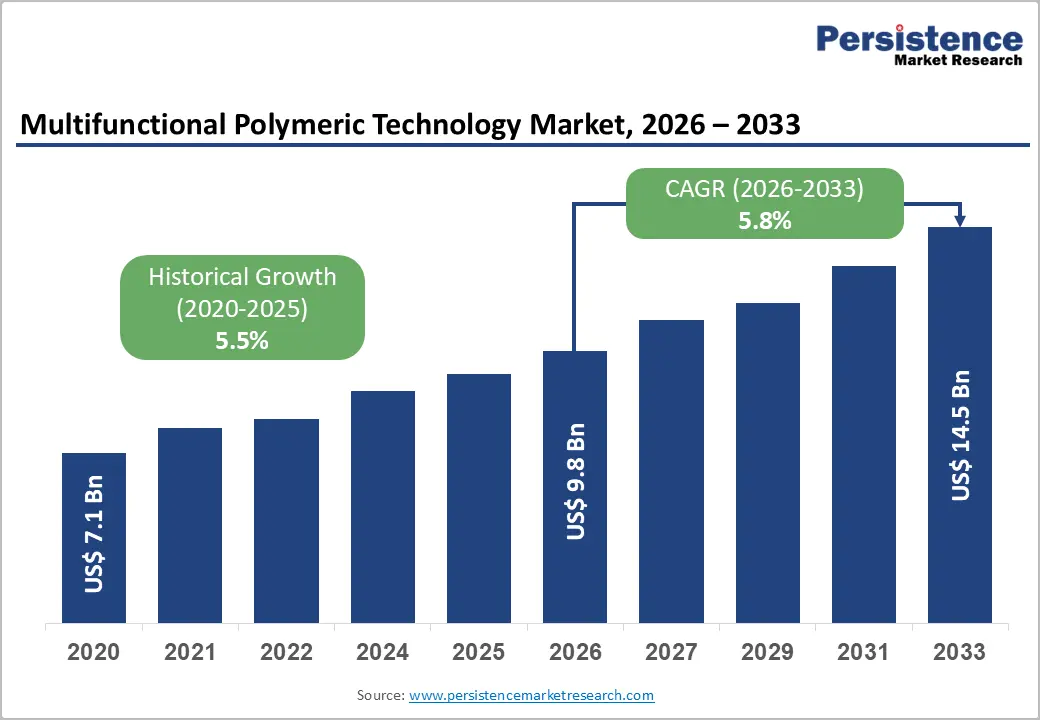
The global multifunctional polymeric technology market size is likely to be valued at US$9.8 billion in 2026 and is expected to reach US$14.5 billion by 2033, growing at a CAGR of 5.8% during the forecast period from 2026 to 2033, driven by the growing adoption of advanced polymer systems engineered to deliver multiple functional benefits, including rheology control, surface enhancement, stability improvement, and targeted performance in complex formulations.
Increasing demand for high-performance and multifunctional ingredients in cosmetics, topical formulations, and advanced drug delivery systems, alongside the rising need for precision-engineered materials in medical technologies, is driving market growth.
Continuous innovation in polymer chemistry, including the development of more efficient and sustainable formulations, is supporting market expansion. Growth is reinforced by the expansion of pharmaceutical and fast-moving consumer goods industries, where product differentiation and performance enhancement are key competitive factors.
Key Industry Highlights:
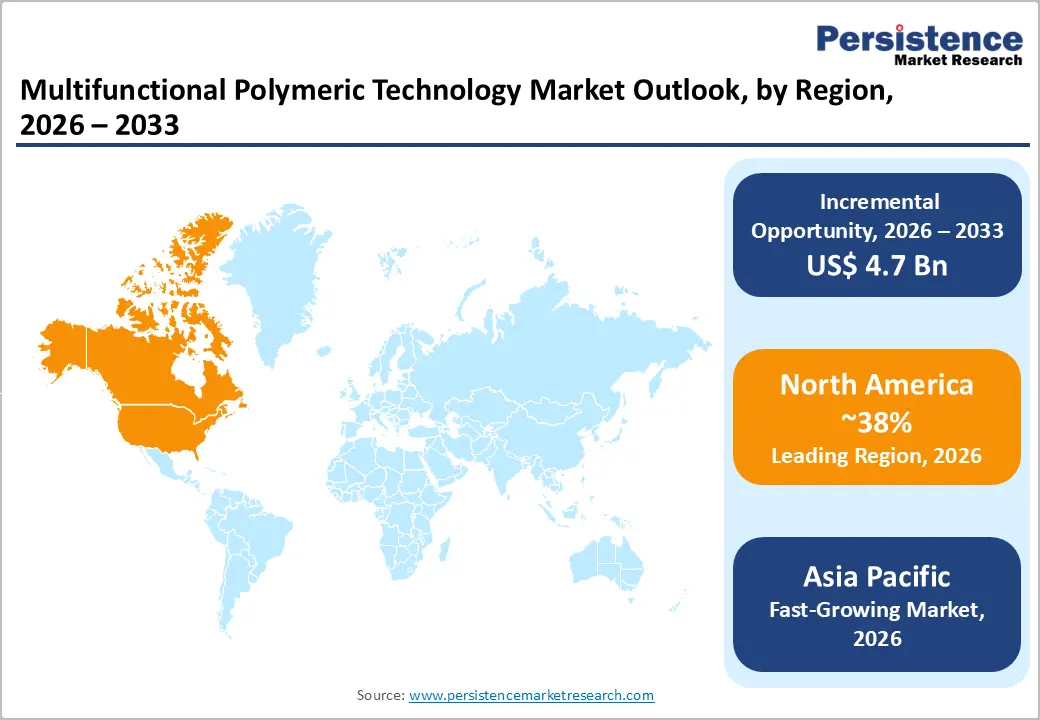
- Leading Region: North America is anticipated to be the leading region, accounting for a market share of 38% in 2026, driven by strong innovation, regulatory standards, and advanced healthcare and personal care industries.
- Fastest-growing Region: Asia Pacific is likely to be the fastest-growing region, supported by expanding manufacturing capabilities and rising demand across the healthcare and personal care sectors.
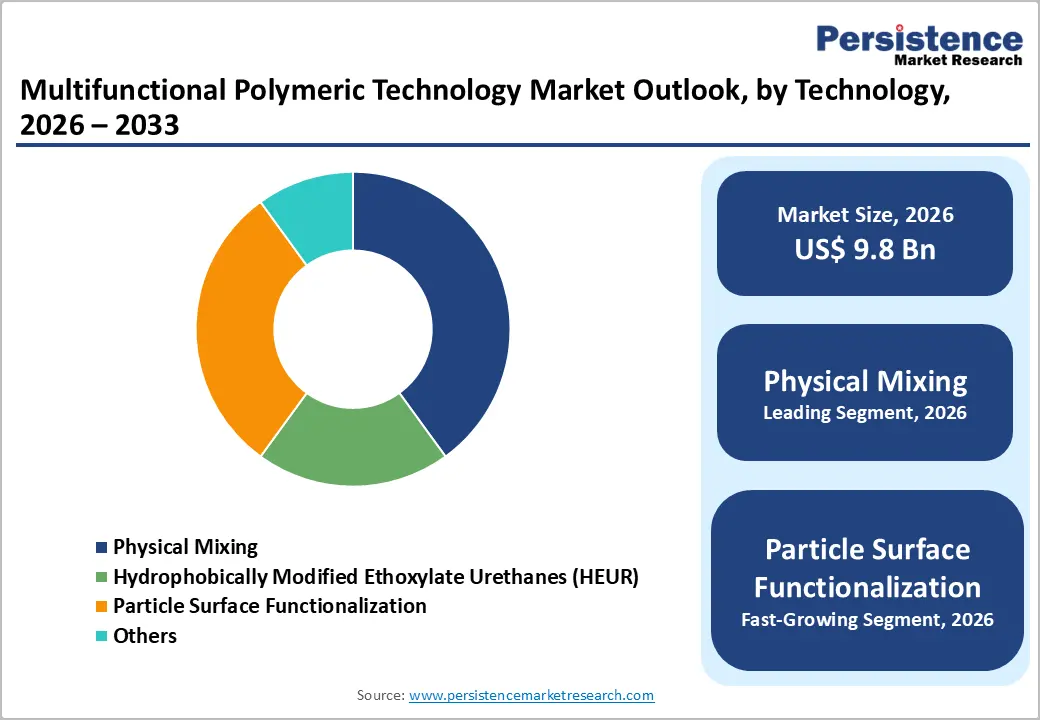
- Leading Technology Type: Physical mixing is projected to represent the leading technology type in 2026, accounting for 42% of the revenue share, driven by its cost-effective and widely adopted integration capabilities.
- Leading Application: Personal care products are anticipated to be the leading application, accounting for over 48% of the revenue share in 2026, supported by their high demand for stable and enhanced formulations.
| Key Insights | Details |
|---|---|
|
Multifunctional Polymeric Technology Market Size (2026E) |
US$9.8 Bn |
|
Market Value Forecast (2033F) |
US$14.5 Bn |
|
Projected Growth (CAGR 2026 to 2033) |
5.8% |
|
Historical Market Growth (CAGR 2020 to 2025) |
5.5% |
DRO Analysis
Driver - Advancements in Rheology Control and Formulation Stability
Continuous progress in rheology control technologies is enabling multifunctional polymer systems to deliver superior viscosity management, suspension stability, and enhanced texture across personal care and pharmaceutical formulations. Innovations in associative polymers, including HEUR-based systems, allow formulators to achieve precise flow behavior and consistency, particularly in complex aqueous environments.
These advancements are increasingly critical in meeting consumer expectations for high-performance, aesthetically appealing products with extended shelf life and uniformity.
Improved formulation stability supports the development of advanced drug delivery systems and medical-grade products where consistency and reliability are essential. Enhanced rheological properties contribute to better dispersion of active ingredients, controlled release profiles, and reduced formulation failure risks.
As industries prioritize efficiency and product differentiation, the demand for advanced polymeric technologies capable of delivering multifunctional performance continues to expand steadily.
Rising Demand from Personal Care and Pharmaceutical Sectors
The growing demand for high-quality personal care products is significantly driving the adoption of multifunctional polymer technologies. Consumers increasingly seek products with improved texture, stability, and performance, encouraging manufacturers to incorporate advanced polymers that enhance sensory attributes and product longevity. The expansion of skincare, haircare, and oral care segments is reinforcing the need for reliable formulation technologies.
In the pharmaceutical sector, the increasing focus on advanced drug delivery systems and formulation efficiency is accelerating demand. Multifunctional polymers enable controlled release, improved bioavailability, and enhanced stability of active pharmaceutical ingredients. With rising healthcare awareness and expanding pharmaceutical production, these materials are becoming essential in ensuring product efficacy, safety, and regulatory compliance.
Restraint - Regulatory Hurdles in Biocompatibility and Safety Approvals
Stringent regulatory frameworks governing the use of polymers in pharmaceutical and personal care applications present significant challenges for market participants. Requirements for biocompatibility, toxicity evaluation, and long-term safety validation often lead to extended approval timelines and increased development costs. Regulatory bodies demand comprehensive testing and documentation, particularly for products intended for medical or therapeutic use.
These regulatory complexities slow down innovation and limit the rapid commercialization of new multifunctional polymer technologies. Companies must invest heavily in compliance processes, clinical validation, and quality assurance systems, which can strain resources, especially for smaller players. As standards continue to evolve, maintaining compliance while driving innovation remains a critical balancing act for industry stakeholders.
Technological Integration Challenges across Applications
Integrating multifunctional polymer technologies across diverse applications presents technical challenges due to varying formulation requirements and compatibility issues. Each end-use sector, from personal care to medical devices, demands specific performance characteristics, making it difficult to develop universally adaptable polymer systems. Achieving consistent results across different formulations often requires extensive customization and testing.
Scalability and process optimization can pose barriers, particularly when transitioning from laboratory development to large-scale production. Variations in raw materials, environmental conditions, and manufacturing processes can impact performance outcomes. These complexities increase development time and costs, potentially limiting adoption among manufacturers seeking cost-effective and easily deployable solutions.
Opportunity - Technological Convergence with Sustainable and Bio-Based Alternatives
The increasing emphasis on sustainability is creating strong opportunities for multifunctional polymer technologies to evolve toward bio-based and environmentally friendly alternatives. Manufacturers are actively exploring renewable raw materials and biodegradable polymer systems to reduce environmental impact while maintaining high performance. This shift aligns with regulatory pressures and consumer demand for eco-conscious products.
Advancements in green chemistry and material science are enabling the development of sustainable polymers with multifunctional capabilities, such as enhanced stability and biodegradability. These innovations open new avenues in personal care, pharmaceuticals, and packaging applications, where sustainability is becoming a key differentiator. Companies investing in eco-friendly technologies are likely to gain a competitive edge in the evolving market landscape.
Technological Convergence with 3D Printing
The integration of multifunctional polymer technologies with 3D printing is unlocking new possibilities in customized product development and advanced manufacturing. These polymers enable precise control over material properties, making them suitable for applications requiring tailored performance, such as medical devices and specialized formulations. The ability to design complex structures with specific functional attributes enhances innovation potential.
In the healthcare sector, this convergence supports the development of patient-specific devices and drug delivery systems, improving treatment outcomes. 3D printing allows for efficient prototyping and reduced material waste, aligning with cost and sustainability goals. As additive manufacturing technologies advance, multifunctional polymers play a crucial role in shaping next-generation applications.
Category-wise Analysis
Technology Type Insights
Physical mixing is expected to lead the multifunctional polymeric technology market, accounting for approximately 42% of revenue in 2026, driven by its simplicity, cost-effectiveness, and compatibility with existing manufacturing infrastructure.
This method enables the integration of multifunctional properties without complex chemical modification, making it highly suitable for large-scale production in personal care and pharmaceutical formulations. For example, BASF SE utilizes advanced physical blending techniques in its polymer dispersions to improve formulation stability and texture in personal care and coating applications.
Particle surface functionalization is likely to represent the fastest-growing segment in 2026, supported by increasing demand for precision-engineered materials with enhanced interfacial properties and targeted functionality.
This technology enables modification of polymer particle surfaces to improve compatibility, adhesion, and performance in complex systems, making it highly valuable in advanced pharmaceutical formulations and high-performance personal care products. For example, Evonik Industries AG, which leverages surface modification technologies to enhance functionality in pharmaceutical excipients and specialty polymer systems.
Application Insights
Personal care products are projected to lead the market, capturing around 48% of the revenue share in 2026, supported by strong consumer demand for high-performance, stable, and aesthetically appealing formulations.
Multifunctional polymer technologies play a critical role in enhancing product texture, viscosity, spreadability, and overall sensory experience in skincare, haircare, and oral care products. For example, Dow Inc., which develops specialty polymers used in personal care formulations to enhance texture, stability, and performance in a wide range of consumer products.
Pharmaceutical formulations are likely to be the fastest-growing application in 2026, driven by increasing demand for advanced drug delivery systems and improved therapeutic efficiency.
Multifunctional polymers are widely used to enhance solubility, stability, and controlled release of active pharmaceutical ingredients, making them essential in modern drug development. Growth in this segment is driven by the rising prevalence of chronic diseases, increasing investment in pharmaceutical research, and the need for more effective and patient-friendly treatment options. For example, DuPont de Nemours, Inc., which provides advanced excipient technologies that support controlled drug delivery and enhanced pharmaceutical formulation performance.
Regional Insights
North America Multifunctional Polymeric Technology Market Trends
North America is anticipated to be the leading region, accounting for a market share of 38% in 2026, driven by strong demand across the pharmaceutical, medical device, and high-end personal care industries. The region benefits from advanced research infrastructure, high adoption of innovative materials, and a well-established regulatory framework that ensures product quality and safety. Increasing use of multifunctional polymers in drug delivery systems, biomedical devices, and premium consumer formulations continues to strengthen market penetration.
The presence of leading manufacturers and continuous investment in material science innovation contribute to steady technological advancement and product differentiation across applications. Companies are investing in smart polymers and advanced functionalization techniques to improve efficiency and performance. For example, 3M Company actively develops multifunctional polymer-based materials for medical and industrial applications, supporting innovation in advanced healthcare solutions and specialty coatings.
Europe Multifunctional Polymeric Technology Market Trends
Europe is likely to be a significant market for multifunctional polymeric technology in 2026, due to its well-established chemical industry and stringent environmental regulations. The region emphasizes sustainable and eco-friendly polymer development, driving demand for biodegradable and bio-based multifunctional materials. Regulatory frameworks such as REACH encourage manufacturers to adopt safer and more sustainable alternatives, influencing innovation in polymer chemistry. Strong demand from the automotive, healthcare, and packaging industries supports consistent adoption of advanced polymer technologies across various applications.
A prominent trend in Europe is the integration of sustainability with performance, leading to increased development of recyclable and low-impact polymer systems. Companies are focusing on enhancing functionality while reducing their environmental footprint. For example, Arkema S.A. is actively expanding its portfolio of sustainable specialty polymers, supporting applications in personal care, coatings, and advanced materials aligned with environmental standards. Increasing investments in circular economy initiatives are encouraging the use of recyclable polymer systems across industries. Growing collaboration between research institutions and manufacturers is accelerating innovation in high-performance, eco-friendly polymer technologies.
Asia Pacific Multifunctional Polymeric Technology Market Trends
The Asia Pacific region is likely to be the fastest-growing region in 2026, driven by rapid industrialization, expanding manufacturing capabilities, and increasing demand from the healthcare and consumer goods sectors. Countries such as China and India play a crucial role due to their large-scale production capacity and growing investments in specialty chemicals. Rising middle-class populations and increasing consumption of personal care and pharmaceutical products accelerate demand for multifunctional polymer technologies across the region.
The region is witnessing significant trends in localized production, cost optimization, and technology transfer through partnerships and joint ventures. Companies are focusing on scaling up production and enhancing formulation capabilities to meet regional demand efficiently. For example, LG Chem Ltd., which is expanding its advanced polymer solutions to support applications in healthcare, electronics, and high-performance materials, is reinforcing the region’s strong growth trajectory. Increasing government support for domestic manufacturing and specialty chemicals is strengthening regional competitiveness. Expanding R&D investments are also contributing to innovation in high-performance and application-specific polymer technologies.
Competitive Landscape
The global multifunctional polymeric technology market exhibits a moderately fragmented structure, driven by the presence of multiple multinational chemical companies alongside specialized material innovators competing across diverse application areas such as personal care, pharmaceuticals, and advanced materials.
The market is characterized by continuous investment in research and development, with companies focusing on enhancing polymer functionality, sustainability, and application-specific performance. Strategic collaborations, mergers, and geographic expansions are commonly adopted to strengthen market positioning and broaden product portfolios.
With key leaders including BASF SE, Dow Inc., Arkema S.A., Evonik Industries AG, and DuPont de Nemours, Inc., the competitive environment remains innovation-driven and technology-focused. These players compete through advanced product development, sustainable polymer solutions, and strong distribution networks, while also leveraging partnerships and long-term supply agreements to maintain market share. Companies emphasize high-performance formulations, regulatory compliance, and customization capabilities to meet evolving end-user requirements, ensuring sustained competitiveness in a steadily advancing market landscape.
Key Industry Developments:
- In February 2026, NEXTCHEM (MAIRE) expanded its advanced polymer portfolio with the launch of the NXPand™ suite and introduced NX CONSER PolyFlex™ technology, a sustainable solution for producing polytetramethylene ether glycol (PTMEG), a key polymer used in spandex fibers, supporting high-performance textile applications through both conventional and bio-based feedstocks.
- In October 2025, Clariant AG launched TexCare™ One Terra, a next-generation multifunctional polymer designed for ultra-concentrated laundry formulations, particularly capsules, offering enhanced cleaning performance at low temperatures and reduced dosages while supporting sustainability through high biodegradability and use of renewable feedstocks.
- In November 2025, Otsuka Chemical Co., Ltd. introduced a new controlled polymer technology acquired from Kuraray Co., Ltd., enhancing its multifunctional polymer capabilities through advanced living polymerization methods and supporting expansion with a new production plant to develop high-performance polymers for applications such as electronics, healthcare, and advanced materials.
Companies Covered in Multifunctional Polymeric Technology Market
- BASF SE
- Dow Inc.
- DuPont de Nemours, Inc.
- Arkema S.A.
- Evonik Industries AG
- Solvay S.A.
- Covestro AG
- Mitsubishi Chemical Holdings Corporation
- LG Chem Ltd.
- SABIC (Saudi Basic Industries Corporation)
- 3M Company
- Huntsman Corporation
Frequently Asked Questions
The global multifunctional polymeric technology market is projected to reach US$9.8 billion in 2026.
Rising demand for advanced multifunctional polymers that enhance performance, stability, and efficiency in personal care, pharmaceutical, and medical applications drives the market.
The multifunctional polymeric technology market is expected to grow at a CAGR of 5.8% from 2026 to 2033.
Key opportunities lie in the development of sustainable bio-based polymers and expanding applications in advanced drug delivery and high-performance formulations.
BASF SE, Dow Inc., DuPont de Nemours, Inc., Arkema S.A., Evonik Industries AG, and Solvay S.A are the leading players.


