




- Medical Devices
- Meniscal Fixation Devices Market
Meniscal Fixation Devices Market Size, Share, and Growth Forecast 2026–2033
Meniscal Fixation Devices Market by Product Type (Screw Fixation Devices, Others), Application (Sports Injuries, Degenerative Conditions, Trauma, Others), End-user (Hospitals, Ambulatory Surgical Centers, Specialty Clinics), and Regional Analysis, 2026–2033

Meniscal Fixation Devices Market Size and Trends Analysis
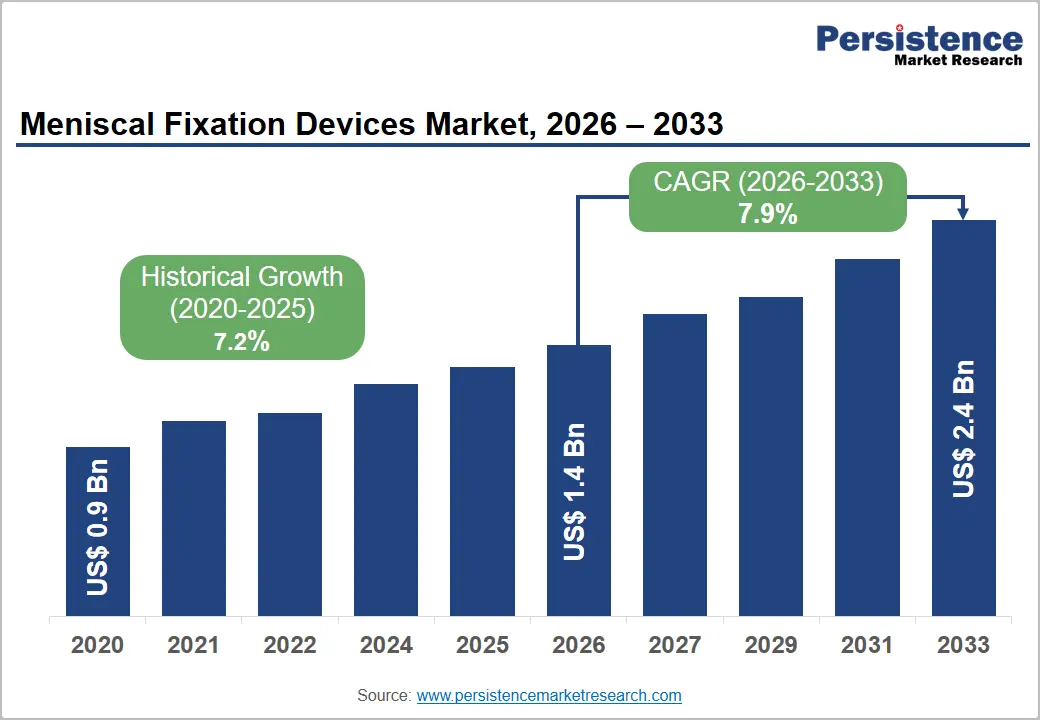
The global meniscal fixation devices market size is likely to be valued at US$1.4 billion in 2026 and is expected to reach US 2.4 billion by 2033, registering a CAGR of 7.9% during the forecast period from 2026 to 2033, driven by the rising incidence of meniscal injuries, increasing preference for joint-preserving surgical procedures, and advancements in minimally invasive orthopedic technologies. Meniscal fixation devices are specialized orthopedic implants designed to repair torn or damaged menisci, the crescent-shaped fibrocartilaginous structures in the knee that distribute load, enhance joint stability, and protect the articular cartilage. These devices, including screw-based, suture-based, and staple-based fixation systems, are widely used in arthroscopic and open meniscal repair procedures performed in hospitals, ambulatory surgical centers, and specialty orthopedic clinics.
Key Market Highlights:
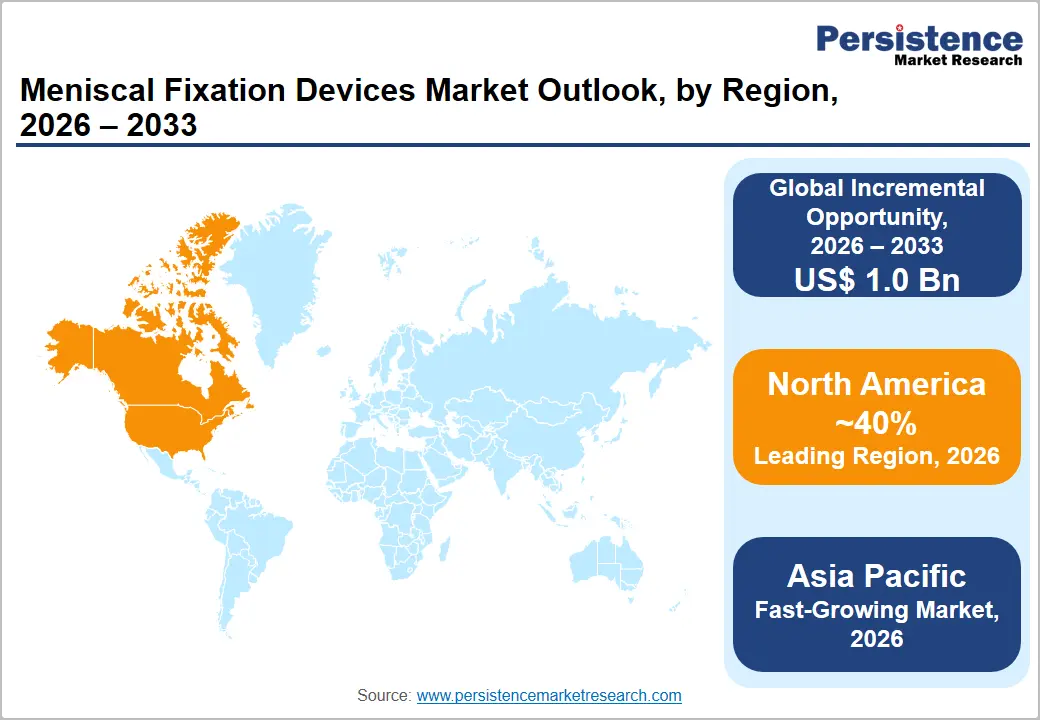
- Leading Region: North America is forecast to dominate with approximately a 40% share in 2026, driven by high sports injury prevalence, advanced arthroscopic surgical infrastructure, and strong reimbursement for meniscal repair procedures under private insurance and Medicare.
- Fastest-growing Region: Asia Pacific is projected to grow at a CAGR of approximately 9.5% through 2033, supported by rising sports participation, expanding orthopedic surgical capacity, and improving medical device access in China, India, and Southeast Asia.
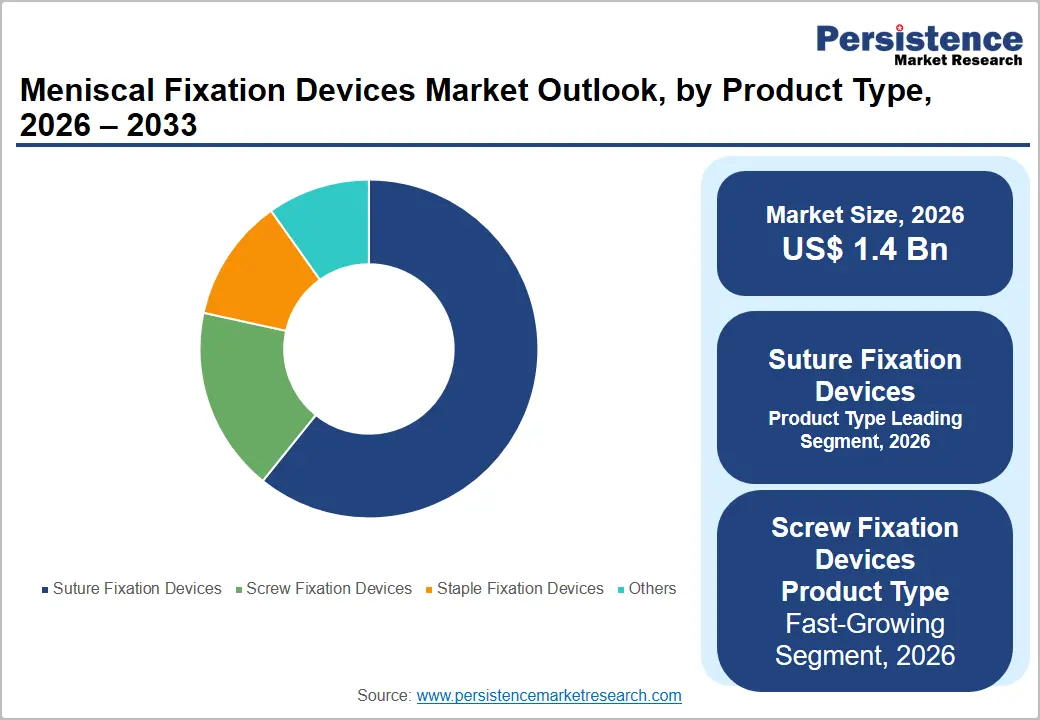
- Dominant Product Type: Suture fixation devices are anticipated to lead the product segment, commanding approximately 48% of product type revenue in 2026, driven by clinical preference for all-inside suture-based repair systems that replicate native tissue biomechanics and support biological healing.
- Fastest-growing Product Type: Screw fixation devices are estimated to register the fastest product growth at a CAGR of approximately 8.5% through 2033, driven by bioabsorbable screw innovation and expanding use in complex meniscal root tear repair indications.
- Dominant End-user: Hospitals are anticipated to be the largest end-user segment at approximately a 55% share in 2026, reflecting the procedural complexity of meniscal repair and the concentration of orthopedic surgical expertise in hospital-based settings.
- Key Market Opportunity: The shift toward meniscus preservation over meniscectomy, supported by long-term clinical evidence linking meniscal loss to accelerated knee osteoarthritis, is creating sustained structural demand growth for fixation devices across all patient age groups.
- Innovation Trend: Next-generation all-inside fixation implants incorporating resorbable polymers, biological augmentation, and augmented reality-assisted arthroscopic navigation are redefining surgical precision and broadening the clinically repairable meniscal tear spectrum.
DRO Analysis
Driver – Rising Sports Injury Incidence and Growing Meniscus Preservation Awareness
The increasing global participation in recreational and competitive sports is generating a rising incidence of knee injuries, of which meniscal tears represent one of the most common orthopedic presentations. The American Academy of Orthopaedic Surgeons (AAOS) estimates that meniscal tears are among the most frequently occurring knee injuries in the U.S., with over 850,000 meniscal procedures performed annually. Globally, growing youth and adult participation in football, basketball, skiing, and running is sustaining a high volume of acute meniscal tear presentations at orthopedic centers.
Critically, the clinical consensus among orthopedic surgeons has shifted significantly toward meniscus preservation over partial meniscectomy. The AAOS and European Society of Sports Traumatology, Knee Surgery and Arthroscopy (ESSKA) have both issued guidelines supporting repair over resection wherever anatomically feasible, directly expanding the addressable meniscal fixation device market.
Barrier – Technical Complexity and Steep Surgical Learning Curve
Arthroscopic meniscal repair is technically demanding, requiring advanced surgical skill, specialized instrumentation, and significant case volume experience to achieve consistent clinical outcomes. The all-inside fixation technique, while preferred in many tear configurations, requires proficiency in arthroscopic visualization, anchor placement, and tissue tensioning that is not uniformly distributed across the global orthopedic surgical community.
In lower-resourced healthcare settings and smaller community hospitals, the limited availability of trained arthroscopic surgeons and adequate operating room infrastructure constrains meniscal repair adoption, often resulting in default to simpler partial meniscectomy despite its inferior long-term outcomes. The surgical learning curve represents a sustained barrier to market penetration in emerging economies and rural healthcare markets globally.
Opportunity – Innovation in All-Inside Fixation Implants and Biological Augmentation
The development of next-generation all-inside meniscal fixation systems represents the primary innovation-driven growth opportunity in the market. Advanced implant designs incorporating bioabsorbable polymers, collagen-coated suture anchors, and hydrogel-based biological scaffolds are expanding the range of repairable tear configurations while promoting biological healing at the repair site. Leading manufacturers, including Arthrex and Smith & Nephew, have introduced implants that integrate fixation with growth factor delivery, aiming to improve healing rates in the avascular zone of the meniscus where blood supply is insufficient for spontaneous repair.
Augmented reality-assisted arthroscopic navigation and robotic-assisted knee surgical platforms are creating new opportunities to improve implant placement accuracy while enabling more surgeons to perform technically complex all-inside meniscal repair procedures. Companies that complement implant innovation with comprehensive training programs, surgical simulation platforms, and digital surgical support tools are well-positioned to capture premium market share as the preference for meniscus preservation continues to grow.
Category-wise Analysis
Product Type Insights
Suture fixation devices are projected to dominate the global product type segment, commanding approximately 48% of the total product type revenue in 2026. Suture-based all-inside fixation systems, exemplified by devices such as Arthrex's FiberStick and Smith & Nephew's Fast-Fix, have become the surgical standard for meniscal repair due to their ability to achieve compression across the tear site, replicate the tensile properties of native meniscal tissue, and avoid the risks associated with rigid implants in the joint space.
Screw fixation devices are estimated to be the fastest-growing product type, advancing at a CAGR of approximately 8.5% through 2033. Growing clinical adoption of screw fixation for meniscal root tear repair, a biomechanically critical indication associated with accelerated knee degeneration if untreated, is the primary driver of screw segment growth.
Application Insights
Sports injuries are anticipated to dominate the application segment, estimated to account for approximately 52% of total application revenue in 2026. Acute traumatic meniscal tears occurring during sports activities represent the highest-volume and most clinically favorable indication for meniscal repair, given the typically younger patient age, higher tissue vascularity at the peripheral tear zone, and greater potential for biological healing.
Degenerative conditions are likely to be the fastest-growing application segment, anticipated to advance at a CAGR of approximately 8.8% through 2033. Expanding clinical evidence supporting repair of degenerative meniscal tears in active middle-aged and older patients, combined with the aging global population and growing policy emphasis on delaying knee arthroplasty through joint preservation interventions, is driving increased referral rates for surgical management of degenerative tears.
End-user Insights
Hospitals are projected to dominate the end-use segment, accounting for approximately 55% of the total end-use share in 2026. Hospitals remain the primary setting for meniscal repair procedures, particularly for complex tears, multi-ligament injuries requiring simultaneous repair, and patients with significant comorbidities requiring anesthesia and post-operative monitoring support.
Ambulatory surgical centers are estimated to be the fastest-growing end-use segment, estimated to advance at a CAGR of approximately 9.2% through 2033. The migration of arthroscopic meniscal repair to ASC settings, driven by CMS reimbursement policy in the U.S., cost efficiency incentives globally, and patient preference for convenient outpatient care, is the defining structural shift in procedure site distribution during the forecast period.
Regional Insights
North America Meniscal Fixation Devices Market Trends and Insights
North America is projected to be the leading regional market, capturing approximately 40% of the global share in 2026, growing at a CAGR of approximately 7.5% through 2033. The region's dominance reflects high sports injury rates, advanced arthroscopic surgical infrastructure, strong reimbursement for meniscal repair under commercial insurance and Medicare, the presence of leading device manufacturers, and high per-capita orthopedic procedure volumes.
U.S. Meniscal Fixation Devices Market Trends and Insights
The U.S. is expected to command approximately 85% of the North America market share in 2026. The U.S. market benefits from a high density of sports medicine and arthroscopic surgery specialists, robust training programs through organizations including the Arthroscopy Association of North America (AANA), and consistent innovation and commercialization by device manufacturers headquartered or with primary commercial operations in the country.
Canada Meniscal Fixation Devices Market Trends and Insights
Canada is projected to account for approximately 15% of the regional market share in 2026. Demand is driven by high recreational and competitive sports participation, well-developed orthopedic surgical services within provincial health systems, and growing awareness of meniscus preservation outcomes supported by Canadian Orthopaedic Association (COA) clinical education initiatives.
Europe Meniscal Fixation Devices Market Trends and Insights
Europe is estimated to be the second-largest regional market, accounting for approximately 28% of the global share in 2026, growing at a CAGR of approximately 7.0% through 2033. ESSKA consensus statements and national orthopedic society guidelines across European markets increasingly support meniscal repair over resection, creating a favorable clinical environment for fixation device adoption.
Germany Meniscal Fixation Devices Market Trends and Insights
Germany is estimated to hold approximately 25% of the European market share in 2026, making it the regional leader. Germany's high density of orthopedic and trauma surgery centers, strong sports medicine culture, and established arthroscopic training programs support consistent high-volume meniscal repair activity.
U.K. Meniscal Fixation Devices Market Trends and Insights
The U.K. is anticipated to account for approximately 17% of the European market share in 2026. NHS England orthopedic surgical volumes and NICE guidance on arthroscopic knee procedures influence meniscal repair rates within the public system. Growing private healthcare sector investment in orthopedic surgical capacity and high recreational sports participation rates among the adult population support demand for meniscal fixation devices across both NHS and independent hospital channels.
Asia Pacific Meniscal Fixation Devices Market Trends and Insights
Asia Pacific is projected to be the fastest-growing regional market, advancing at a CAGR of approximately 9.5% through 2033, driven by rising sports participation, expanding private orthopedic hospital capacity, improving medical device regulatory frameworks, and increasing awareness of meniscus preservation outcomes among both surgeons and patients.
China Meniscal Fixation Devices Market Trends and Insights
China is projected to hold approximately 46% of the market share in 2026. Rising youth and adult sports participation driven by national fitness promotion campaigns, government investment in sports infrastructure ahead of major international sporting events, and the rapid expansion of private orthopedic hospital networks are driving strong meniscal repair procedure volume growth.
India Meniscal Fixation Devices Market Trends and Insights
India is forecast to register the fastest-growing major country market in the region. Rising urbanization, expanding sports participation in cricket, football, and kabaddi, and rapidly growing private hospital and day surgery center investment are driving meniscal repair procedure volume growth. Increasing fellowship training in arthroscopic surgery supported by the Indian Orthopaedic Association (IOA) and Indian Arthroscopy Society (IAS) is progressively expanding the pool of surgeons capable of performing advanced meniscal fixation techniques.
Competitive Landscape
The global meniscal fixation devices market is moderately concentrated, with a small number of large orthopedic and sports medicine device manufacturers commanding significant share through broad product portfolios, established surgeon relationships, and global commercial infrastructure. Arthrex, Inc. maintains a leading position through its comprehensive all-inside fixation system portfolio and intensive surgeon training and education programs that build brand loyalty among arthroscopic surgeons globally.
Innovation in implant materials, fixation mechanisms, and biological augmentation is a key competitive differentiator in the market. DePuy Synthes (Johnson & Johnson), Medtronic plc, and ConMed Corporation are investing in next-generation all-inside systems integrating resorbable anchors, hybrid fixation constructs, and enhanced visualization systems. Smaller specialized players, including B. Braun Melsungen AG, Integra LifeSciences Corporation, and Aesculap, Inc., compete in defined product segments and regional markets.
Key Industry Developments:
- In July 2024, Zimmer Biomet Holdings, Inc. introduced an advanced suture fixation device that incorporates smart technology for real-time monitoring of surgical outcomes. This innovative approach aims to improve the precision and effectiveness of meniscal repairs.
- In January 2024, Stryker Corporation announced a strategic partnership with a leading orthopedic research institution to develop next-generation meniscal fixation devices. This collaboration aims to leverage cutting-edge technology and clinical expertise to enhance product offerings and improve patient outcomes.
Companies Covered in Meniscal Fixation Devices Market
- Arthrex Inc.
- Smith & Nephew plc
- Stryker Corporation
- Zimmer Biomet Holdings Inc.
- DePuy Synthes (Johnson & Johnson)
- Medtronic plc
- ConMed Corporation
- B. Braun Melsungen AG
- Integra LifeSciences Corporation
- Aesculap Inc.
Frequently Asked Questions
The global meniscal fixation devices market is estimated at US$1.4 billion in 2026.
The meniscal fixation devices market is primarily driven by rising sports injury incidence, the global clinical shift from meniscectomy to meniscus preservation supported by AAOS and ESSKA guidelines, an aging population with growing degenerative meniscal tear burden, and innovation in all-inside suture and screw fixation implant technology.
The meniscal fixation devices market is forecast to grow at a CAGR of 7.9% between 2026 and 2033.
Key opportunities include innovation in all-inside fixation systems with biological augmentation for improved healing in avascular tear zones, expansion of meniscal repair indications for degenerative tears and root tears, and the growing ambulatory surgical center channel creating new volume and procurement dynamics for streamlined fixation device portfolios.
The leading players, including Arthrex, Inc., Smith & Nephew plc, Stryker Corporation, Zimmer Biomet Holdings, Inc., DePuy Synthes (Johnson & Johnson), Medtronic plc, ConMed Corporation, B. Braun Melsungen AG, Integra LifeSciences Corporation, and Aesculap, Inc., are competing on product innovation, surgeon training investment, and global distribution reach.


