




- Pharmaceuticals
- Maternal Health Therapeutics Market
Maternal Health Therapeutics Market Size, Share, and Growth Forecast 2026 - 2033
Maternal Health Therapeutics Market by Therapeutic Class (Hormonal Therapies, Antihypertensives, Pain & Symptom Management, Fertility Drugs, Others), Indication (Postpartum Hemorrhage, Preeclampsia & Gestational Hypertension, Gestational Diabetes Mellitus, Maternal Infections, Others), Maternal Care (Preconception, Prenatal, Labor & Delivery, Postnatal/Postpartum), Route of Administration (Injectables, Oral, Others), Distribution Channel, and Regional Analysis, 2026 - 2033

Maternal Health Therapeutics Market Size and Trend Analysis
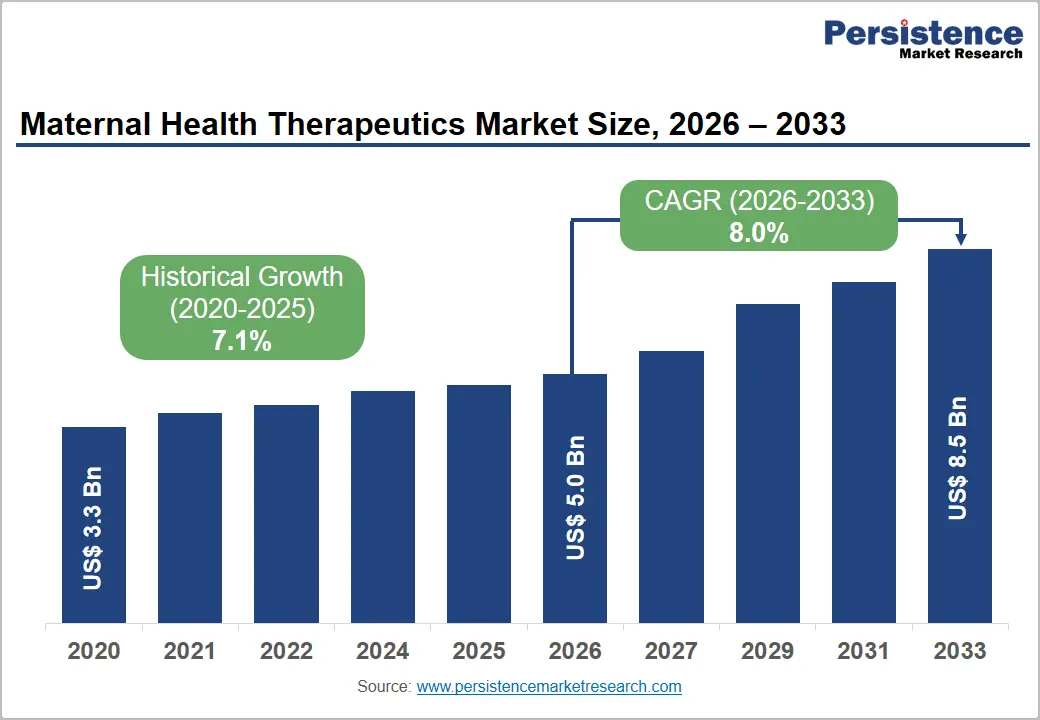
The global maternal health therapeutics market size is expected to be valued at US$ 5.0 billion in 2026 and projected to reach US$ 8.5 billion by 2033, growing at a CAGR of 8.0% between 2026 and 2033.
The convergence of rising global birth rates in developing economies, the growing prevalence of pregnancy-related complications, and expanding government and international organization investments in maternal healthcare.
The World Health Organization (WHO) estimates that approximately 295,000 women die annually from preventable pregnancy and childbirth-related causes, the vast majority in low- and middle-income countries (LMICs), creating urgent and sustained demand for evidence-based maternal health therapeutics across preconception, prenatal, delivery, and postpartum care continua. Innovation in fertility drugs, oxytocin formulations, and antihypertensive therapies is further broadening the market's therapeutic scope and commercial potential.
Key Industry Highlights:
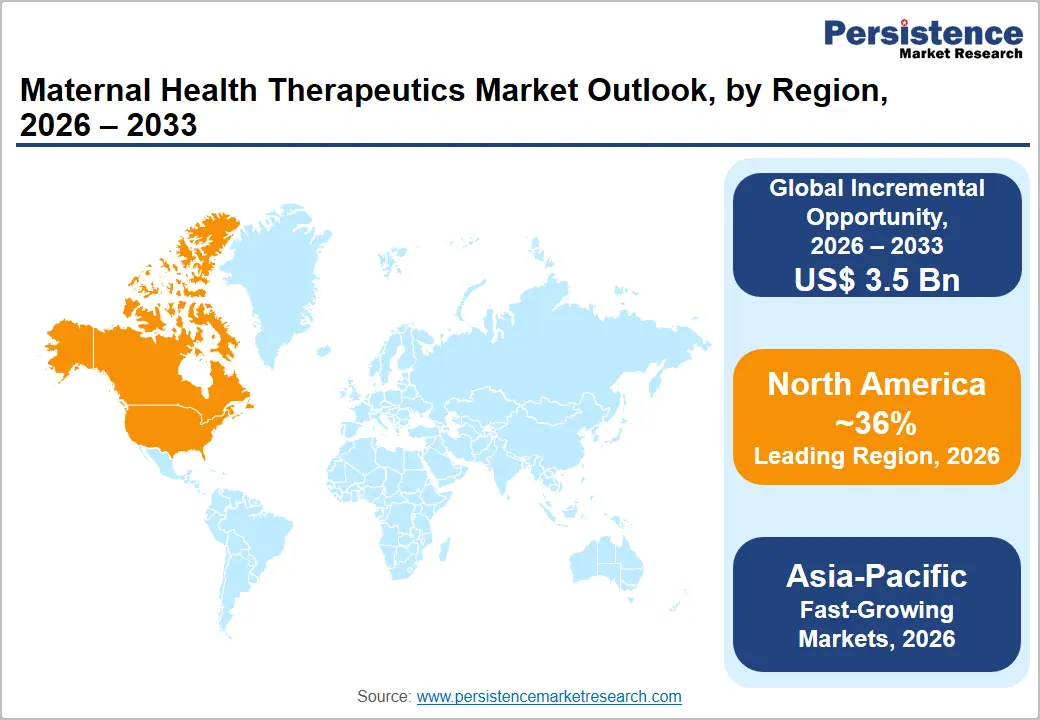
- Leading Region - North America: North America holds approximately 36% of global maternal health therapeutics revenues in 2026, anchored by the world's most advanced maternal-fetal medicine infrastructure, strong fertility drug demand driven by over 300,000 annual ART cycles (SART), and proactive FDA drug approval frameworks.
- Fastest Growing Region - Asia Pacific: Asia Pacific is the fastest-growing maternal health therapeutics market in the forecast period driven by China's fertility policy reforms and ART subsidy expansion, India's PMSMA program scaling prenatal care, and domestic generics manufacturers supplying cost-effective maternal therapeutics across ASEAN.
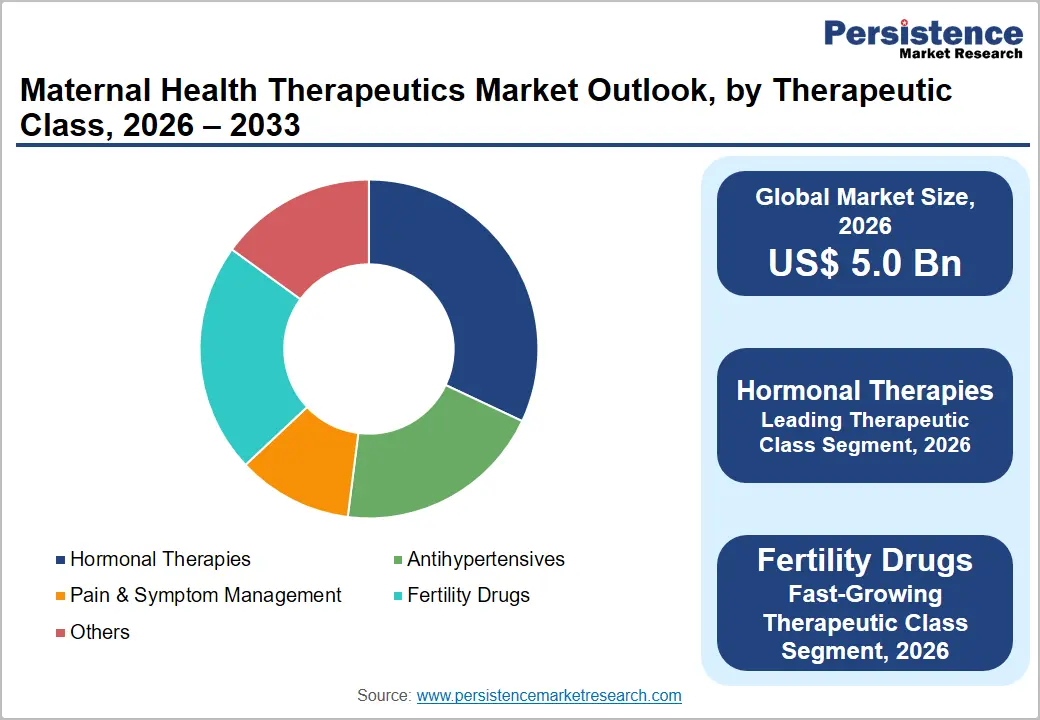
- Dominant Segment - Hormonal Therapies: Hormonal therapies lead the therapeutic class segment with approximately 32% market share in 2026, underpinned by the universal clinical use of oxytocin, progesterone, and misoprostol across labor induction, PPH prevention, and pregnancy maintenance all listed on the WHO Essential Medicines List.
- Fast-Growing Segment - Fertility Drugs: Fertility drugs are the fast-growing therapeutic class, propelled by the WHO's estimate that 1 in 6 people globally experience infertility, over 1 million annual ART cycles in Europe (ESHRE), and expanding government fertility treatment subsidies in China, South Korea, and India.
- Key Market Opportunity - Digital Maternal Health Integration: Telemedicine and connected health platforms with prenatal telehealth usage rising over 50% during 2020-2021 per CDC data are creating new distribution channels for maternal therapeutics, improving medication adherence and expanding pharmaceutical access to previously underserved rural and peri-urban maternal populations worldwide.
Market Dynamics
Drivers - Rise in Global Burden of Maternal Complications Driving Therapeutic Demand
The persistent and growing burden of preventable maternal morbidity and mortality is the foremost demand driver for maternal health therapeutics. The WHO reports that postpartum hemorrhage (PPH) is the leading cause of maternal mortality globally, responsible for approximately 27% of all maternal deaths. Preeclampsia and hypertensive disorders of pregnancy affect an estimated 2-8% of pregnancies worldwide, per the International Society for the Study of Hypertension in Pregnancy (ISSHP).
Gestational diabetes mellitus (GDM) now affects over 16% of pregnancies globally according to the International Diabetes Federation (IDF). The clinical imperative to address these life-threatening and morbidity-generating conditions with evidence-based pharmacological interventions from oxytocin and misoprostol for PPH to magnesium sulfate for preeclampsia directly sustains high and growing therapeutic demand across all regions.
Rising Rates of Infertility and Growing Acceptance of Assisted Reproductive Technology
The rapid growth in the incidence of infertility and the expanding uptake of assisted reproductive technology (ART) are powerful catalysts for fertility drug demand the fastest-growing therapeutic class in the maternal health therapeutics market. The WHO estimates that approximately 17.5% of the adult population globally, roughly 1 in 6 people, experience infertility.
According to the European Society of Human Reproduction and Embryology (ESHRE), over 1 million ART cycles are performed annually in Europe alone. The progressive destigmatization of infertility treatment, growing availability of IVF clinics in the Asia Pacific and Latin America, and favorable reimbursement reforms in several countries are collectively accelerating demand for gonadotropins, clomiphene, and progesterone-based fertility therapeutics.
Restraints - Under-Resourced Healthcare Systems and Drug Access Gaps in High-Burden LMICs
The countries with the highest maternal mortality burden, concentrated in Sub-Saharan Africa and South Asia, frequently lack the healthcare infrastructure, cold-chain logistics, and trained healthcare workers needed to administer and monitor maternal health therapeutics effectively.
The United Nations Population Fund (UNFPA) notes that essential medicines, such as oxytocin heat-stable formulations, remain inconsistently available at the point of care in many LMICs. These systemic access barriers constrain the commercial market potential for innovative maternal health therapies in regions where the unmet clinical need is greatest.
Regulatory Complexity and Ethical Challenges in Maternal Drug Development
Developing and obtaining regulatory approval for new maternal health therapeutics is inherently more complex than for non-pregnant populations, due to the ethical constraints of clinical trial design involving pregnant women and fetuses. The FDA and EMA require extensive safety and teratogenicity data before approving drugs for use in pregnancy, lengthening development timelines and inflating R&D costs. This regulatory risk profile has historically discouraged pharmaceutical innovation in maternal indications, resulting in many medications used in obstetrics being prescribed off-label, a practice that creates liability concerns and limits commercial market authorization.
Opportunities - The Fast-Growing Therapeutic Class with Strong Pipeline Momentum
Fertility drugs represent the fastest-growing therapeutic class in the maternal health therapeutics market, driven by the global infertility epidemic, expanding ART adoption, and a robust clinical pipeline of novel gonadotropin formulations and luteinizing hormone (LH) receptor agonists.
Ferring Pharmaceuticals launched Rekovelle (follitropin delta) the world's first individualized gonadotropin product dosed using an algorithm based on body weight and anti-Müllerian hormone (AMH) level, marking a precision medicine advance in fertility treatment. Merck KGaA's GONAL-f remains the global leading recombinant FSH product. The ESHRE fertility guidelines' growing emphasis on ovarian stimulation standardization and personalization is driving increased drug utilization per ART cycle. With infertility rates rising globally and IVF adoption accelerating in China, India, and Southeast Asia, this segment offers the most dynamic near-term commercial growth opportunity.
Digital Health Integration and Telemedicine Expanding Prenatal Therapeutic Access
The integration of digital health platforms with maternal care delivery is creating new distribution channels and patient engagement opportunities for maternal health therapeutics. Telemedicine-based prenatal care services accelerated by the COVID-19 pandemic have expanded access to prescription prenatal vitamins, antihypertensive monitoring, and GDM management protocols in rural and peri-urban settings. The U.S. Centers for Disease Control and Prevention (CDC) reported that telehealth utilization among pregnant women increased by over 50% during 2020-2021 and remained elevated thereafter.
Digital therapeutics for gestational diabetes management, including continuous glucose monitoring (CGM) paired with pharmacological intervention, are gaining clinical validation. Companies integrating connected health solutions with maternal therapeutic portfolios are positioned to capture expanded market access, improve medication adherence, and generate premium-tier revenue per patient across the maternal care continuum.
Category-wise Analysis
Therapeutic Class Insights
Hormonal therapies represent the leading therapeutic class in the maternal health therapeutics market, commanding approximately 32% of total revenues in 2026. This dominance reflects the clinical centrality of hormonal interventions across the entire maternal care continuum from progesterone supplementation for pregnancy maintenance and prevention of preterm birth, to oxytocin administration for labor induction and PPH prevention, to postpartum contraceptive hormonal therapies.
Ferring Pharmaceuticals' oxytocin portfolio and Bayer AG's hormonal contraceptive and gynecological therapeutic products are among the leading commercial contributors. The WHO Essential Medicines List includes multiple hormonal agents for maternal care, including oxytocin, misoprostol, and progesterone, underscoring their irreplaceable clinical role and sustaining high prescription volumes globally across both high-income and LMIC markets.
Indication Insights
Postpartum hemorrhage (PPH) represents the leading indication segment in the maternal health therapeutics market, accounting for approximately 28% of global revenues in 2026. PPH is the single leading cause of maternal mortality worldwide, affecting an estimated 5-8% of all births globally per the WHO, and is responsible for over 70,000 maternal deaths annually. The standard of care relies on uterotonic drugs oxytocin, ergometrine, misoprostol, tranexamic acid, and carbetocin administered at delivery.
The WHO recommends prophylactic uterotonics for all deliveries, creating a universal and high-volume prescription mandate. The approval of heat-stable carbetocin (Ferring Pharmaceuticals) as a thermostable alternative to oxytocin has expanded access in resource-limited settings, reinforcing the PPH indication's market leadership.
Regional Insights
North America Maternal Health Therapeutics Market Trends and Insights
North America dominates due to advanced maternal care infrastructure, high adoption of pregnancy complication drugs, and strong insurance coverage. The U.S. reports rising rates of gestational diabetes and hypertensive disorders, increasing drug utilization. According to CDC, maternal mortality remains high for a developed region, supporting therapeutic demand. High spending per patient drives strong pharmaceutical penetration across hospitals and specialty OB-GYN care.
U.S. Maternal Health Therapeutics Market Trends and Insights
The United States is the largest contributor in North America, driven by high-risk pregnancies and advanced obstetric pharmacotherapy adoption. It is expected to reach ~USD 2.8 billion (share-adjusted from 2026 market base). CDC data shows pregnancy-related complications like preeclampsia occur in ~5-7% of pregnancies, directly increasing antihypertensive and emergency drug use. High obesity and delayed pregnancies further raise maternal therapeutic demand across hospital systems.
Canada Maternal Health Therapeutics Market Trends and Insights
Canada is the fastest-growing market, expected to grow at ~8.5% CAGR, supported by expanding maternal screening programs and universal healthcare access. Rising focus on prenatal monitoring and indigenous maternal health programs is increasing adoption of iron supplements, antihypertensives, and infection-control therapies. Government-funded maternal care ensures high treatment compliance and increasing pharmaceutical penetration across provincial healthcare systems.
Europe Maternal Health Therapeutics Market Trends and Insights
Europe is a key maternal health therapeutics market due to strong public healthcare systems, standardized clinical guidelines, and high prenatal care access. EU countries maintain low maternal mortality (around 10-15 per 100,000 live births in high-income settings per WHO). Strong government focus on preventive maternal care, and increasing IVF and late pregnancies drive steady therapeutic demand.
Germany Maternal Health Therapeutics Market Trends and Insights
Germany is the largest European market, expected to reach ~USD 1.2 billion equivalent share-adjusted value by 2026 baseline scaling. High adoption of hospital-based obstetric care and advanced treatment of gestational diabetes and hypertension support growth. Germany has one of the highest prenatal care access rates in Europe (>95% institutional births), increasing demand for antibiotics, insulin therapy, and uterotonics in hospital settings.
UK Maternal Health Therapeutics Market Trends and Insights
The UK is the fastest-growing European market (~7.8% CAGR) driven by increasing maternal age and rising preeclampsia incidence. NHS data shows a steady rise in high-risk pregnancies requiring antihypertensives and diabetes management drugs. Strong maternal health surveillance programs and digital prenatal care expansion are boosting therapeutic adoption, particularly in urban hospital networks.
Asia Pacific Maternal Health Therapeutics Market Trends and Insights
Asia Pacific is the fast-growing market due to high birth volume, improving healthcare access, and rising government maternal health programs. WHO estimates nearly 87% of global maternal deaths occur in developing regions like South Asia and Sub-Saharan Africa, indicating high unmet need. Rapid hospital expansion and awareness of pregnancy complications are accelerating drug adoption in India, China, and Southeast Asia.
China Maternal Health Therapeutics Market Trends and Insights
China is the largest market, expected to reach ~USD 1.3 billion equivalent share-adjusted value. The rise in maternal age after policy relaxation and increasing gestational diabetes cases are major drivers. National health reforms and hospital modernization have significantly improved access to uterotonics, insulin therapy, and infection-control drugs across urban and tier-2 cities.
India Maternal Health Therapeutics Market Trends and Insights
India is likely to witness a fast-growth (10% CAGR) driven by government maternal programs (e.g., Janani Suraksha Yojana), rising institutional deliveries, and improving prenatal care coverage. WHO reports India contributes significantly to global maternal mortality burden reduction efforts. Expanding rural healthcare infrastructure is increasing demand for iron supplements, antibiotics, and emergency obstetric drugs like oxytocin.
Competitive Landscape
The global maternal health therapeutics market is moderately fragmented, with multinational pharmaceutical leaders Pfizer Inc., Merck & Co., Bayer AG, and Ferring Pharmaceuticals holding significant branded product portfolios across hormonal therapies, fertility drugs, and uterotonics, while a competitive tier of Indian generics manufacturers Sun Pharma, Dr. Reddy's, Lupin, and Aurobindo supply affordable essential maternal medicines to LMICs. Key differentiators include proprietary drug formulation innovation (e.g., heat-stable carbetocin), ART protocol integration partnerships, and WHO prequalification status. Strategic priorities include lifecycle management of established maternal drugs, geographic expansion in Asia Pacific, and digital health platform integration for prenatal therapeutic delivery.
Key Developments:
- May 2026: Novartis Canada had launched the third edition of its Health Equity Initiative, with a strong focus on advancing women’s health and improving equitable access to healthcare services. The initiative aimed to address disparities in healthcare outcomes by supporting community programs, education campaigns, and partnerships with healthcare stakeholders.
- April 2026: Bayer had launched a nationwide initiative in India aimed at improving prenatal nutrition and strengthening maternal health outcomes. The program focused on raising awareness about the importance of balanced nutrition during pregnancy, particularly adequate intake of folic acid, iron, and essential micronutrients to support fetal development and reduce pregnancy-related complications.
Companies Covered in Maternal Health Therapeutics Market
- Pfizer Inc.
- Merck & Co., Inc.
- Bayer AG
- Ferring Pharmaceuticals
- Novartis AG
- Johnson & Johnson
- Sanofi S.A.
- Teva Pharmaceutical Industries Ltd.
- Sun Pharmaceutical Industries Ltd.
- Dr. Reddy’s Laboratories Ltd.
- Lupin Limited
- Aurobindo Pharma Limited
- Others
Frequently Asked Questions
The global maternal health therapeutics market is projected to be valued at US$ 5.0 billion in 2026.
Rising maternal complications, aging pregnancies, chronic diseases, improved healthcare access, and higher prenatal monitoring adoption.
North America leads with approximately 36% share in 2026.
Expansion in emerging markets, improved maternal screening, novel therapies, digital care integration, and preventive treatments.
Ferring Pharmaceuticals, Merck & Co., Inc., Pfizer Inc., Bayer AG, Novartis AG, Organon & Co.


