




- Inks, Coatings, Adhesives & Sealants (ICAS)
- Joint Tape Market
Joint Tape Market Size, Share, and Growth Forecast, 2026 - 2033
Joint Tape Market By Material (Paper Joint Tape, Fiberglass Mesh Tape, Metal/Corner Tape, Polymer/Plastic Tape, Composite/Specialty Tape), Technology (Non-Adhesive/Embedded Tape, Self-Adhesive Tape, Pressure-Sensitive Tape, Alkali-Resistant Tape, Reinforced/Coated Tape), Application, End-user and Regional Analysis for 2026 - 2033

Joint Tape Market Size and Trends Analysis
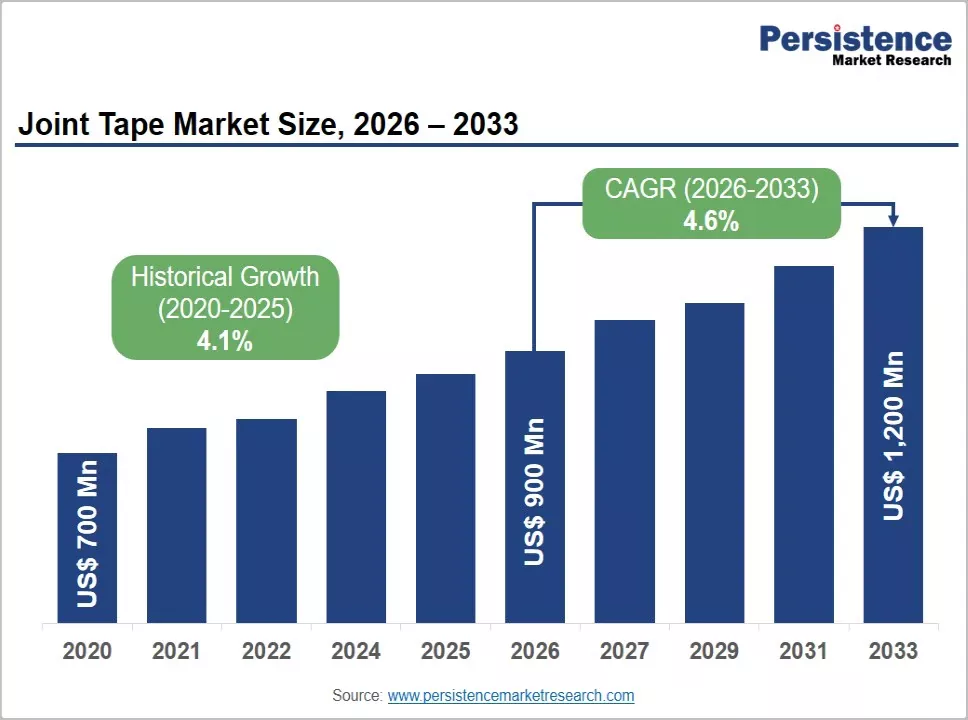
The global joint tape market size is likely to be valued at US$ 900 million in 2026 and is expected to reach US$ 1,200 million by 2033, growing at a CAGR of 4.6% between 2026 and 2033.
Market expansion is supported by residential and commercial construction, increasing use of gypsum boards, and renovation activity. Demand is also benefiting from the adoption of self-adhesive fiberglass mesh tapes, reinforced joint tapes, and specialized corner finishing products. Joint tapes remain important in drywall installation because they reinforce board seams, reduce joint cracking, and provide smooth finishes across walls, ceilings, and interior partitions.
Key Industry Highlights
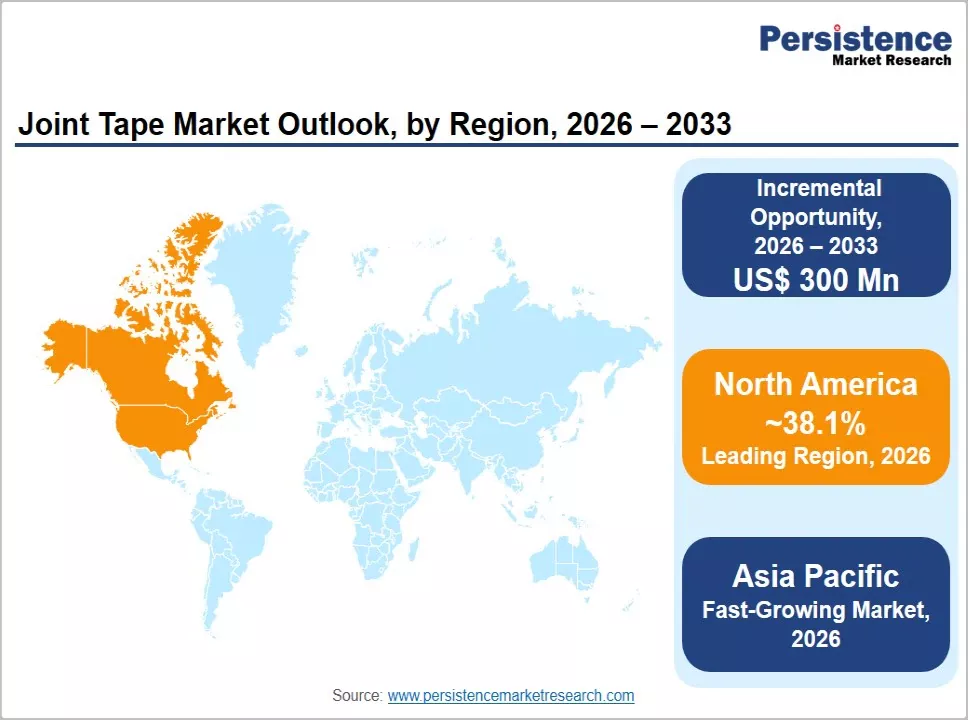
- Leading Region: North America is anticipated to account for 38.1% of the market share, supported by established drywall construction practices, residential renovation, commercial building activity, and demand for professional finishing materials.
- Fastest-growing Region: Asia Pacific, driven by urbanization, residential construction, infrastructure development, and increasing adoption of gypsum board systems across China and India.
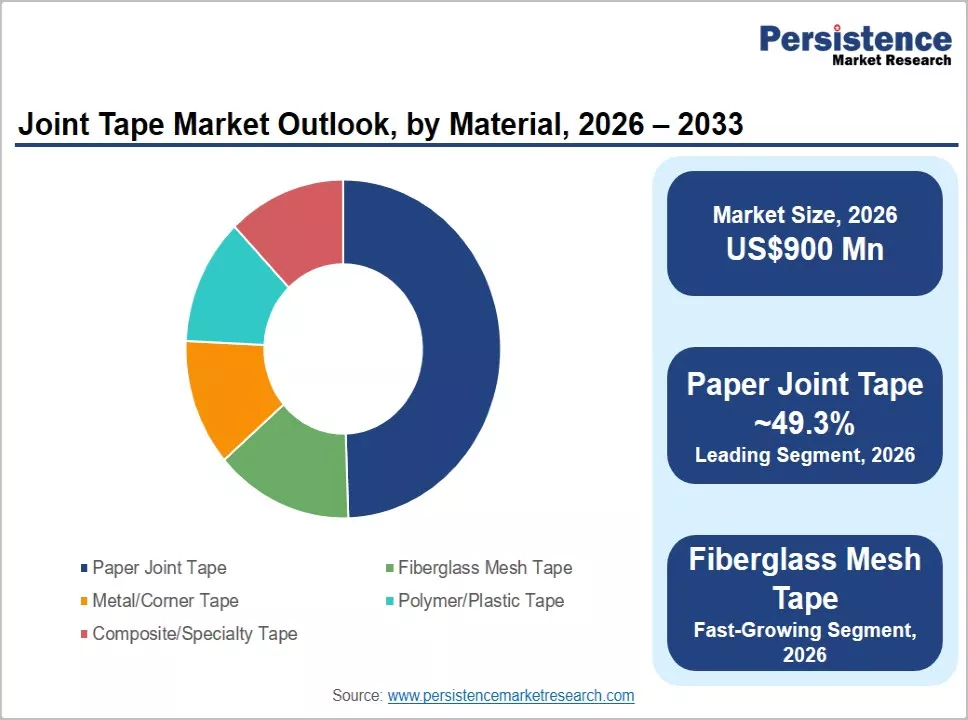
- Dominant Material: Paper joint tape, anticipated to account for 49.3% of global demand, supported by strong bonding performance, competitive pricing, and widespread use in professional drywall finishing.
- Leading Technology: Non-adhesive and embedded joint tape, anticipated to account for 62.4% of the market, reflecting continued use of conventional joint-compound application systems.
DRO Analysis
Drivers - Expansion of Residential and Commercial Construction
The expansion of residential and commercial construction is increasing demand for drywall finishing materials, including paper joint tape, fiberglass mesh tape, and reinforced corner products. Joint tape forms an essential component of gypsum board installation because it reinforces connections between panels and supports smooth surface finishing. In the United States, construction spending remained a major economic activity, with residential and non-residential construction representing substantial portions of private construction expenditure.
Canada's housing starts reached 259,028 units in 2025, increasing 5.6% from 2024. These construction activities support recurring demand for drywall joint reinforcement and interior finishing materials.
Residential construction remains an important source of demand because drywall systems are widely used in interior walls, ceilings, partitions, and renovation projects. Commercial buildings, including offices, healthcare facilities, educational institutions, hotels, and retail properties, require extensive drywall installation and finishing. Joint tape is used across these projects to reinforce seams, prevent surface cracking, and maintain consistent wall finishes. Increasing construction activity and the replacement of older interior materials are therefore supporting demand for conventional paper tape as well as faster-installation fiberglass mesh products.
Increasing Adoption of Fiberglass Mesh Tape and Efficient Drywall Installation
Manufacturers are expanding fiberglass mesh and paperless tape portfolios to address installation efficiency, joint strength, and moisture-related requirements. Self-adhesive fiberglass tape eliminates the separate embedding step required by conventional paper tape, reducing application time during drywall finishing. Saint-Gobain ADFORS offers FibaTape Original for drywall joints, finishing, and crack repair. Its open fiberglass mesh construction supports compound application while reducing the occurrence of bubbles and blisters. USG also offers Sheetrock Brand Fiberglass Joint Tape, which eliminates the bedding coat and supports a two-coat finishing process.
The development of reinforced fiberglass and nonwoven tape is also expanding product applications. These materials address joint movement, moisture exposure, and crack resistance across residential and commercial interiors. FibaFuse MAX, introduced by Saint-Gobain ADFORS in June 2025, uses a tri-directional reinforcement layer designed to resist cracking from different directions. Such product developments are increasing the availability of specialized joint reinforcement solutions and supporting the adoption of fiberglass-based products among contractors and professional drywall installers.
Restraint - Fluctuating Raw Material Costs and Installation-Related Performance Requirements
Joint tape manufacturers depend on paper, glass fiber, polymer resins, adhesives, coatings, and specialty reinforcement materials. Changes in pulp prices, energy costs, chemical inputs, and transportation expenses influence manufacturing and distribution costs.
Fiberglass mesh tape also requires controlled weaving, coating, and adhesive application to maintain dimensional stability and bonding performance. Differences in substrate conditions, joint compound compatibility, application thickness, and installation practices influence finished joint quality. Paper tape requires correct embedding in joint compound, while self-adhesive mesh products require compatible finishing compounds. These performance requirements increase the importance of product consistency, technical specifications, and contractor familiarity across construction applications.
Opportunity - Development of Reinforced, Moisture-Resistant, and Specialty Joint Tapes
The increasing use of moisture-resistant gypsum boards, cement boards, and specialized interior systems is creating opportunities for alkali-resistant, reinforced, and coated joint tapes. These products address applications involving bathrooms, kitchens, basements, and other areas exposed to moisture or alkaline substrates. Saint-Gobain ADFORS offers FibaTape Cement for applications involving cement boards and mortar walls, with an alkali-resistant coating. Its product portfolio also includes FibaTape Mold-X and specialized products for different drywall applications. Such offerings expand the use of fiberglass reinforcement beyond conventional gypsum board seams and support demand for application-specific finishing materials.
Category-wise Analysis
Material Insights
Paper joint tape is anticipated to account for 49.3% of market share. Its position is supported by competitive pricing, strong bonding characteristics, and widespread use in conventional drywall finishing. Paper tape is embedded in joint compound and applied over gypsum board seams and inside corners. Its center crease supports accurate positioning during corner finishing, while its paper structure provides reinforcement across flat joints. USG's Sheetrock Brand Paper Joint Tape is designed for reinforcing flat joints and inside corners and meets ASTM C475 requirements. These characteristics maintain paper tape's importance among professional drywall contractors and construction companies.
Fiberglass mesh tape is anticipated to be the fastest-growing material category. Its growth is supported by faster application, moisture-related product options, and reduced installation steps. The open mesh structure allows joint compound to pass through the tape, supporting joint reinforcement and reducing the formation of bubbles.
Saint-Gobain ADFORS' FibaTape range includes original, cement-compatible, and specialized drywall reinforcement products. Metal and corner tape, polymer/plastic tape, and composite/specialty tape serve applications requiring impact resistance, corner protection, flexibility, and additional reinforcement. The material landscape therefore reflects continued paper tape demand alongside increasing adoption of specialized fiberglass and polymer-based products.
Technology Insights
Non-adhesive and embedded joint tape is anticipated to account for 62.4% of the market share. This segment primarily includes paper joint tape installed with joint compound during conventional drywall finishing. The application process involves placing the tape over the gypsum board seam, embedding it in joint compound, and applying additional finishing coats. Professional contractors continue to use this method because of its established installation practices, compatibility with conventional drywall systems, and suitability for flat joints and inside corners. USG's Sheetrock Brand Paper Joint Tape is specifically designed for use with joint compounds and provides reinforcement against cracking, stretching, and tearing.
Self-adhesive tape is anticipated to be the fastest-growing technology category, supported by reduced installation steps and increasing demand for efficient drywall repair. These products feature an adhesive backing that holds the tape in position before compound application.
The online distribution channel for self-adhesive products is projected to grow at a CAGR of 7.2%. Pressure-sensitive tape, alkali-resistant tape, and reinforced or coated tape address specialized requirements involving adhesion, cement-board compatibility, moisture exposure, and joint movement. Product differentiation increasingly centers on adhesive performance, tensile strength, coating quality, resistance to cracking, and compatibility with finishing compounds.
Application Insights
Seam and drywall joint reinforcement is anticipated to account for 46.3% of the market share, making it the leading application category. Joint tape is primarily used to reinforce connections between gypsum board panels and create smooth surfaces before painting, wallpapering, or other interior finishing. Paper tape remains widely used in flat joints and inside corners, while fiberglass mesh tape is applied in drywall installation and repair. USG and Saint-Gobain ADFORS offer products specifically designed for drywall seams, surface reinforcement, and crack repair. The extensive use of gypsum board across residential walls, commercial partitions, and suspended ceilings supports recurring demand for seam reinforcement products.
Corner beading and reinforcement is anticipated to be the fastest-growing application category, supported by demand for durable interior corners and improved impact resistance. Metal, paper-faced metal, and polymer corner products are used to protect external corners and maintain straight finishing lines. Commercial buildings, including schools, hospitals, offices, and hospitality facilities, require durable corner finishing in high-traffic interior areas. Ceiling joints, repair and renovation, and interior decoration or trim represent additional applications. Manufacturers are expanding specialty corner profiles and reinforced finishing products to address different architectural designs, substrate conditions, and installation requirements.
Regional Insights
North America Joint Tape Market Trends
North America is anticipated to account for 38.1% of the market share, supported by established gypsum board construction practices, residential renovation, commercial building activity, and a developed network of drywall contractors and building-material distributors. The region has an established market for paper joint tape, fiberglass mesh tape, corner reinforcement, and specialty finishing products. Demand is supported by new housing construction, commercial interiors, maintenance, and refurbishment projects.
U.S. Joint Tape Market Trends
The U.S. represents the principal regional demand center, supported by extensive residential construction, commercial property development, and drywall renovation. According to the U.S. Census Bureau, construction spending reached a seasonally adjusted annual rate of US$2,203.1 billion in August 2026. Private residential construction accounted for US$882.3 billion of this annualized expenditure, while non-residential construction reached US$773.0 billion. These activities support demand for drywall installation materials, including paper joint tape, self-adhesive fiberglass tape, and corner reinforcement products. USG maintains an established product portfolio through its Sheetrock and Beadex brands, covering paper and fiberglass joint tape for professional drywall finishing.
Europe Joint Tape Market Trends
Europe represents an established market for joint tape, supported by residential refurbishment, commercial interiors, gypsum board construction, and renovation of existing buildings. Germany, France, the U.K., and other European countries maintain demand for paper-based, fiberglass, and specialty joint reinforcement products. European manufacturers also supply drywall finishing systems, including joint compounds, tapes, corner beads, and accessories. Demand is influenced by construction investment, renovation activity, energy-efficient building upgrades, and regulatory requirements for building performance and product quality.
Germany Joint Tape Market Trends
Germany remains an important European market due to its established construction materials industry, commercial building base, and residential renovation activity. According to Destatis, real construction order intake in Germany's main construction industry increased 6.8% in 2025, while building construction orders increased 7.5% in real terms. The annual turnover of the main construction industry reached €120.5 billion in nominal terms. These developments support demand for interior finishing products, including gypsum board joint tape, corner reinforcement, and specialized drywall accessories. Knauf maintains a significant presence in gypsum-based construction systems and offers paper joint tape for gypsum board partitions, suspended ceilings, and wall cladding.
Asia Pacific Joint Tape Market Trends
Asia Pacific is anticipated to be the fastest-growing regional market, supported by urbanization, housing development, commercial construction, and increasing use of gypsum board systems. China, India, Japan, and ASEAN countries represent important demand centers for drywall finishing products. The regional market includes both conventional paper joint tape and fiberglass mesh tape, with product demand influenced by construction methods, local manufacturing capacity, and distribution networks. Residential housing programs, commercial property development, and renovation of existing buildings contribute to the consumption of joint reinforcement materials.
China Joint Tape Market Trends
China represents a major construction market with extensive residential, commercial, and infrastructure-related building activity. However, the property development sector experienced a contraction in 2025. According to the National Bureau of Statistics of China, real estate development investment declined 17.2% in 2025, while newly started building floor space decreased 20.4%. Government-supported housing construction and renovation of older residential communities remain relevant sources of construction activity.
In 2025, construction or preparation of 27,000 old urban residential communities began, benefiting 4.99 million households. These activities support demand for drywall repair, interior finishing, fiberglass mesh reinforcement, and specialized joint tapes.
India Joint Tape Market Trends
India represents an expanding market for joint tape due to residential construction, urban housing development, commercial property investment, and increasing use of modern interior finishing systems. The Pradhan Mantri Awas Yojana-Urban 2.0 program, launched in September 2024, targets an additional one crore eligible urban households over five years. The Ministry of Statistics and Programme Implementation also reported real construction-sector GVA growth of 8.6% in FY2024-25 in its first advance estimates. These developments support demand for interior wall systems, gypsum board partitions, ceiling joints, and repair materials. Domestic and international suppliers offering paper tape, fiberglass mesh tape, and specialty reinforcement products are positioned across construction-material distribution and professional contractor channels.
Competitive Landscape
The global joint tape market is fragmented, with competition distributed among gypsum board manufacturers, fiberglass mesh producers, drywall accessory manufacturers, and specialty building-material suppliers. Competition is primarily based on tape strength, bonding performance, resistance to cracking, adhesive quality, dimensional stability, product consistency, and compatibility with joint compounds. Established manufacturers compete through broad product portfolios, contractor relationships, distribution networks, and integrated drywall finishing systems. Specialized suppliers differentiate through self-adhesive fiberglass tape, nonwoven reinforcement, alkali-resistant products, polymer corner systems, and application-specific finishing solutions.
Dominant strategies include product development, material innovation, manufacturing efficiency, portfolio expansion, and distribution partnerships. Manufacturers are introducing reinforced paperless tape, improved paper formulations, moisture-resistant products, and specialty corner reinforcement. Recent acquisitions are also expanding product portfolios across interior finishing, exterior PVC profiles, and code-compliance applications. The competitive environment therefore reflects continued demand for conventional paper tape alongside increasing product differentiation in fiberglass, polymer, and specialty reinforcement materials.
Key Industry Developments
- In September 2026, Trim-Tex, Inc. announced the acquisition of E-Z Tape, adding a specialized drywall tape product line to its code-compliance portfolio. The transaction expands its presence in firestopping and life-safety applications while integrating the acquired product range with its manufacturing capabilities and distribution network.
Companies Covered in Joint Tape Market
- Saint-Gobain ADFORS
- USG Corporation
- Knauf Group
- Georgia-Pacific
- National Gypsum Company
- CertainTeed
- Trim-Tex, Inc.
- ClarkDietrich
- Strait-Flex International
- Hamilton Drywall Products
- Hyde Tools
- FibaTape
- ProForm
- Taping Tools Inc.
- Master Wall Inc.
- OX Tools Global
Frequently Asked Questions
The global joint tape market is valued at US$ 900 million in 2026.
The global joint tape market is expected to reach US$ 1,200 million by 2033.
Key trends include increasing adoption of self-adhesive fiberglass mesh tape, reinforced paperless tape, moisture-resistant joint reinforcement, alkali-resistant products, specialty corner tapes, and improved drywall finishing solutions.
Paper joint tape is the leading material segment, accounting for approximately 49.3% of market share, supported by its strong bonding performance, competitive pricing, and widespread use in professional drywall finishing.
The market is projected to grow at a 4.6% CAGR from 2026 to 2033.
Key players include Saint-Gobain ADFORS, USG Corporation, Knauf Group, Georgia-Pacific, National Gypsum Company, CertainTeed, Trim-Tex, ClarkDietrich, and Strait-Flex International.


