




- Technology
- Indoor Farming Technology Market
Indoor Farming Technology Market Size, Share, and Growth Forecast 2026 - 2033
Indoor Farming Technology Market by Component Type (Hardware [Climate Control Systems, Lighting Systems, Sensors, Irrigation Systems], Software [Web-Based, Cloud-Based], Services [System Integration & Consulting, Managed Services, Assisted Professional Services]), Facility Type (Greenhouses, Vertical Farms [Shipping Container, Building-Based], Others), Crop Category, Growing Mechanism, and Regional Analysis for 2026 - 2033

Indoor Farming Technology Market Size and Trend Analysis
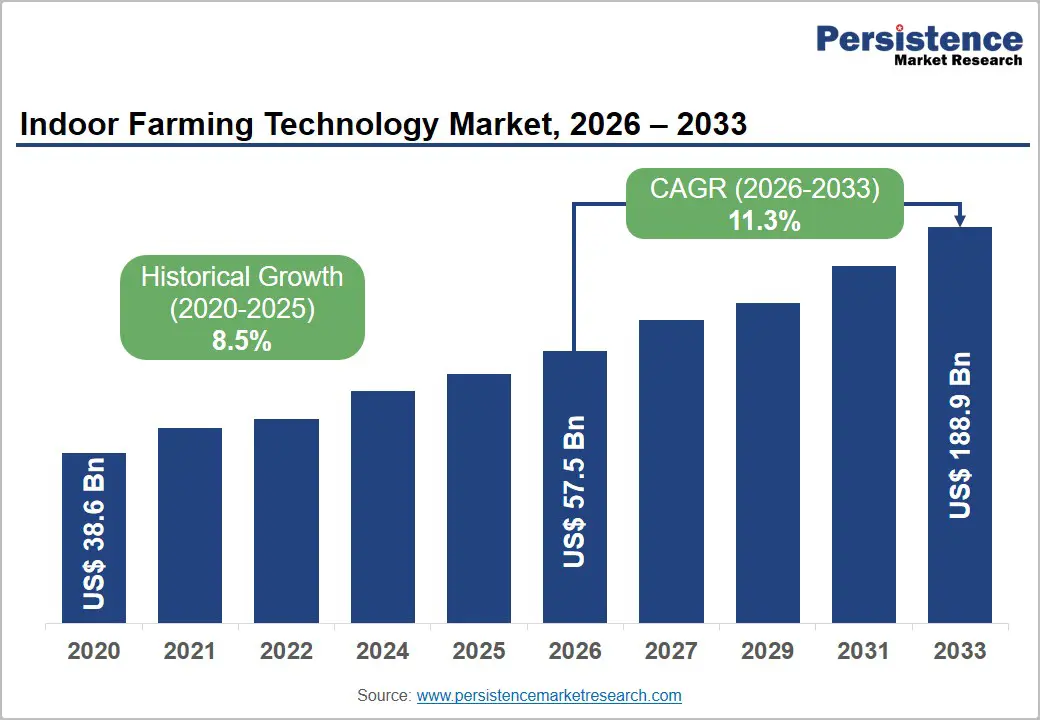
The global indoor farming technology market size is valued at US$ 57.5 billion in 2026 and is projected to reach US$ 188.9 billion, growing at a CAGR of 11.3% between 2026 and 2033. This robust expansion is principally driven by surging global food security imperatives, the rapid proliferation of energy-efficient LED lighting and precision climate-control technologies, and mounting urbanization pressure that is compressing arable land availability.
Supportive government policies, including the U.S. Department of Agriculture (USDA) farm-innovation grants and the European Union's Farm to Fork Strategy, target sustainable food systems.
Key Industry Highlights:
- Leading Region: North America leads the global indoor farming technology market with approximately 34% revenue share in 2026, driven by strong VC investment, favorable USDA regulatory frameworks, and robust retail demand for locally sourced, pesticide-free produce.
- Fastest Growing Region: Asia Pacific is the fast-growing market expanding at a CAGR exceeding 13%, propelled by urbanization-driven food security imperatives, state-backed plant factory programs in China and Japan, and rising consumer demand for safe produce in India.
- Dominant Segment: The hardware segment dominates by component type with approximately 58% sshare in 2026, led by surging adoption of energy-efficient LED horticultural lighting systems and advanced multi-parameter sensor arrays across greenhouse and vertical farm facilities globally.
- Fastest Growing Segment: Cloud-based software is the fastest-growing sub-segment within the software category, driven by SaaS platforms enabling real-time remote monitoring, predictive analytics, and AI-driven crop management that reduce operational costs by up to 30% for indoor farm operators.
- Key Opportunity: The integration of AI, IoT sensors, and cloud-based farm management platforms represents the most significant market opportunity, enabling precision cultivation at scale and opening the indoor farming technology market to a broader segment of small and mid-sized commercial farm operators globally.
DRO Analysis
Drivers - Rising Global Food Security Concerns and Urban Population Growth
Acute food security pressures, amplified by a global urban population projected to reach 6.7 billion by 2050 according to the United Nations Department of Economic and Social Affairs (UN DESA), are compelling governments and agribusinesses to accelerate investment in controlled-environment agriculture.
With roughly 33% of the world's soils already classified as degraded by the Food and Agriculture Organization (FAO), indoor farming offers a proven alternative producing up to 390 times more yield per square foot than conventional open-field cultivation, with dramatically lower water consumption. Countries across the Middle East, Southeast Asia, and Sub-Saharan Africa are channelling public funding into vertical and greenhouse infrastructure to reduce dependence on volatile import supply chains and ensure year-round crop availability.
Technological Innovation in LED Lighting and Climate Control Systems
Continuous advancement in horticultural LED lighting technology is a pivotal enabler of indoor farming scalability. Modern full-spectrum LED systems consume up to 50% less energy than legacy high-pressure sodium (HPS) lamps while delivering optimized photosynthetic photon flux densities (PPFD) for accelerated crop cycles.
The U.S. Department of Energy (DOE) reported that horticultural lighting efficiency improvements have reduced energy cost per gram of crop produced by over 40% since 2015. Simultaneously, AI-integrated climate control platforms enable real-time modulation of temperature, humidity, and CO2 concentration, substantially reducing crop loss rates.
Restraints - High Capital Expenditure and Operational Energy Costs
Despite strong long-term economics, the indoor farming sector remains constrained by prohibitively high upfront capital costs. Establishing a commercial-scale vertical farm can require investments ranging from US$ 10 million to US$ 100 million, depending on automation level and facility size, according to estimates from the Cornell University College of Agriculture and Life Sciences.
Electricity, which accounts for 25% of total operational costs in fully enclosed vertical farms, continues to pressure margins, especially in regions with high industrial power tariffs. These financial barriers limit market entry predominantly to well-capitalized corporations and institutional investors, slowing adoption among small and mid-sized agribusinesses in Latin America, Africa, and parts of South Asia where access to affordable project financing is constrained.
Skilled Workforce Shortages and Technology Complexity
The deployment and management of sophisticated indoor farming systems spanning sensor networks, hydroponic rigs, and AI-driven analytics platforms demands a workforce with cross-disciplinary expertise in agronomy, data science, and mechanical engineering. The International Labour Organization (ILO) has flagged a widening skilled-labour gap in precision agriculture sectors across both developed and developing economies.
This talent deficit can translate into suboptimal system calibration, elevated crop failure rates, and deferred maintenance cycles, eroding return on investment. Without coordinated vocational training programs and digital upskilling initiatives, technology complexity will remain a meaningful friction point that restrains the pace of market expansion, particularly in regions where agricultural mechanization infrastructure is nascent.
Opportunities - Rapid Expansion of Vertical Farming in Urban Micro-Markets
Urban vertical farming presents a transformational opportunity for market participants, with city-centre facilities capable of supplying hyperlocal fresh produce with minimal logistics carbon footprint. The World Resources Institute (WRI) estimates that urban and peri-urban agriculture could meet up to 10% of global vegetable demand by 2050 if adequately scaled.
Shipping container-based vertical farms, highly modular and rapidly deployable, are increasingly attractive to municipalities, hospitality chains, and supermarket retailers seeking to shorten supply chains. Investments in this sub-segment are accelerating: Plenty Unlimited secured a US$ 400 million investment from SoftBank Vision Fund 2 in 2022 to expand its indoor farming capacity.
Integration of AI, IoT, and Cloud-Based Farm Management Software
The convergence of Artificial Intelligence (AI), Internet of Things (IoT) sensor arrays, and cloud-based farm management software constitutes a high-value opportunity for technology vendors and systems integrators. Cloud-based software platforms enable remote, real-time monitoring and predictive analytics across distributed farm networks, reducing operational overhead by an estimated 20% per facility according to pilot studies published by Wageningen University & Research.
The global smart agriculture market, anchored by IoT adoption in controlled environments, is expected to expand significantly through the forecast period. Software-as-a-Service (SaaS) business models also lower the barrier to technology adoption for smaller operators, broadening the addressable customer base.
Category-wise Analysis
Component Type Insights
The hardware segment dominates the indoor farming technology market by component type, accounting for approximately 58% of total revenue in 2026. This leadership is underpinned by the capital-intensive nature of constructing and equipping controlled-environment facilities, where LED lighting systems, climate control units, sensors, and irrigation infrastructure represent the largest per-facility expenditure categories.
According to the Association for Vertical Farming (AVF), lighting alone can constitute up to 30% of total hardware procurement costs in a fully enclosed vertical farm. The ongoing transition from legacy lighting to energy-efficient LED systems, coupled with increasing adoption of multi-parameter sensor arrays for real-time crop monitoring, continues to sustain high hardware revenue.
Facility Type Insights
Greenhouses represent the leading segment in the facility-type category, commanding approximately 52% of total market revenue in 2026. Their dominance is attributable to lower construction costs compared to fully enclosed vertical farms, combined with the ability to leverage natural sunlight, which significantly reduces energy expenditure.
The International Society for Horticultural Science (ISHS) reports that the global greenhouse cultivation area exceeded 500,000 hectares as of its most recent assessment, with the Netherlands, Spain, Turkey, and China accounting for most of the commercial greenhouse production. Technological enhancements such as retractable roofing systems, automated shade management, and hydroponic integration are elevating greenhouse productivity.
Crop Category Insights
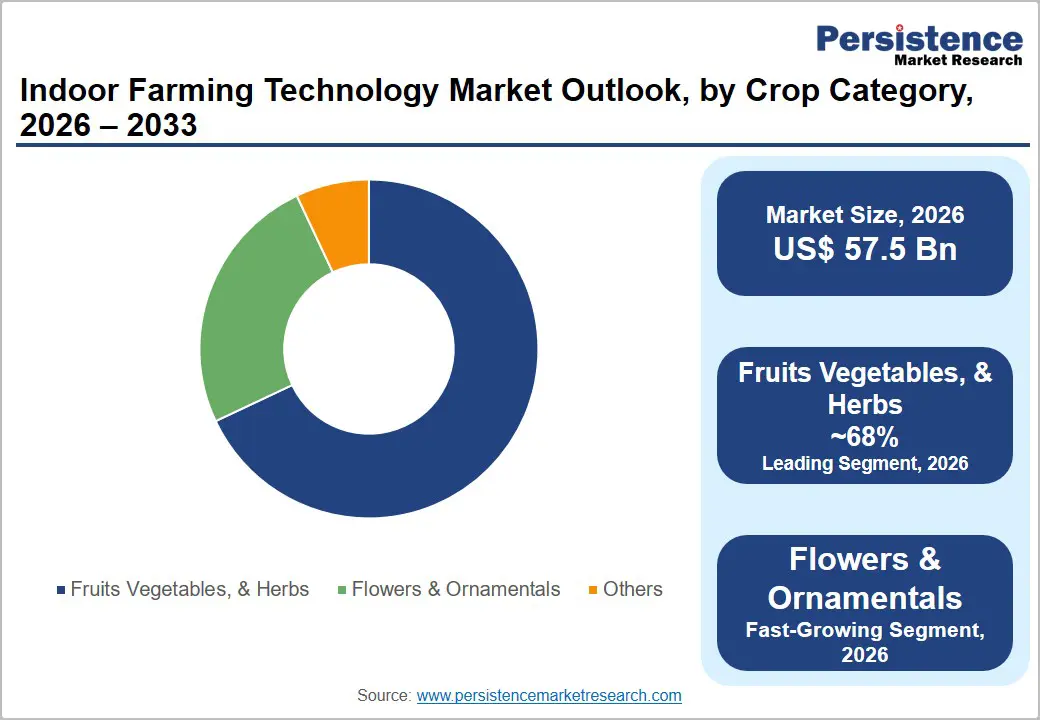
Fruits, Vegetables & Herbs constitute the dominant crop category in the indoor farming technology market, representing approximately 68% of total revenue in 2026. This segment's leadership reflects strong consumer demand for year-round availability of high-value fresh produce, including leafy greens, tomatoes, strawberries, and culinary herbs that are well-suited to hydroponic and aeroponic cultivation environments.
The U.S. Department of Agriculture (USDA) notes that the domestic controlled-environment vegetable sector has experienced consistent output growth, driven by foodservice procurement contracts and retail private-label programs. Herbs such as basil, mint, and cilantro offer rapid harvest cycles of 21-30 days, delivering strong revenue velocity for indoor farm operators.
Growing Mechanism Insights
Hydroponics is the leading growing mechanism in the indoor farming technology market, holding an estimated 61% market share in 2026. The technique's supremacy is rooted in its commercial maturity, versatility across crop types, and demonstrated water-use efficiency of up to 90% compared to soil-based cultivation, according to NASA's original plant growth research and affirmed by subsequent commercial deployments globally.
Hydroponic systems are compatible with a broad spectrum of indoor farm configurations, from large-scale greenhouse operations to compact shipping-container farms, providing significant operational flexibility. The Netherlands and Japan have led commercial hydroponic sophistication, with nutrient film technique (NFT) and deep-water culture (DWC) systems now standard across major facilities.
Regional Analysis
North America Indoor Farming Technology Market Trends & Analysis
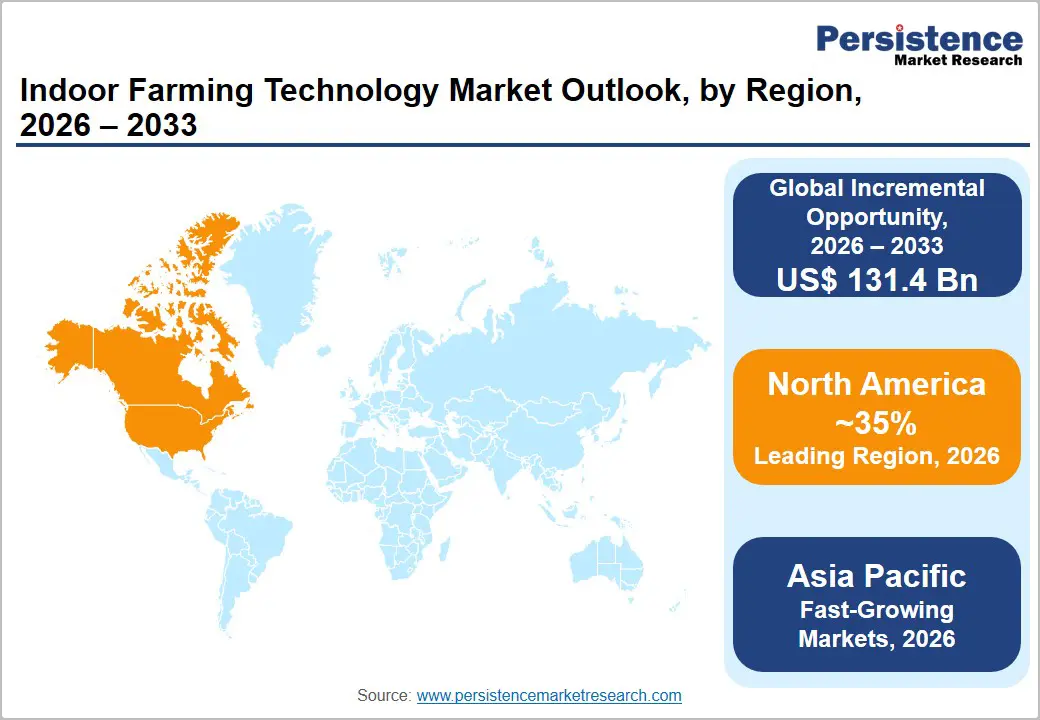
North America is the largest regional market for indoor farming technology, representing approximately 34% of global revenue in 2026. The U.S. is home to large-scale operators such as Aero Farms, AppHarvest, and Bowery Farming, and the country's favorable regulatory environment for hydroponic produce, now eligible for USDA Organic certification under revised 2023 rules, is opening premium retail channels. Canada is emerging as a significant growth market, driven by extreme climate conditions that limit year-round field production and increasing government investment in food sovereignty infrastructure.
U.S. Indoor Farming Technology Market
The U.S. accounts for most North American revenues, estimated at approximately US$ 17.2 Bn in 2026, supported by a dense network of commercial greenhouse and vertical farm operators, high consumer willingness to pay premium prices for locally grown produce, and active R&D investment in next-generation growing technologies.
Europe Indoor Farming Technology Market Trends, Drivers & Insights
Europe is the second-largest regional market, with indoor farming deeply embedded in the agricultural systems of the Netherlands, Germany, Spain, and the U.K. The EU's Farm to Fork Strategy under the European Green Deal mandates a 25% increase in organic farming area by 2030 and a 50% reduction in chemical pesticide use, directly incentivizing controlled-environment agriculture investment. Post-Brexit trade frictions have prompted U.K. retailers to accelerate domestic sourcing from indoor farms, and Germany's strong industrial manufacturing base is enabling domestic production of precision lighting and climate-control systems that reduce import dependency.
Germany Indoor Farming Technology Market
Germany represents the largest single indoor farming technology market in continental Europe, estimated at approximately US$ 7.3 Bn in 2026, underpinned by its world-class greenhouse horticultural sector and significant government co-investment in agricultural digitalization under the Digital Agricultural Strategy.
U.K. Indoor Farming Technology Market
The UK’s indoor farming technology growth is estimated at approximately US$ 4.8 Bn in 2026, with rapid expansion fueled by post-Brexit domestic food resilience strategies and significant supermarket chain investment in British-grown fresh produce contracts with controlled-environment agriculture suppliers.
France Indoor Farming Technology Market Trends
France's indoor farming technology market is estimated at approximately US$ 3.6 Bn in 2026, with growth driven by the country's emphasis on agri-food innovation under France 2030, a government investment plan allocating funds to sustainable agricultural technology, including vertical farming and precision greenhouse systems.
Asia Pacific Indoor Farming Technology Market Drivers & Analysis
Asia Pacific is the fast-growing regional market, projected to expand at a CAGR exceeding 13% between 2026 and 2033. China, Japan, and South Korea are the primary growth engines, each operating large-scale vertical farm programs aimed at addressing domestic food production deficits exacerbated by urbanization and agricultural land scarcity. In India, the National Horticulture Board (NHB) has initiated cluster-based greenhouse development programs in states including Maharashtra, Himachal Pradesh, and Karnataka, while growing retail and hospitality sector demand for pesticide-free produce is stimulating private investment in hydroponic infrastructure.
China Indoor Farming Technology Market Trends
China's market is estimated at approximately US$ 9.4 Bn in 2026, backed by substantial state investment in plant factories under the 14th Five-Year Plan for Agricultural Modernization and a vast network of commercial greenhouse operations totalling over 4 million hectares of protected cultivation area.
India Indoor Farming Technology Market
India's indoor farming technology market is estimated at approximately US$ 2.1 Bn in 2026, with growth anchored in expanding commercial greenhouse adoption in horticultural states, rising institutional procurement of fresh produce by quick-commerce platforms, and government subsidies under the National Agriculture Development Programme (RKVY).
Japan Indoor Farming Technology Market
Japan's market is estimated at approximately US$ 3.8 Bn in 2026, reflecting its global leadership in plant factory innovation, government-backed R&D through the Ministry of Agriculture, Forestry and Fisheries (MAFF), and high domestic demand for precision-grown, contamination-free produce amid ongoing food safety awareness.
Competitive Landscape
The global indoor farming technology market exhibits a moderately fragmented structure, with a mix of large diversified Agri-tech conglomerates, specialized vertical farm operators, and emerging start-ups competing across hardware, software, and services sub-segments. Leading players are pursuing aggressive geographic expansion through joint ventures, franchise models, and licensing agreements, particularly in Asia Pacific and the Middle East.
R&D investment is concentrated in AI-driven crop analytics, energy-efficient lighting systems, and modular farm architectures. Key differentiators include proprietary data platforms, energy cost advantages via renewable integration, and long-term procurement contracts with major food retailers.
Key Developments:
- In August 2025, 80 Acres Farms merged with Soli Organic to form one of the largest indoor farming networks in the U.S. The merger brings together advanced farming technology, strong retail supply chains, and crop-growing expertise to deliver fresh produce to over 17,000 stores across the country. The combined company is expected to generate around USD 200 million in revenue in its first year.
- In January 2025, Signify (Philips Horticulture LED Solutions) expanded its horticultural LED product line with the launch of Greenpower LED top lighting Compact, a next-generation fixture delivering 20% higher light output with reduced energy consumption, targeting large-scale greenhouse growers in Europe and North America.
Companies Covered in Indoor Farming Technology Market
- Signify N.V. (Philips Horticulture LED Solutions)
- Plenty Unlimited Inc.
- Freight Farms
- Aero Farms
- Bowery Farming
- AppHarvest (now part of Local Bounti / broader CEA ecosystem)
- Local Bounti Corporation
- Gotham Greens
- Iron Ox
- Infarm (InFarm GmbH)
- Village Farms International
- BrightFarms
- Urban-gro, Inc.
- Priva Group
- Ridder Group
- Netafim
- Heliospectra AB
- Gavita International
- OSRAM
- LumiGrow (part of Fluence by OSRAM)
Frequently Asked Questions
The global Indoor Farming Technology market is valued at US$ 57.5 Bn in 2026 and is projected to reach US$ 188.9 Bn by 2033, expanding at a CAGR of 11.3% during the forecast period, driven by urbanization, food security imperatives, and technology innovation in controlled-environment agriculture.
Primary demand drivers include rising global food security concerns attributable to population growth and soil degradation, rapid advancement in energy-efficient LED horticultural lighting and AI-integrated climate-control systems, supportive government initiatives such as the USDA farm-innovation grants and the EU's Farm to Fork Strategy, and growing consumer preference for locally grown, pesticide-free fresh produce.
The Hardware segment is the market leader, accounting for approximately 58% of total indoor farming technology revenue in 2026. Its dominance is driven by the capital-intensive procurement of LED lighting systems, climate control units, sensor arrays, and precision irrigation equipment required to equip commercial greenhouse and vertical farm facilities globally.
North America is the leading region, holding approximately 34% of global market revenue in 2026. The region benefits from high levels of Agri-tech venture capital investment, a well-developed commercial greenhouse and vertical farm operator ecosystem, revised USDA Organic certification eligibility for hydroponic produce, and robust retail-driven demand for locally sourced fresh produce.
Leading companies in the global Indoor Farming Technology market include Signify N.V. (Philips Horticulture LED Solutions), Plenty Unlimited Inc., Freight Farms, AeroFarms, Bowery Farming, Gotham Greens, Local Bounti Corporation, Iron Ox, Infarm (InFarm GmbH), Village Farms International, Urban-gro Inc., Priva Group, Ridder Group, Netafim, Heliospectra AB, and OSRAM (ams OSRAM - Horticultural Lighting Division), among others.


