




- Medical Devices
- Hormone Infusion Pumps Market
Hormone Infusion Pumps Market Size, Share, and Growth Forecast, 2026 - 2033
Hormone Infusion Pumps Market by Product Type (External Pumps, Wearable/Patch Pumps, Others), Application (Diabetes Management, Endocrinology & Hormone Replacement Therapy, Others), End-user, Technology, and Regional Analysis for 2026 - 2033

Hormone Infusion Pumps Market Size and Trends Analysis
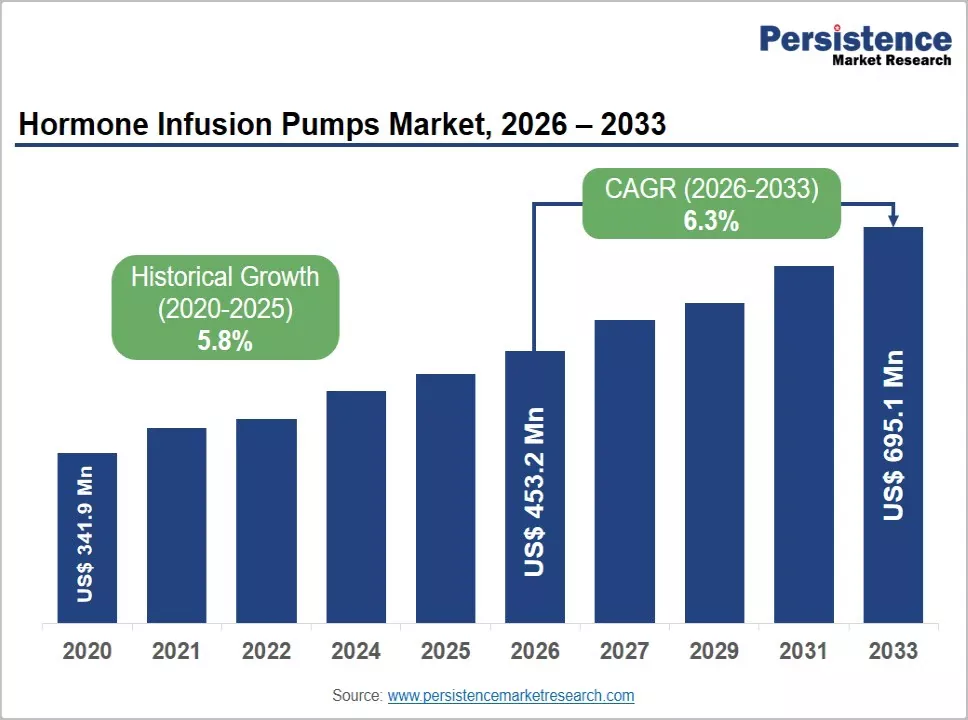
The global hormone infusion pumps market size is likely to be valued at US$453.2 million in 2026 and is expected to reach US$695.1 million by 2033, growing at a CAGR of 6.3% between 2026 and 2033, driven by the increasing prevalence of diabetes and endocrine disorders, broader use of continuous subcutaneous hormone delivery, and the growing adoption of automated and connected infusion technologies.
The market is also moving from conventional stand-alone devices toward connected systems that integrate pumps with continuous glucose monitoring, mobile applications, remote monitoring, and automated dosing algorithms. Clinical guidelines are increasingly supporting broader access to continuous subcutaneous insulin infusion and automated insulin delivery.
Key Industry Highlights:
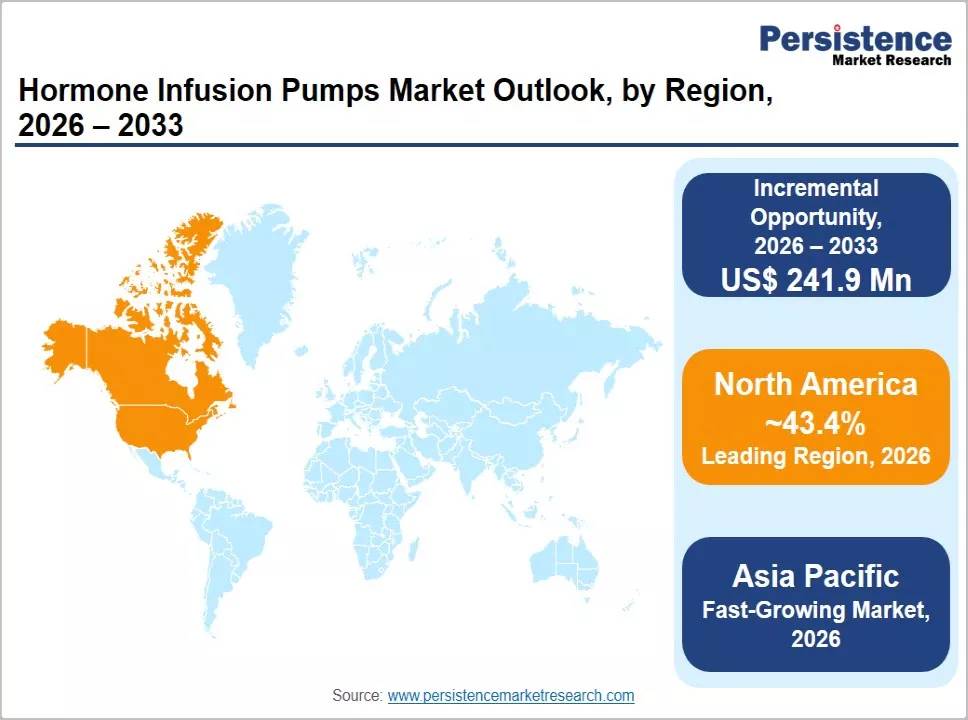
- Leading Region: North America is projected to account for 43.4% of the market share in 2026, supported by advanced healthcare infrastructure, established reimbursement systems, and strong adoption of automated insulin delivery.
- Fastest-growing Region: Asia Pacific, driven by its large diabetes population, expanding healthcare infrastructure, increasing medical-device manufacturing, and relatively lower penetration of advanced pump technologies.
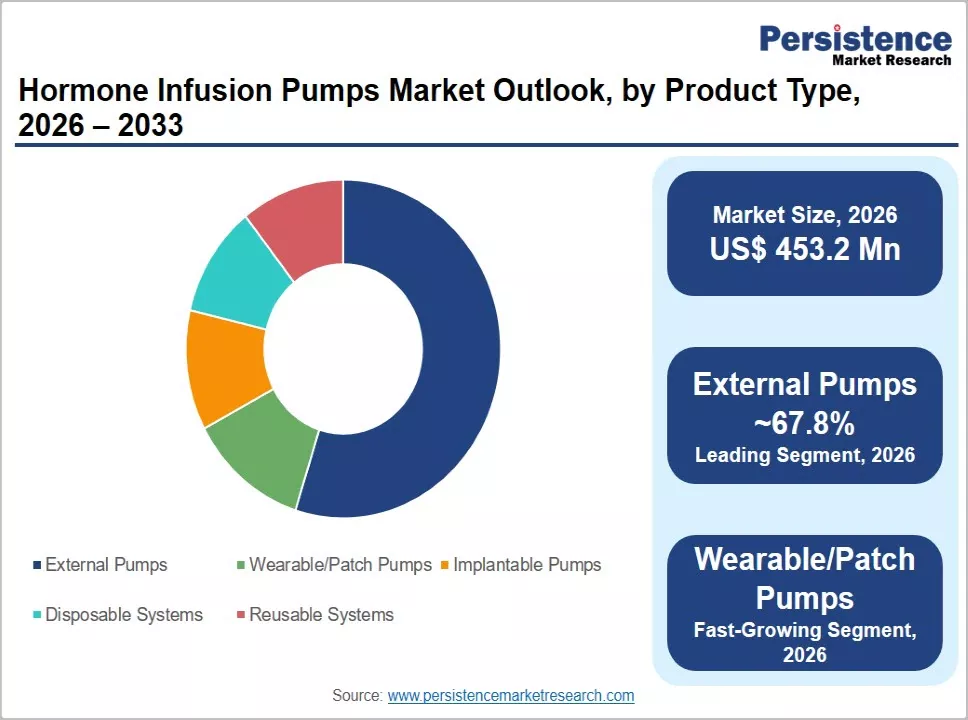
- Dominant Product Type: External pumps, anticipated to account for 67.8% of the market share in 2026, supported by established clinical use, programmable insulin delivery, and compatibility with CGM and automated insulin delivery technologies.
- Leading Application: Diabetes management, anticipated to represent 51.8% of the market share in 2026, reflecting the dominant role of insulin infusion in type 1 diabetes and the expanding use of automated pump systems among insulin-requiring adults with type 2 diabetes.
DRO Analysis
Drivers - Rising Diabetes Prevalence Expands the Addressable Patient Base
The growing prevalence of diabetes represents a fundamental demand driver for hormone infusion pumps, particularly insulin delivery systems. The International Diabetes Federation estimates that 589 million adults worldwide were living with diabetes in 2024, equivalent to approximately one in nine adults. The organization projects that the number could reach approximately 853 million by 2050. Four out of five adults with diabetes live in low- and middle-income countries, highlighting the long-term requirement for scalable and cost-efficient treatment technologies.
The U.S. represents a major demand center, with approximately 38.5 million adults aged 20–79 years living with diabetes in 2024. The expanding diabetic population increases the potential patient pool for insulin pumps, particularly among individuals requiring intensive insulin therapy. For manufacturers, this trend creates opportunities to expand pump use beyond traditional patient groups by improving affordability, simplifying device initiation, reducing training requirements, and supporting broader reimbursement coverage.
Automation and Connected Care Increase the Clinical Value of Pump Systems
The integration of infusion pumps with continuous glucose monitoring and automated dosing algorithms is increasing the clinical utility of pump-based therapy. The American Diabetes Association's 2026 Standards of Care support the use of continuous glucose monitoring and automated insulin delivery across appropriate patient populations while removing certain treatment prerequisites that previously limited access to these technologies.
For manufacturers, connectivity changes the competitive basis of the market. Pump systems are increasingly evaluated as part of broader treatment ecosystems that combine hardware, sensors, algorithms, mobile applications, cloud-based data, and recurring consumables. Companies that can establish interoperability with multiple glucose-monitoring systems can improve patient choice and increase the long-term value of their installed base.
Restraint - High Total Cost and Device-Management Requirements Limit Adoption
The total cost of pump therapy remains a structural barrier, particularly in price-sensitive healthcare systems. Expenses may include the pump itself, infusion sets, reservoirs, sensors, replacement components, software, training, clinical consultations, and ongoing technical support. Reimbursement also varies by country and patient eligibility.
In the U.S., Medicare coverage for continuous subcutaneous insulin infusion pumps and related supplies is subject to specific medical-necessity requirements. Such eligibility criteria can delay adoption among patients who may benefit clinically but do not immediately meet coverage requirements.
Device reliability represents another constraint. The U.S. Food and Drug Administration has identified risks associated with infusion-pump failures, including over-infusion, under-infusion, delayed therapy, software defects, mechanical failures, battery problems, and user-interface issues. As pumps become increasingly connected, manufacturers must also manage cybersecurity, interoperability, software validation, human-factors engineering, and post-market surveillance. These requirements increase development costs and can extend regulatory timelines, particularly for advanced automated systems.
Opportunities - Expansion of Home-Based Endocrine and Diabetes Management
The shift from facility-based treatment toward home-based chronic disease management creates significant opportunities for hormone infusion pump manufacturers. Patients increasingly expect therapies that can be administered outside hospitals while allowing healthcare professionals to maintain visibility into treatment performance.
Singapore provides an example of a healthcare system supporting continuous subcutaneous insulin infusion for eligible patients with type 1 diabetes through formal health technology assessment and subsidy mechanisms. In the U.S., manufacturers are also developing distribution and payment models intended to reduce upfront financial barriers and improve access to pump therapy.
The commercial opportunity extends beyond the initial device sale. Manufacturers can develop recurring revenue through infusion sets, reservoirs, sensors, software services, remote monitoring, replacement components, and patient-support programs. Smaller pumps with simplified interfaces can further expand the home-use population by reducing training requirements and improving everyday convenience.
Wearable Pumps and Endocrine-Specific Delivery Create New Growth Niches
Wearable and patch pumps offer an opportunity to address demand for smaller, discreet, and tubing-free treatment systems. The growth of wearable technologies is particularly relevant for patients who require continuous therapy but seek greater mobility and less visible equipment.
Endocrine-specific delivery also creates specialized opportunities beyond conventional insulin therapy. MicroPort's La Fenice hypophyseal hormone infusion pump, for example, is designed to deliver gonadotropin-releasing hormone in pulses for patients with idiopathic hypogonadotropic hypogonadism. This demonstrates how programmable infusion technology can reproduce physiological hormone-release patterns.
The opportunity is particularly relevant in reproductive endocrinology, pituitary disorders, and selected hormone-replacement applications where timing and dosing patterns can affect treatment outcomes. Manufacturers that combine miniaturization, programmable delivery, connectivity, and condition-specific algorithms can establish differentiated positions in specialized therapeutic markets rather than competing solely on conventional insulin-pump hardware.
Category-wise Analysis
Product Type Analysis
External pumps are anticipated to account for 67.8% of the market share in 2026. Their leadership reflects the established use of continuous subcutaneous insulin infusion, clinical familiarity, and a broad installed base. External pumps support programmable basal rates, bolus dosing, replaceable infusion sets, and integration with continuous glucose monitoring and automated insulin delivery systems. Their established clinical infrastructure remains a key advantage. Hospitals and specialty centers commonly use external systems when initiating pump therapy because clinicians can configure devices, educate patients, and monitor treatment before patients transition to routine home use. Examples include Medtronic's MiniMed systems and Tandem Diabetes Care's t X2 and Mobi platforms, which combine programmable insulin delivery with CGM-enabled automation.
Wearable and patch pumps are anticipated to be the fastest-growing product type, supported by demand for tubing-free delivery, compact form factors, discretion, and smartphone connectivity. Insulet's Omnipod 5 illustrates this trend. In January 2025, the company expanded the system into five additional European countries and added compatibility with Abbott FreeStyle Libre 2 Plus and Dexcom G6 sensors. Medtronic is also developing smaller pump configurations, with its 2026 corporate filing identifying MiniMed Flex as a smaller pump platform. Implantable pumps remain a specialized segment because implantation requires procedures, clinical monitoring, and device management. Disposable and reusable systems will increasingly compete on convenience, reliability, total cost of ownership, and reimbursement economics.
Application Insights
Diabetes management is anticipated to account for 51.8% of the market share in 2026. Insulin is the dominant hormone administered through infusion pumps, particularly for people with type 1 diabetes who require continuous insulin delivery. Pump therapy enables programmable basal dosing and flexible mealtime insulin administration compared with conventional injections. The application base is also expanding beyond traditional type 1 diabetes populations. In August 2024, Insulet received U.S. clearance for Omnipod 5 in adults with type 2 diabetes, broadening the addressable population for automated insulin delivery. In February 2025, Tandem Diabetes Care received FDA clearance for Control-IQ+ in adults with type 2 diabetes, followed by its U.S. launch in March.
The endocrinology and hormone replacement therapy segment is anticipated to be the fastest-growing application segment. Although the patient base is smaller than diabetes management, specialized endocrine disorders can benefit from precise and programmable hormone delivery. Relevant applications include selected pituitary disorders, reproductive hormone deficiencies, hypogonadism, and other conditions requiring controlled hormone administration. MicroPort's La Fenice system provides a relevant example of specialized hormone infusion. Its programmable GnRH delivery is designed to replicate physiological pulsatile secretion for patients with idiopathic hypogonadotropic hypogonadism. Other potential applications include selected growth-hormone therapies and reproductive endocrinology.
Regional Insights
North America Hormone Infusion Pumps Market Trends
North America is anticipated to account for 43.4% of the market share in 2026. The U.S. represents about 74% of the regional market, supported by a large diabetes population, advanced endocrinology infrastructure, established reimbursement pathways, and strong medical-device innovation.
U.S. Hormone Infusion Pumps Market Trends
The U.S. remains the principal country market, with approximately 38.5 million adults aged 20–79 living with diabetes in 2024. The presence of major manufacturers such as Medtronic, Insulet, and Tandem Diabetes Care reinforces product availability and technological adoption. Tandem's February 2025 FDA clearance of Control-IQ+ for adults with type 2 diabetes expanded automated insulin delivery beyond its traditional type 1 diabetes base, while Medtronic's April 2025 FDA approval of Simplera Sync for MiniMed 780G strengthened CGM-pump integration. These developments are accelerating competition around automated dosing, sensor compatibility, smartphone control, and connected care rather than pump hardware alone.
Canada Hormone Infusion Pumps Market Trends
Canada represents a smaller but strategically relevant market, supported by universal healthcare infrastructure and established diabetes-management services. Provincial funding programs influence access to insulin pumps and supplies, creating differences in adoption between provinces. The market is therefore increasingly shaped by evidence of long-term clinical value, reimbursement eligibility, and the ability of manufacturers to provide complete pump, CGM, consumable, and patient-support ecosystems.
Europe Hormone Infusion Pumps Market Trends
Europe is a major secondary market, supported by established healthcare systems, specialist endocrinology networks, and expanding adoption of automated insulin delivery. Germany, the U.K., France, and Spain provide substantial patient populations, while Nordic countries demonstrate relatively strong digital-health adoption.
U.K. Hormone Infusion Pumps Market Trends
The U.K. is particularly important as NHS England has actively expanded hybrid closed-loop adoption. By 2024–2025, around 62% of eligible children and young people with type 1 diabetes were using hybrid closed-loop systems, compared with 36% a year earlier. This creates a stronger institutional pathway for CGM-integrated pumps and supports manufacturers offering interoperable technologies. In 2025, Ypsomed and CamDiab expanded the iOS version of mylife CamAPS FX across multiple European countries, enabling YpsoPump users to manage automated insulin delivery through compatible iPhones.
Germany Hormone Infusion Pumps Market Trends
Germany combines a large diabetic population with sophisticated specialist care and a strong medical-device industry. The country's reimbursement and procurement environment supports established pump manufacturers, while demand is shifting toward automated and connected systems. In January 2025, Insulet expanded Omnipod 5 into Germany's neighboring European markets, including Italy and the Nordic countries, with compatibility for both Abbott FreeStyle Libre 2 Plus and Dexcom G6. This broader interoperability strengthens the appeal of tubeless automated delivery across Europe.
Asia Pacific Hormone Infusion Pumps Market Trends
Asia Pacific is anticipated to be the fastest-growing regional market, driven by its large diabetic population, expanding healthcare infrastructure, growing specialist services, and comparatively lower penetration of advanced pump technologies. China, India, Japan, and Southeast Asian markets offer different opportunities ranging from premium technology adoption to cost-efficient local production.
China Hormone Infusion Pumps Market Trends
China has the region's largest addressable diabetes population, with approximately 148 million adults aged 20–79 living with diabetes in 2024. Rising healthcare investment and domestic medical-device capabilities are supporting wider access to advanced delivery technologies. Ypsomed opened its first dedicated Chinese production facility in Changzhou in June 2025, creating capacity for up to 100 million injection devices annually and bringing manufacturing closer to Asian customers. This localization can improve supply-chain resilience and strengthen regional market participation.
India Hormone Infusion Pumps Market Trends
India had approximately 89.8 million adults aged 20–79 with diabetes in 2024, creating substantial long-term demand potential. However, affordability remains a major constraint because advanced pumps and CGM systems can carry significant costs relative to conventional insulin delivery. Growth will therefore depend on lower-cost products, broader reimbursement, local manufacturing, and smartphone-based management. Singapore also provides a useful regional regulatory model, with its Health Sciences Authority offering a Priority Review Scheme that shortens review turnaround by 35% for qualifying medical devices addressing areas such as diabetes.
Overall, North America is expected to retain market leadership, Europe to deepen adoption through organized healthcare programs, and Asia Pacific to deliver the strongest structural growth through 2033.
Competitive Landscape
The global hormone infusion pumps market is moderately concentrated among major insulin-pump manufacturers, although the broader category remains fragmented because specialist endocrine applications include smaller regional companies and condition-specific devices.
Leading companies are prioritizing product miniaturization, automated dosing, CGM integration, smartphone connectivity, recurring consumables, reimbursement expansion, and geographic growth. Competitive differentiation increasingly depends on the overall treatment ecosystem rather than the pump alone. Emerging models include pharmacy distribution, simplified payment structures, remote monitoring, software services, and connected patient-support programs.
Key Industry Developments:
- In September 2026, Tandem Diabetes Care announced that Tandem Mobi became available in 12 international markets, including Germany, Italy, Spain, Sweden, Switzerland, and the United Kingdom.
- In April 2026, Tandem Diabetes Care received FDA clearance for Control-IQ+ automated insulin delivery technology for use during pregnancy in people with type 1 diabetes.
Companies Covered in Hormone Infusion Pumps Market
- Medtronic plc
- Insulet Corporation
- Tandem Diabetes Care, Inc.
- Ypsomed Holding AG
- Beta Bionics, Inc.
- F. Hoffmann-La Roche Ltd.
- SOOIL Development Co., Ltd.
- Medtrum Technologies Inc.
- MicroPort Scientific Corporation
- EOFlow Co., Ltd.
- Debiotech SA
- Terumo Corporation
- Nipro Corporation
- MicroTech Medical (Hangzhou) Co., Ltd.
- ViCentra B.V.
- Sequel Med Tech, Inc.
Frequently Asked Questions
The global hormone infusion pumps market is valued at approximately US$453.2 million in 2026.
The hormone infusion pumps market is expected to reach approximately US$695.1 million by 2033.
Key trends include the adoption of wearable and patch pumps, CGM-integrated automated insulin delivery, smartphone-controlled pumps, remote monitoring, smaller device designs, and greater interoperability between pumps, sensors, and digital health platforms.
External pumps are the leading product type, anticipated to account for approximately 67.8% of the market, while diabetes management is the leading application, representing approximately 51.8%.
The hormone infusion pumps market is projected to grow at a CAGR of 6.3% from 2026 to 2033.
Major players include Medtronic plc, Insulet Corporation, Tandem Diabetes Care, Inc., Ypsomed Holding AG, and Beta Bionics, Inc.


