




- Food Ingredients & Additives
- Honey Powder Market
Honey Powder Market Size, Share, and Growth Forecast, 2026 – 2033
Honey Powder Market by Form (Granulated, Powdered, Spray-Dried, Freeze-Dried), Source (Organic, Conventional), Application (Food & Beverages, Beauty & Personal Care, Nutraceuticals & Dietary Supplements, Others), and Regional Analysis for 2026-2033

Honey Powder Market Share and Trends Analysis
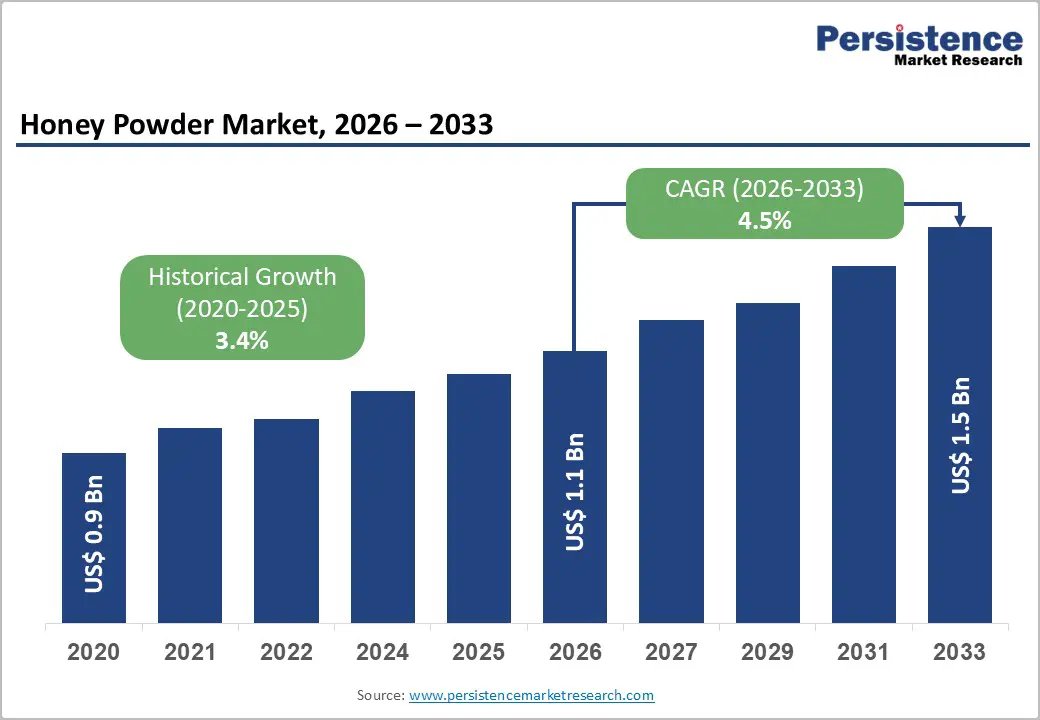
The global honey powder market size is likely to be valued at US$ 1.1 billion in 2026, and is projected to reach US$ 1.5 billion by 2033, growing at a CAGR of 4.5% during the forecast period 2026−2033. The market is entering a phase of steady expansion driven by a structural shift toward natural sweeteners, clean-label food formulations, and functional nutrition solutions. Rising urbanization and changing dietary patterns support demand for shelf-stable, easily transportable alternatives to liquid honey across food manufacturing and consumer packaged goods.
Increased clinical and nutritional awareness of honey-derived ingredients enhances adoption in nutraceutical and dietary supplement formulations, where powder formats enable precise dosing and improved stability. Technological integration into drying, encapsulation, and moisture-control processes improves product consistency and scalability, enabling broader commercial application across bakery, beverage, cosmetics, and wellness products. Expansion of organized retail and digital commerce infrastructure strengthens market access, particularly in developing economies with rising middle-income populations. Regulatory recognition of honey as a natural food ingredient by authorities such as the Food and Agriculture Organization (FAO) and Codex Alimentarius Commission supports standardization and cross-border trade.
Key Industry Highlights
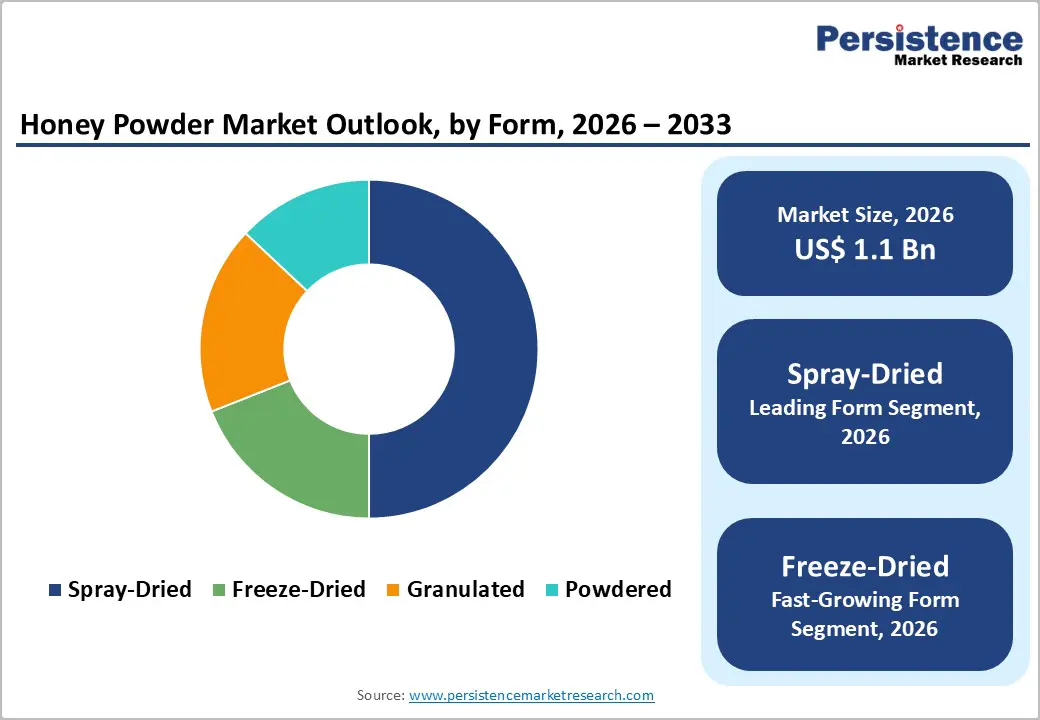
- Product Type Leadership: Spray-dried honey powder is expected to lead, accounting for approximately 50% of revenue in 2026, owing to its compatibility with large-scale food processing and cost efficiency.
- Fastest-growing Product Type: Freeze-dried honey powder is expected to grow the fastest between 2026 and 2033, driven by rising demand for premium, minimally processed, nutrient-retentive ingredients.
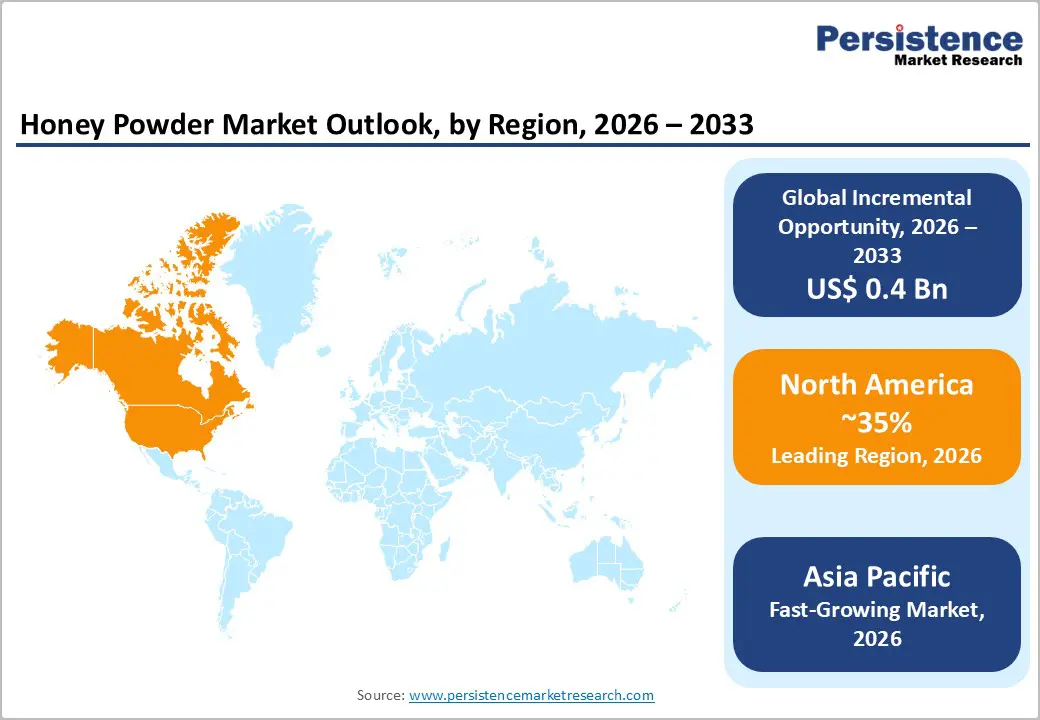
- Regional Dominance: North America is expected to account for roughly 35% of the market in 2026, supported by advanced processing and extensive distribution networks.
- Fastest-growing Market: Asia Pacific is projected to be the fastest-growing market through 2033, driven by the rising adoption of honey powder in clean-label, functional foods, beverages, and nutraceutical applications.
- June 2025: Former footballer David Beckham unveiled BeeUp, a new kids’ snack brand focused on nutrient-rich options such as honey-sweetened granola bites, with an emphasis on wholesome ingredients and fun branding to appeal to families.
| Key Insights | Details |
|---|---|
| Honey Powder Market Size (2026E) | US$ 1.1 Bn |
| Market Value Forecast (2033F) | US$ 1.5 Bn |
| Projected Growth (CAGR 2026 to 2033) | 4.5% |
| Historical Market Growth (CAGR 2020 to 2025) | 3.4% |
Market Factors – Growth, Barriers, and Opportunity Analysis
Increasing Consumer Preference for Natural and Low-Calorie Sweeteners
Rising preference for natural and low-calorie sweeteners reflects a structural change in consumer decision-making shaped by health awareness and long-term risk perception. Refined sugar intake is widely associated with metabolic imbalance, weight management challenges, and fluctuating energy levels, which has encouraged consumers to reassess sweetening choices in daily diets. Natural alternatives aligned with minimal processing resonate with clean-label expectations and support confidence in food quality. Guidance from the World Health Organization states that free sugars should account for less than 10% of total daily energy intake to reduce the risk of obesity and non-communicable diseases, thereby reinforcing consumer motivation to reduce conventional sugar consumption. This guidance has gained broad visibility through public health communication, strengthening the credibility of low-calorie and naturally derived sweetening options in consumer perception.
Commercial adoption accelerates as food and beverage manufacturers align portfolios with evolving demand patterns. Natural low-calorie sweeteners support reformulation strategies that preserve sensory appeal while enabling calorie-reduction claims suited to wellness-focused positioning. These attributes enhance product acceptance across packaged foods, beverages, and nutritional formulations where the balance between taste and health value influences repeat purchases. Retail channels benefit from higher shelf traction of products perceived as better-for-you, while brands leverage ingredient transparency to reinforce trust and brand equity. This demand shift supports premiumization opportunities, improves alignment with regulatory nutrition guidance, and enables access to health-conscious consumer segments.
Competition from Synthetic and Alternative Natural Substitutes
The presence of synthetic sweeteners and natural alternatives constrains demand due to structural cost and consistency advantages. Industrial buyers prioritize price stability, uniform sweetness, and predictable functional performance across batches. Engineered substitutes provide standardized flavor intensity, a long shelf life, and simplified storage, without sensitivity to climatic variation or raw material volatility. Procurement teams favor ingredients that integrate seamlessly into large-scale processing lines, support precise formulation control, and reduce wastage risk. These attributes align closely with margin protection goals in the production of packaged food, beverages, and nutraceuticals. As formulation science advances, substitutes increasingly replicate sensory profiles while maintaining lower unit costs, reinforcing purchasing shifts toward scalable sweetening systems.
Brand positioning and regulatory alignment further strengthen the adoption of substitutes. Clean-label strategies often rely on well-recognized plant-derived sweeteners or calibrated blends that support sugar reduction targets without introducing supply uncertainty. Synthetic options benefit from extensive technical documentation, stable regulatory acceptance, and wide availability through global distributors. These factors shorten qualification timelines and lower compliance management effort for manufacturers. Marketing strategies emphasize calorie reduction, controlled glycemic response, and functional versatility, which resonates with health-oriented product portfolios. In contrast, naturally derived dehydrated sweeteners face challenges related to source variability, moisture sensitivity, and premium pricing structures.
Technological Convergence in Beauty and Personal Care Formulations
The increasing alignment of food science, cosmetic chemistry, and biotechnology elevates natural functional ingredients into advanced formulation platforms. Powdered honey benefits from modern dehydration, encapsulation, and microgranulation technologies that preserve bioactive compounds while delivering formulation stability. These processing capabilities support integration into creams, serums, masks, and solid cosmetics without viscosity imbalance or microbial exposure. Clean-label positioning, traceability expectations, and a preference for multifunctional ingredients increase interest among premium and dermocosmetic brands. Formulators recognize its humectant efficacy, antioxidant properties, and skin-comfort properties, which align with efficacy-driven product development strategies. Technological convergence enables uniform particle size, controlled solubility, and extended shelf stability, supporting scalable production across mass and prestige portfolios.
Innovation in delivery systems within personal care supports wider adoption across hybrid beauty formats, including waterless products, active-infused powders, and solid bars. Research and development teams prioritize ingredients compatible with automation, precision dosing, and sustainable manufacturing workflows. This ingredient aligns with these requirements through low moisture content, reduced logistics burden, and compatibility with high-speed blending systems. Digital formulation platforms and data-based ingredient validation accelerate adoption by demonstrating performance parity with synthetic humectants under standardized testing protocols. Regulatory familiarity and established consumer trust linked to natural sweeteners reinforce brand confidence across regions.
Category-wise Analysis
Form Insights
Spray-dried formats are likely to dominate with approximately 50% of the honey powder market revenue share in 2026, due to compatibility with large-scale food processing, cost efficiency, and consistent quality performance. This format aligns well with industrial production requirements where volume consistency, throughput reliability, and standardized input materials remain critical. Spray-dried formats provide a balance of scalability and functional stability, enabling predictable performance across diverse formulations. Food and beverage manufacturers show strong preference for this form in bakery, beverage, and confectionery applications, supported by uniform particle size, controlled moisture levels, and efficient dispersion. Existing processing infrastructure across global manufacturing hubs accelerates adoption. Regulatory familiarity and broad supplier networks strengthen commercial confidence.
Freeze-dried honey powder is expected to witness the fastest growth between 2026 and 2033, as demand increases for premium, minimally processed, and nutrient-retentive ingredients. This processing method preserves sensitive enzymes, volatile flavor compounds, and bioactive compounds, thereby supporting high-value product positioning. Nutraceutical, dietary supplement, and specialty food formulators favor this format for applications requiring functional integrity and clean-label differentiation. Higher unit pricing supports margin-focused strategies rather than volume-driven distribution models. Growth in clinical nutrition, personalized wellness, and functional supplementation expands addressable demand.
Source Insights
Conventional honey powder is projected to lead, with a forecasted revenue share of nearly 65% in 2026, owing to its affordability, broader availability, and established supply chains that support large-scale industrial use. Its cost-effectiveness appeals to food manufacturers requiring a consistent ingredient supply for bakery, confectionery, and beverage applications. Consumer trust is reinforced by familiarity and reliable performance across processed foods, which supports repeat purchase behavior. Retail penetration remains strong across supermarkets and traditional outlets, providing easy accessibility. Preventive healthcare applications favor this form as a natural, economical alternative for functional nutrition. Strong logistics networks, widespread supplier presence, and stable pricing further consolidate market dominance for conventional formats.
Organic honey powder is anticipated to be the fastest-growing segment between 2026 and 2033, driven by heightened consumer trust in certified pesticide-free sourcing and alignment with wellness trends. Consumers increasingly associate organic certification with safety, purity, and superior nutritional value, enhancing brand appeal. Cultural acceptance increases among health-conscious demographics, supported by greater availability in specialty stores, organic marketplaces, and wellness-focused outlets. Preventive healthcare adoption expands as digital commerce platforms facilitate direct access to premium products, enabling personalized consumption. Growing emphasis on sustainable sourcing, eco-conscious production, and ethical supply chains strengthens confidence in organic formats and drives accelerated market expansion.
Application Insights
Food & beverages are projected to be the leading segment, accounting for an estimated 65% of the honey powder market share in 2026, supported by extensive use of the ingredient in bakery, cereal, snack, and beverage mixes. Honey powder provides industrial food manufacturers with consistent sweetness, flavor stability, and moisture control, ensuring uniform product quality across high-volume production. Its functional versatility allows seamless incorporation into reduced-sugar formulations, supporting health-oriented product strategies without compromising taste. Ease of handling, blending, and storage enhances operational efficiency, while compatibility with automated processing lines reinforces adoption. Strong supply chains, reliable regulatory compliance, and widespread commercial familiarity consolidate its leadership position across regional and global food markets.
Nutraceuticals & dietary supplements are expected to be the fastest-growing segment between 2026 and 2033, driven by the expansion of functional nutrition and the need for ingredient standardization. Honey powder delivers standardized bioactive compounds that support formulation consistency in immune, energy, and wellness-focused products. Clinical validation of honey-based ingredients strengthens trust among manufacturers and consumers, supporting premium positioning. Digital retail platforms expand market access, enabling direct-to-consumer distribution for specialty and personalized supplements. The powdered format enables precise dosing, efficient packaging, and scalable production, thereby reducing operational costs. Rising consumer preference for natural, preventive healthcare solutions is accelerating the integration of multivitamin blends, functional gummies, and powdered drink mixes globally.
Regional Insights
North America Honey Powder Market Trends
North America is forecasted to dominate the honey powder market with an estimated share exceeding 35% in 2026, reflecting strong industrial adoption, advanced processing infrastructure, and established distribution networks. High demand from bakery, confectionery, beverage, and functional food manufacturers drives consistent volume consumption, supported by technological capabilities in spray-drying, freeze-drying, and encapsulation. Regulatory frameworks ensure quality standards and food safety compliance, reducing market entry risks for large-scale industrial users. Consumer preference for natural sweeteners combined with widespread awareness of functional nutrition reinforces purchasing behavior. Large-scale retail penetration across supermarkets, e-commerce platforms, and specialty stores ensures broad accessibility, enhancing adoption across mainstream and premium product lines. Sophisticated supply chains for sourcing raw honey from domestic and international producers ensure consistent product quality, particle uniformity, and moisture control, supporting formulation reliability for both mass-market and value-added applications.
Another key factor contributing to the forecasted dominance is the integration of innovation-driven applications across the nutraceutical, dietary supplement, and clinical nutrition segments. Increasing investment in research and development accelerates adoption of honey powder in immune-boosting formulations, energy blends, and clean-label functional foods. Digital commerce platforms facilitate direct access to premium products, allowing faster product launches and consumer engagement. Industrial players leverage high-efficiency processing technologies that reduce unit costs and ensure scalability, thereby strengthening competitive positioning. Expansion in reduced-sugar and health-oriented product formulations further amplifies demand, as powdered honey supports sweetness modulation, solubility, and shelf-life stability. Strategic partnerships with ingredient suppliers and logistics providers enhance distribution efficiency, while ongoing product innovation in hybrid formats and carrier materials improves functionality.
Europe Honey Powder Market Trends
Europe is expected to remain a prominent market for honey powder through 2033, driven by its established food manufacturing infrastructure, stringent regulatory frameworks, and high consumer awareness of natural and functional ingredients. Industrial adoption spans bakery, confectionery, beverage, and snack applications, where honey powder is valued for stability, flavor consistency, and formulation flexibility. The surging demand for clean-label and reduced-sugar products drives the incorporation of natural ingredients in mainstream and premium formulations. Advanced processing facilities, including spray-drying and freeze-drying units, enable high-quality, standardized powders with controlled moisture content and particle uniformity. Well-developed supply chains ensure reliable sourcing of raw honey, maintaining consistent product quality across multinational and regional production networks. Increasing interest in sustainable sourcing and traceability further strengthens commercial confidence, allowing manufacturers to differentiate products through certified natural or organic attributes.
Growth in nutraceuticals, dietary supplements, and clinical nutrition applications is also significant, driven by consumer focus on preventive health, immunity support, and energy enhancement. Honey powder supports functional formulations by retaining bioactive compounds, providing long shelf stability, and being compatible with multi-ingredient blends. Digital and e-commerce platforms enhance access for specialty and premium products, enabling direct-to-consumer engagement and personalized offerings. Innovation in carrier materials, hybrid formulations, and microencapsulation improves flowability, solubility, and storage efficiency, supporting large-scale industrial applications. High investment in research and development ensures product efficacy, safety, and standardization, thereby fostering trust among manufacturers and end users.
Asia Pacific Honey Powder Market Trends
The Asia Pacific market is expected to be the fastest-growing during the 2026-2033 forecast period, driven by rising urbanization, increasing disposable income, and growing awareness of functional and natural ingredients. The rapid expansion of modern retail chains, e-commerce platforms, and cold-chain logistics enhances access to ingredients for industrial and direct-to-consumer applications. Food and beverage manufacturers increasingly incorporate honey powder into bakery, confectionery, snack, and beverage products to meet evolving consumer demand for natural sweeteners and reduced-sugar formulations. Investment in advanced processing infrastructure, including spray-drying, freeze-drying, and encapsulation facilities, ensures high-quality production at scale with consistent particle size, solubility, and moisture content. Rising interest in clean-label and nutrient-retentive ingredients further strengthens adoption among premium and health-focused brands. Government initiatives promoting food safety standards, certification, and support for small- and medium-scale manufacturers reduce entry barriers and reinforce confidence in commercial use.
Growth is also expected to be fueled by increasing demand from the nutraceutical, dietary supplement, and clinical nutrition sectors, as functional and preventive healthcare solutions gain prominence. Honey powder’s inclusion in immune-supporting, energy-enhancing, and wellness-focused formulations benefits from standardized bioactive profiles and extended shelf stability, supporting industrial scalability. Digitalization of supplement and specialty product retail enables wider distribution, facilitating direct consumer engagement and personalized product offerings. Manufacturers leverage innovations in carrier materials and hybrid formulations to improve flowability, storage efficiency, and solubility, reducing operational costs and expanding product applicability.
Competitive Landscape
The global honey powder market landscape is characterized by the presence of both multinational ingredient suppliers and smaller regional processors. Being moderately fragmented, only a handful of the top food and beverage companies, including ADM, Augason Farms, Lamex Food Group Limited, Judee's Gluten Free, and Whole Earth Brands, hold a significant combined share. These giants have been able to achieve this through strong brand recognition, established supply chains, and technological capabilities in processing and quality control. These companies leverage advanced spray-drying, freeze-drying, and encapsulation technologies to deliver consistent particle size, moisture content, and bioactive retention across food, beverage, and nutraceutical applications. Regional manufacturers focus on localized demand, supplying niche markets, specialty ingredients, and customized formulations that address specific consumer preferences, clean-label requirements, and cultural tastes.
Competitive positioning in the market centers on quality consistency, sourcing transparency, and application-specific customization. Multinational suppliers emphasize traceable raw honey sourcing, certifications, and process standardization to build credibility with industrial and retail customers. Regional players differentiate through flexibility, responsiveness, and specialized products that cater to small-scale or premium applications. Application-driven customization, such as reduced-sugar bakery formulations, immune-support supplements, and functional beverages, strengthens commercial relevance. Companies also invest in R&D to improve solubility, flowability, and shelf stability, enabling integration into hybrid product formats. Strategic collaborations with distributors, ingredient brokers, and e-commerce channels further enhance market reach and penetration.
Key Industry Developments
- In January 2026, BCLS Roaliv reformulated its Honey Luster Lip Serum and launched a limited-edition Loveworthy Holiday Fragrance, expanding its beauty portfolio with products designed to combine skincare benefits and seasonal appeal.
- In September 2025, Gisou launched a trio of pastry inspired honey infused lip oils, available globally in three seasonal shades with high shine hydration and culinary themed scent profiles, bridging beauty trends with artisanal collaboration.
- In August 2025, researchers from the University of Oxford developed a low-cost, sustainable honey bee dietary supplement using CRISPR-Cas9 gene editing, where modified Yarrowia lipolytica yeast produced key pollen sterols. The edited yeast biomass was cultured in bioreactors, harvested, and then dried into a powder to produce the sterol-enriched supplement.
Companies Covered in Honey Powder Market
- ADM
- Augason Farms.
- Lamex Food Group Limited
- Judee's Gluten Free
- Whole Earth Brands.
- iHerb, LLC.
- Nate's Honey
- Wuhu Deli Foods Co.,Ltd.
- Xi'an Herb Bio-Tech Co.Ltd
- Mevive International.
- Venkatesh Natural Extract Pvt. Ltd.
Frequently Asked Questions
The global honey powder market is projected to reach US$ 1.1 billion in 2026.
Rising demand for natural sweeteners, clean-label ingredients, and functional applications in food, beverages, and nutraceuticals are driving the market.
The market is poised to witness a CAGR of 4.5% from 2026 to 2033.
Integration of honey powder in functional foods, dietary supplements, clean-label products, and innovative personal care formulations represents key market opportunities.
Some of the key market players include ADM, Augason Farms, Lamex Food Group Limited, Judee's Gluten Free, Whole Earth Brands, and iHerb, LLC.


