




- Specialty & Fine Chemicals
- Hempcrete Market
Hempcrete Market Size, Share, and Growth Forecast, 2026 - 2033
Hempcrete Market by Binder Type (Lime-Based Binders, Cement-Based Binders, Others), Construction Method (Cast-In-Place Systems, Spray Applications, Others), End-user, and Regional Analysis for 2026 - 2033

Hempcrete Market Size and Trends Analysis
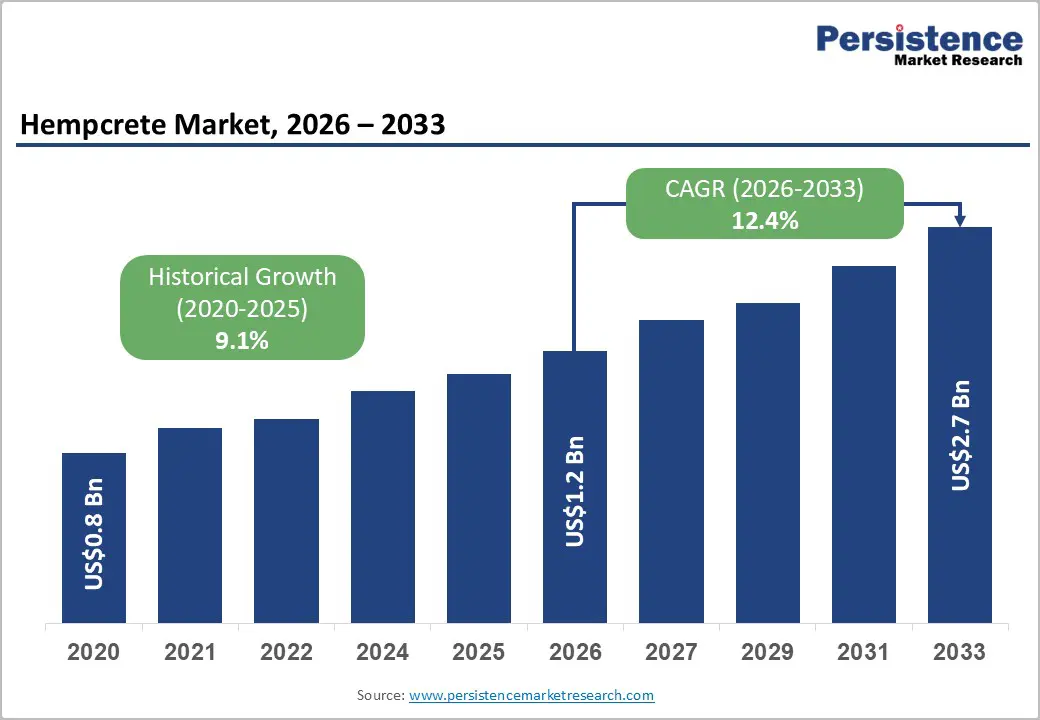
The global hempcrete market size is likely to be valued at US$ 1.2 billion in 2026 and is expected to reach US$ 2.7 billion by 2033, growing at a CAGR of 12.4% between 2026 and 2033, driven by increasing emphasis from developers and regulators on reducing carbon emissions and enhancing indoor environmental quality.
Key factors supporting market expansion include favorable policies that promote low-carbon construction, improved supply chain infrastructure for industrial hemp, and ongoing innovations in binder technologies and prefabricated building systems. While adoption is currently strongest in residential construction and renovation projects, greater standardization and proven performance are enabling broader uptake in commercial building applications.
Key Industry Highlights:
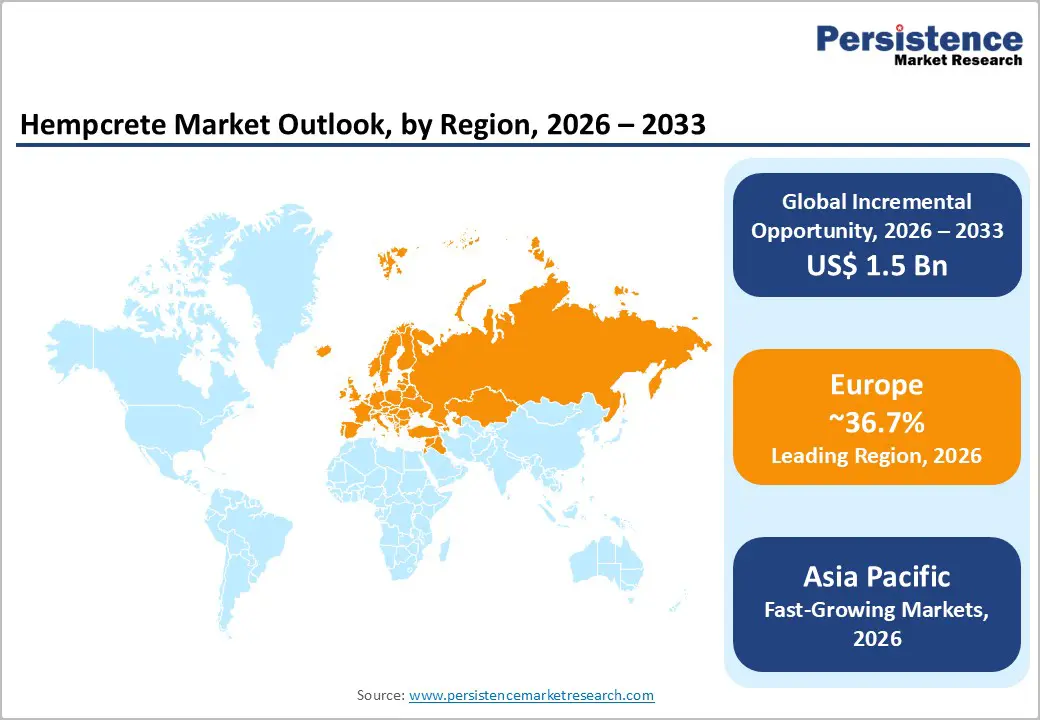
- Leading Region: Europe is projected to account for 36.7% of the market share, supported by established supply chains, favorable regulatory frameworks, and strong adoption in countries such as France, Belgium, and the U.K.
- Fastest-growing Region: Asia Pacific is the fastest-growing region, driven by rapid urbanization, increasing demand for sustainable construction materials, and expanding adoption in countries such as China, India, and Japan, with growth supported by prefabrication and affordable housing initiatives.
- Investment Plans: The market is witnessing rising investments in hemp processing infrastructure, manufacturing facilities, and product innovation, particularly in North America and Europe, where companies are expanding production capacity and developing advanced binder technologies to improve scalability and cost efficiency.
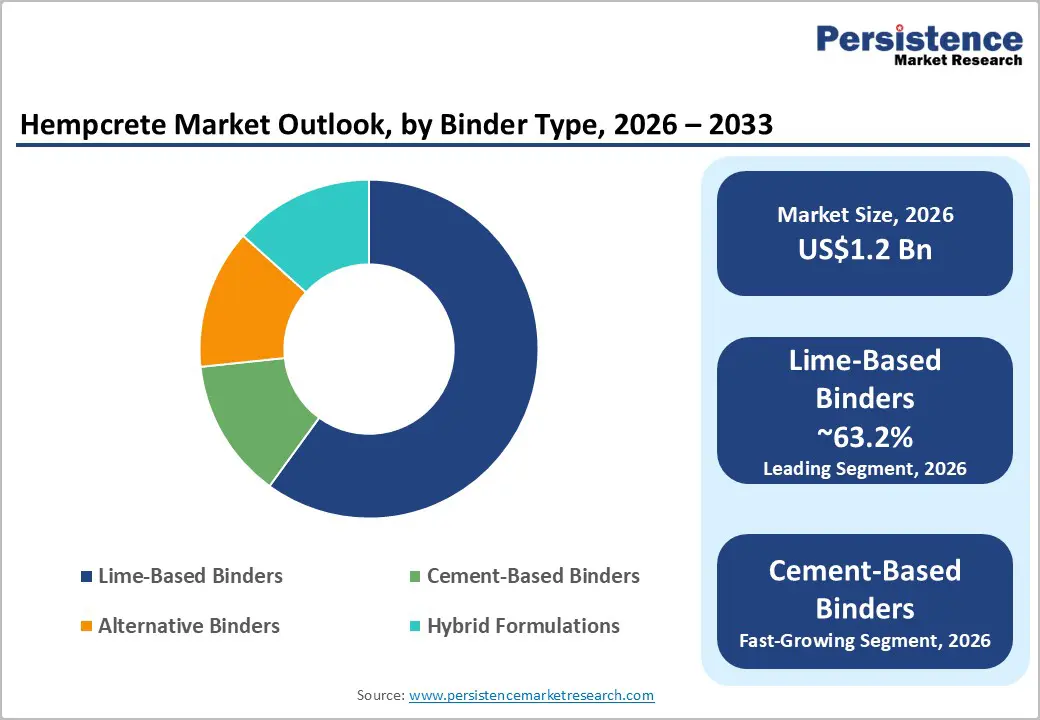
- Dominant Binder Type: Lime-based binders dominate the market, accounting for 63.2% of market share, driven by their compatibility with hemp fibers, low environmental impact, and widespread use in residential and heritage construction.
- Leading End-user: Residential construction is estimated to hold 60.9% of the market share, supported by growing demand for energy-efficient, non-toxic, and sustainable housing solutions.
| Key Insights | Details |
|---|---|
| Hempcrete Market Size (2026E) | US$1.2 Bn |
| Market Value Forecast (2033F) | US$2.7 Bn |
| Projected Growth (CAGR 2026 to 2033) | 12.4% |
| Historical Market Growth (CAGR 2020 to 2025) | 9.1% |
Market Factors - Growth, Barriers, and Opportunity Analysis
Growth Analysis - Regulatory and Policy Pressure to Reduce Embodied Carbon
Stringent building codes and net-zero targets are accelerating demand for low-carbon construction materials. Governments across developed regions are introducing green procurement policies and incentives that favor bio-based materials such as hempcrete. The material’s ability to sequester carbon during plant growth, combined with low embodied energy in production, offers measurable lifecycle emission reductions compared to conventional materials such as concrete and brick. These advantages allow developers to meet sustainability certification requirements and regulatory thresholds, making hempcrete a viable solution for environmentally compliant construction projects.
Advancements in Binder Chemistry and Material Performance
Technological improvements in binder formulations have significantly enhanced hempcrete’s structural and thermal performance. Traditional lime-based systems are now complemented by hydraulic lime blends, low-carbon cement alternatives, and alkali-activated binders that reduce curing time and improve durability. These innovations address earlier limitations such as slow drying and inconsistent strength. As a result, engineers and architects are increasingly specifying hempcrete in a wider range of applications, including prefabricated panels and semi-structural components, which expands its commercial viability.
Industrialization and Prefabrication of Hempcrete Systems
The shift from artisanal construction methods to industrial-scale production is transforming the hempcrete market. Factory-manufactured blocks, panels, and modular systems ensure consistent quality, reduce on-site labor requirements, and shorten construction timelines. Automated spray and robotic placement technologies further enhance efficiency and scalability. These developments are making hempcrete more attractive to large contractors and real estate developers, supporting broader adoption across residential and commercial construction.
Barrier Analysis - Limited Supply Chain Infrastructure for Hemp Processing
The availability of processed hemp hurd remains uneven across regions, creating supply constraints. In areas lacking local processing facilities, transportation and logistics costs significantly increase material prices. This supply chain fragmentation leads to inconsistent availability and delays in large-scale construction projects. In some cases, logistics can increase total material costs by a substantial margin, limiting competitiveness against conventional building materials.
Regulatory Barriers and Lack of Standardized Building Codes
Hempcrete is typically classified as a non-structural material, requiring integration with load-bearing frameworks such as timber or steel. The absence of harmonized standards across regions complicates regulatory approvals and slows adoption in commercial projects. Builders must often navigate complex permitting processes, increasing project timelines and costs. Limited awareness among regulators and construction professionals further contributes to slower market penetration.
Opportunity Analysis - Growth in Retrofit and Affordable Housing Projects
Hempcrete offers strong insulation, moisture regulation, and carbon reduction benefits, making it highly suitable for retrofit applications and affordable housing initiatives. Its vapor-permeable structure helps improve indoor air quality while reducing heating and cooling demand, which is critical in aging building stock across Europe and North America. Governments promoting energy-efficient renovations through incentive programs are increasing demand for materials that enhance building performance without adding significant structural load. Hempcrete can capture a growing share of retrofit spending, particularly in wall insulation, façade upgrades, and non-structural infill applications, where ease of installation and sustainability credentials are key decision factors. Its compatibility with traditional construction techniques also supports adoption in heritage building renovations.
Development of Low-Carbon Binder Technologies
Emerging binder technologies, including geopolymer and alkali-activated systems, present significant opportunities to further reduce the carbon footprint of hempcrete while improving performance characteristics. These advanced binders enhance compressive strength, durability, and curing speed, addressing some of the limitations of conventional lime-based systems. This makes hempcrete more suitable for prefabricated components and commercial construction, where consistency and faster project timelines are essential. Ongoing research collaborations between material scientists, universities, and manufacturers are accelerating innovation in hybrid binder formulations. As regulatory pressure on embodied carbon intensifies, these low-carbon binder solutions are expected to play a critical role in expanding hempcrete’s applicability across mainstream construction segments.
Expansion in Emerging Markets through Modular Construction
Rapid urbanization in Asia Pacific and other developing regions is generating strong demand for cost-effective and sustainable construction materials. Integrating hempcrete with modular and prefabricated construction systems enables faster project delivery, reduced labor dependency, and improved quality control. This approach is particularly relevant for large-scale residential housing, disaster-resilient structures, and government-backed affordable housing programs. Early investment in hemp processing infrastructure, localized manufacturing units, and supply chain development will provide companies with a competitive advantage in these high-growth markets. As awareness increases and regulatory frameworks evolve, hempcrete is expected to gain traction as a scalable solution for sustainable urban development.
Category-wise Analysis
Binder Type Insights
Lime-based binders are expected to lead the market, accounting for approximately 63.2% of the share in 2026, driven by their strong compatibility with hemp fibers and environmentally favorable characteristics. This dominance reflects their widespread use in traditional hemp-lime construction across regions such as Europe and North America. Lime binders provide excellent breathability, effective moisture regulation, and long-term durability, making them well-suited for residential construction, heritage restoration, and energy-efficient housing projects. For example, they are widely utilized in eco-housing developments in countries such as France and the U.K., where regulations encourage the use of natural building materials. Their low embodied carbon footprint and alignment with green building standards further support their leading position, with the segment expected to maintain its dominance throughout the forecast period.
Cement-based and blended low-carbon binders are experiencing the fastest growth due to enhanced mechanical performance and reduced curing times. These formulations enable faster construction cycles and improved structural integration, making them attractive for commercial and prefabricated applications. Innovations in hybrid systems, such as lime-cement blends and geopolymer-based binders, are improving compressive strength while maintaining relatively low environmental impact. For example, precast hempcrete panels using blended binders are being deployed in modular housing and office projects where speed and uniformity are critical. As construction timelines tighten and developers prioritize scalability, this segment is anticipated to gain a significant share of the market by 2033.
End-user Insights
Residential construction is expected to be the largest end-user segment, accounting for 60.9% of the market share in 2026, and is anticipated to maintain its dominance throughout the forecast period. Demand is driven by homeowners and developers seeking energy-efficient, non-toxic, and sustainable building materials. Hempcrete’s superior insulation, thermal mass, and moisture regulation properties make it ideal for single-family homes, eco-villages, and low-rise multi-family housing. For example, hempcrete has been widely adopted in green housing projects across France and Canada, particularly in passive house developments. Its growing use in renovation and retrofit projects further strengthens its position as the leading segment.
Commercial construction is expected to be the fastest-growing segment, driven by increasing corporate sustainability commitments and the adoption of green building certifications. Offices, retail developments, and hospitality projects are incorporating hempcrete to improve indoor air quality, energy efficiency, and overall environmental performance. For instance, boutique hotels and eco-friendly office spaces in Europe are using hempcrete as part of their sustainability branding and compliance strategies. As product standardization improves and performance data becomes more widely accepted, hempcrete is anticipated to gain traction in larger commercial developments, including mixed-use buildings and institutional projects.
Regional Insights
North America Hempcrete Market Trends - Policy-Driven Adoption and Supply Chain Expansion
North America is a rapidly growing market for hempcrete, driven by sustainability initiatives and increasing awareness of bio-based construction materials. The U.S. leads the region, supported by state-level incentives for green building and expanding industrial hemp cultivation following regulatory clarity under the 2018 Farm Bill. Investments in processing facilities and manufacturing plants are strengthening the supply chain and reducing material costs. For example, Hempitecture has expanded its manufacturing footprint for hemp-based insulation and building materials, improving domestic availability and lowering reliance on imports. Similarly, Americhanvre continues to execute residential and commercial hempcrete projects, supporting market awareness and contractor training.
Key growth drivers include strong demand for energy-efficient housing, government-backed funding for sustainable materials, and increasing private-sector investment in green construction. Regulatory frameworks are evolving, with hempcrete gaining recognition as a non-structural infill material in several jurisdictions. For instance, demonstration homes and eco-housing developments in states such as Colorado and California are showcasing hempcrete’s viability in mainstream construction. As supply chains mature and technical standards become more widely accepted, North America is expected to see accelerated adoption across both residential and small-scale commercial applications.
Europe Hempcrete Market Trends - Regulatory Leadership and Industrial-Scale Production
Europe is projected to lead the market with a 36.7% share in 2026, supported by long-established construction practices and highly favorable regulatory frameworks for bio-based materials. Countries such as France, Belgium, and the U.K. are at the forefront of adoption, with well-developed supply chains and advanced manufacturing capabilities. A key example is IsoHemp, which operates one of Europe’s largest industrial hempcrete block production facilities, enabling consistent product quality and large-scale project delivery. In France, companies such as Cavac Biomateriaux support the upstream supply of hemp hurd and bio-based construction inputs, strengthening regional integration.
The region benefits from robust green building standards and widespread adoption of certifications such as BREEAM, which incentivize low-carbon materials. Investments in production capacity, recycling initiatives, and binder innovation are accelerating commercialization. For example, IsoHemp’s introduction of recycling processes for hempcrete waste reflects a shift toward circular construction practices. These developments, combined with strong policy alignment under European climate targets, ensure that Europe will maintain its leadership position while expanding into commercial and institutional building segments.
Asia Pacific Hempcrete Market Trends - Urbanization-Led Growth and Prefabrication Integration
Asia Pacific is expected to be the fastest-growing region, driven by rapid urbanization and increasing demand for sustainable construction materials. Countries such as China, India, and Japan are actively exploring hempcrete for residential, commercial, and infrastructure applications. The region’s strong manufacturing base supports the development of prefabricated hempcrete systems, enabling cost-effective production at scale. In India, startups and research-backed firms such as Gohemp Agroventures are promoting hempcrete for eco-housing and rural construction, demonstrating its potential in affordable housing initiatives.
Government-led housing programs and sustainability goals are further driving adoption. In China, integration of prefabrication technologies with low-carbon materials is encouraging experimentation with hemp-based composites in modular construction. Meanwhile, Japan’s focus on high-performance, energy-efficient buildings is supporting niche adoption in premium residential projects. Although regulatory frameworks are still evolving, increasing collaboration between local governments, construction firms, and material innovators is accelerating pilot projects and commercialization. As investments in processing infrastructure and technical standardization continue, Asia Pacific is expected to emerge as a major growth engine for the global hempcrete market.
Competitive Landscape
The global hempcrete market is transitioning from a fragmented structure to a more consolidated one, with a mix of large manufacturers and smaller specialized firms. Leading companies focus on industrial production, binder innovation, and integrated supply chains. Market consolidation is driven by economies of scale, technological advancements, and increasing demand for standardized products. Key strategies include vertical integration, product standardization, and investment in research and development. Companies are focusing on improving material performance, expanding production capacity, and forming strategic partnerships to enhance market reach.
Key Industry Developments:
- In March 2025, Hempitecture launched a fire-resistant hempcrete material tested under ASTM E84 standards, aimed at enhancing building safety and expanding adoption in wildfire-prone regions, particularly across North America’s residential and commercial construction sectors.
Companies Covered in Hempcrete Market
- IsoHemp
- Hempitecture
- Cavac Biomateriaux
- American Lime Technology
- Gohemp Agroventures
- HempFlax Group
- JustBioFiber Structural Solutions
- UK Hempcrete
- Hemcrete Projects
- La Chanvrière
- Biohm
- Dun Agro Hemp Group
- Hemp Building Company
- EcoCocon
- Chanvribloc
- Hemp Block USA
Frequently Asked Questions
The global hempcrete market size is estimated to be US$ 1.2 billion in 2026.
The hempcrete market is projected to reach US$2.7 billion by 2033.
Key trends include the rising adoption of lime-based binders, growing use of prefabricated hempcrete systems, increasing integration of low-carbon and blended binder technologies, and expanding applications in green-certified residential and commercial construction.
The residential construction segment is the leading segment, accounting for 60.9% of the market share, driven by demand for eco-friendly and energy-efficient housing.
The hempcrete market is expected to grow at a CAGR of 12.4% from 2026 to 2033.
Major players include IsoHemp, Hempitecture, Cavac Biomateriaux, American Lime Technology, and Gohemp Agroventures.


