




- Technology
- Generative AI in Animation Market
Generative AI in Animation Market Size, Share, and Growth Forecast 2026 - 2033
Generative AI in Animation Market by Product Type (Transformers, GANs, VAEs, Others), by Component (Solutions, Services), by Application (Gaming, Television/OTT, Films, Other), by Regional Analysis, 2026 - 2033

Generative AI in Animation Market Size and Trends Analysis
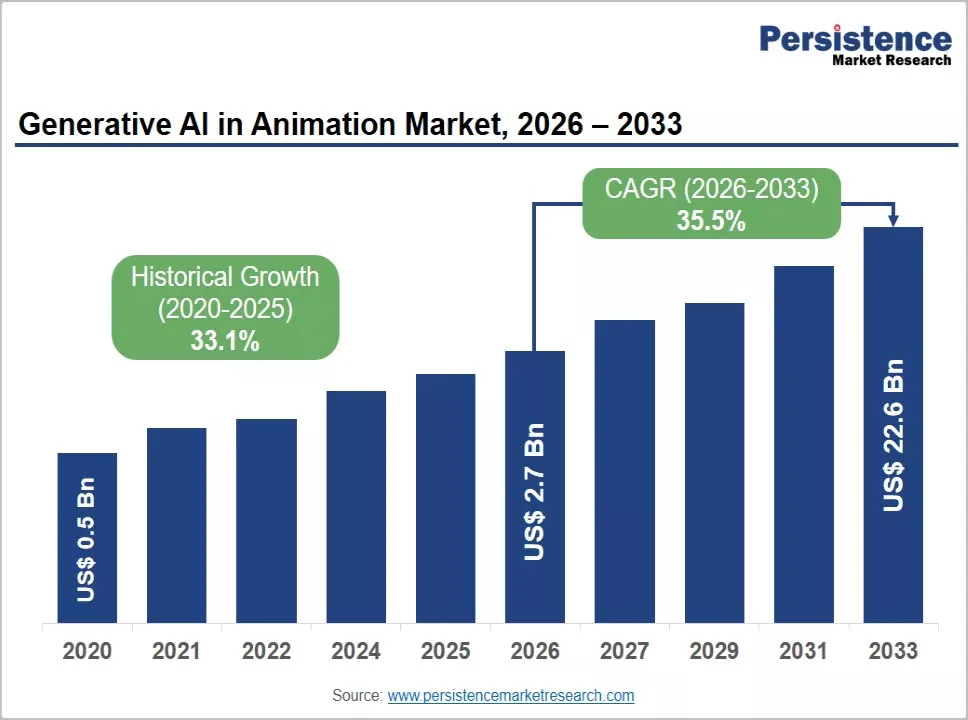
The global generative AI in animation market size is expected to be valued at US$2.70 billion in 2026 and is projected to reach US$22.64 billion by 2033, growing at a CAGR of 35.5% during the forecast period from 2026 to 2033, driven by the rapid integration of generative AI into animation production workflows. Animation studios are increasingly adopting transformer-based diffusion models, real-time character rigging systems, and AI-powered motion synthesis to reduce pre-production timelines and automate tasks such as keyframing and asset generation.
The market's growth reflects increasing demand for AI-enabled production capabilities across the animation industry. Major studios are exploring AI-assisted rendering, background generation, and other production applications, demonstrating the potential for generative AI to support large-scale workflows. In addition, declining inference costs, rising OTT content production, and growing adoption of AI-native creative tools across the gaming and film industries are expected to support market expansion through 2033.
Key Industry Highlights:
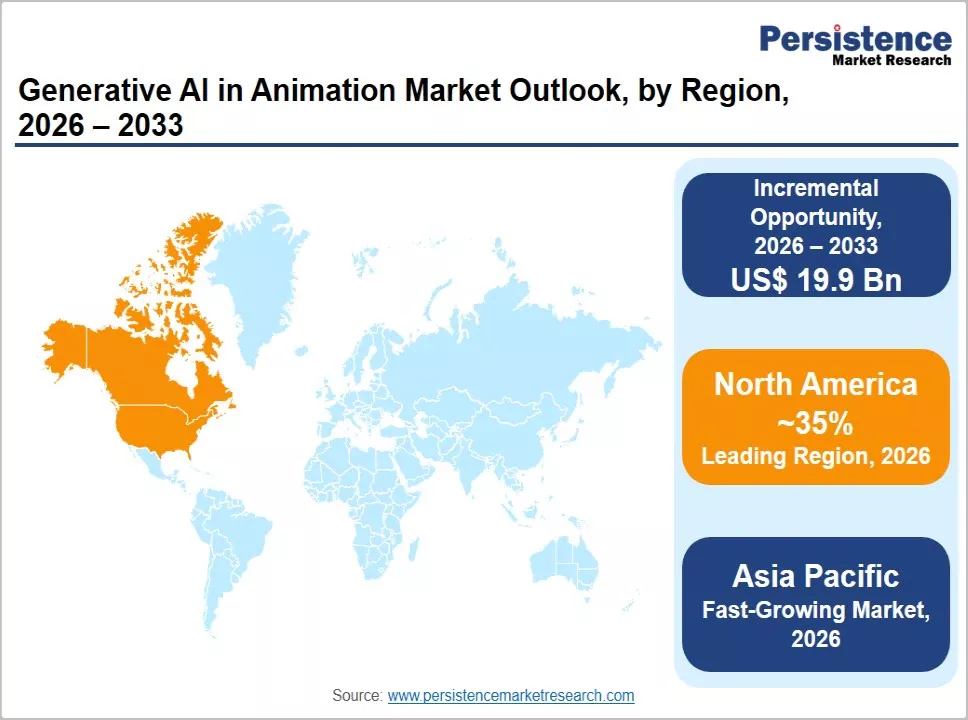
- Regional Leader: North America is anticipated to command 35.0% of the global generative AI in animation market in 2026, anchored by Hollywood's concentration of major IP owners and the proximity of leading AI infrastructure vendors, including NVIDIA, Microsoft, and Alphabet. This ecosystem is poised to reinforce tool development and enterprise adoption at a scale that remains difficult for other regions to replicate.
- Fastest-Growing Region: Asia Pacific is set to record a regional CAGR of 38% during the forecast period, creating a significant geographic opportunity for vendors. Japan's animator labor shortage, China's content mandate policies, and India's AVGC-XR national mission are anticipated to create a multi-jurisdictional policy tailwind, supporting AI adoption across all three economies.
- Leading Segment: Transformer-based architectures are estimated to account for 50.0% of product type share in 2026, supported by their ability to maintain temporal coherence across animation frames and enable multimodal conditioning. These capabilities are poised to sustain their adoption in production environments requiring scene-level consistency across hundreds of sequential frames.
- Fastest-Growing Segment: Television and OTT is poised to emerge as the fastest-growing application segment during the forecast period, supported by the high-volume production requirements of streaming animation. A single animated series is anticipated to require more than 50,000 individual asset renders per season, making AI-assisted production increasingly important for studios operating within platform commissioning budgets.
- Key Market Opportunity: At a CAGR of 35.5%, the generative AI in animation market is expanding at nearly double the rate of the broader enterprise AI software sector, reflecting a specific inflection in animation production economics where AI-driven automation directly addresses the cost and throughput constraints that studios face as OTT platform demand for animated content accelerates globally.
Market Dynamics
Drivers - Surging OTT Content Demand Compressing Production Economics
Streaming platforms are commissioning animated content at a pace that traditional production pipelines cannot sustain. Netflix disclosed in its 2023 annual report that animated originals accounted for a disproportionate share of total viewing hours relative to their production volume, creating acute pressure to accelerate output without proportional cost increases. Generative AI directly addresses this constraint: AI-driven background generation, in-betweening automation, and style-transfer tools can reduce asset production time by an estimated 40–60% per episode, according to industry benchmarks cited by the Visual Effects Society (VES). Studios serving OTT platforms are therefore adopting generative AI not as a creative experiment but as an operational imperative.
NVIDIA's Hardware Ecosystem Lowering the Adoption Threshold
The cost and accessibility of generative AI inference have changed materially since NVIDIA Corporation launched its H100 Tensor Core GPU and expanded NVIDIA Omniverse for real-time 3D animation collaboration in 2023. Cloud-based rendering through NVIDIA Omniverse Cloud allows independent animation studios and boutique visual effects houses to access GPU-accelerated generative AI workflows without capital expenditure on on-premises infrastructure. This democratization is pulling mid-market studios, previously priced out of AI adoption, into the generative AI in animation industry, broadening the addressable buyer base significantly.
Restraints - Intellectual Property Ambiguity Creating Enterprise Risk Aversion
The generative AI in the animation sector faces a material legal overhang. Ongoing litigation, including the class-action filed against Stability AI and Midjourney in the U.S. District Court for the Northern District of California in 2023, has not yet produced settled precedent on whether AI-generated animation assets trained on copyrighted material infringe existing IP. Large studios with significant IP estates, such as Universal Pictures and major television broadcasters, are delaying full-scale deployment pending clearer regulatory guidance from bodies including the U.S. Copyright Office, which issued a policy statement on AI-generated works in February 2023 but stopped short of comprehensive statutory clarification.
Workforce Integration Friction Slowing Deployment Velocity
Animation professionals are resisting tool adoption at a pace that outstrips management expectations. The Animation Guild (IATSE Local 839), which represents animators and visual development artists in Hollywood, negotiated AI-specific protections in its 2023 contract covering disclosure requirements when AI tools are used in productions. This institutionalized caution, legitimate from a labor perspective, introduces procedural friction into studio workflows, slowing the speed at which generative AI in animation solutions move from pilot to full production deployment.
Opportunities - Localized Content Production for Emerging Language Markets
Generative AI is opening a commercially significant new frontier: low-cost, high-volume animated content production in languages and cultural contexts previously underserved by major studios. Amazon Web Services Inc. has positioned its AI translation and voice synthesis tools alongside generative animation capabilities, enabling regional broadcasters across Southeast Asia, Sub-Saharan Africa, and Latin America to produce locally relevant animated programming at a fraction of historical costs. The United Nations Educational, Scientific and Cultural Organization (UNESCO) documented in its 2023 cultural diversity report that fewer than 10% of globally distributed animated content originates outside North America, Europe, and Japan, a gap that generative AI tools are now structurally positioned to close.
Independent Game Studios Adopting Procedural Animation Generation
The independent gaming segment represents an underappreciated growth vector for the generative AI in animation landscape. Historically, AAA-quality character animation and cinematic cutscenes required development budgets inaccessible to independent studios. Runway AI's Gen-2 video generation model, released in 2023 and refined through 2024, demonstrated that photorealistic motion synthesis is now achievable outside enterprise-tier budgets. The Entertainment Software Association (ESA) reports that independent studios represent over 35% of new game releases on major platforms. As procedural animation generation matures, this cohort represents a high-velocity, high-volume customer segment that incumbent enterprise software vendors have largely failed to serve.
Category-wise Insights
Product Type Analysis
Transformers are expected to account for 50.0% of the global generative AI in animation market in 2026, equivalent to US$1.35 billion. Transformer-based architectures dominate because they handle the sequential, context-dependent nature of animation, temporal coherence across frames, character consistency through scene transitions, and multi-modal conditioning on dialogue and motion scripts more effectively than earlier generative approaches. Feature film studios deploy transformer-based diffusion models for storyboard-to-animatic conversion, while television production houses use them for automated lip-sync generation against dubbed audio tracks. Adobe Inc.'s Firefly generative model, built on transformer architecture, exemplifies enterprise-grade adoption, with major animation studios integrating Firefly APIs directly into Adobe After Effects pipelines.
Generative Adversarial Networks (GANs) represent the fastest-growing product type segment. Style-transfer and real-time texture synthesis, core GAN applications, are gaining traction in live-service gaming environments, where dynamic visual asset generation must occur at render time. NVIDIA's StyleGAN3, updated in 2023 to address aliasing artifacts in motion sequences, has expanded GAN adoption specifically for character skin and environment generation in interactive animation contexts.
Component Analysis
Solutions are likely to account for 75.0% of the global generative AI in animation market in 2026, equivalent to US$2.02 billion. Buyers overwhelmingly prefer integrated software solutions over standalone services because animation production demands workflow continuity; AI capabilities embedded within existing digital content creation (DCC) tools such as Autodesk Maya and Adobe Substance 3D eliminate the file format conversion and pipeline interruption that service-based models introduce. Enterprise buyers at studios including Pixar Animation Studios (a division of The Walt Disney Company) and Sony Pictures Imageworks procure solutions with direct API integration into their proprietary rendering environments, prioritizing interoperability over bespoke service engagements.
Services, encompassing managed AI animation production, model fine-tuning, and prompt engineering consultancy, constitute the fastest-growing component. The catalyst is a skills gap: most animation studios lack internal machine learning expertise to configure and optimize foundation models. Hugging Face reported in its 2024 platform data that enterprise API usage for animation-specific model fine-tuning grew at over 200% year-on-year, reflecting studios outsourcing model customization to specialist services providers.
Application Analysis
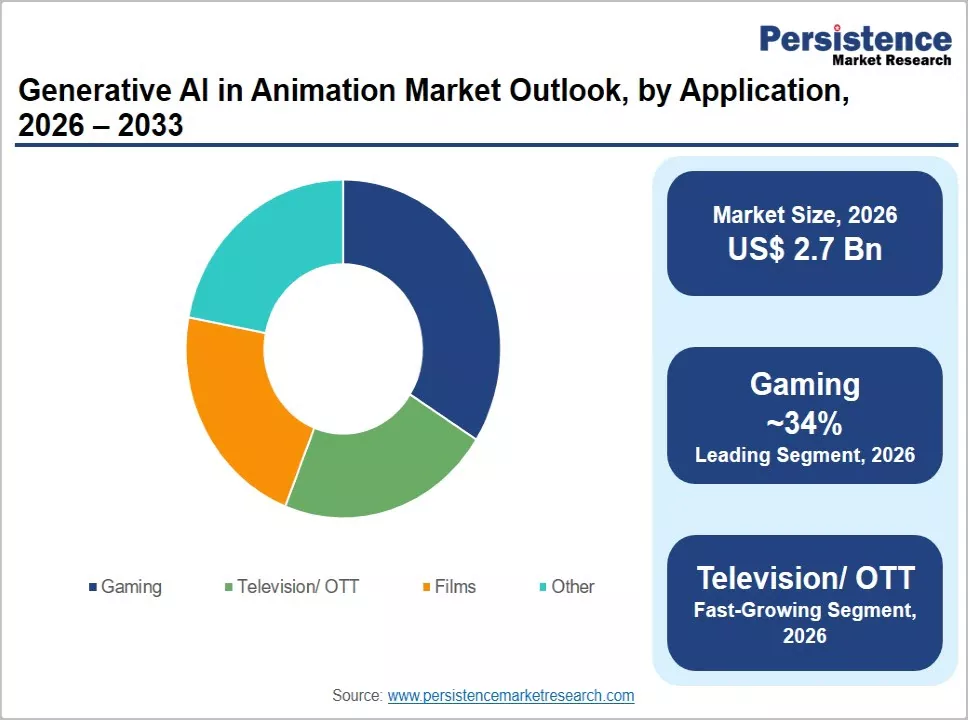
The gaming segment is expected to account for 34.0% of the global generative AI in animation market in 2026, equivalent to US$0.92 billion. Gaming leads as real-time animation generation is foundational to interactive entertainment in a way it is not for linear media; non-player character (NPC) behavioral animation, procedural environment generation, and dynamic facial expression synthesis must execute within strict frame-rate budgets, creating strong pull for inference-optimized generative AI solutions. Major game publishers, including Electronic Arts Inc., have deployed generative AI for NPC dialogue animation, and Ubisoft demonstrated its Ghostwriter AI tool for generating NPC barks and associated facial animation, illustrating the transition from experimental to production-grade deployment.
Television/OTT is likely to be the fastest-growing application segment. The catalyst is the volume economics of episodic content: a single animated series season may require tens of thousands of individual asset renders, making AI-assisted production economically transformative. Netflix's partnership with Japanese studio Production I.G, experimenting with AI-generated background art for select anime titles from 2023, exemplifies how platform commissioning practices are actively pulling generative AI adoption into broadcast and streaming pipelines ahead of theatrical timelines.
Regional Insights
North America Generative AI in Animation Market
North America is predicted to account for 35.0% of the global generative AI in animation market in 2026, representing US$0.94 billion. The region's leadership reflects the concentration of major IP holders, enterprise software vendors, and GPU infrastructure in the United States. The U.S. National AI Initiative Act of 2020 created sustained federal investment in AI research commercialization, and Hollywood's competitive pressure to reduce production costs has accelerated studio adoption faster than any other geography. North America will maintain its dominant share through the forecast period, anchored by the density of enterprise buyers and venture capital flowing into animation-specific AI startups.
U.S. Generative AI in Animation Market
The U.S. generative AI in animation market is likely to represent 77.0% of the North America regional market in 2026, equivalent to US$0.73 billion. Los Angeles and San Francisco serve as the dual epicenters of demand, with entertainment studios driving application pull, technology vendors driving tooling supply. Continued investment by Microsoft Corporation in OpenAI's Sora video generation model signals further capability expansion that will deepen enterprise penetration through 2033.
Europe Generative AI in Animation Market
Europe is expected to account for 22.0% of the global generative AI in animation market in 2026, representing US$0.59 billion. The European generative AI in animation landscape is shaped by the European Union's AI Act, provisionally agreed in December 2023, which introduces transparency obligations for AI-generated audiovisual content. Rather than suppressing adoption, these requirements are accelerating enterprise procurement of compliant, auditable generative AI solutions, creating a regulatory-driven upgrade cycle among broadcasters operating under European Audiovisual Media Services Directive (AVMSD) obligations. Investment in animation AI infrastructure is concentrated in France, Germany, and the U.K.
Germany Generative AI in Animation Market
The Germany generative AI in animation market is anticipated to account for 20.0% of the Europe regional market in 2026, equivalent to US$0.12 billion. Germany's demand is driven by its advertising and commercial animation sector, where brands are deploying generative AI for rapid iteration of animated campaign assets. The German Federal Government's €1 billion AI investment framework announced in 2023 is channeling funding toward creative AI applications, supporting market expansion through the forecast period.
U.K. Generative AI in Animation Market
The U.K. generative AI in animation market is predicted to account for 19.0% of the Europe regional market in 2026, equivalent to US$0.11 billion. The U.K.'s established animation sector, anchored by studios including Aardman Animations and a strong VFX cluster around Soho, is adopting generative AI tools to compete for international co-production commissions. The U.K. Creative Industries Council's 2024 AI roadmap explicitly identified generative animation as a priority capability for maintaining the country's global content export position.
France Generative AI in Animation Market
The France generative AI in animation market is likely to represent 16.0% of the Europe regional market in 2026, equivalent to US$0.10 billion. France's globally recognized animation industry, home to studios including Ubisoft Motion Pictures and major co-producers of European animated television, is integrating generative AI into development pipelines supported by Centre National du Cinéma et de l'image animée (CNC) digital transition funding. The CNC's 2024 strategic plan explicitly allocated grants for AI-assisted animation production modernization.
Asia Pacific Generative AI in Animation Market
Asia Pacific is expected to account for 29.0% of the global generative AI in animation market in 2026, representing US$0.78 billion, and advances at the fastest regional CAGR of 38% through 2033. The region's acceleration is driven by China's domestic content mandate, Japan's world-leading anime industry pursuing efficiency through AI, and India's rapidly scaling animation outsourcing sector. Government AI investment programs across the region, particularly China's New Generation Artificial Intelligence Development Plan, are compressing the technology adoption cycle compared with historical patterns.
China Generative AI in Animation Market
The China generative AI in animation market is likely to represent 38.0% of the Asia Pacific regional market in 2026, equivalent to US$0.30 billion. State mandates for domestic content production across streaming platforms regulated by the National Radio and Television Administration (NRTA) are creating structural demand for AI-assisted animation that can scale output without proportional headcount growth. Baidu Inc.'s ERNIE generative model has been adapted for animation asset generation by several Chinese studios, signaling domestic capability development independent of Western tooling.
Japan Generative AI in Animation Market
The Japan generative AI in animation market is expected to represent 24.0% of the Asia Pacific regional market in 2026, equivalent to US$0.19 billion. Japan's anime production industry, which the Association of Japanese Animations (AJA) valued at over ¥2.9 trillion in 2022, faces a structural labor shortage of trained animators, making AI-assisted in-betweening and background art generation a near-term operational necessity. Sony Group Corporation's investment in AI animation tools for anime production pipelines positions Japan for accelerated adoption through 2033.
India Generative AI in Animation Market
The India generative AI in animation market is set to represent 11.0% of the Asia Pacific regional market in 2026, equivalent to US$0.09 billion. India's animation and VFX outsourcing industry, supported by the Animation, Visual Effects, Gaming, Comics and Extended Reality (AVGC-XR) national mission launched by the Ministry of Information and Broadcasting in 2023, is adopting generative AI tools to move up the value chain from execution-only outsourcing toward creative production services. Strong English-language capability and competitive labor costs position India as a high-growth generative AI in animation hub through 2030.
Competitive Landscape
The global generative AI in animation market is competitively bifurcated between large-platform incumbents and specialist AI-native challengers. Adobe Inc., Autodesk Inc., NVIDIA Corporation, Alphabet Inc., and Microsoft Corporation control the infrastructure and enterprise software layer, competing on ecosystem integration, API breadth, and enterprise security compliance. Against them, Runway AI, Stability AI, Synthesia, and Luma AI compete on model quality, output fidelity, and speed of capability iteration.
The decisive competitive variable is not model architecture alone; it is pipeline integration depth. Studios evaluating generative AI solutions prioritize tools that embed within existing DCC environments without disrupting established rendering and compositing workflows. Winning vendors are those that can demonstrate production-grade output quality within a studio's existing technical stack, not standalone excellence on benchmark tasks.
Key Industry Developments:
- In September 2026, Autodesk showcased AI-powered capabilities in Flow Studio, using generative AI to accelerate character creation, scene assembly, animation, and production workflows while preserving editable assets and direct creative control for animation and VFX professionals.
- In May 2026, Amazon MGM Studios and AWS launched the GenAI Creators’ Fund, supporting three animation projects with AI tools and funding, while Project Nara enables collaborative generative-AI workflows for video creation, editing, and production management.
- In March 2026, Google’s AI Futures Fund invested US$1 million in Animaj, providing early access to Veo, Gemini, and Imagen models and DeepMind support to accelerate AI-powered animation and children’s content production for YouTube.
Companies Covered in Generative AI in Animation Market
- Adobe Inc.
- Autodesk Inc.
- NVIDIA Corporation
- Alphabet Inc.
- Microsoft Corporation
- Meta Platforms Inc.
- Amazon Web Services Inc.
- The Walt Disney Company
- DreamWorks Animation
- Kartoon Studios, Inc.
- Hugging Face
- Runway AI
- Stability AI
- Synthesia
- Luma AI
Frequently Asked Questions
The global generative AI in animation market is valued at US$2.70 billion in 2026 and is projected to reach US$22.64 billion by 2033, expanding at a CAGR of 35.5%. The primary growth catalyst is rising demand from OTT platforms for high-volume animated content production, driving studios to adopt AI tools that compress asset generation timelines and reduce per-episode costs.
Two primary forces are driving generative AI in the animation market growth: the surge in streaming platform content commissioning requiring faster, lower-cost animated production cycles, and the democratization of GPU-accelerated AI infrastructure through cloud platforms. The U.S. National AI Initiative Act has sustained federal investment in AI commercialization, accelerating enterprise-grade tool deployment across the animation industry's production pipeline.
Transformer-based architectures hold the largest product type share at 50.0% of the generative AI in animation market, owing to their superior temporal coherence across sequential animation frames and multi-modal conditioning capabilities. This dominance is structurally stable through the forecast period, as feature film and episodic television production demands scene-level consistency that alternative generative architectures have not reliably delivered in commercial deployments.
North America dominates the generative AI in the animation market with 35.0% of global share in 2026, driven by the geographic concentration of major entertainment IP holders in Los Angeles and leading AI infrastructure vendors, including NVIDIA Corporation, Microsoft Corporation, and Alphabet Inc., in San Francisco. The U.S. National AI Initiative Act provides sustained federal investment that reinforces North America's structural lead through the forecast period.
The generative AI in animation market's most material opportunity lies in localized content production for emerging language markets, regions where UNESCO data shows fewer than 10% of distributed animated content originates locally. Independent animation studios and regional broadcasters across Southeast Asia, Sub-Saharan Africa, and Latin America are best positioned to capture this opportunity, enabled by cloud-based generative AI tools that eliminate the capital expenditure barriers that previously confined high-quality animation to major studio budgets.
The generative AI in animation market is competitively bifurcated between large platform incumbents, Adobe Inc., NVIDIA Corporation, Autodesk Inc., Microsoft Corporation, and Alphabet Inc., and AI-native challengers including Runway AI, Stability AI, and Luma AI. Competition is intense, with primary differentiation determined by depth of integration into professional digital content creation environments, output fidelity at production scale, and enterprise compliance with emerging regulatory frameworks such as the EU AI Act.


