




- Processed Food
- Frozen Custard Market
Frozen Custard Market Size, Share, and Growth Forecast, 2026 - 2033
Frozen Custard Market by Product Type (Dairy-based, Plant-based/Vegan), Flavor (Classic, Innovative/Artisanal), Distribution Channel (Supermarkets/Hypermarkets, Specialty Shops), End User, and Regional Analysis for 2026 - 2033

Frozen Custard Market Size and Trends Analysis
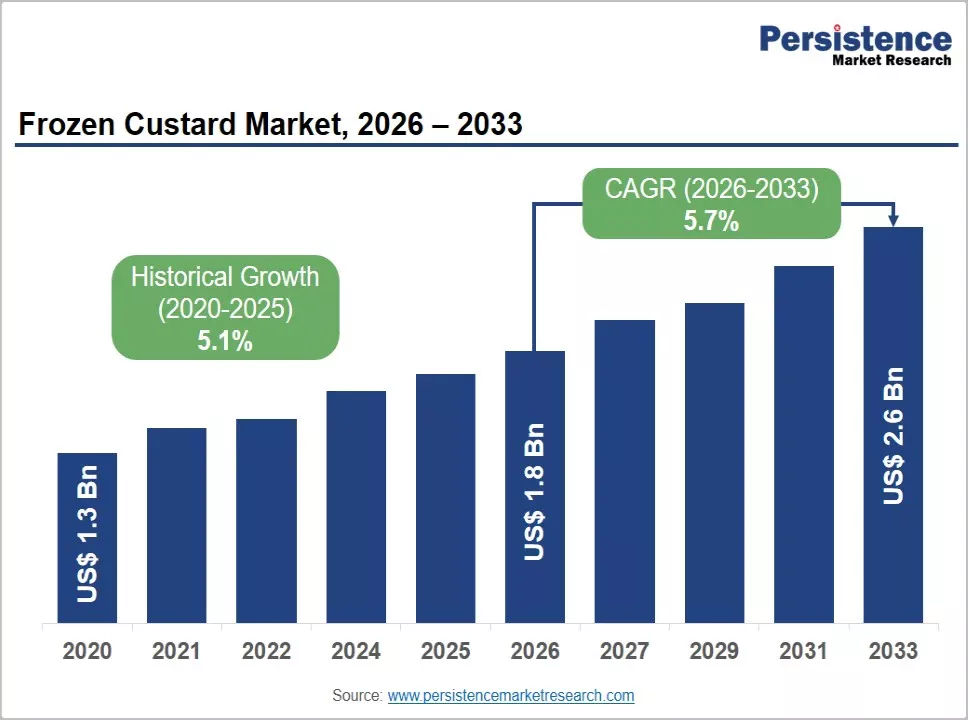
The global frozen custard market size is likely to be valued at US$1.8 billion in 2026 and is expected to reach US$2.6 billion by 2033, growing at a CAGR of 5.7% between 2026 and 2033, driven by rising demand for premium, freshly made frozen desserts, steady franchise expansion of custard-focused restaurant chains, and growing innovation in flavors and dietary formats.
Frozen custard, defined by its egg yolk content, dense texture, and freshly churned preparation, occupies the premium tier of the frozen dairy dessert category. Consumers are increasingly choosing smaller quantities of high-quality desserts, which supports growth for custard stands, drive-thru formats, and take-home packs.
Key Industry Highlights
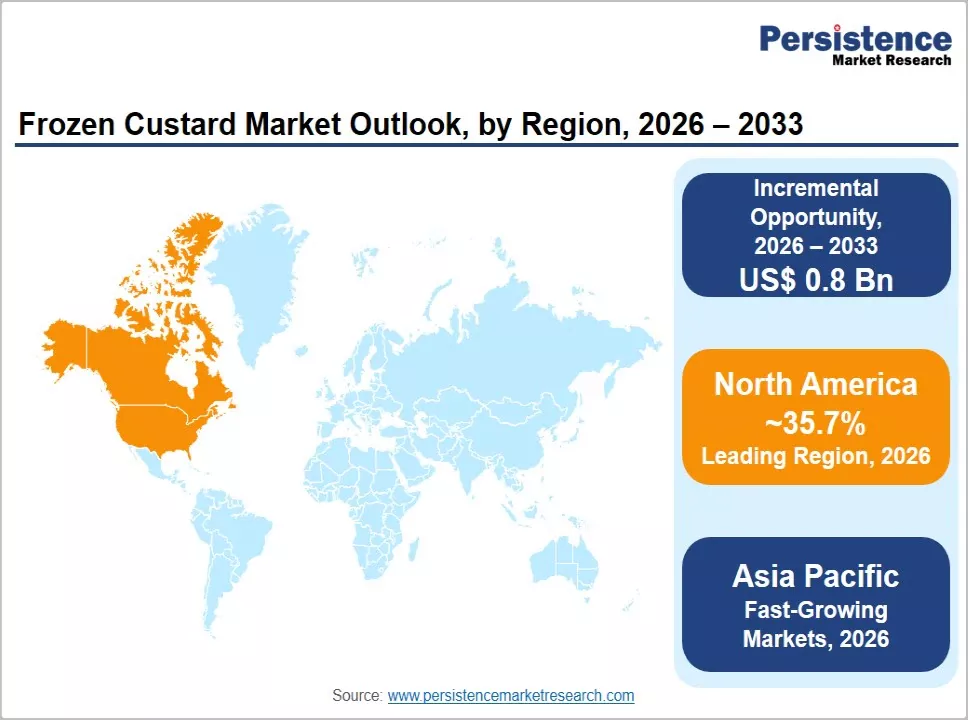
- Leading Region: North America, anticipated to account for 35.7% of the market share, supported by the long-established custard tradition in the U.S. Midwest, large franchise networks, and strong frozen dessert consumption.
- Fastest-growing Region: Asia Pacific, driven by rising disposable incomes, expanding dessert and café culture, and growing adoption of freshly made frozen desserts in urban centers.
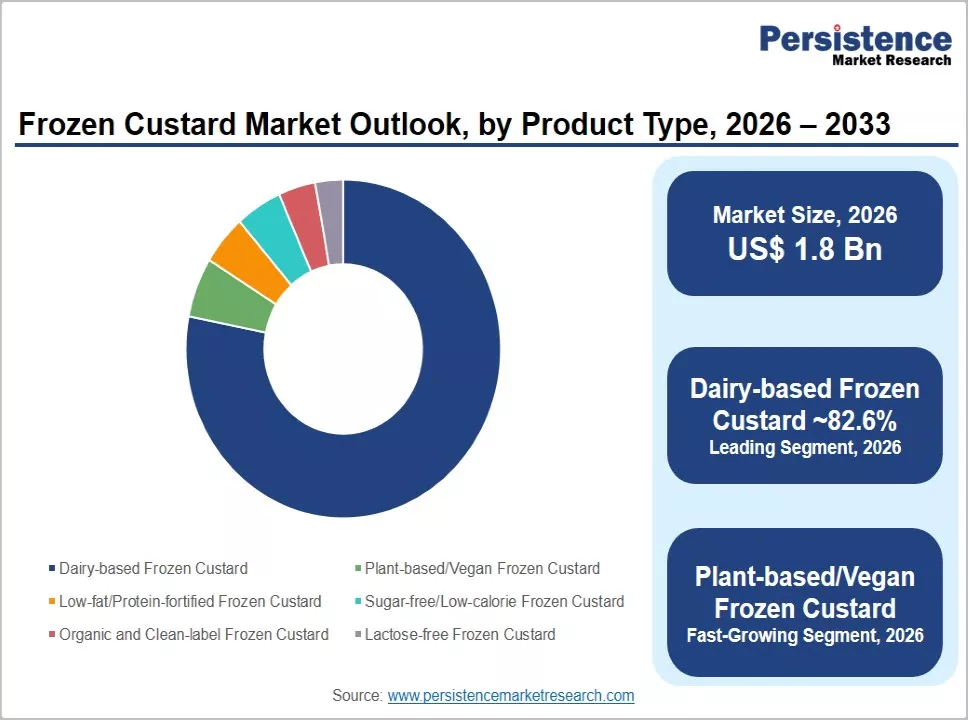
- Dominant Product Type: Dairy-based frozen custard, anticipated to hold approximately 82.6% of the market, supported by the egg yolk and milkfat composition that defines the product.
- Leading Flavor: Classic flavors (vanilla and chocolate), anticipated to account for approximately 59.3% of the market share, supported by their role as the base for sundaes, shakes, malts, and concretes.
DRO Analysis
Drivers - Premiumization and Experience-led Dessert Consumption Are Supporting Demand
Consumers are shifting toward premium, smaller-portion indulgence. The International Dairy Foods Association (IDFA) reports that flavor remains the top driver of ice cream purchases, while interest in ingredients and nutritional information continues to grow. Frozen custard, made with egg yolks and served freshly churned, aligns with this preference for quality and visible freshness. Chains such as Culver's rotate through a 30-flavor Flavor of the Day program, which encourages repeat visits and positions custard as a destination product.
Experience-led formats are also expanding consumption occasions. Custard stands, drive-thru shops, and loyalty-app promotions are increasing visit frequency, while seasonal and limited-edition offerings sustain customer interest. This is leading operators to invest in new locations and menu innovation, which increases category visibility and supports higher spending per visit.
Franchise Expansion and Multi-Unit Development Are Broadening Market Access
Franchise-led growth is extending frozen custard beyond its traditional Midwest base. Culver's opened 45 restaurants in 2025 to reach 1,041 restaurants in 26 states, with 59 additional franchise-owned openings planned for 2026 according to its franchise disclosure filing. Freddy's Frozen Custard & Steakburgers opened its 600th restaurant in October 2026, while Rita's Italian Ice & Frozen Custard reported more than 30 new shop signings year-to-date in July 2026, an increase of over 100% compared with 2025.
New formats are lowering entry barriers. Rita's reported that drive-thru shops generated 38% higher average sales than non-drive-thru locations in 2025, and second-generation real estate and flexible shop formats are reducing build-out costs. These developments are expanding access to fresh custard in suburban and secondary markets and increasing demand for dairy, egg, and custard mix supply.
Restraint - Input Cost Volatility, Affordability Pressure, and Product Standards Limit Growth Momentum
Input cost volatility and affordability pressure remain structural challenges for the Frozen Custard Market. The product relies on dairy, cream, sugar, and egg yolk, and price movements in these inputs directly affect operator margins. Consumers are also weighing out-of-home dessert spending carefully. Research released by the National Frozen & Refrigerated Foods Association in July 2026 found that nearly three-quarters of adults view keeping frozen treats at home as more affordable than going out for dessert, a trend that favors take-home ice cream over custard stand visits.
Product standards and operating requirements add further constraints. The U.S. Food and Drug Administration (FDA) standard of identity (21 CFR 135.110) requires frozen custard to contain at least 1.4% egg yolk solids by weight, which limits formulation flexibility for plant-based and egg-free products labeled as custard. Seasonal demand patterns, fresh daily production, and cold-chain control also raise operating complexity for small independent operators.
Opportunities - Better-for-you and Plant-based Formats Create New Consumer Segments
One of the most significant opportunities in the market is the expansion of dietary-focused formats beyond traditional indulgence. Sugar-free, low-calorie, protein-fortified, lactose-free, and plant-based products address consumers who want custard-style texture with lower sugar or without dairy. Mammoth Creameries, for example, offers keto-friendly and diabetic-conscious frozen custard, illustrating how specialist brands are targeting health-oriented demand. IDFA's 2026 innovation conference identified protein optimization and reduced sugar as leading themes for frozen dairy processors.
The commercial opportunity is strongest where operators combine health-oriented formulations with the sensory qualities that define custard. Foodservice mixes and bases designed for sugar-free and plant-based preparation allow independent stands and quick-service restaurants to add these options without separate production lines.
Asia Pacific Offers Strong Expansion Potential through Premium Dessert Culture
Asia Pacific presents substantial growth potential because of rising disposable incomes, expanding urban populations, and a developing café and dessert-shop culture. In China, tea and beverage chains including Mixue, HeyTea, and CHAGEE had introduced gelato and ice cream offerings by 2026, showing that consumers are receptive to freshly made frozen desserts sold in shop formats.
India's ice cream category is attracting investment from global and domestic players, with growing consumer interest in dairy-based, milkfat-positioned products. These conditions are creating openings for master franchise agreements, premium dessert concepts, and custard mixes tailored to local flavors.
Category-wise Analysis
Product Type Insights
Dairy-based frozen custard is anticipated to account for approximately 82.6% of the market share. The segment benefits from the established composition of the product, which combines milkfat, milk solids, and egg yolk to deliver a dense, smooth texture that distinguishes custard from conventional ice cream. For example, Culver's, Freddy's, and Andy's prepare custard fresh in-store, and Andy's states that its custard is made fresh hourly using cream sourced from an independent dairy farm in the upper Midwest. Regulatory definitions based on egg yolk and dairy content further reinforce the leading position of this segment.
Plant-based/vegan frozen custard is anticipated to be the fastest-growing product type, driven by demand from lactose-intolerant, vegan, and flexitarian consumers. For example, oat-, almond-, and coconut-based frozen dessert bases are being used to approximate custard texture without dairy or egg. Low-fat/protein-fortified and sugar-free/low-calorie variants are also gaining attention as consumers look for lower-sugar indulgence, supported by industry focus on protein and reduced-sugar innovation.
Flavor Insights
Classic flavors, led by vanilla and chocolate, are anticipated to account for approximately 59.3% of the market share. These flavors serve as the base for sundaes, shakes, malts, and concretes, which drive a large portion of custard stand sales. For example, Culver's offers chocolate and vanilla every day alongside a rotating Flavor of the Day. IDFA's 2026 consumer survey ranked chocolate as America's favorite ice cream flavor and showed butter pecan ahead of vanilla, indicating that traditional flavors continue to anchor consumer preference.
Innovative/artisanal flavors are anticipated to be the fastest-growing flavor category, driven by consumer interest in exotic fruits, cultural fusion, and limited-edition offerings. For example, Culver's announced two new Flavor of the Day options for 2026 and expanded its pumpkin-themed fall desserts, while Andy's introduced seasonal peach and key lime items in summer 2026. Industry commentary on 2026 frozen dessert trends also highlights sweet-and-savory pairings and viral flavor combinations, which encourage experimentation by operators.
Regional Insights
North America Frozen Custard Market Trends
North America is anticipated to account for 35.7% of the market share, with the U.S. representing the dominant share of regional demand. The region benefits from a long custard tradition in the Midwest, large franchise systems, and established dairy supply chains. More than 40 U.S. ice cream and frozen dairy dessert manufacturers, representing over 90% of U.S. ice cream sales, signed IDFA's 2025 Ice Cream Commitment to remove certified artificial colors, reflecting an industry shift toward simpler ingredient statements.
U.S. Frozen Custard Market Trends
The U.S. remains the dominant market in North America due to its established custard chains, franchise development, and consumer familiarity with the product. Culver's reached 1,041 restaurants in 26 states at the end of 2025, and Freddy's opened its 600th restaurant in October 2026. In April 2026, Freddy's expanded its development team to support continued franchise growth, and in June 2026, it launched Freddy's Bevies, a beverage lineup featuring custard cream sodas, flavored teas, and lemonades.
Andy's Frozen Custard marked its 40th anniversary in 2026 with a roadshow across 14 states and more than 170 locations. These developments show operators using custard as a base for broader menu innovation and expansion into new states, which is increasing revenue per visit and category awareness.
Europe Frozen Custard Market Trends
Europe is a mature ice cream market where frozen custard remains a niche premium category. Demand is shaped by premiumization, ingredient transparency, and health-related regulation. Attention to labeling and sugar content is encouraging reformulation, while specialty gelato and dessert shops provide an existing retail base for premium frozen offerings. Germany is the largest ice cream producer in the European Union, with 608 million liters produced in 2025 according to Eurostat data, while the U.K. has a strong out-of-home soft serve culture.
Germany Frozen Custard Market Trends
Germany represents a major European market because of its large ice cream manufacturing base and strong consumption culture. Per capita ice cream consumption was 8.0 liters in 2024, according to the Federation of German Confectionery Industry (BDSI), with industrial manufacturers selling 540.8 million liters. Of that volume, 487.5 million liters were consumed at home, indicating a retail-oriented market where take-home formats lead. The established ice cream parlor tradition provides a channel for specialty custard offerings aimed at premium-seeking consumers.
U.K. Frozen Custard Market Trends
The U.K. remains an important European market for premium and out-of-home frozen desserts. Retail data for the four weeks ending June 27, 2026 showed ice cream value sales rising 13.2% to £272 million and unit sales rising 15.1% to 108.3 million during a heatwave, indicating the sensitivity of demand to weather. Industry commentary values the UK soft serve market at £1.6 billion, with 70% of consumers enjoying ice cream or soft serve out of home at least once a month.
Health-related regulation on products high in fat, salt, and sugar is influencing formulation and promotion decisions, which favors operators offering reduced-sugar and portion-controlled options. Trade commentary from the Ice Cream Alliance in February 2026 also pointed to renewed consumer interest in premium, all-natural dairy.
Asia Pacific Frozen Custard Market Trends
Asia Pacific is anticipated to be the fastest-growing regional market due to rising disposable incomes, urbanization, and expanding dessert-shop formats. Frozen custard remains an emerging category in the region, and growth is supported by broader ice cream and freshly made dessert demand, premium positioning, and the expansion of international franchise concepts. Participation of younger consumers in dessert-led social occasions and growing online food delivery adoption also support demand for novel flavors and formats.
India Frozen Custard Market Trends
India is emerging as a major growth market for premium frozen desserts. Amul is estimated to hold about 19% of retail value in 2026 and Kwality Wall's about 9%, indicating a fragmented competitive landscape. In March 2026, The Magnum Ice Cream Company completed the acquisition of a 61.9% stake in Kwality Wall's India, and in May 2026, the company was reported to be planning a shift to a fully dairy-based portfolio by 2027. Kwality Wall's reported 31.8% organic volume growth in the September 2026 quarter. These developments reflect rising preference for dairy-based, premium frozen products, a trend that supports custard-style offerings.
China Frozen Custard Market Trends
China continues to develop freshly made frozen dessert formats alongside its established packaged ice cream sector. Yili ranked first in China's ice cream market by retail value in 2025, followed by Magnum, according to China Daily reporting. In summer 2026, traditional packaged ice cream recorded slower sales while freshly made frozen desserts delivered independent growth. Consumption is concentrated in first- and second-tier cities, where shopping malls and leisure venues support premium, freshly made desserts. These conditions position frozen custard as a likely premium extension within the shop-based dessert category.
Competitive Landscape
The global frozen custard market is fragmented, with competition among national franchise chains, regional multi-unit operators, independent custard stands, and dairy producers. Scale differs widely across the competitive set. Culver's operates more than 1,000 restaurants in 26 states, Freddy's has surpassed 600 restaurants, Rita's has more than 600 locations, and Andy's operates more than 170 locations in 14 states, while many other brands operate as regional or single-market businesses. Major companies compete based on freshness, flavor rotation, menu breadth, drive-thru formats, loyalty programs, and franchise unit economics.
Leading companies are focusing on new restaurant openings, menu innovation, digital loyalty platforms, and beverage and dessert extensions. Smaller operators differentiate through local dairy sourcing, artisanal flavors, and community engagement. Competitive differentiation increasingly depends on the ability to combine consistent product quality with convenient formats and frequent flavor news. Franchise growth, product freshness, and flavor announcements remain the most visible competitive levers.
Key Industry Developments
- In July 2026, Rita's Italian Ice & Frozen Custard reported more than 30 new shop signings year-to-date, supported by drive-thru and second-generation real estate formats that reduce build-out costs.
- In June 2026, Freddy's launched Freddy's Bevies, a beverage lineup featuring custard cream sodas, flavored teas, and lemonades, extending custard into the premium beverage category.
- In 2026, Culver's announced two new Flavor of the Day options, expanded pumpkin-themed fall desserts, and added new functions to its Delicious Rewards program, strengthening flavor-led engagement and digital loyalty.
- In May 2026, Andy's Frozen Custard opened a location in northwest Houston, Texas, extending its Houston-area presence as part of continued expansion in Texas.
Companies Covered in Frozen Custard Market
- Culver Franchising System, LLC
- Freddy's Frozen Custard & Steakburgers
- Rita's Italian Ice & Frozen Custard
- Andy's Frozen Custard
- Shake Shack Inc.
- Oberweis Dairy
- Kopp's Frozen Custard
- Leon's Frozen Custard
- Gilles Frozen Custard
- Ted Drewes Frozen Custard
- Whit's Frozen Custard
- Abbott's Frozen Custard
- Nielsen's Frozen Custard
- Sheridan's Frozen Custard
- Zesty's Frozen Custard
Frequently Asked Questions
The global frozen custard market is projected to be valued at US$ 1.8 billion in 2026.
The market is expected to reach US$ 2.6 billion by 2033.
Key trends include premiumization of frozen desserts, franchise and drive-thru expansion, rotating and seasonal flavor programs, growth of sugar-free, protein-fortified, and plant-based formats, and the extension of custard into beverages and take-home packs.
Dairy-based frozen custard is anticipated to remain the leading product type, accounting for approximately 82.6% of the market.
The market is projected to expand at a CAGR of 5.7% between 2026 and 2033.
Major companies include Culver Franchising System, Freddy's Frozen Custard & Steakburgers, Rita's Italian Ice & Frozen Custard, Andy's Frozen Custard, and Shake Shack.


