




- Processed Food
- Flavor Modulator Market
Flavor Modulator Market Size, Share, Growth, and Regional Forecast, 2026 to 2033
Flavor Modulator Market is segmented by Product Type (Sweet Flavor Modulators, Salt Flavor Modulators, Fat Flavor Modulators, Bitter Masking Modulators, Others), by Form (Liquid, Powder/Granules, Encapsulated), by End-user (Food & Beverage, Pharmaceuticals & Nutraceuticals, Animal Feed, Others), and by Regional Analysis, 2026 - 2033

Flavor Modulator Market Share and Trends Analysis
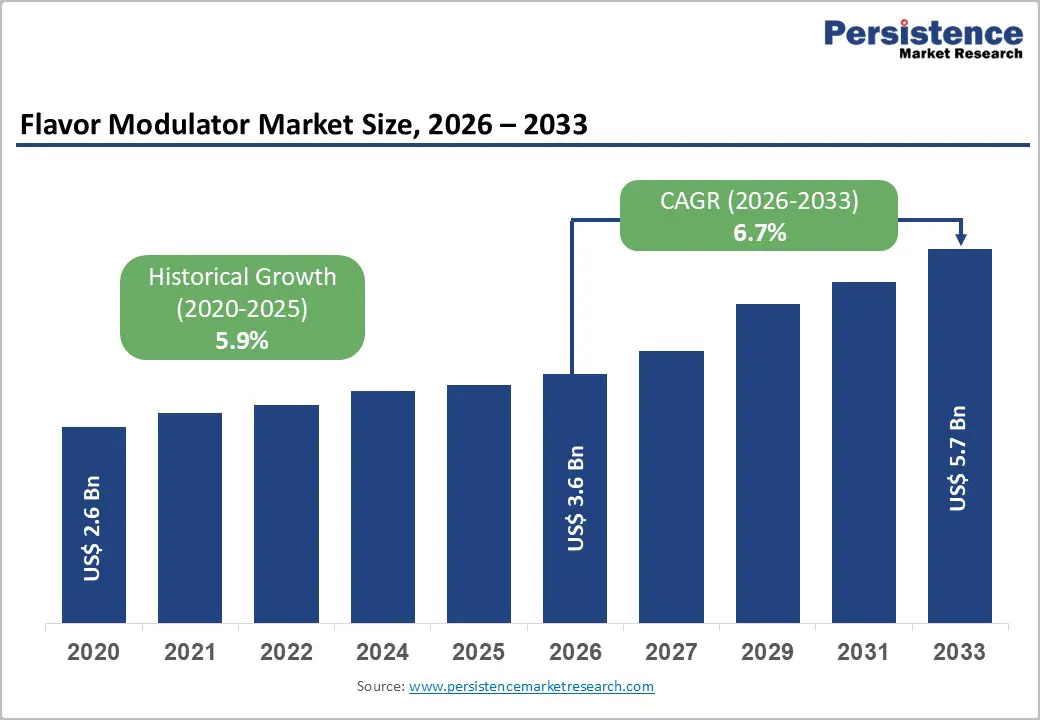
The global flavor modulator market size is expected to be valued at US$ 3.6 billion in 2026 and projected to reach US$ 5.7 billion by 2033, growing at a CAGR of 6.7% between 2026 and 2033.
The market is primarily driven by the rise in global health crises related to obesity and diabetes, which has forced food manufacturers to reduce sugar, salt, and fat content without compromising on taste. Flavor modulators provide a critical technological solution by enhancing desired taste perceptions or masking off-notes in reformulated products. This shift is supported by stringent government regulations on labeling and the increasing consumer preference for clean-label, low-calorie food and beverage options worldwide.
Key Industry Highlights:
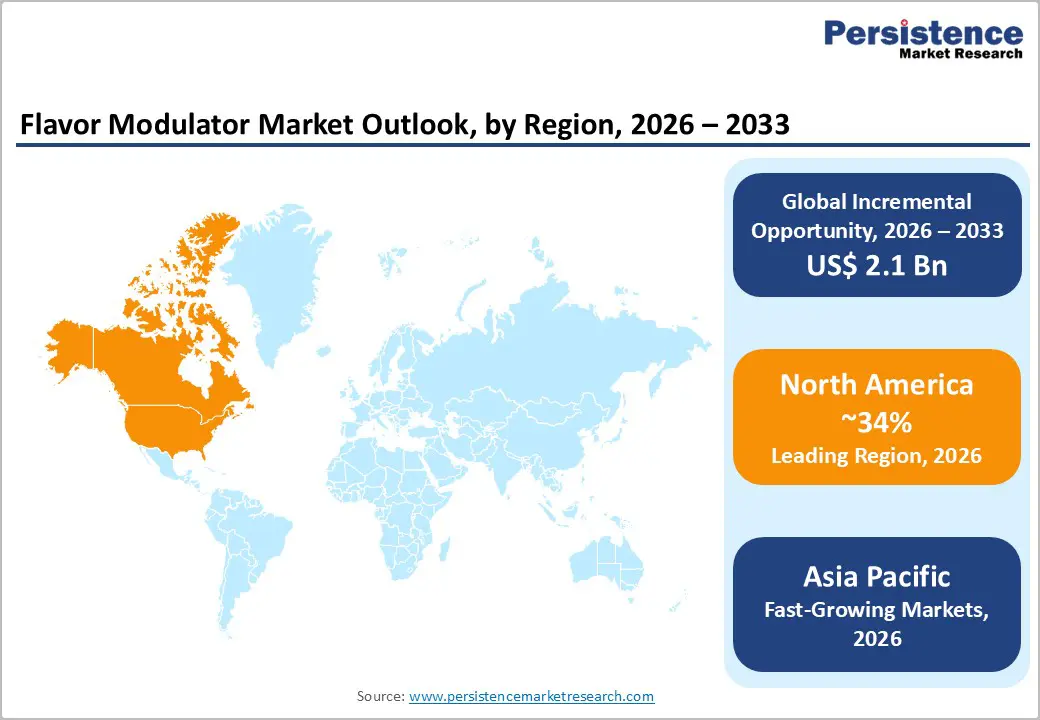
- Leading Region: North America held the largest market share of 34% in 2025, supported by advanced food processing technology and strong regulatory support for healthy reformulation in the U.S.
- Fastest Growing Region: Asia Pacific is the most dynamic market, expected to grow at the fastest rate due to massive population growth, urbanization, and government-led health initiatives in China and India.
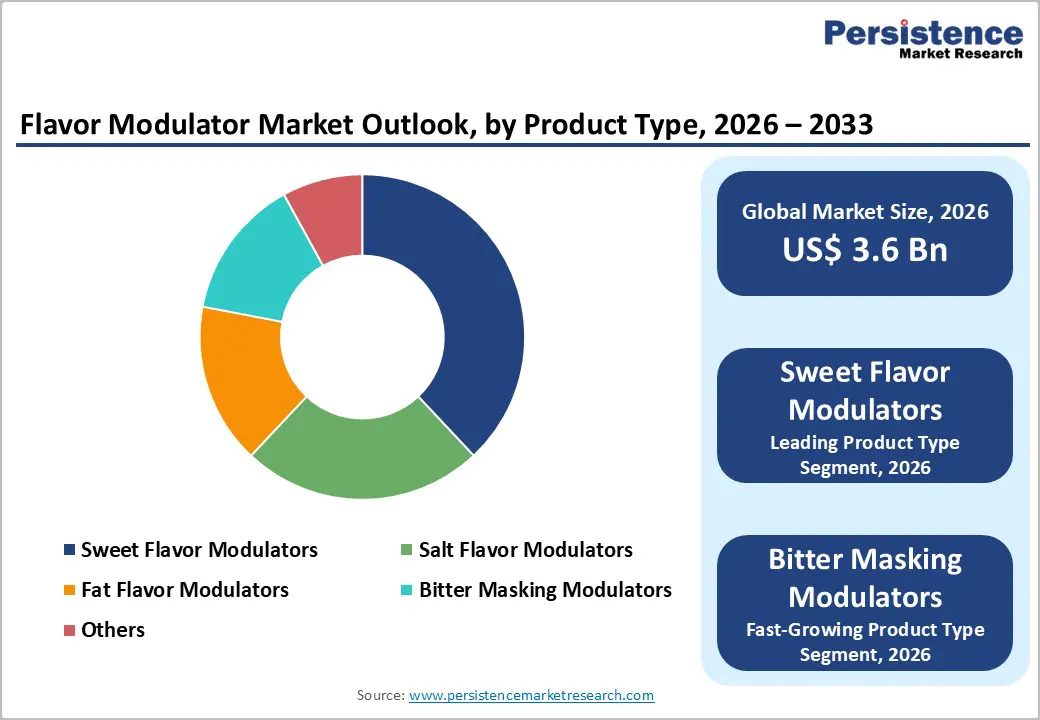
- Dominant Segment: Sweet Flavor Modulators represented 38% of the market in 2025, as beverage companies globally strive to reduce sugar content while maintaining the sweetness profile consumers expect.
- Fastest Growing Segment: Bitter Masking Modulators is the fastest-growing product type, driven by the explosive growth of the plant-based protein sector and functional health supplements.
- Key Market Opportunity: The application of Artificial Intelligence in molecular discovery and the expansion of the Pharmaceuticals & Nutraceuticals sector represent the most significant future revenue pockets for manufacturers.
| Key Insights | Details |
|---|---|
| Global Flavor Modulator Market Size (2026E) | US$ 3.6 Bn |
| Market Value Forecast (2033F) | US$ 5.7 Bn |
| Projected Growth (CAGR 2026 to 2033) | 6.7% |
| Historical Market Growth (CAGR 2020 to 2025) | 5.9% |
Market Dynamics
Driver - Rising Global Demand for Sugar and Sodium Reduction Initiatives
Mounting regulatory pressure and public health advocacy are fundamentally reshaping formulation strategies across the global flavor modulator market. The World Health Organization continues to emphasize reduced sugar and sodium intake to combat obesity, diabetes, and cardiovascular diseases, prompting governments in more than 50 countries to introduce sugar taxes and front-of-pack labeling mandates. Reformulation, however, presents sensory challenges, including diminished mouthfeel and lingering bitterness from high-intensity sweeteners such as stevia. Flavor modulators play a critical technical role in restoring taste balance without increasing caloric content.
Major ingredient innovators such as Givaudan SA and Kerry Group PLC are advancing solutions that enhance sweetness perception, mask off-notes, and improve saltiness impact in reduced-sodium applications. As clean-label and health-forward product development accelerates globally, reliance on precision taste modulation technologies is expected to intensify across food, beverage, and nutraceutical segments.
Restraints - High Cost of Research and Development for Novel Molecules
Scientific precision comes at a substantial financial cost in the global flavor modulator market. Developing receptor-targeted molecules that enhance sweetness, suppress bitterness, or rebalance salt perception without imparting off-notes requires advanced analytical platforms, sensory mapping, and molecular screening technologies. The process often spans several years and demands significant capital allocation for validation trials and regulatory assessments. Large multinational ingredient companies such as IFF and Symrise AG maintain competitive advantages due to their established R&D infrastructure and proprietary databases. In contrast, smaller innovators face funding constraints and longer commercialization timelines. Additionally, volatility in sourcing natural raw materials used in certain modulators further elevates production costs, limiting broader adoption among price-sensitive food and beverage manufacturers.
Opportunity - Technological Advancements in Artificial Intelligence and Biotechnology
Digital acceleration is redefining innovation cycles in the global flavor modulator market. The integration of Artificial Intelligence and machine learning enables rapid mapping of taste receptor interactions and predictive identification of high-performance modulating compounds. Companies such as dsm-firmenich are leveraging digital twins and computational modeling to significantly reduce discovery timelines and optimize formulation accuracy. This approach allows manufacturers to screen thousands of botanical and bio-based molecules efficiently, accelerating the development of sweet enhancers and bitter masking agents tailored to evolving regulatory and consumer demands.
Parallel advances in biotechnology, particularly precision fermentation, are unlocking scalable production of rare natural modulators with improved sustainability profiles. These technologies reduce reliance on volatile raw material sourcing while lowering long-term production costs. As AI-driven insights converge with bio-manufacturing capabilities, the market is positioned for faster innovation, enhanced cost efficiency, and differentiated clean-label solutions.
Category-wise Analysis
Product Type Insights
The Sweet Flavor Modulators segment is the leading segment in product type, accounting for a dominant 38% market share in 2025. This leadership is a direct result of the global war on sugar, where beverage and confectionery companies are under immense pressure to reduce calorie counts without sacrificing the "craveability" of their products. These modulators are prized for their ability to extend the sweetness perception of natural sugars or to round out the flavor profile of natural sweeteners like Rebaudioside M. Meanwhile, Bitter Masking Modulators is identified as the fastest-growing segment through 2033. This rapid growth is fueled by the explosion of functional energy drinks, plant-based meats, and health-fortified snacks that require the neutralization of unpleasant tastes associated with vitamins, minerals, and plant proteins.
End-user Insights
The Food & Beverage sector remains the primary leading segment for flavor modulators, driven by the sheer volume of global consumption of processed foods and soft drinks. Brands like PepsiCo and Nestlé are major end-users of these technologies to meet their sustainability and health targets. Within this channel, the beverage industry is the most significant contributor. On the other hand, the Pharmaceuticals & Nutraceuticals channel is projected to be the fastest-growing sales channel. The rise of "medical foods" and the increasing fortification of everyday snacks with medicinal herbs and proteins are driving the need for advanced masking and enhancement solutions to ensure these healthy products are actually enjoyable to consume.
Regional Insights
North America Flavor Modulator Market Trends and Insights
North America is the leading region in the global market, holding a 34% market share in 2025. The region's dominance is primarily driven by the United States, which boasts one of the most advanced food processing industries in the world. The U.S. Department of Agriculture (USDA) and the FDA have been instrumental in promoting sodium and sugar reduction through voluntary and mandatory guidelines. Furthermore, the North American innovation ecosystem is highly mature, with companies like Ingredion Inc. and Sensient Technologies Corp. leading the charge in developing "nature-identical" modulators that meet the rigorous demands of the region's health-conscious consumers.
The prevalence of lifestyle-related diseases in the U.S. has led to a massive market for diet sodas and low-calorie snacks, where flavor modulators are a standard requirement. Additionally, the region has a high concentration of nutraceutical companies that are increasingly adopting Bitter Masking Modulators for their supplement lines. The infrastructure for Research and Development (R&D) is also a key factor, with numerous collaborative projects between academia and the private sector focusing on the molecular basis of taste. This combination of regulatory pressure, industrial scale, and technological prowess ensures that North America remains at the forefront of the global industry.
Asia Pacific Flavor Modulator Market Trends and Insights
Asia Pacific is the fastest-growing segment globally, with a projected high CAGR through 2033. This growth is propelled by the rapid urbanization and changing dietary habits in China, India, and ASEAN countries. As the middle class expands, there is a significant shift toward Westernized processed foods, leading to an increase in sugar-related health issues. Consequently, governments in the region are taking action; for example, the Healthy China 2030 initiative specifically targets the reduction of salt, oil, and sugar in the national diet, creating a massive opening for flavor modulation technologies.
The region also benefits from significant manufacturing advantages, with China being a global hub for ingredient production. Local companies such as T.Hasegawa are expanding their presence, competing with global giants by offering localized flavor profiles that appeal to regional palates. In India, the rising awareness of protein-fortified foods and the growth of the pharmaceutical sector are driving the demand for bitter masking agents. The sheer scale of the population and the speed of industrialization make Asia Pacific the most critical future battleground for the global flavor modulator market.
Competitive Landscape
The global flavor modulator market is a consolidated landscape dominated by a "Big Four" in the flavor and fragrance world: Givaudan SA, IFF, dsm-firmenich, and Symrise AG. These companies control a significant portion of the market share due to their extensive patent portfolios and global manufacturing footprints. Their strategies focus heavily on vertical integration and strategic acquisitions to secure raw material supplies and novel technologies. However, a fragmented tier of specialized players like Flavorchem & Orchidia Fragrances and Apura Ingredients, Inc. are carving out niches by offering high-touch customer service and customized solutions for smaller brands. The trend toward biotechnology and fermentation is also allowing new entrants to challenge established players by offering sustainable, lab-grown natural modulators.
Key Developments:
- In January 2026, ADM announced a strategic investment at its Erlanger, Kentucky campus to strengthen innovation capabilities and support growing reformulation demand across the food and beverage sector.
- In July 2025, dsm-firmenich introduced a new range of ModulaSENSE® maskers designed to enhance taste performance in plant-based formulations, supporting the expansion of Vertis™ CanolaPRO®. The launch addresses ongoing challenges related to off-notes in alternative protein applications.
- In February 2025, T. Hasegawa USA completed the expansion of its advanced Flavor Innovation Center in California, reinforcing its R&D capabilities to meet rising demand for customized flavor solutions and next-generation product reformulation.
Companies Covered in Flavor Modulator Market
- Givaudan SA
- IFF
- Kerry Group PLC
- Sensient Technologies Corp.
- Ingredion Inc.
- Symrise AG
- Tate & Lyle PLC
- dsm-firmenich
- Balchem Corporation
- McCormick & Company
- Mane SA
- Apura Ingredients, Inc.
- T.Hasegawa
- Flavorchem & Orchidia Fragrances
- Others
Frequently Asked Questions
The global flavor modulator market is projected to be valued at US$ 3.6 billion in 2026.
Rising Global Demand for Sugar and Sodium Reduction Initiatives is driving demand for flavor modulator market.
The Global Flavor Modulator market is poised to witness a CAGR of 6.7% between 2026 and 2033.
Technological Advancements in Artificial Intelligence and Biotechnology is creating opportunity for key players in the Flavor Modulator market.
Key industry leaders include Givaudan SA, IFF, Kerry Group PLC, Symrise AG, Sensient Technologies Corp., Ingredion Inc., Tate & Lyle PLC, and Others.


