




- Retail
- Flavor Capsule Cigarette Market
Flavor Capsule Cigarette Market Size, Share, and Growth Forecast 2026 - 2033
Flavor Capsule Cigarette Market by Product Type (Regular, Slim, Premium), Flavor (Menthol, Mint, Fruit, Tobacco, Others), Capsule Type (Single Capsule, Double/Multi Capsule), Distribution Channel (Offline Stores, Online Stores), and Regional Analysis, 2026 - 2033

Flavor Capsule Cigarette Market Share and Trends Analysis
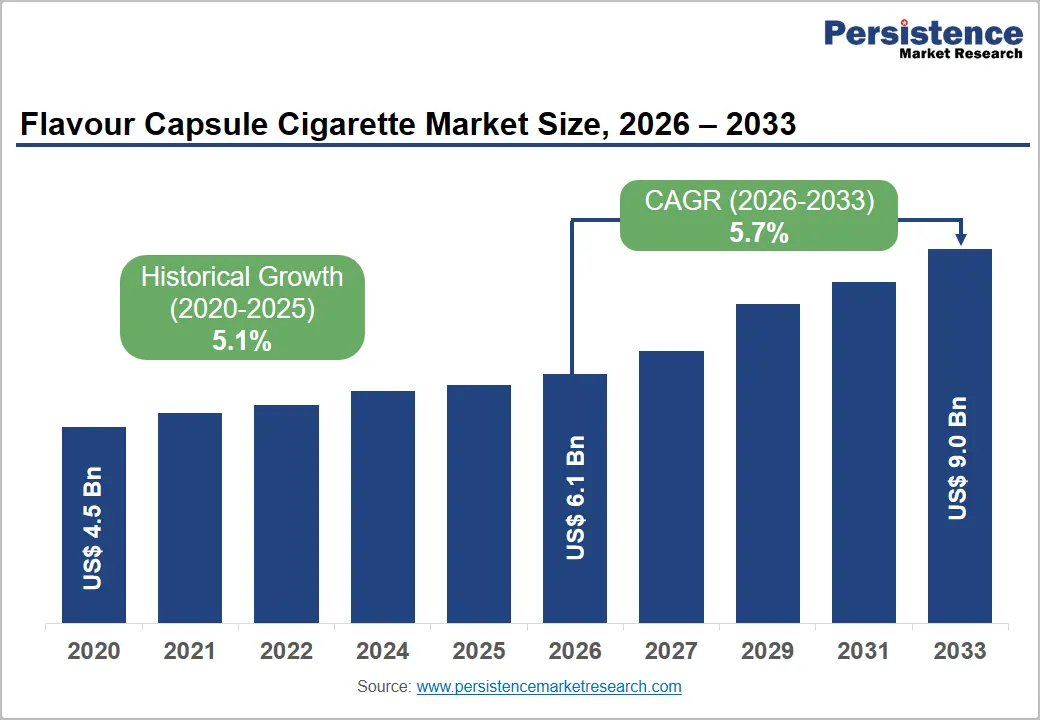
The global flavor capsule cigarette market size is expected to be valued at US$ 6.1 billion in 2026 and projected to reach US$ 9.0 billion by 2033, growing at a CAGR of 5.7% between 2026 and 2033. It is a rapidly evolving segment of the global tobacco industry, driven by rising consumer demand for enhanced taste experiences and innovative product formats. These cigarettes feature breakable capsules in filters that release menthol, fruit, or mixed flavours, offering a customizable smoking experience.
The market is characterized by continuous product innovation, strong brand competition, and growing adoption in emerging economies. Asia Pacific and Latin America remain key consumption hubs due to favorable demographics and higher acceptance of flavored products. However, increasing regulatory scrutiny on flavored tobacco is shaping product strategies, pushing manufacturers toward premiumization and next-generation capsule technologies.
Key Industry Highlights
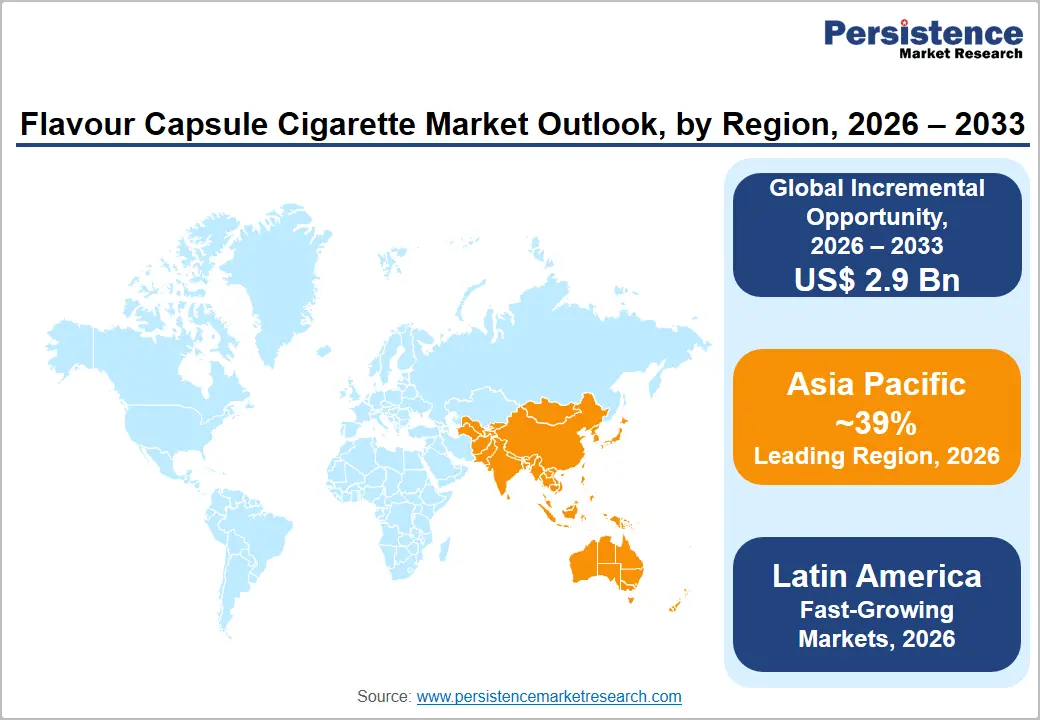
- Leading Region: Asia Pacific is likely to lead the global market with 39% market share in 2026, anchored by China’s CNTC state-controlled domestic capsule volumes, South Korea’s KT&G Esse® premium brand, and Japan’s high-value konbini retail capsule distribution across PMI, JTI, and BAT product lines.
- Fast-Growing Market: Latin America is projected to register the high CAGR driven by 60 million regional adult smokers per PAHO data, limited flavor regulation in Brazil, Mexico, and Colombia, and PMI/BAT capsule brand expansion through their Marlboro® and Lucky Strike® lines.
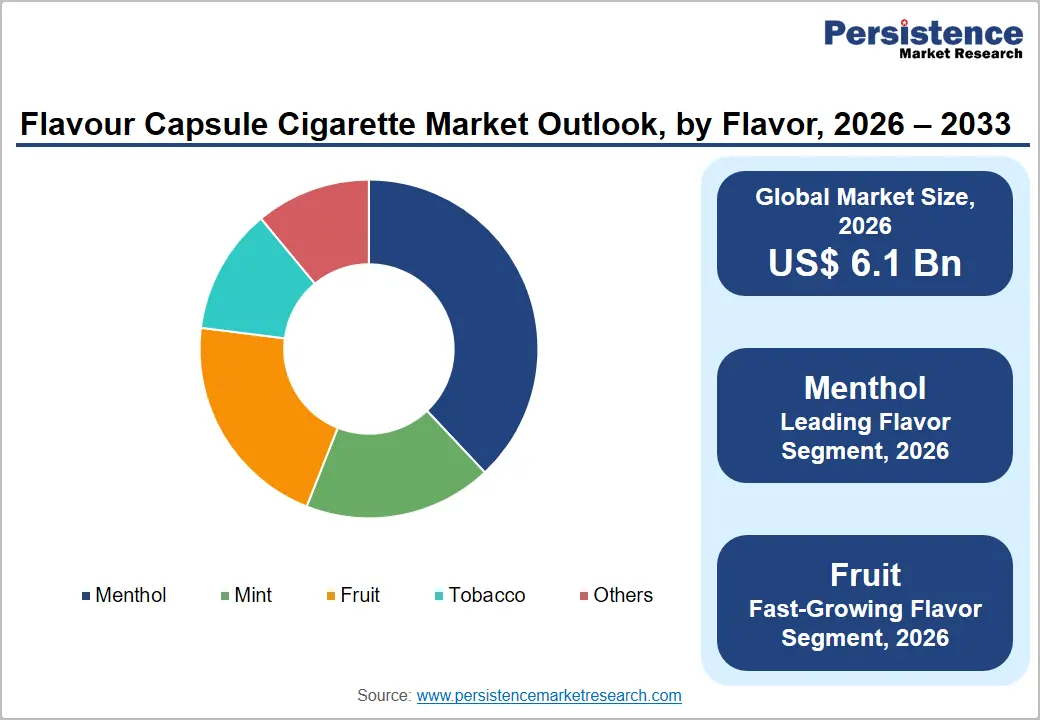
- Dominant Flavor Segment: Menthol is likely to lead the flavor category with 38% share in 2026, underpinned by deep consumer preference across Japan, South Korea, China, and Vietnam markets where menthol and cooling capsule variants historically account for 20-40% of premium cigarette category volumes.
- Fast-Growing Flavor Type: Fruit Flavor Capsules represent the fastest growing flavor type over 2026 - 2033, driven by BAT’s Vogue® Série and JTI’s Winston® Duo Tropical, introducing watermelon, mango, and lychee variants in Southeast Asia and Latin America regions with no current fruit flavor bans and strong consumer novelty demand.
- Key Opportunity: Latin America’s 60 million adult smokers and Southeast Asia’s flavor-unregulated markets represent a combined US$ 2.9 billion incremental dollar opportunity between 2026 and 2033, with double/multi-capsule format innovation and fruit flavor variant launches offering the highest per-unit revenue premium over conventional cigarette formats.
Market Dynamics
Drivers - Strong Consumer Demand for Customizable and Novel Tobacco Experiences in the Asia Pacific
The Asia Pacific region’s large and culturally diverse smoking population has demonstrated a particularly strong affinity for flavor capsule cigarettes, driven by preferences for novelty, personalization, and premium product positioning. Japan Tobacco International (JTI)’s Winston® Xplosion, BAT’s Lucky Strike® Click & Roll, and PMI’s L&M® capsule variants have achieved significant commercial success in Japan, South Korea, Indonesia, and Vietnam, where capsule penetration in the overall cigarette market ranges from 20% to over 40% in select categories.
The ability of capsule cigarettes to deliver multiple flavor experiences, switching between traditional tobacco and menthol or fruit at the smoker’s discretion by crushing the capsule, addresses the consumer desire for variety within a single product, sustaining repeat purchase loyalty and premium price acceptance that conventional cigarette formats cannot replicate.
Premiumization Trend and Brand Portfolio Expansion by Multinational Tobacco Companies
Global tobacco companies are investing heavily in capsule cigarette product innovation and brand portfolio expansion as a strategic response to declining conventional cigarette volumes in developed markets. Philip Morris International (PMI) reported that flavor variants and reduced-risk products collectively accounted for a growing share of its cigarette revenue mix. British American Tobacco (BAT) expanded its capsule cigarette offerings under the Dunhill®, Rothmans®, and Lucky Strike® brands across multiple markets. KT&G Corporation, South Korea’s largest domestic tobacco company, holds a dominant position in the Korean capsule cigarette segment with its Esse® brand.
The World Tobacco Index, published by industry analysts, notes that the introduction drives higher net revenue per thousand cigarettes due to premium pricing sustaining manufacturer incentive for continued product line development and marketing investment across both established and emerging markets.
Restraints - Regulatory Bans on Menthol and Flavored Cigarettes in Major Markets
Regulatory restrictions on menthol and flavored cigarettes represent the most significant structural restraint on the global flavor capsule cigarette market. The European Union’s Tobacco Products Directive (EU TPD) banned menthol cigarettes across all 27 EU member states effective May 2020, removing a key capsule flavor variant from one of the world’s largest tobacco markets. In the United States, the FDA’s Center for Tobacco Products has issued proposed rules to prohibit menthol cigarettes, which, if finalized, would eliminate the primary flavor capsule category from the U.S. market. These regulatory headwinds are progressively reducing the total addressable market for capsule cigarettes in high-regulation geographies, concentrating future volume growth in regulatory-permissive markets.
Opportunities - Fruit Flavor Capsules: Fastest Growing Flavor Segment in Regulatory-Permissive Markets
Fruit-flavored capsule cigarettes represent the fastest-growing flavor segment in the global market, driven by strong consumer preference for non-menthol flavor novelty in Southeast Asia, Latin America, and parts of Africa where fruit flavor additive bans have not been implemented. Indonesia’s large kretek (clove cigarette) culture has created a receptive consumer base for fruit and non-tobacco flavor experimentation, while Vietnam, Thailand, and the Philippines represent high-growth fruit capsule demand markets.
Multinational tobacco companies, including BAT’s Vogue® Série and JTI’s Winston® Duo lines, are introducing tropical fruit capsule variants, including watermelon, peach, and lychee, that are commanding price premiums over conventional cigarettes in Asian retail channels. As flavor capsule cigarettes remain unregulated in these markets, the fruit flavor sub-segment offers the highest near-term volume and revenue growth trajectory.
Category-wise Analysis
Product Type Insights
Regular capsule cigarettes lead the product type category, commanding the dominant share of the global flavor capsule cigarette market in 2026. Standard-format capsule cigarettes offered in the conventional king-size configuration represent the highest-volume product format due to their broad price accessibility, familiarity to the existing smoker base, and availability across the widest range of retail distribution channels globally.
The China National Tobacco Corporation (CNTC), the world’s largest tobacco company by volume, markets regular-format capsule cigarettes under multiple domestic brands in China’s retail market, where capsule variants have achieved a significant share of the premium domestic cigarette category. PMI’s L&M® and Marlboro® capsule lines and BAT’s Lucky Strike® in regular format remain the highest-volume capsule product lines internationally. While slim and premium formats are the fastest-growing within the capsule segment, the regular format retains volume leadership through broad consumer base coverage across all major Asia Pacific, Latin American, and Middle Eastern markets.
Flavor Insights
Menthol represents the leading flavor segment in the global flavor capsule cigarette market, accounting for approximately 38% share in 2026. Menthol capsule cigarettes offer the most established consumer preference profile delivering a cooling sensation that many smokers associate with a lighter, more palatable tobacco experience.
Menthol’s dominance pre-dates capsule technology, with menthol cigarettes historically representing approximately 36% of U.S. cigarette sales per FDA market data before regulatory action. In Asia Pacific, the world’s largest capsule cigarette market, menthol and mint capsule variants collectively dominate consumer preference in Japan, South Korea, China, and Vietnam. KT&G’s Esse® Menthol and JTI’s Winston® Xplosion Menthol exemplify the commercially successful menthol capsule product positioning across major Asian markets, reinforcing the flavor’s leadership revenue position.
Capsule Type Insights
Single capsule cigarettes represent the dominant capsule type segment in 2025, accounting for the majority of global flavor capsule cigarette volume. Single capsule products—containing one crushable flavor bead embedded in the filter were the format that established the capsule cigarette category commercially and remain the most widely distributed configuration across Asia Pacific, Latin America, and Middle East & Africa retail networks. JTI’s Winston® Xplosion, PMI’s Marlboro® Click, and BAT’s Lucky Strike® Click & Roll in single-capsule configuration collectively represent the highest-volume capsule product lines globally.
Double and multi-capsule formats offering two or more flavor bead options within a single cigarette are the fast-growing capsule type sub-segment, driven by consumer demand for flavor switching versatility and the ability to combine tobacco-to-menthol transitions or tobacco-to-fruit flavor combinations within a single product.
Distribution Channel Insights
Offline stores, including tobacco specialist retailers, convenience stores, supermarkets, and duty-free outlets, dominate the flavor capsule cigarette distribution channel, accounting for the substantial majority of global market revenues in 2025. The age-gated nature of tobacco retail, requiring in-store age verification at the point of purchase, structurally concentrates cigarette sales within licensed physical retail environments. In the Asia Pacific, the largest capsule cigarette region, neighborhood convenience stores (konbini) in Japan, tobacco kiosks in South Korea, and traditional tobacco retail networks in Indonesia and Vietnam serve as the primary points of brand trial and volume purchase.
However, online tobacco retail through age-verified platforms is gaining modest traction in Japan, Australia, and parts of Europe where digital retail infrastructure is mature and regulatory frameworks permit licensed online tobacco sales.
Regional Insights
North America Flavor Capsule Cigarette Market Trends and Insights
North America represents a constrained market for flavor capsule cigarettes due to the FDA’s proposed menthol cigarette ban and the broader decline of the U.S. adult smoking rate to 11.5%. Despite a historically strong menthol cigarette preference among specific demographics, regulatory headwinds are fundamentally limiting capsule product introduction and commercial expansion, with industry attention shifting toward Canada and Mexico, where flavor capsule products maintain operational regulatory environments.
U.S. Flavor Capsule Cigarette Market Size
The United States accounts for approximately 85% of North American revenues, yet represents a declining and heavily regulated capsule market. FDA’s proposed menthol ban and the U.S. CDC’s documented adult smoking rate of 11.5% in 2021 create structural headwinds. Capsule products are primarily distributed through licensed tobacco specialty and convenience retail channels, with limited new product introduction activity by Altria Group Inc. and Reynolds American Inc.
Europe Flavor Capsule Cigarette Market Trends and Insights
Europe faces the most restrictive regulatory environment for capsule cigarettes globally, with the EU Tobacco Products Directive’s 2020 menthol ban eliminating the primary capsule flavor from all EU member state markets. Market activity is now concentrated in non-EU Eastern European markets where flavor regulations remain less harmonized, and in tobacco-to-tobacco capsule variants still permitted under EU TPD provisions, with Imperial Brands PLC and BAT focusing on compliant product formats.
Germany Flavor Capsule Cigarette Market Size
Germany contributes approximately 20% of European capsule cigarette revenues, primarily through tobacco-on-tobacco capsule variants permitted under EU TPD. With Germany’s adult smoking rate of approximately 24% per Federal Ministry of Health (BMG) data and a strong retail tobacco infrastructure, BAT’s Vogue® and Philip Morris’ compliant capsule formats maintain commercial activity in the premium segment.
U.K. Flavor Capsule Cigarette Market Size
The U.K. contributes approximately 17% of European revenues, also constrained by EU TPD-equivalent post-Brexit regulations implemented through The Tobacco and Related Products Regulations 2016 (TRPR). Imperial Brands PLC and BAT maintain permitted capsule formats, while MHRA’s track-and-trace requirements and declining U.K. adult smoking rate of approximately 13% per NHS Digital constrain volume growth.
France Flavor Capsule Cigarette Market Size
France contributes approximately 14% of European capsule cigarette revenues. ANSES (Agence nationale de sécurité sanitaire) enforces EU TPD menthol provisions strictly, limiting capsule products to tobacco-on-tobacco formats. France’s adult smoking prevalence of approximately 26% per Sante Publique France sustains moderate tobacco volume, with PMI’s Marlboro® and BAT’s Rothmans® maintaining limited capsule presence under compliant product frameworks.
Asia Pacific Flavor Capsule Cigarette Market Trends and Insights
Asia Pacific is dominant market with 39% share in 2026, anchored by the world’s largest smoking populations in China, Indonesia, Japan, Vietnam, and South Korea, minimal flavor capsule regulatory restrictions, and deep consumer preference for menthol and novel capsule variants. China’s CNTC dominates domestic capsule volumes through state-controlled retail, while Japan and South Korea represent premium high-per-unit-revenue capsule markets favored by JTI, PMI, and KT&G’s Esse®.
India Flavor Capsule Cigarette Market Size
India accounts for approximately 7% of Asia Pacific flavor capsule cigarette revenues, a modest share reflecting the dominance of bidis and smokeless tobacco in India’s tobacco market. ITC Limited, India’s largest cigarette company, has introduced flavor capsule variants under its Gold Flake® brand, targeting urban premium cigarette consumers, operating within Cigarettes and Other Tobacco Products Act (COTPA) compliance frameworks that restrict but do not ban flavor additives.
Competitive Landscape
The global flavour capsule cigarette market is characterized by intense competition driven by continuous product innovation, flavor diversification, and aggressive marketing strategies. Manufacturers compete primarily on capsule technology, flavor intensity, packaging appeal, and brand positioning to attract younger adult smokers. The market is highly consolidated at the top, yet fragmented across regional and local players who adapt products to specific consumer preferences. Pricing strategies, regulatory adaptability, and distribution strength across retail and convenience channels also play a critical role in competitive positioning.
Key Developments:
- In January 2026, Philip Morris Japan launched a new capsule-based flavour variant for its IQOS ILUMA heated tobacco portfolio under the TEREA range, named “Stellar Pearl.” The product introduced a dual-sensory experience combining mint with a yellow citrus “scent switch,” allowing users to alternate between flavour profiles during consumption.
- In April 2026, Philip Morris International’s UK affiliate launched LEVIA, a new range of tobacco-free nicotine pods designed for the IQOS ILUMA series. The product introduced a zero-tobacco formulation while maintaining a flavour-to-flavour capsule experience to enhance sensory delivery during use.
Companies Covered in Flavor Capsule Cigarette Market
- Philip Morris International (PMI)
- British American Tobacco (BAT)
- Japan Tobacco International (JTI)
- Imperial Brands PLC
- China National Tobacco Corporation (CNTC)
- KT&G Corporation
- ITC Limited
- Altria Group Inc.
- Reynolds American Inc.
- Gudang Garam Tbk
- Djarum
- Karelia Tobacco Company Inc.
- Eastern Company S.A.E
Frequently Asked Questions
The global flavor capsule cigarette market is projected to be valued at US$ 6.1 billion in 2026.
Consumers, especially younger adults, are increasingly attracted to cigarettes offering burst flavour capsules (menthol, fruit, citrus) that improve taste and reduce harshness.
Asia Pacific leads with approximately 39% market share in 2025, driven by China’s CNTC controlling the world’s largest state tobacco market, South Korea’s KT&G Esse® brand dominance, Japan’s high-value konbini retail capsule distribution, and Southeast Asia’s largely unregulated flavor environment enabling full menthol, mint, and fruit capsule product portfolios from PMI, BAT, and JTI.
Manufacturers are increasingly focusing on multi-flavour and dual-capsule formats, allowing users to switch or combine flavours during consumption, which significantly enhances sensory appeal and product differentiation.
Key players include Philip Morris International (PMI), British American Tobacco (BAT), Japan Tobacco International (JTI), Imperial Brands PLC, China National Tobacco Corporation (CNTC), KT&G Corporation, ITC Limited, Altria Group Inc., Reynolds American Inc., Gudang Garam Tbk, Djarum, Karelia Tobacco Company Inc., Eastern Company S.A.E, Reemtsma Cigarettenfabriken GmbH, and Alliance One International (Pyxus), among others.


