




- Specialty & Fine Chemicals
- Faux Leather Market
Faux Leather Market Size, Share, Trends, and Growth Forecast 2026 - 2033
Faux Leather Market by Product Type (PU/Polyurethane, PVC/Polyvinyl Chloride, Bio-based), Application (Footwear, Automotive, Furniture, Others), and Regional Analysis for 2026 - 2033

Faux Leather Market Size and Trend Analysis
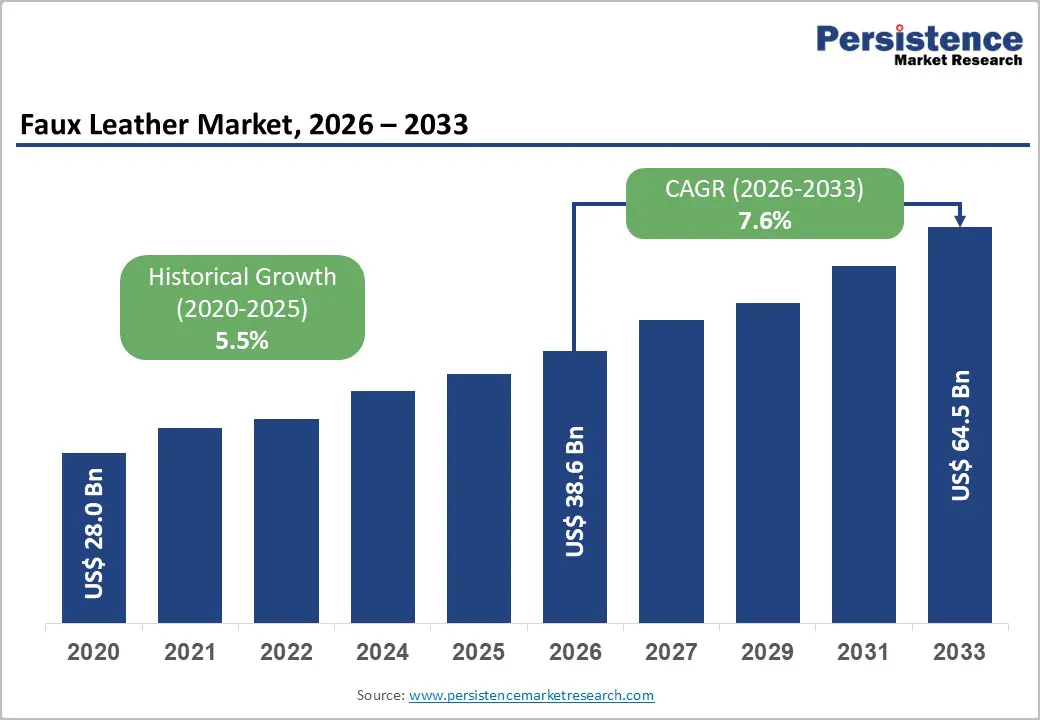
The global faux leather market size is likely to be valued at US$ 38.6 billion in 2026 and is projected to reach US$ 64.5 billion by 2033, growing at a CAGR of 7.6% between 2026 and 2033.
The market is primarily propelled by surging consumer and corporate preference for cruelty-free, animal-friendly materials across the fashion, automotive, and furniture sectors. Rising regulatory pressure against natural leather tanning chemicals, combined with technological breakthroughs in water-based and solvent-free PU (Polyurethane) formulations, has significantly reduced the environmental footprint of synthetic leather manufacturing.
Key Industry Highlights:
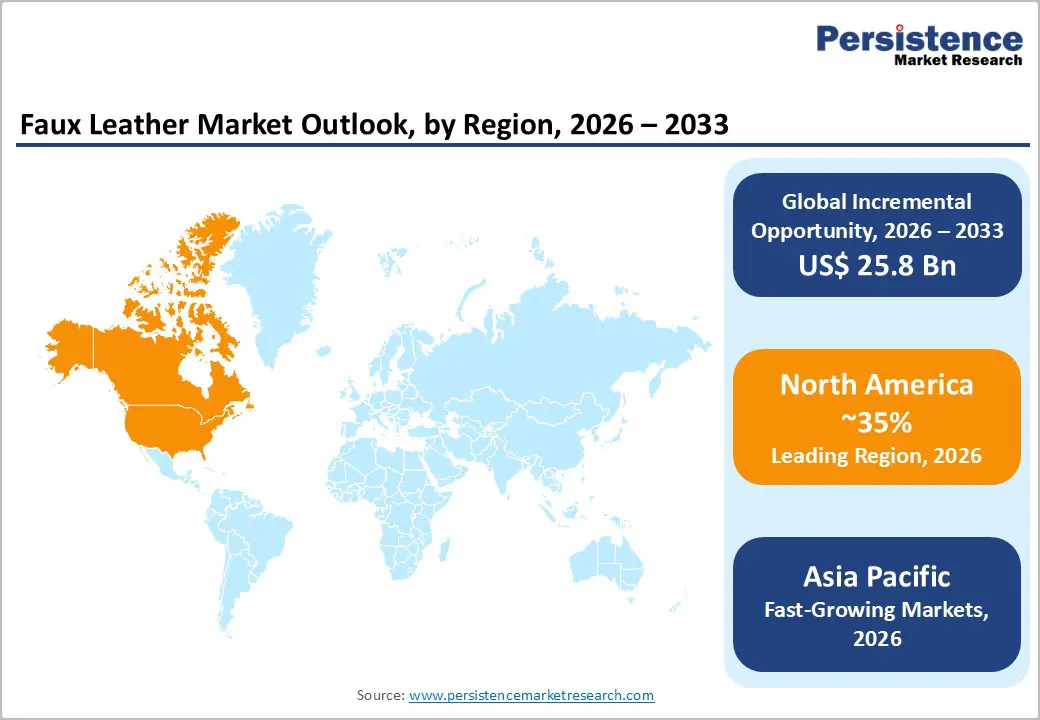
- Leading Region: North America leads the global faux leather market, backed by strong consumer preference for cruelty-free materials, stringent product labelling regulations such as 16 CFR Part 24, and robust automotive and fashion sector demand for premium synthetic leather alternatives.
- Fastest Growing Region: Asia Pacific is the fastest-growing regional market, driven by rapid expansion of footwear and automotive manufacturing in China, India, and Vietnam, alongside rising middle-class spending on synthetic leather goods and government green manufacturing initiatives.
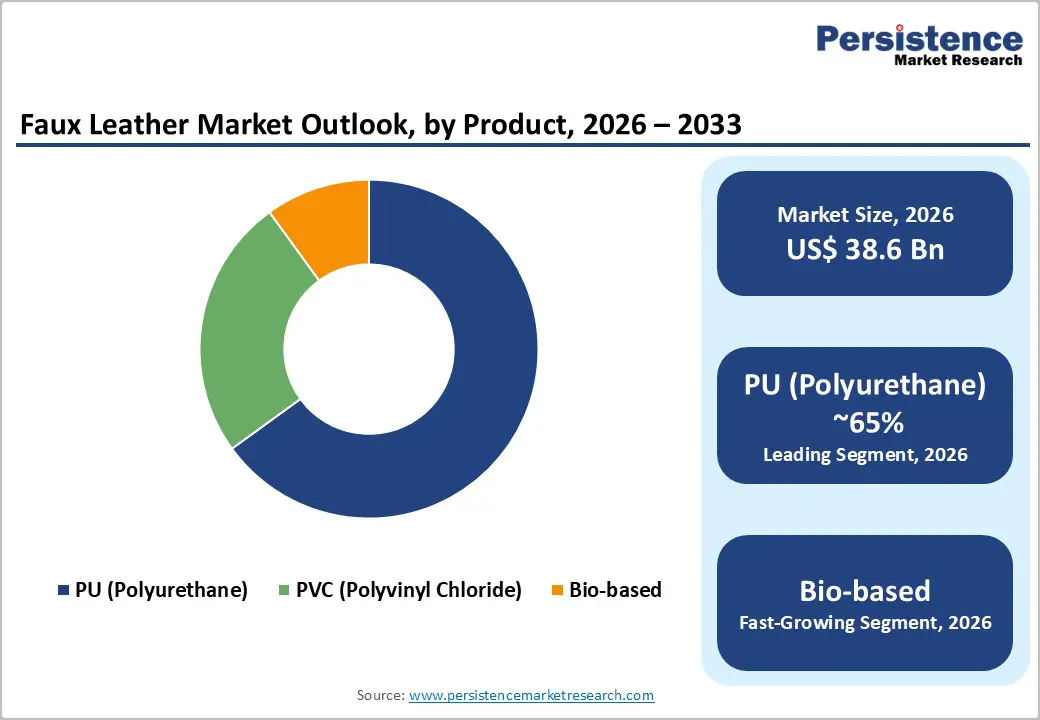
- Dominant Segment - PU (Polyurethane) faux leather dominates with approximately 64% market share, owing to its superior UV resistance, low VOC emissions, recyclability, and broad acceptance in high-value automotive, footwear, and furniture applications.
- Fastest Growing Segment - Automotive is the fastest-growing application segment, fuelled by rising EV adoption, OEM sustainability commitments, and increasing use of premium bio-based and PU-based synthetic leather for eco-friendly vehicle interiors globally.
- Key Opportunity: Bio-based and mycelium-derived faux leather present high-growth opportunities as fashion, luxury, and automotive sectors seek fully biodegradable alternatives, supported by innovations like Haptex® 4.0, LOVR hemp leather, and circular bio-fabricated materials gaining mainstream traction.
| Key Insights | Details |
|---|---|
| Faux Leather Market Size (2026E) | US$ 38.6 Bn |
| Market Value Forecast (2033F) | US$ 64.5 Bn |
| Projected Growth CAGR (2026 - 2033) | 7.6% |
| Historical Market Growth (2020 - 2025) | 5.5% |
Market Dynamics
Drivers - Rising Demand for Cruelty-Free and Vegan Products Across Fashion and Automotive Industries
Growing global consciousness around animal welfare and sustainable consumerism has substantially accelerated the adoption of faux leather as a preferred alternative to genuine leather. International animal rights campaigns, notably those by PETA (People for the Ethical Treatment of Animals) have catalysed significant shifts in purchasing behaviour, compelling major fashion houses and automotive original equipment manufacturers (OEMs) to commit to vegan material sourcing.
A 2023 survey by The Vegan Society noted that approximately 79% of UK consumers actively considered product ethics before purchase decisions. Automotive manufacturers, including Volkswagen, BMW, and Tesla, have introduced leather-free interior trims to cater to the expanding eco-conscious buyer segment. This behavioural transition is positively reinforcing long-term demand for polyurethane and bio-based faux leather across premium and mass-market product lines globally.
Technological Advancements in Recyclable and Bio-Based Synthetic Leather Formulations
Continued material science innovation is broadening the functional appeal of faux leather. In July 2024, BASF SE launched Haptex® 4.0, a fully recyclable polyurethane solution enabling synthetic leather and its PET (Polyethylene Terephthalate) fabric substrate to be recycled jointly without layer separation, addressing one of the most persistent end-of-life challenges in the industry. The solution demonstrated 52% lower greenhouse gas emissions, over 20% energy savings, and 30% less water usage compared to conventional solvent-based PU leather production.
Simultaneously, research institutions such as Germany's DITF (Deutsche Institute für Textil- und Faserforschung) and FILK Freiberg developed bio-based synthetic leather using polybutylene succinate (PBS) in June 2024, facilitating efficient recycling through uniform material composition. These innovations are strengthening faux leather's competitive position against natural leather globally.
Restraints - Environmental Concerns Associated with PVC-Based Faux Leather Production
Despite its commercial advantages, PVC (Polyvinyl Chloride)-based faux leather presents notable environmental and health risks. PVC production requires chlorine-intensive chemical processes, and the use of phthalate-based plasticizers such as DEHP, DBP, and BBP is restricted under EU REACH Regulation (Annex XVII).
The European Chemicals Agency (ECHA) has progressively tightened permissible thresholds for hazardous substances in synthetic leather-based consumer goods. These regulatory restrictions add compliance costs for manufacturers and limit market access, particularly in the European Union and North America, potentially suppressing overall volume growth in the PVC segment.
Perception of Lower Quality Relative to Genuine Leather
A persistent challenge for faux leather market participants is the prevailing consumer perception that synthetic alternatives inherently compromise on premium quality, durability, and breathability compared to full-grain genuine leather. This perception is particularly pronounced in the luxury fashion and high-end automotive upholstery segments, where material authenticity is a key purchase driver.
Studies indicate that consumers in developed markets are still willing to pay a premium of 20%-35% more for genuine leather goods, constraining faux leather's penetration in the premium tier. This quality stigma necessitates sustained R&D investment in microfiber and solvent-free PU technologies to bridge the tactile and performance gap.
Market Opportunities
Accelerating Adoption of Bio-Based Faux Leather in the Automotive Sector
The automotive industry represents one of the most compelling growth frontiers for bio-based and next-generation synthetic leather. As global automakers race to decarbonize vehicle production and align with ESG (Environmental, Social, and Governance) commitments, the demand for petroleum-free interior materials is intensifying rapidly. In September 2024, Volkswagen AG partnered with Revo tech GmbH to pilot LOVR, a hemp-based artificial leather engineered to be bio-based, fully recyclable, and petroleum-free for future vehicle interiors.
With the global electric vehicle (EV) market expanding International Energy Agency (IEA) data indicates global EV sales reached 17.1 million units in 2024automotive OEMs are increasingly specifying premium faux leather alternatives to align with sustainability goals. This trend is creating significant demand for high-performance, low-carbon interior surface materials, benefiting producers with strong bio-based product portfolios.
Expansion of Bio-Based and Mycelium Leather in the Premium Fashion Segment
The emergence of next-generation plant-based and bio-fabricated faux leather presents a transformative commercial opportunity for forward-looking manufacturers and investors. Novel bio-based alternatives derived from mycelium (fungal networks), pineapple leaf fibre (Piñatex®), apple waste, and cactus have gained considerable traction among premium fashion and luxury accessory brands seeking to communicate sustainability credentials.
In April 2024, Tory Burch, TômTex, and TLC Worldwide collaborated to develop a circular synthetic leather from waste shrimp shells and coffee grounds, enabling fully biodegradable, plastic-free fashion accessories. Additionally, Hydefy, a Chicago-based startup, launched a purse in collaboration with Stella McCartney in June 2025 using fungus-derived leather material 'Fy'.
Category-wise Analysis
Product Type Insights
By product type, the PU (Polyurethane) segment dominates the global faux leather market, accounting for approximately 64% market share in 2026. PU faux leather's market leadership is underpinned by its superior balance of performance attributesincluding high UV resistance, low VOC emissions, waterproof properties, soft tactile appeal, and recyclability compared to PVC alternatives. Polyurethane-based faux leather is also considered more environmentally responsible than PVC, which can release dioxins and toxic chlorine compounds during production and disposal.
PU leather's acceptance in critical industries such as footwear, automotive interiors, premium furniture, and high-fashion accessories reinforces its dominant market share. The bio-based faux leather sub-segment, though currently accounting for a small share, is emerging as the fastest-growing type, driven by policy incentives in the EU and consumer demand for fully biodegradable alternatives made from agricultural and biological feedstocks.
Application Insights
In terms of application, the Footwear segment holds the leading share in the global faux leather market, contributing approximately 29% of total market revenue in 2026. Faux leather's dominance in footwear is driven by its versatility in producing a wide variety of shoe styles from sports trainers and formal shoes to sandals, boots, and slippers significantly lower cost and with greater design flexibility than genuine leather. Global shoe production continues to scale rapidly to meet demand from expanding middle-class populations in Asia Pacific and Latin America.
Synthetic leather shoes exhibit superior water resistance and durability under repeated use, and footwear brands are increasingly launching certified vegan and eco-labelled lines incorporating recycled and bio-based synthetic leather. The Automotive application segment is projected as the fastest-growing application, supported by rising EV adoption, which emphasises premium, sustainable interior materials.
Regional Insights
North America Faux Leather Market Trends
North America commands the leading regional position in the global faux leather market, driven by strong brand-level commitments to ethical sourcing, robust consumer awareness of animal welfare, and a well-established innovation ecosystem. The United States has seen significant growth in faux leather adoption across the automotive OEM, fashion retail, and upholstered furniture sectors.
American consumers are progressively embracing vegan and cruelty-free lifestyle choices, bolstering faux leather demand across mass-market and premium retail channels. Key fashion retailers and automotive brands headquartered in the U.S. and Canada are integrating high-performance PU-based synthetic leather into their product lines to meet ESG disclosures and scope 3 emissions targets.
Asia Pacific Faux Leather Market Trends
Asia Pacific is the largest regional market for faux leather by volume and is also projected to register the fastest growth through 2033. China dominates Asia Pacific's synthetic leather production and consumption, acting as both the world's largest manufacturing base and a rapidly growing domestic end-user market. The region's well-integrated raw material supply chains polyol, MDI isocyanates, and PET fabrics, support competitive-cost PU and PVC leather production.
Japan and South Korea contribute meaningfully to premium PU leather innovation, with established companies investing in high-end microfiber synthetic leather for automotive interiors and luxury accessories. ASEAN nations, including Vietnam and Indonesia, are growing as strategic manufacturing hubs for global footwear brands seeking cost-efficient but quality synthetic leather sourcing.
Europe Faux Leather Market Trends
Europe represents a highly regulated and sustainability-driven market for faux leather, with Germany, France, the United Kingdom, and Italy collectively forming the region's core demand base. The EU REACH Regulation under Regulation (EC) No 1907/2006, administered by the European Chemicals Agency (ECHA), imposes stringent restrictions on hazardous substances including phthalates, azo dyes, and chromium VI compounds in synthetic leather goods sold across the European Economic Area (EEA).
Germany remains a hub of faux leather technological development, as demonstrated by the DITF and FILK Freiberg's development of PBS (polybutylene succinate)-based recyclable synthetic leather in June 2024. The UK's sustainability-driven procurement policies in automotive and fashion supply chains are accelerating vegan material adoption.
Competitive Landscape
The global faux leather market exhibits a moderately fragmented competitive structure, with a mix of large multinational chemical and materials companies, vertically integrated regional manufacturers, and niche bio-material innovators. Established leaders such as BASF SE and Konrad Hornschuch AG leverage deep PU chemistry expertise and long-standing relationships with automotive and furniture OEMs.
Asian manufacturers, particularly in China and India, compete aggressively on cost efficiency and scale. Key competitive strategies include investment in recyclable and solvent-free PU formulations, capacity expansion in high-growth markets, and partnerships with bio-material start-ups to capture next-generation leather demand. Emerging players are differentiating through circular economy credentials, plant-based leather innovation, and blockchain-enabled supply chain traceability.
Key Developments:
- In June 2025, Hydefy (a Chicago startup) is developing a fungus-based leather alternative (material “Fy”), avoiding both animal and petroleum inputs. They recently launched a product collaboration with Stella McCartney for a purse made with their material.
- In March 2025: Mayur Uniquoters Ltd., one of the world’s largest synthetic leather manufacturers, reported an installed capacity of 48.6 million linear meters (PVC) and 5 million linear meters (PU) annually, while investing in eco-friendly coating lines to meet sustainability and export-market demand (particularly the U.S. and EU).
Companies Covered in Faux Leather Market
- BASF SE
- Adams Plastics
- Konrad Hornschuch AG
- Penche Faux Leather
- Bridge Synthetic Leather Co., Ltd.
- Hantron Plastic Products Co., Ltd.
- Responsive Industries Ltd.
- Supreme Creations Ltd.
- ISA Industrial Ltd.
- Antilotex Flock Italia S.r.l.
- Giriraj Coated Fab PVT. LTD.
Frequently Asked Questions
The global Faux Leather market is valued at US$ 38.6 Bn in 2026 and is projected to reach US$ 64.5 Bn by 2033, growing at a CAGR of 7.6% during the 2026-2033 forecast period. The market was valued at approximately US$ 28.0 Bn in 2020, reflecting a historical CAGR of 5.5% between 2020 and 2025.
The primary growth drivers include the rising global consumer demand for cruelty-free and vegan materials across fashion, footwear, and automotive sectors, supported by animal welfare campaigns from organisations such as PETA. Technological breakthroughs such as BASF's Haptex® 4.0 offering 52% lower GHG emissions along with stricter chemical regulations such as the EU REACH Regulation restricting toxic tanning substances in natural leather, are further accelerating the transition to faux leather alternatives.
The PU (Polyurethane) segment leads the global faux leather market with approximately 64% share in 2024. PU faux leather's dominance is attributed to its superior combination of performance properties including low VOC emissions, waterproofing, UV stability, high peel strength, and growing recyclability compared to PVC.
North America leads the global Faux Leather market, driven by strong consumer awareness of ethical and sustainable products, robust automotive demand for vegan interior materials, and regulatory frameworks such as 16 CFR Part 24 and California Proposition 65.
Prominent companies operating in the global Faux Leather market include BASF SE, Konrad Hornschuch AG (a subsidiary of Continental AG), Responsive Industries Ltd., Bridge Synthetic Leather Co., Ltd., Hantron Plastic Products Co., Ltd., Giriraj Coated Fab PVT. LTD., Antidote Flock Italia S.r.l., ISA Industrial Ltd., Supreme Creations Ltd., Adams Plastics, and Penche Faux Leather.


