




- Beauty & Personal Care
- Europe Keratin Market
Europe Keratin Market Size, Share, and Growth Forecast 2026 - 2033
Europe Keratin Market by Product Type (Hydrolyzed Keratin, Oxidized Keratin, Alpha-Keratin, Others), Form (Powder, Liquid, Cream/Gel, Capsules/Tablets), Application (Personal Care & Cosmetics, Pharmaceuticals & Healthcare, Food & Nutraceuticals, Textile & Industrial Applications, Others), Distribution Channel (Direct Sales/B2B, Supermarkets & Hypermarkets, Specialty Stores, Pharmacies & Drug Stores, Online Retail, Others), and Country Analysis, 2026 - 2033

Europe Keratin Market Size and Trend Analysis
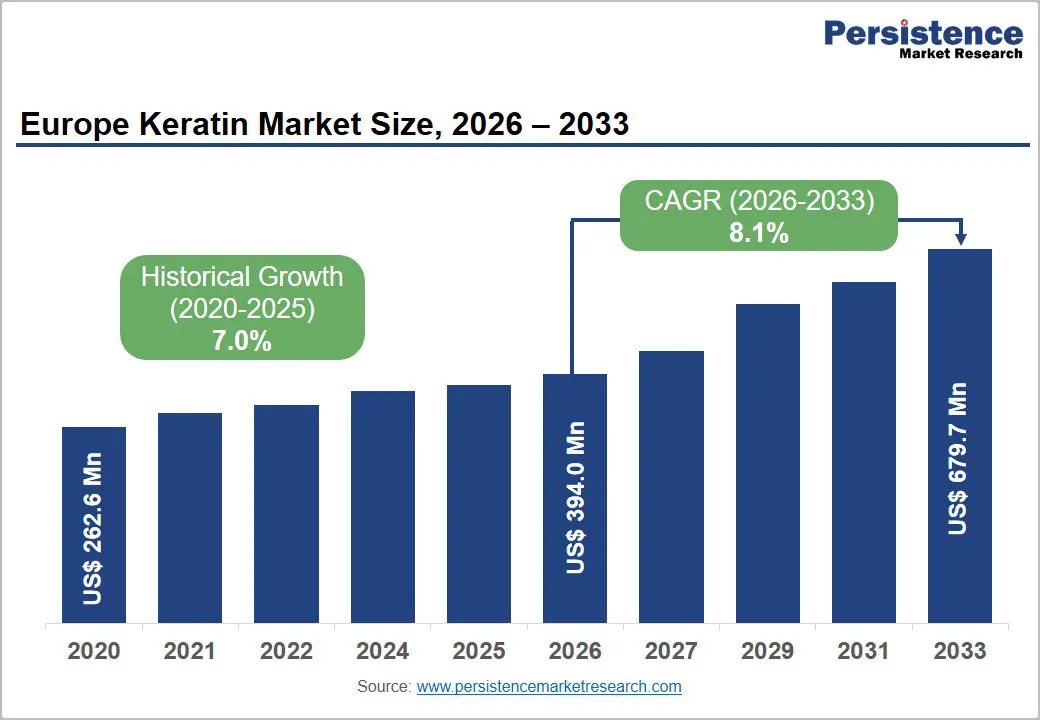
Europe keratin market size is expected to be valued at US$ 394.0 million in 2026 and is projected to reach US$ 679.7 million by 2033, growing at a CAGR of 8.1% between 2026 and 2033. This strong growth trajectory is primarily driven by surging consumer demand for premium hair care and personal care formulations, increasing adoption of keratin-based nutraceuticals, and the rising prevalence of hair and nail disorder management within European healthcare systems.
Europe's well-established cosmetics industry, valued at over EUR 80 billion according to Cosmetics Europe relies heavily on hydrolyzed and alpha-keratin as functional actives. Concurrently, growing awareness of sustainable, animal- and plant-derived protein sources is reshaping raw material sourcing strategies, attracting new investment across Germany, France, and the U.K. The market also benefits from favorable regulatory frameworks under EU Cosmetics Regulation (EC) No 1223/2009, which has enabled consistent market expansion across member states.
Key Industry Highlights
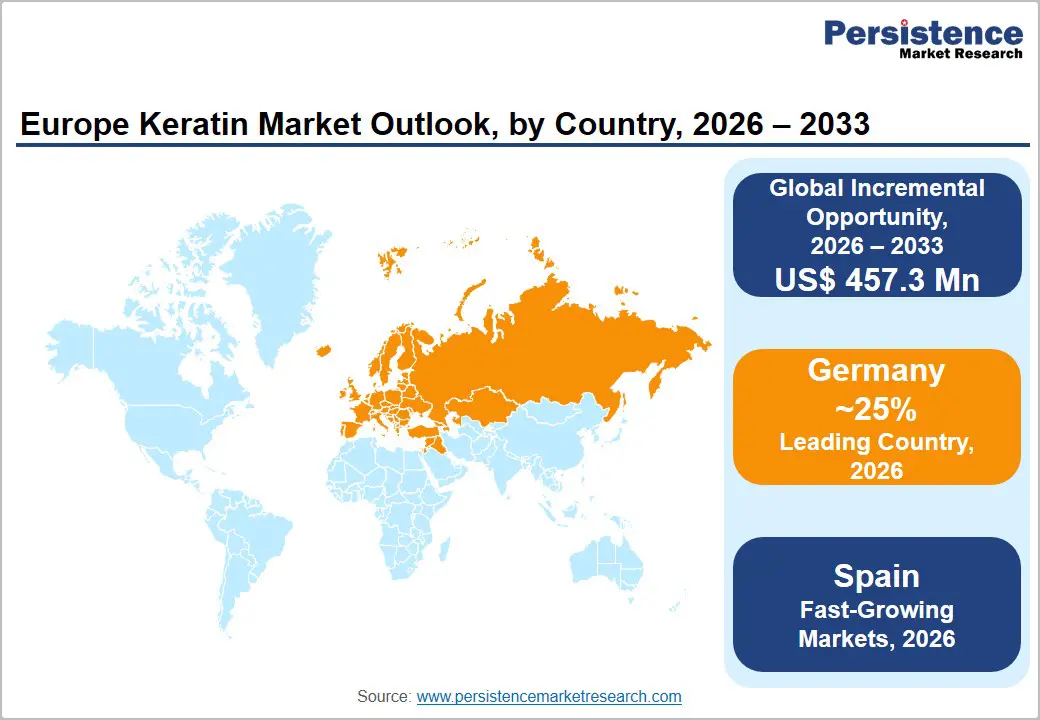
- Leading Country: Germany leads the Europe keratin market with 25% market share in 2025, driven by its world-class specialty chemicals industry, strong pharmaceutical sector, and premium personal care consumer spending.
- Fastest Growing Country: Spain is projected to register the highest national CAGR in Europe through 2033, fueled by rapid growth in professional beauty services, expanding nutraceutical adoption, and rising e-commerce beauty retail penetration.
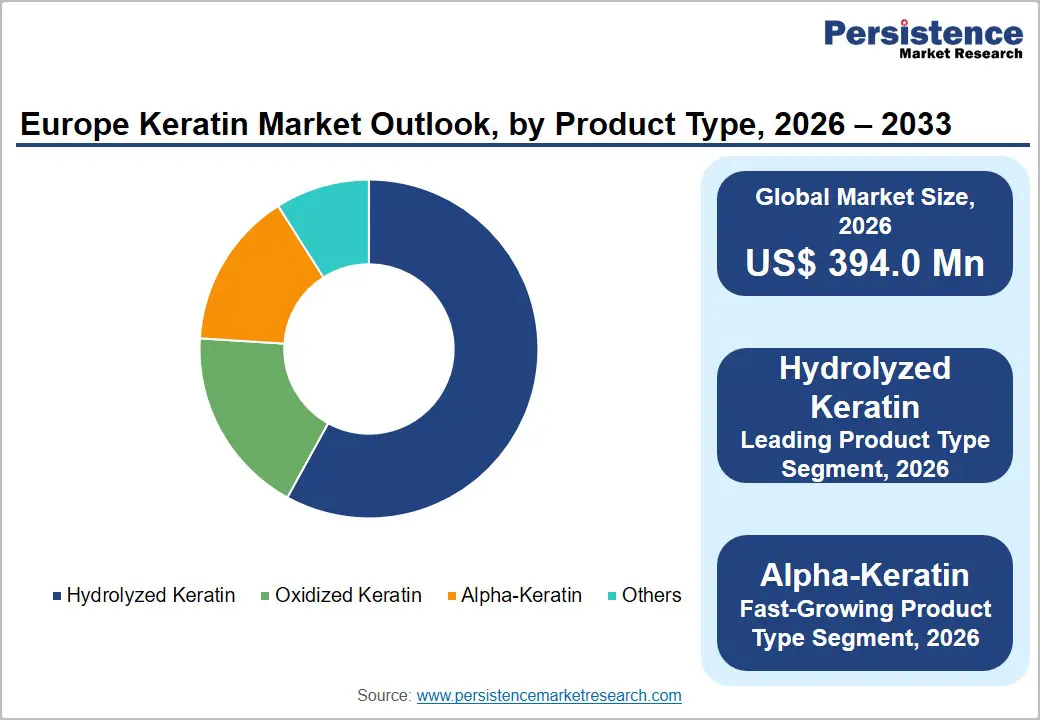
- Dominant Segment: Hydrolyzed Keratin leads the Product Type category with 58% European market share in 2025, underpinned by its broad functional versatility, superior scalp penetration, and universal acceptance in cosmetic formulations.
- Fastest Growing Segment: Alpha-Keratin is the fastest-growing product type through 2033, driven by emerging clinical evidence of its superior structural repair efficacy and growing adoption in premium, science-backed hair treatment formulations.
- Key Opportunity: The development of sustainable, plant-derived, and biotechnology-enabled keratin alternatives represents the most significant market opportunity through 2033, aligned with EU Green Deal objectives and surging vegan cosmetics demand.
Market Dynamics
Drivers - Booming Demand from Europe's Premium Personal Care and Cosmetics Industry
Europe's personal care and cosmetics sector represents one of the most dynamic end-markets for keratin ingredients, fueled by strong consumer spending on hair care, skin care, and professional salon treatments. According to Cosmetics Europe The Personal Care Association, the European cosmetics and personal care industry employs over 2 million people and generates annual retail sales exceeding EUR 80 billion, with hair care constituting one of the largest sub-segments.
Keratin proteins, particularly hydrolyzed forms, are widely used as film-forming agents, conditioning actives, and structural repair components in shampoos, conditioners, serums, and professional Brazilian blowout treatments. The accelerating trend toward science-backed, bioactive haircare, amplified by social media influence and dermatologist endorsements, is expanding demand for high-purity keratin ingredients among both mass and prestige cosmetics brands across Germany, France, Italy, and the U.K.
Restraints - Ethical and Regulatory Concerns Over Animal-Derived Keratin Sourcing
The predominant commercial source of keratin, including feathers, wool, horns, and hair raises significant ethical and sustainability concerns that are increasingly reflected in European regulatory scrutiny and consumer preferences. The EU's Animal By-Products Regulation (EC) No 1069/2009 imposes stringent requirements on the collection, processing, and traceability of animal-derived raw materials, adding compliance costs and operational complexity for manufacturers.
Rising demand for vegan and cruelty-free cosmetics, supported by the EU Cosmetics Regulation's prohibition on animal testing, is also creating competitive pressure from plant-based and synthetic protein alternatives, constraining growth prospects for conventional animal-derived keratin formulations in the premium cosmetics segment.
Opportunities - Expansion into Sustainable and Plant-Derived Keratin Innovations
The accelerating shift toward sustainability in European personal care and cosmetics presents a transformative opportunity for manufacturers that can develop and commercialize plant-derived or fermentation-based keratin alternatives. Euromonitor International has consistently identified sustainability and natural sourcing as among the top consumer purchasing drivers in European beauty markets. Brands responding to the European Green Deal and EU Farm to Fork Strategy are actively reformulating product lines to replace animal-derived actives with bio-based alternatives.
Companies investing in biotechnology-enabled keratin biosynthesis, leveraging microbial fermentation to produce human-identical keratin proteins, are positioned to capture significant market share as vegan beauty becomes mainstream.
Category-wise Analysis
Product Type Insights
The hydrolyzed keratin segment dominates Europe keratin market, likely to capture approximately 58% of total market revenue in 2026. This is driven by hydrolyzed keratin's superior functional versatility: the hydrolysis process reduces the molecular weight of native keratin, producing peptides and amino acids that readily penetrate the hair cortex and skin barrier to deliver measurable conditioning, strengthening, and anti-breakage benefits.
According to the International Cosmetic Ingredient Dictionary and Handbook maintained by the Personal Care Products Council (PCPC), hydrolyzed keratin appears in hundreds of approved INCI-listed cosmetic formulations, reflecting its universal acceptance among formulators. Its broad compatibility with surfactant systems, emulsifiers, and other actives further entrenches its dominance. The Alpha-Keratin segment, however, is emerging as the fastest-growing product type, driven by growing scientific evidence supporting its superior structural repair efficacy in damaged hair treatment applications.
Form Insights
The liquid form is likely to register a leading position, accounting for approximately 44% of the total market share in 2026. Liquid keratin formulations offer ease of incorporation into aqueous-based cosmetic systems, including shampoos, conditioners, leave-in treatments, and serums, making them the preferred choice for both professional salon brands and consumer-facing product lines. Their high bioavailability and uniform dispersion in water-based matrices enable consistent dosage and efficacy delivery.
The widespread use of liquid keratin concentrates in professional Brazilian straightening and bond-repair treatments, a segment that has experienced significant commercial growth across European salons, further reinforces this segment's dominance. Powder form is identified as the fastest-growing format, driven by expanding nutraceutical supplement applications and the clean beauty movement's preference for preservative-free, waterless formulations.
Regional Insights
Germany Europe Keratin Market Trends and Insights
Germany is likely to lead the keratin market in Europe, with nearly 25% of the total share in 2026. The country's dominance reflects the strength of its pharmaceutical and specialty chemicals industry, home to global ingredient suppliers including BASF SE and Clariant AG, which integrate keratin-derived actives into their personal care and life sciences portfolios. Germany's well-developed regulatory compliance infrastructure and strong R&D ecosystem support consistent product innovation.
German consumers exhibit high per-capita spending on premium hair care and functional nutraceuticals, sustained by a strong health-conscious culture and mature retail distribution networks. The country's professional salon sector, one of the largest in Europe, drives demand for high-performance keratin treatment systems. Regulatory alignment with EU Cosmetics Regulation (EC) No 1223/2009 and rigorous quality standards under ISO 22716 (GMP for cosmetics) further reinforce Germany's position as both a leading producer and consumer of premium keratin ingredients.
France Europe Keratin Market Trends and Insights
France holds a prominent position in the European keratin market, underpinned by its globally recognized status as the epicenter of luxury cosmetics and dermocosmetics. French cosmetics conglomerates including L'Oréal and brands within the LVMH portfolio, actively incorporate hydrolyzed keratin and bioactive peptide complexes into premium hair care and scalp treatment formulations. France's FEBEA (Fédération des Entreprises de la Beauté) reports that France's cosmetics industry exports exceed EUR 15 billion annually, maintaining its position as the world's leading cosmetics exporter.
The French market is characterized by strong clinical credibility requirements for cosmetic claims, driving demand for well-substantiated keratin actives with documented in vitro and in vivo efficacy data. The growing popularity of dermatologist-recommended hair and scalp care brands in French pharmacies a channel that commands significant consumer trust, is expanding keratin ingredient demand within the dermocosmetics segment. Regulatory oversight by ANSM (Agence nationale de sécurité du médicament) ensures high safety and quality standards, reinforcing brand credibility for keratin-containing cosmetic and pharmaceutical products in the French market.
Spain Europe Keratin Market Trends and Insights
Spain is identified as the fastest-growing national market for keratin in Europe over the forecast period 2026 - 2033, driven by rapid growth in its professional beauty services sector, expanding e-commerce beauty retail, and increasing consumer investment in hair health and treatment. Spain's professional hairdressing sector, estimated to employ over 200,000 professionals according to CINFAC (Confederación Española de Peluquería y Estética) is a robust channel for premium keratin smoothing and repair treatments. Growing urbanization and rising disposable incomes among younger Spanish consumers are further accelerating premium personal care adoption.
Spain's expanding nutraceutical market, supported by AESEG (Asociación Española de la Industria Farmacéutica Genérica) data indicating double-digit growth in food supplement consumption, is also creating new keratin demand in capsule and tablet formats targeting hair and nail health. International keratin ingredient brands are actively partnering with Spanish cosmetics formulators and salon chains to expand distribution. Additionally, Spain's Mediterranean climate, associated with UV-driven hair damage and specific scalp concerns, supports strong consumer receptivity to restorative keratin treatments, providing a sustained demand foundation for market participants.
Competitive Landscape
Europe keratin market presents a moderately fragmented competitive landscape, with a mix of multinational ingredient conglomerates, notably BASF SE, Croda International Plc, and Clariant AG and a significant number of specialized regional players including Kerline Srl, Pettenon Cosmetics S.p.A., and Tricobiotos S.p.A.
Market leaders differentiate through proprietary hydrolysis technologies, certified sustainable sourcing, and in-house application laboratories. Key strategic trends include vertical integration into raw material processing, investment in biotech-derived keratin platforms, expansion of e-commerce and DTC supplement channels, and co-development agreements with European cosmetics brands. Regional players compete primarily on specialized formulation expertise and flexible batch manufacturing capabilities tailored to niche cosmetic and nutraceutical applications.
Key Developments:
- July, 2025: Croda International Plc announced that it had registered a new trade name for its innovative non-animal keratin ingredient designed for hair repair applications. The development was positioned as part of its broader strategy to expand sustainable and bio-based cosmetic ingredients.
- January, 2025: Pettenon Cosmetics S.p.A. announced that it had completed a merger with G&P Cosmetics, strengthening its position in the professional haircare and salon-grade product segment. The merger was aimed at expanding its formulation capabilities, product portfolio, and distribution reach across European and international markets.
Companies Covered in Europe Keratin Market
- BASF SE
- Croda International Plc
- Kerline Srl
- LC Ingredients
- Sabelle Cosmetics
- GK Hair
- Keraplast Technologies
- Keune Haircosmetics
- Pettenon Cosmetics S.p.A.
- Tricobiotos S.p.A.
- PH Laboratories Srl
- Hipertin S.A.
- Stapiz
- Clariant AG
- Others
Frequently Asked Questions
Europe keratin market is projected to be valued at US$ 394.0 million in 2026.
Rising hair damage concerns, salon treatments demand, premium cosmetics growth, and increasing natural ingredient preference.
Germany leads the European keratin market with approximately 25% of the total regional market share in 2026.
Expanding natural cosmetics, biotech keratin innovations, premium salon services, and nutraceutical applications growth opportunities.
BASF SE, Croda International Plc, Clariant AG, Keraplast Technologies Kerline Srl, Pettenon Cosmetics S.p.A.


