




- Technology
- Europe Iris Biometrics in Healthcare Market
Europe Iris Biometrics in Healthcare Market Size, Share, and Growth Forecast 2026 - 2033
Europe Iris Biometrics in Healthcare Market by Component (Hardware, Software, Services), Deployment (On-Premises, Cloud-Based, Hybrid), Application, End-User, and Country Analysis for 2026 - 2033

Europe Iris Biometrics in Healthcare Market Size and Trends Analysis
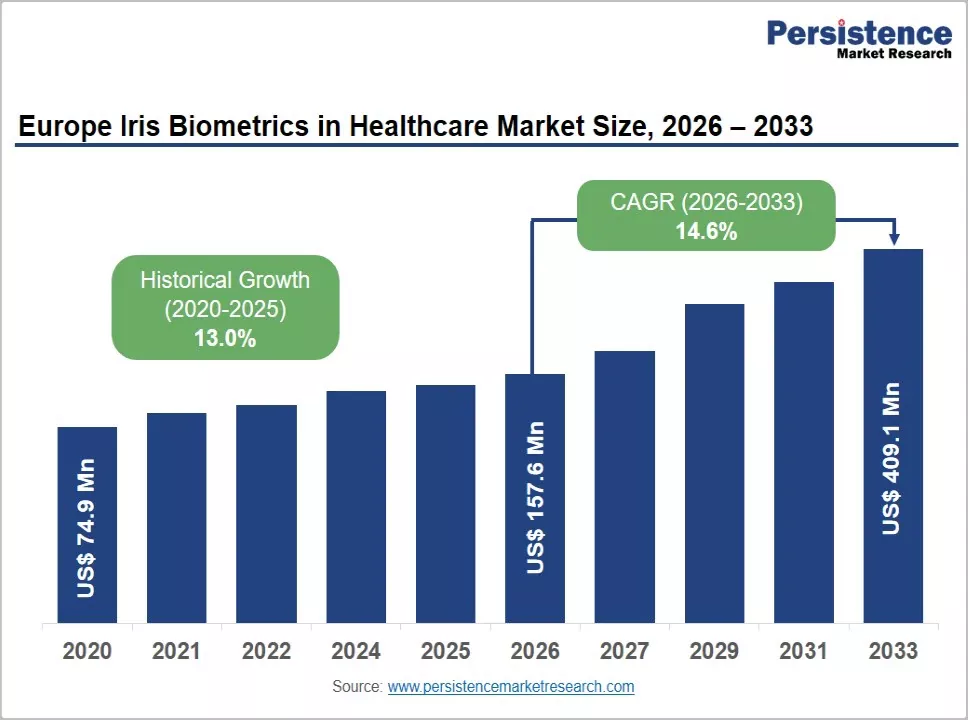
The Europe iris biometrics in healthcare market is expected to be valued at US$ 157.6 million in 2026 and is projected to reach US$ 409.1 million by 2033, growing at a CAGR of 14.6% between 2026 and 2033.
Rising incidents of medical identity fraud and the region's push toward interoperable digital health records are the primary factors driving the growth of the market. Hospitals across Germany, France, and the U.K. are replacing password- and card-based access with iris recognition to secure Electronic Health Record systems, reduce patient misidentification errors, and comply with strengthened data protection mandates such as the EU's Medical Device Regulation. Growing adoption of telehealth platforms further reinforces demand, as providers require contactless, high-accuracy authentication for remote consultations.
Key Industry Highlights
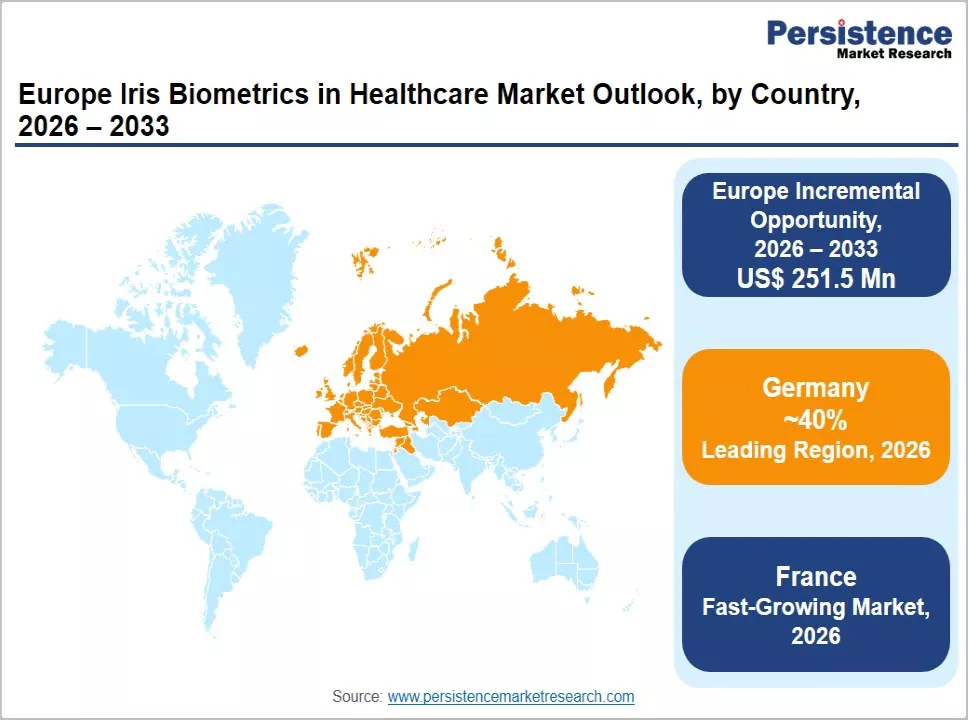
- Leading Country: Germany is likely to lead the Europe iris biometrics in healthcare market, holding around 40% share in 2026, driven by robust digital health infrastructure and strong hospital network investment across the country.
- Fastest-growing country: France represents the fastest-growing market, fueled by national e-health reforms, telehealth expansion, and rising government investment in hospital cybersecurity infrastructure.
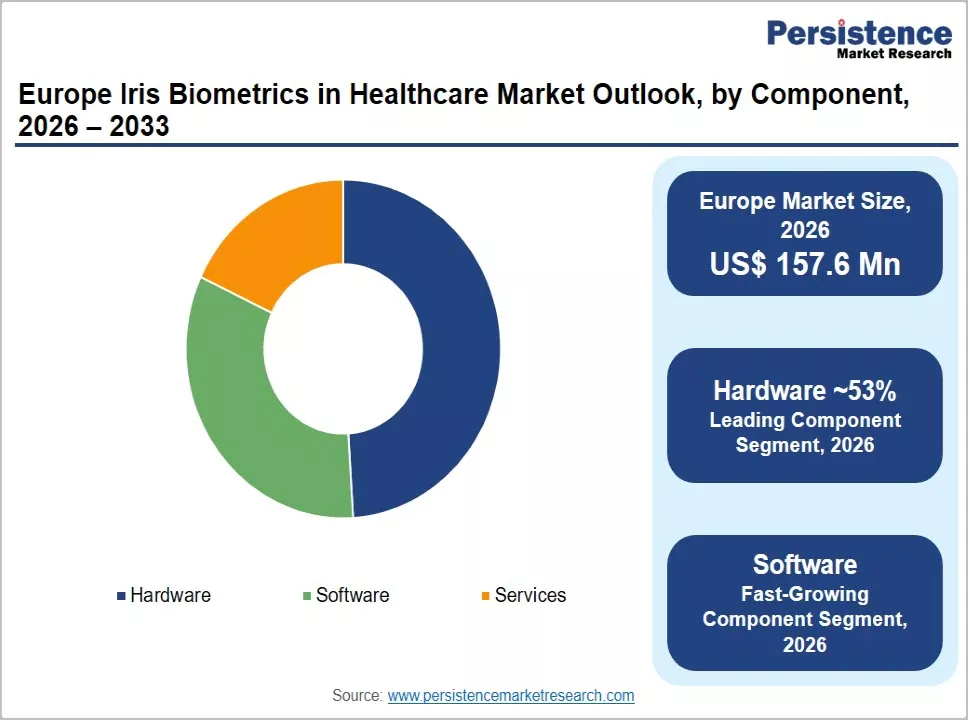
- Leading Segment: Hardware is the leading component segment, accounting for around 53% of the market share in 2026, as scanners and capture devices remain foundational to every iris biometric deployment across hospitals and clinics.
- Fastest-growing Segment: Software represents the fastest-growing component segment through 2033, driven by rising demand for cloud-integrated platforms and analytics tools supporting hospital-wide biometric authentication systems.
- Key Growth Opportunity: Cloud-based deployment and telehealth authentication present significant opportunity, as hospitals increasingly adopt scalable, subscription-based biometric solutions to serve smaller and remote healthcare facilities.
Market Dynamics
Drivers - Rising Cases of Patient Identity Errors and Medical Fraud
Misidentification of patients remains a persistent safety concern across European hospitals, prompting the adoption of iris recognition for accurate registration and record-matching. The European Commission's digital health initiatives emphasize unique patient identifiers, and iris scanning offers a non-contact, highly accurate alternative to manual verification. Health systems in Germany and France are piloting iris-based enrollment at admission desks to curb duplicate records, insurance fraud, and administrative errors, directly reducing costly re-testing and billing disputes.
As hospital networks digitize records under national e-health strategies, the reliability of iris biometrics in eliminating look-alike or shared-identity errors makes it a preferred safeguard, reinforcing sustained procurement across acute care and diagnostic facilities region-wide.
Expansion of Telehealth and Remote Patient Authentication Needs
Expanding telehealth services across Europe following pandemic-era adoption has created lasting demand for secure remote identity verification. Regulatory bodies including national health ministries in Germany and Italy now require stronger authentication before granting remote access to prescriptions and patient portals, and iris recognition satisfies this without physical contact. IDEMIA and Iris ID have expanded partnerships with telehealth platforms to embed iris capture through standard webcams and mobile devices, lowering the technology barrier. This convergence of remote care expansion and biometric security requirements continues to widen the addressable base of healthcare providers seeking iris-based authentication tools, particularly across ambulatory and long-term care settings that increasingly rely on virtual consultation.
Restraints - High Implementation and Integration Costs
Deploying iris recognition infrastructure across large hospital networks requires substantial capital investment in scanners, middleware, and integration with existing Electronic Health Record systems. Smaller clinics and ambulatory centers across Rest of Europe markets often lack the budget flexibility that larger hospital groups in Germany or the U.K. possess, delaying adoption cycles by several years. Ongoing calibration, staff training, and compliance validation add recurring costs, making return-on-investment calculations difficult for budget-constrained facilities and slowing broader market penetration.
Data Privacy and Regulatory Compliance Complexity
Biometric data is classified as sensitive personal information under the General Data Protection Regulation, subjecting iris recognition deployments to strict consent, storage, and audit obligations. Hospitals need to implement encrypted storage and limited-access protocols before deployment, and non-compliance risks significant financial penalties. This regulatory burden discourages some healthcare administrators from adopting biometric authentication, particularly in jurisdictions where enforcement of health-data rules has intensified, tempering the pace of procurement in several European markets.
Opportunities - Growing Integration with Cloud-Based Healthcare Platforms
The shift of European hospital IT infrastructure toward cloud-hosted systems creates a significant opportunity for iris biometrics vendors to embed authentication as a managed service rather than a costly on-site deployment. Cloud-based delivery reduces upfront hardware expenditure for smaller providers and allows centralized updates across multi-site hospital groups, a model already being piloted by Thales and TECH5 in partnership with regional health networks. As national digital health strategies in Germany and France prioritize interoperable cloud platforms, vendors offering software-as-a-service iris authentication stand to capture new contracts from mid-sized hospital chains and diagnostic laboratory networks that previously found on-premises systems cost-prohibitive, broadening the addressable customer base considerably over the coming years.
Rising Demand from Ambulatory and Long-Term Care Facilities
Ambulatory surgical centers and long-term care facilities across Europe are expanding rapidly as healthcare systems shift toward outpatient and community-based care models to manage aging populations. These facilities increasingly require lightweight, easily deployable authentication for staff access and medication dispensing, creating a fresh growth avenue for compact iris scanning devices.
Companies such as M2SYS Technology and BioEnable Technologies are tailoring portable iris capture units specifically for smaller care settings, priced and sized for facilities that cannot support full hospital-grade infrastructure. With Europe's elderly population continuing to grow, sustained investment in long-term care infrastructure presents a durable opportunity for vendors willing to adapt their product lines to smaller-scale healthcare environments.
Category-wise Analysis
Component Insights
Hardware represents the leading segment, holding around 53% share of the Europe iris biometrics in healthcare market in 2026. This leadership stems from the foundational role of iris scanners, cameras, and capture devices in every deployment, regardless of the software or service layer. Hospitals across Germany and France continue to prioritize high-precision optical sensors capable of functioning reliably under clinical lighting conditions and across diverse patient populations. Leading suppliers such as Iris ID and IriTech, Inc. have expanded their hardware portfolios with compact, medical-grade scanners designed for integration into existing hospital workstations, supporting the segment’s leading position.
Software represents the fastest-growing component segment, driven by increasing demand for biometric data management, identity verification, analytics, and seamless integration with electronic health record systems. Growing hospital digitization and the need for real-time identity authentication across registration, clinical, and administrative workflows are also supporting software adoption across European healthcare facilities.
Deployment Insights
On-premises deployment remains the leading segment, as large hospital networks prioritize direct control over sensitive biometric data storage and increasingly prefer locally hosted infrastructure. Facilities in Germany and the U.K. with established IT departments continue to use on-site servers to satisfy internal data governance policies and reduce dependence on third-party cloud infrastructure. This preference is reinforced by greater scrutiny of patient data handling under regional privacy frameworks, which supports in-house systems for organizations seeking direct control over data access and storage. Consequently, on-premises solutions retain a leading share among large acute-care institutions and specialized diagnostic centers that manage high patient volumes and require dedicated, locally hosted biometric databases.
Application Insights
Patient identification & registration represents the leading application segment, reflecting the core use case driving initial biometric adoption across European hospitals. Accurate identification at the point of admission helps reduce duplicate medical records and administrative errors, supporting health systems seeking to streamline patient intake and improve data accuracy. Hospitals in France and Italy have integrated iris scanning at registration desks to link patients with existing digital health records, supporting faster processing and more accurate patient matching. As the entry point for many biometric deployments, this application continues to account for a significant share of healthcare provider spending on iris recognition technology across the region.
End-User Insights
Hospitals & clinics represent the leading end-user segment, owing to their scale, patient volumes, and complex authentication requirements across registration, workforce access, and medication management. Large hospital groups across Germany and the U.K. operate multi-department facilities where consistent identity verification across numerous touchpoints supports investment in dedicated biometric infrastructure. These institutions also face stringent requirements for patient data accuracy and secure access, increasing demand for reliable authentication solutions. With ongoing hospital modernization programs across major European markets, this segment is expected to retain its leading position as a primary adopter of iris biometric systems in the near term.
Country-level Analysis
Germany Iris Biometrics in Healthcare Market Insights
Germany is expected to lead the Europe iris biometrics in healthcare market, capturing around 40% share in 2026, supported by its large hospital network and advanced digital health infrastructure. Government support for electronic patient record initiatives and a strong medical technology ecosystem continue to support adoption of iris-based authentication across healthcare facilities. Increasing focus on secure patient identification and workforce access further supports Germany’s position as a major market for healthcare iris biometrics.
U.K. Iris Biometrics in Healthcare Market Insights
The U.K. is projected to hold a significant share of the market in 2026, driven by National Health Service digitization programs and increasing emphasis on secure workforce authentication across large hospital trusts. Investment in telehealth infrastructure and remote patient verification tools is also supporting adoption of iris recognition technology across NHS-affiliated facilities. Continued digital transformation of healthcare workflows is expected to support demand for biometric identity solutions.
France Iris Biometrics in Healthcare Market Insights
France represents the fastest-growing market, propelled by national e-health reforms and expanding telehealth adoption. Government-backed digital health identity programs and increasing investment in hospital cybersecurity are accelerating the deployment of iris-based patient and workforce authentication across French healthcare facilities. Greater integration of digital identity solutions into healthcare workflows is also supporting demand for secure biometric technologies.
Competitive Landscape
The Europe iris biometrics in healthcare market is moderately fragmented, with established biometric technology providers competing alongside specialized healthcare-focused entrants. Leading companies are investing in research and development to enhance scanning accuracy, reduce hardware footprint, and integrate iris recognition with existing hospital IT ecosystems. Key differentiators include speed of capture, contactless operation, and compliance with regional data protection standards.
Strategic partnerships with electronic health record vendors and telehealth platforms are emerging as a common growth model, alongside increasing emphasis on cloud-delivered, subscription-based biometric services that lower adoption barriers for smaller healthcare providers across the region.
Key Industry Developments
- In December 2025, NEC Corporation developed a walk-through multimodal biometric authentication system that combines face and iris recognition to verify individuals accurately and quickly while they are walking, both indoors and outdoors. This hands-free technology aims to enhance security and reduce congestion at critical facilities, with proof-of-concept trials starting in fiscal 2026 and implementation targeted for fiscal 2027.
- In September 2025, Iris ID launched the IrisAccess iA1000 series, a new non-contact access control device that uses Iris-Face Fusion technology for fast and highly accurate authentication. It features dual iris and face cameras, a circular LCD touchscreen, Wi-Fi/PoE, OSDP/Wiegand support, AES 256-bit encryption, PAD, and an optional multi-format card reader for mobile credentials.
Companies Covered in Europe Iris Biometrics in Healthcare Market
- IDEMIA
- Princeton Identity
- EyeLock LLC
- M2SYS Technology
- Iris ID
- NEC Corporation
- IriTech, Inc.
- Thales
- Aware, Inc.
- TECH5
- CMITech
- HID Global
- BioEnable Technologies
- Others
Frequently Asked Questions
The market is expected to reach US$ 157.6 million in 2026.
Rising cases of patient misidentification and medical record fraud are encouraging hospitals to adopt iris recognition solutions, which offer accurate, contactless identity verification for registration and record access.
Germany is likely to lead the market while holding around 40% share in 2026, supported by its advanced digital health infrastructure and strong hospital investment.
Cloud-based deployment models present a major opportunity, allowing smaller hospitals and ambulatory centers to adopt iris authentication without heavy upfront hardware investment.
Leading players include IDEMIA, Princeton Identity, EyeLock LLC, Iris ID, NEC Corporation, Thales, HID Global, and TECH5, among others.


