




- Metals & Minerals
- Europe Cathode Material Market
Europe Cathode Material Market Size, Share, and Growth Forecast 2026-2033
Europe Cathode Material Market by Material Type (NMC, LFP, NCA, LCO, LMO), Battery Type (Li-ion, Lead Acid, Sodium-ion, Other), End-user (Automotive, Consumer Electronics, Energy Storage, Industrial, Power Tools), and Regional Analysis for 2026–2033

Europe Cathode Material Market Size and Trend Analysis
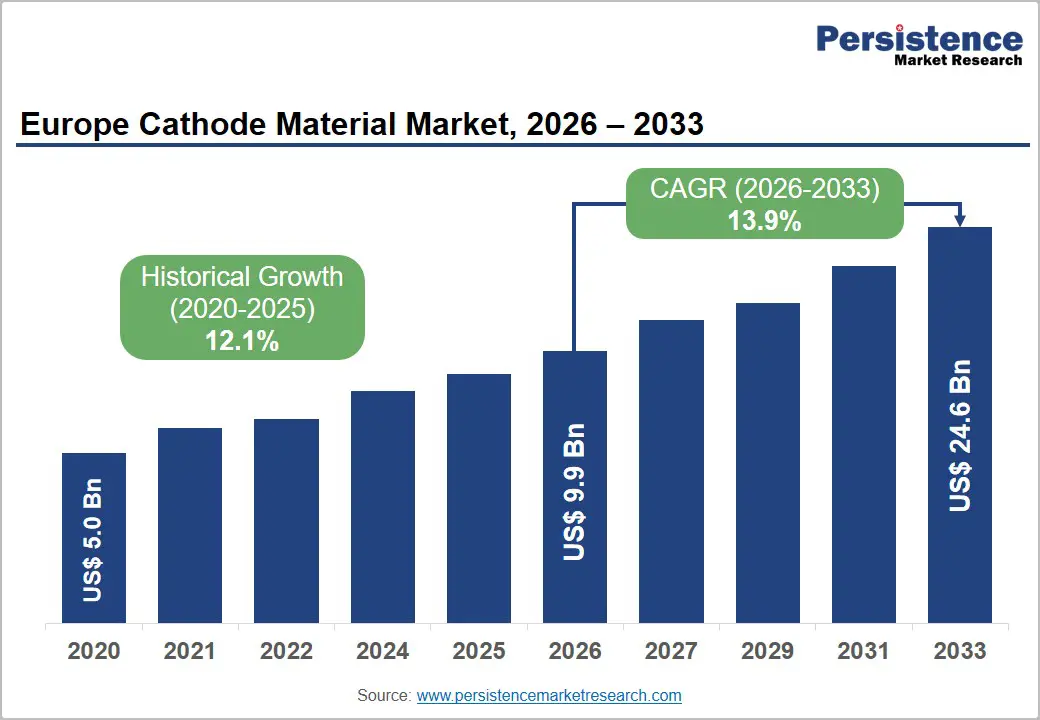
The Europe Cathode Material market size is expected to be valued at US$ 9.9 billion in 2026 and projected to reach US$ 24.6 billion by 2033, growing at a CAGR of 13.9% between 2026 and 2033.
Europe's cathode material market is experiencing compounding structural growth, driven by the continent's legally binding 2035 combustion engine ban under EU Regulation 2023/851, the accelerating deployment of utility-scale battery energy storage systems, and the strategic push to establish a sovereign European battery supply chain under the European Battery Alliance (EBA) and Critical Raw Materials Act (CRMA 2024).
The European Automobile Manufacturers' Association (ACEA) reported that battery electric vehicles accounted for 14.6% of new car registrations in the EU in 2023, with EV penetration advancing progressively, each electric vehicle requiring 40–90 kg of cathode material per battery pack, creating a direct, unit-volume-correlated demand driver that will sustain above-market growth through 2033 as European OEM electrification timelines converge.
Key Industry Highlights:
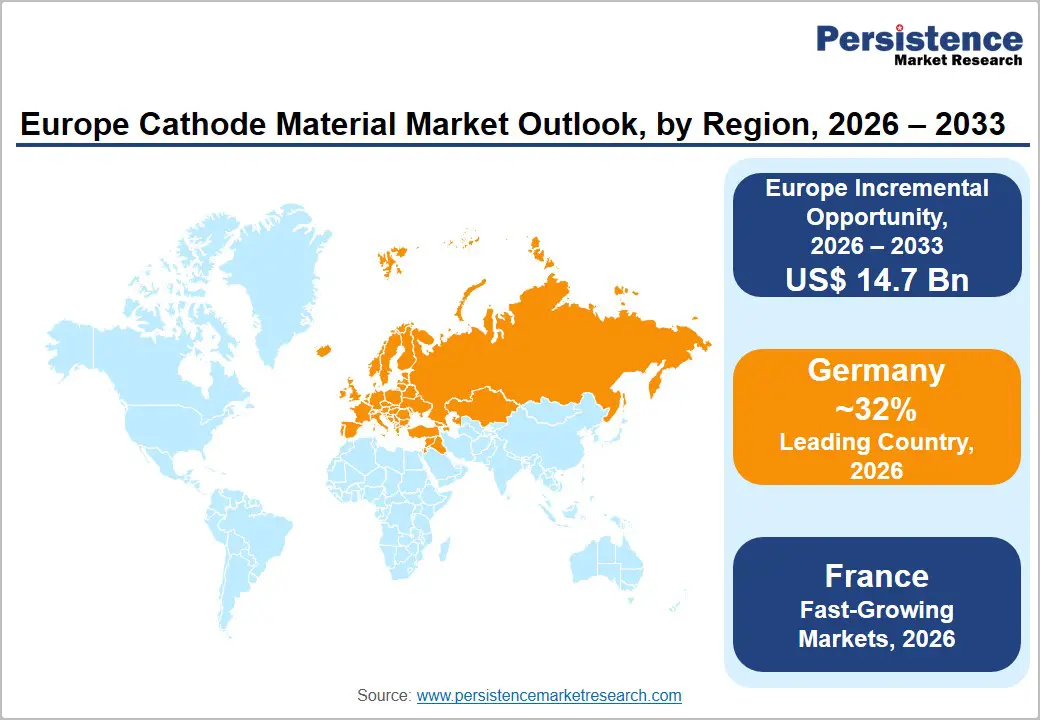
- Leading Region: Germany leads the European cathode material market with approximately 32% share in 2026, anchored by Volkswagen, BMW, and Mercedes-Benz EV production volumes, BASF's Schwarzheide domestic cathode plant, and CATL's 100 GWh Erfurt gigafactory, creating permanent high-volume cathode intake demand within European borders.
- Fastest Growing Region: France is Europe's fastest-growing cathode material market at an estimated CAGR of approximately 22%, powered by ACC and Verkor gigafactory constructions backed by €2 billion from France 2030, positioning France to become Europe's second-largest cathode material market before 2030 as gigafactory capacity reaches full production.
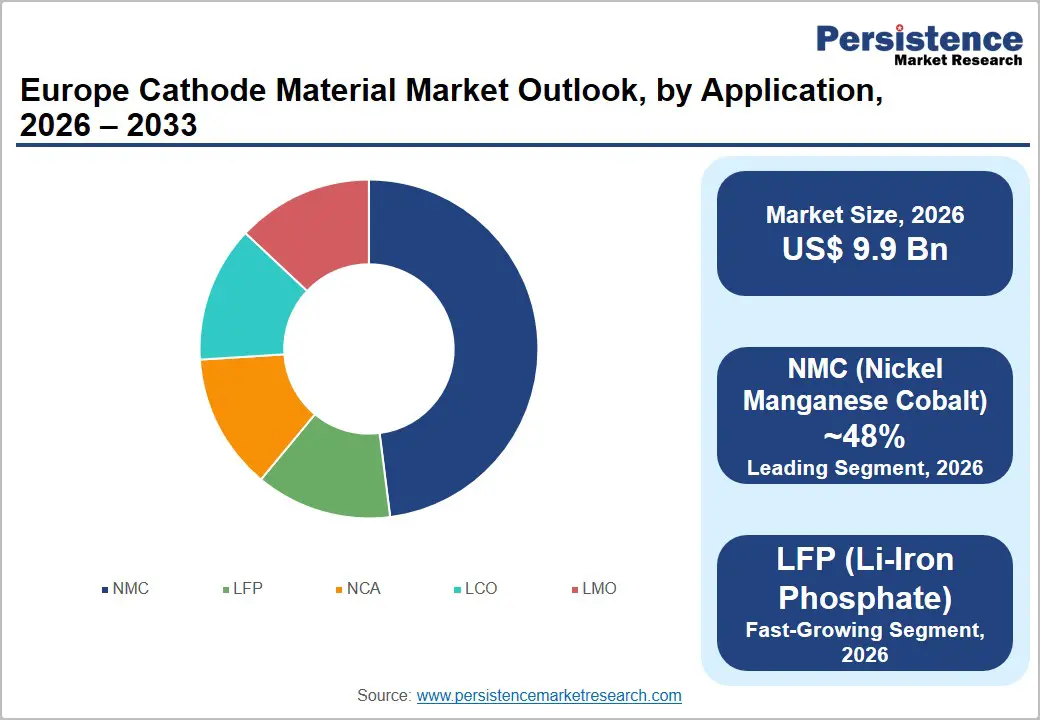
- Leading Segment: NMC dominates the material type segment with approximately 48% European market share in 2026, entrenched by OEM specifications at BMW, Mercedes-Benz, and Audi premium BEV platforms and by BASF and Umicore established design-win positions that sustain NMC's structural leadership across high-energy-density automotive applications.
- Fastest Growing Segment: LFP is the fastest-growing cathode chemistry at an estimated CAGR of approximately 20% through 2033, driven by cobalt-free supply chain advantages, superior thermal safety, 3,000–4,000 cycle lifetimes, and adoption by Tesla and Volkswagen in entry-level BEV platforms and commercial vehicle electrification programs targeting total-lifecycle-cost-optimized fleet operators.
- Key Market Opportunity: The highest-value market opportunity lies in LFP and NMC cathode supply for European stationary energy storage, where REPowerEU's 600 GW renewable energy target is driving BESS deployments from 17 GWh (2023) to 50+ GWh annually by 2027 (SolarPower Europe), creating long-term, high-volume cathode procurement under project contracts with built-in supply chain transparency requirements favoring EU-produced, CRMA-compliant cathode materials.
DRO Analysis
Drivers - EU 2035 ICE Ban and Automotive Electrification Investment
The European Union's binding 2035 internal combustion engine sales ban has triggered the largest automotive capital reallocation in European industrial history, directly generating compounding cathode material demand as every major European OEM accelerates BEV platform investment under legally enforceable compliance timelines. Volkswagen Group has committed €180 billion to electrification by 2030, Stellantis announced €30 billion in EV investment, and BMW Group targets 50% of global sales as BEVs by 2030, each programme representing decades of cathode material procurement at scale.
The European Battery Alliance (EBA) estimates that European battery cell demand will reach approximately 1,200 GWh annually by 2030, requiring cathode active material at 4–6 kg per kWh of battery capacity, implying cathode material demand equivalent to millions of tons annually within the decade. This regulatory-mandated demand pull is structurally unlike any previous industrial procurement cycle in durability, scale, and policy enforceability.
European Battery Alliance Gigafactory Build-Out
The systematic development of European battery gigafactories, catalyzed by the European Battery Alliance (EBA), Important Projects of Common European Interest (IPCEI) on Batteries I & II, and national industrial policy programmes in France, Germany, Hungary, and Poland, is creating geographically proximate, large-scale cathode material procurement demand that favors regional suppliers with established GRS traceability compliance.
Active gigafactory investments include Northvolt, Automotive Cells Company, Verkor, PowerCo, and CATL's Erfurt facility, each representing multi-year cathode material offtake agreements that provide demand visibility of unprecedented duration for cathode producers. BASF SE's Schwarzheide cathode active material plant and Umicore N.V.'s planned European cathode material expansion are strategically positioned to capture this domestic procurement pipeline as European OEMs seek to reduce Chinese supply dependency under the EU's CRMA supply chain diversification mandate.
Restraints - Critical Raw Material Supply Concentration Creating Structural Supply Chain Vulnerability
Europe's cathode material market faces a fundamental structural vulnerability in its dependence on geographically concentrated critical raw material supplies, particularly cobalt (the Democratic Republic of Congo accounts for ~70% of global production, per the USGS), lithium, and nickel. The EU Critical Raw Materials Act (CRMA 2024) formally classifies these materials as strategic, acknowledging that the continent currently produces less than 3% of its battery raw material requirements domestically.
For cathode material producers, this supply concentration creates input cost volatility, ESG compliance risk from artisanal mining practices in DRC, and geopolitical exposure that complicates long-term procurement planning and raises the risk premium attached to European cathode manufacturing cost structures versus Asian competitors with established integrated supply chains.
Dominance of Vertically Integrated Chinese Manufacturers
Chinese cathode material producers, led by CATL, Hunan Shanshan, Beijing Easpring, and GEM Co., benefit from vertically integrated supply chains spanning lithium mining, precursor chemical production, and cathode active material manufacturing that deliver manufacturing cost structures 20–35% lower than European equivalents at equivalent specification. The China Association of Automobile Manufacturers (CAAM) reported China produced over 9.4 million BEVs in 2023, creating domestic cathode demand volume that enables Chinese producers to achieve scale economies unavailable to European manufacturers currently in the ramp-up phase.
European producers face the dual challenge of competing on cost against Chinese incumbents while simultaneously investing in responsible sourcing, carbon-border-compliant manufacturing, and circular economy recovery infrastructure mandated by the EU Battery Regulation (2023/1542), a compliance cost burden that has no equivalent for Chinese producers supplying non-EU markets.
Opportunities - LFP Cathode Material as the Fastest-Growing Chemistry Driven by Cost and Lifecycle Advantages
Lithium iron phosphate (LFP) cathode materials are the fastest-growing segment in the European cathode material market, with a projected compound annual growth rate (CAGR) of approximately 20% through 2033. This growth is driven by LFP's structural benefits, including the absence of cobalt, reducing supply risks, excellent thermal stability, and a cycle life exceeding 3,000 to 4,000 charge cycles. These attributes make LFP particularly appealing to European fleet operators, commercial vehicle manufacturers, and stationary energy storage developers who prioritize total lifecycle costs over gravimetric energy density.
Tesla's adoption of LFP in standard-range models, Volkswagen's launch of LFP-based entry-level electric vehicles, and CATL’s innovative Shenxing LFP fast-charging technology, which can achieve a 400 km charge in just 10 minutes, are normalizing LFP acceptance among European consumers and original equipment manufacturers (OEMs) historically focused on nickel manganese cobalt (NMC) chemistry. European producers such as Arkema S.A. and various emerging specialists are well-positioned to fulfill the growing demand for CRMA-compliant, cobalt-free cathode materials.
Rising Stationary Energy Storage Deployment
The rapid expansion of grid-scale and behind-the-meter battery energy storage systems in Europe is driven by the EU's REPowerEU Plan, which targets 600 GW of renewable energy capacity by 2030 and necessitates battery storage for managing energy intermittency. SolarPower Europe reports that installations of battery energy storage systems (BESS) reached 17.2 GWh in 2023, with projections suggesting annual deployment will exceed 50 GWh by 2027 as grid operators integrate storage with wind and solar resources.
For cathode material producers, stationary storage presents a strategic opportunity. It facilitates high-volume adoption of lithium iron phosphate (LFP) chemistry through long-term contracts, while also benefiting from EU funding under the Trans-European Energy Infrastructure (TEN-E) Regulation and national capacity market mechanisms that provide multi-year revenue visibility for project developers.
Category-wise Insights
Material Type Insights
NMC (Nickel Manganese Cobalt oxide) cathode materials hold the dominant position in the European cathode material market, commanding approximately 48% of total share in 2026. NMC's leadership in Europe reflects the chemistry's optimised balance of high energy density (150–220 Wh/kg), sufficient cycle life, and established OEM qualification across the dominant European EV product categories, premium passenger cars, and performance-oriented BEV segments where energy density per kilogram directly determines vehicle range at equivalent battery weight.
European OEMs, including BMW, Mercedes-Benz, Audi, and Renault, have built their flagship EV platforms around NMC cell chemistry, creating entrenched procurement specifications that sustain NMC's dominant share across the near-to-medium term. BASF SE's HED NMC series and Umicore's NMC cathode products hold established European OEM design-win positions that reinforce the segment's structural supply stability, even as LFP gains share in entry-level and commercial segments.
Battery Type Insights
Li-ion batteries dominate the European cathode material market by battery type, accounting for approximately 82% of total share in 2026. Li-ion's commanding position reflects the technology's structural lock-in across the automotive, consumer electronics, and energy storage application segments that collectively define European cathode material demand, each application relying on the specific energy density, cycle performance, and charging rate characteristics that lithium intercalation cathode chemistry delivers at commercially competitive cost structures.
The European Battery Alliance (EBA) projects all European gigafactory investment through 2030 to be concentrated in Li-ion cell formats, cementing cathode active material demand around lithium-based chemistries for the remainder of the decade. Sodium-ion batteries represent the fastest-growing battery type segment, projected at a CAGR of approximately 25% from a nascent base, as producers including CATL and HiNa Battery advance sodium cathode material technology toward commercial viability for stationary storage applications where lithium's cost premium is a barrier.
End-user Insights
The automotive segment leads the European cathode material market by end use with approximately 68% of total market share in 2026, a dominance that reflects the singular structural reality of European cathode material demand: the continent's EV transition is the primary and overwhelmingly largest driver of cathode active material procurement at every tier of the supply chain. Each battery electric vehicle deployed on European roads requires between 40 and 90 kg of cathode active material, depending on battery capacity, creating a direct, computable demand multiplier between EV sales volumes and cathode procurement.
The European Automobile Manufacturers' Association (ACEA) confirms that over 1.5 million BEVs were registered in the EU in 2023, with annual volumes projected to scale to 6–8 million units by 2030 under the 2035 ICE ban trajectory, each increment adding proportionally to cathode material demand at European gigafactory supply chains. Energy Storage is the fastest-growing end-use segment at an estimated CAGR of approximately 20% through 2033, driven by REPowerEU grid storage mandates.
Regional Insights
Germany Cathode Material Market Insights
Germany is projected to capture approximately 32% of the European cathode material market by 2026, contributing an estimated US$ 2.83 billion and experiencing a compound annual growth rate (CAGR) of 14.2% through 2033. This leadership is supported by the headquarters of major BEV OEMs, Volkswagen Group, BMW AG, and Mercedes-Benz, creating a substantial domestic procurement pipeline.
The German Federal Government has committed over €14 billion to the battery value chain through initiatives like the Zukunftsinvestitionsprogramm and IPCEI Battery II, strengthening Germany’s role as both the leading consumer and an emerging producer of cathode materials in Europe. In response to U.S. tariff escalations in 2025, German OEMs are encouraged to source European cathode suppliers, benefiting local operations of companies like BASF and Umicore.
France Cathode Material Market Insights
France is Europe's fastest-growing cathode material market, projected at a CAGR of approximately 22%, the highest among all major European economies, driven by the French government's "France 2030" industrial plan committing €2 billion specifically to the domestic battery value chain and the emergence of France as the continent's most ambitious new gigafactory geography.
Geopolitically, France's Strategic Autonomy industrial doctrine is accelerating cathode supply chain localisation, and China's assertive rare earth pricing strategies have directly prompted France's Bureau de Recherches Géologiques et Minières (BRGM) to advance critical mineral prospecting programs in French territories and francophone Africa.
Belgium Cathode Material Market Trends
Belgium holds approximately 18% of the European cathode material market in 2026, representing an estimated US$ 1.59 billion, reaching at a CAGR of 13.5%. Belgium's disproportionate market position relative to its economic size is almost entirely attributable to Umicore N.V., whose European cathode manufacturing operations at Hanau (Germany) and planned gigascale expansion make Belgium the continent's single most strategically significant cathode material industry location.
U.S. tariff policy has created an indirect opportunity for Belgian cathode producers: European OEMs accelerating de-risking from Chinese cathode supply are qualifying Umicore's production under EU Battery Regulation supply chain transparency requirements, strengthening Belgium's export position within European battery supply chains.
Competitive Landscape
Europe cathode material market is moderately consolidated at the technology-differentiated tier, with BASF SE, Umicore N.V., and Johnson Matthey collectively anchoring European-headquartered cathode production, while Korean producers LG Chem, POSCO Future M, and Ecopro BM are establishing European manufacturing presences through gigafactory-adjacent supply facilities. Key competitive differentiators include NMC chemistry variant development (high-nickel NMC 811, NMC 9.5.5), EU Battery Regulation traceability compliance, carbon footprint certification, and established OEM design-win qualification pedigrees.
The strategic landscape is shaped by vertical integration investment: leaders are securing lithium, nickel, and cobalt upstream supply while simultaneously investing in battery recycling to create closed-loop cathode material recovery systems that improve both ESG credentials and raw material cost security, a capability that will define competitive positioning through the forecast horizon.
Key Developments:
- May 2026: Hunan Yuneng received a building permit for its cathode material production facility in Mérida, Spain, enabling construction to move into the implementation phase. The project includes an initial annual production capacity of 50,000 tons of lithium iron phosphate (LFP) cathode material, with future expansion planned up to 300,000 tons to support Europe’s growing EV battery supply chain.
- March 2026: Samsung SDI secured a mid-to-long-term supply agreement with L&F for lithium iron phosphate (LFP) cathode materials valued at approximately KRW 1.6 trillion. The partnership supports ESS battery production and strengthens supply-chain diversification, reducing dependence on Chinese suppliers while reinforcing cathode material demand and manufacturing ecosystems.
- January 2026: CATL secured a long-term lithium iron phosphate (LFP) cathode material supply agreement with Ningbo Ronbay covering approximately 3.05 million tons from 2026–2031. The deal strengthens raw material security and supply-chain resilience, supporting growing battery production demand and reinforcing cathode material availability for the expanding EV and energy storage ecosystem, including European battery market development.
Europe Cathode Material Market – Key Insights & Details
| Key Insights | Details |
|---|---|
|
Historical Market Value (2020) |
US$ 5.0 Billion |
|
Current Market Value (2026) |
US$ 9.9 Billion |
|
Projected Market Value (2033) |
US$ 24.6 Billion |
|
CAGR (2026–2033) |
13.9% |
|
Leading Country |
Germany, ~32% market share (2026) |
|
Dominant Segment (Material Type) |
NMC, ~48% market share (2026) |
|
Top-ranking Segment (End Use) |
Automotive, ~68% market share (2026) |
|
Incremental Opportunity (2026–2033) |
US$ 14.7 Billion |
Companies Covered in Europe Cathode Material Market
- BASF SE
- Umicore N.V.
- Johnson Matthey plc
- Arkema S.A.
- CATL
- Sumitomo Metal Mining
- Mitsubishi Chemical Group
- LG Chem Ltd.
- POSCO Future M
- Ecopro BM
- Pure Battery Technologies
- Resonac Holdings (Hitachi Chemical)
- 3M Company
- Samsung SDI
- Kureha Corporation
- Northvolt AB
Frequently Asked Questions
Europe cathode material market size is expected to be valued at US$ 9.9 billion in 2026 and projected to reach US$ 24.6 billion by 2033, growing at a CAGR of 13.9%, representing a cumulative incremental opportunity of US$ 14.7 billion, driven by the legally binding EU 2035 ICE ban, European gigafactory build-out, and the Critical Raw Materials Act (CRMA 2024) mandating European cathode supply chain diversification.
The primary drivers are the EU 2035 combustion engine sales ban (EU Regulation 2023/851) creating a legally mandated EV transition that directly generates cathode material demand, and the European Battery Alliance (EBA) gigafactory investment pipeline targeting 1,200 GWh of annual European battery cell capacity by 2030 at 4–6 kg cathode material per kWh, generating cathode procurement volumes that will underpin above-market CAGR through the forecast horizon.
NMC leads with approximately 48% European market share in 2026, entrenched by its adoption across premium BEV platforms from BMW, Mercedes-Benz, and Audi, and by BASF SE and Umicore N.V.'s established European OEM design-win positions. NMC's superior energy density (150–220 Wh/kg) makes it the preferred chemistry for range-prioritized passenger car applications that define the current European EV market structure.
Germany leads with approximately 32% of the European cathode material market share in 2026, anchored by the EU headquarters of Volkswagen Group, BMW AG, and Mercedes-Benz, BASF SE's Schwarzheide cathode active material plant, and CATL's 100 GWh Erfurt gigafactory, making Germany simultaneously Europe's largest cathode material consumer and a rapidly developing domestic production hub aligned with EU CRMA supply chain localization objectives.
The highest-value strategic opportunity is supplying LFP and NMC cathode materials for European grid-scale stationary energy storage, where SolarPower Europe projects BESS installations scaling from 17.2 GWh (2023) to 50+ GWh annually by 2027 under REPowerEU targets, creating long-term, project-contracted cathode procurement with built-in EU Battery Regulation supply chain transparency requirements that structurally favor CRMA-compliant European or European-qualified cathode material suppliers over non-EU alternatives.


