




- Biotechnology
- Endomyocardial Biopsy Market
Endomyocardial Biopsy Market Size, Share, and Growth Forecast, 2026 - 2033
Endomyocardial Biopsy Market by Product (Biopsy Forceps, Accessories, Bioptomes), Tip Design (Maxi-curved, Pre-curved), Application, End User and Regional Analysis for 2026 - 2033

Endomyocardial Biopsy Market Size and Trends Analysis
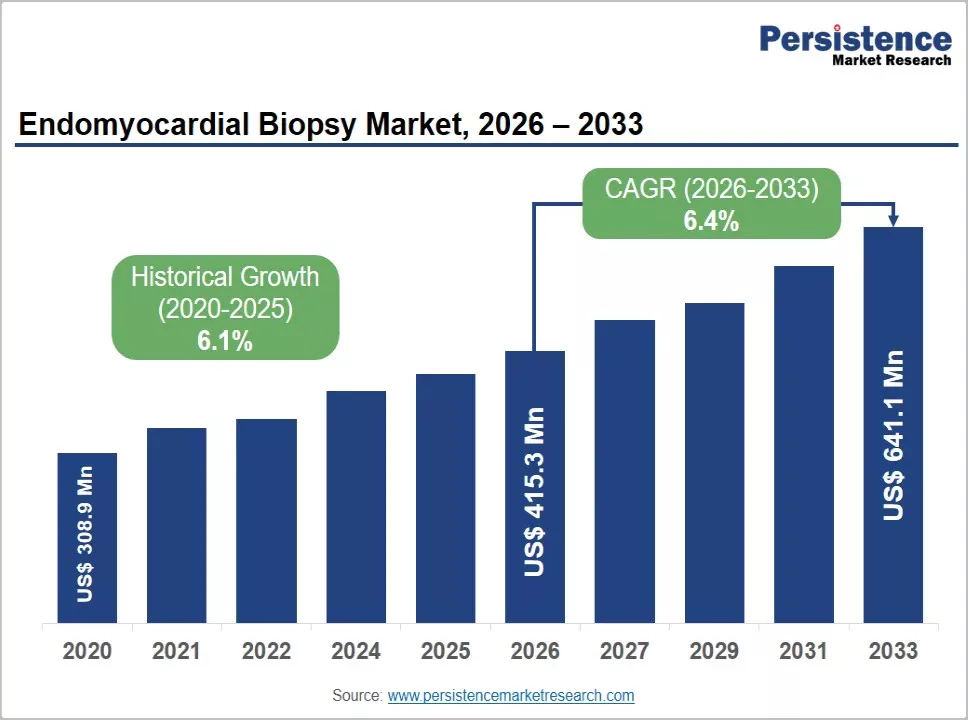
The global endomyocardial biopsy market size is likely to be valued at US$ 415.3 million in 2026 and is expected to reach US$ 641.1 million by 2033, growing at a CAGR of 6.4% between 2026 and 2033, driven by sustained heart transplant surveillance, rising diagnostic demand in myocarditis and cardiomyopathy, and wider use of tissue confirmation in cardiac amyloidosis. Growing heart failure prevalence and procedural advances in sheath and guidance technologies continue to support procedure volumes.
Key Industry Highlights
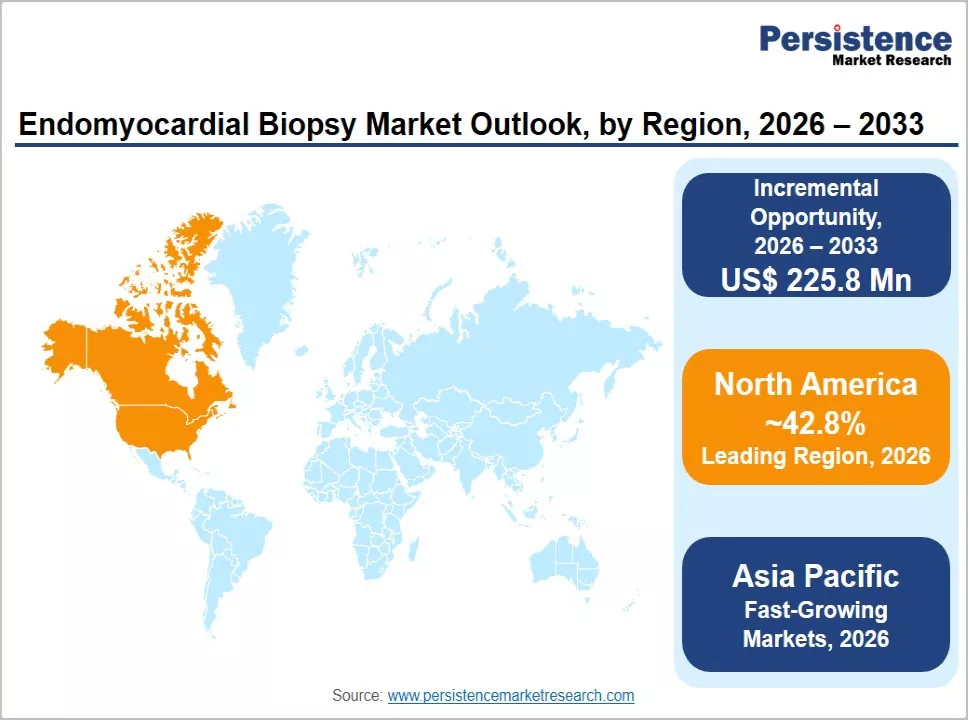
- Leading Region: North America, anticipated to account for 42.8% of the market share, supported by large heart transplant programs, an established cardiac catheterization infrastructure, and structured reimbursement for the procedure.
- Fastest-growing Region: Asia Pacific, driven by expanding cardiovascular specialty care, maturing transplant programs, and rising referrals for histological diagnosis of cardiomyopathy.
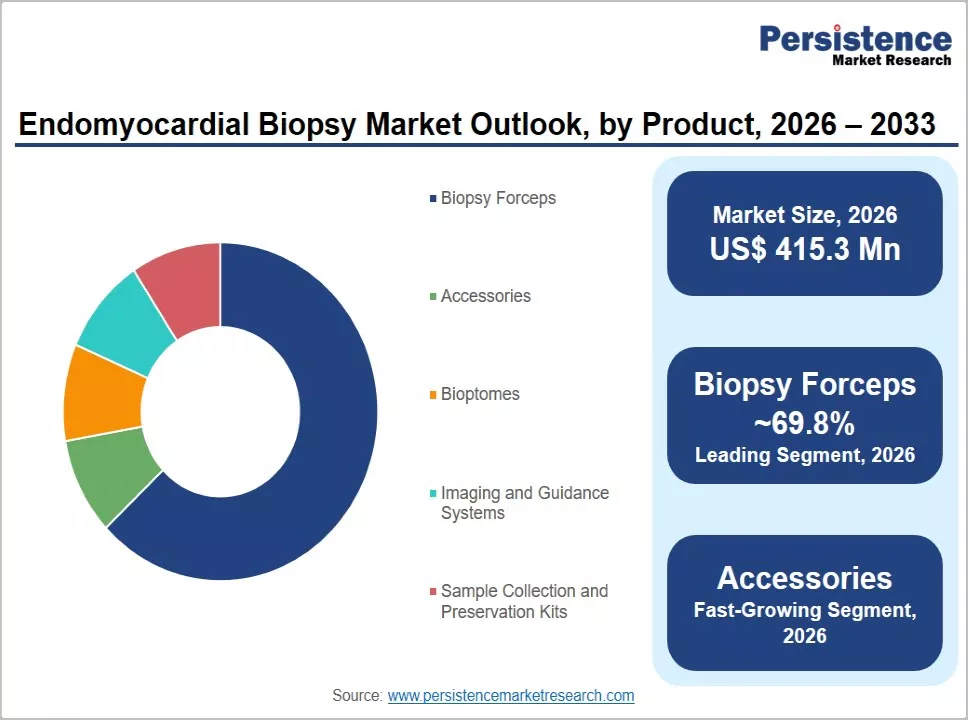
- Dominant Product: Biopsy forceps, anticipated to hold 69.8% of the market in 2026, as every procedure requires forceps to collect multiple tissue samples.
- Leading Application: Heart transplant rejection monitoring, anticipated to account for 41.6% of the market share, supported by guideline-based graft surveillance after transplantation.
DRO Analysis
Drivers - Heart Transplant Surveillance and a Growing Heart Failure Population Sustain Procedure Demand
Heart transplantation remains the largest application area for endomyocardial biopsy. According to the Organ Procurement and Transplantation Network, annual heart transplant volume in the U.S. exceeded 4,500 in 2023, and recipients continue to undergo biopsy-based rejection assessment, particularly during the first post-transplant year.
The American Heart Association estimates that approximately 6.7 million U.S. adults live with heart failure, expanding the pool of patients evaluated for myocarditis, infiltrative disease, and unexplained cardiomyopathy. Higher transplant volumes and a larger heart failure population increase procedure counts, which lifts demand for biopsy forceps, sheaths, and guidance accessories.
Expanding Clinical Indications in Myocarditis and Cardiac Amyloidosis Are Widening Diagnostic Use
Clinical guidance defines a clear role for tissue diagnosis. The joint scientific statement of the American Heart Association, American College of Cardiology, and European Society of Cardiology lists specific scenarios for endomyocardial biopsy, including acute heart failure with suspected myocarditis, and the European Society of Cardiology position statement on myocarditis supports biopsy for definitive diagnosis.
Cardiac amyloidosis and cardiac sarcoidosis add further demand, as non-invasive imaging does not always distinguish disease subtypes. Research published in Heart Rhythm in February 2025 reported previously undetected cardiac amyloidosis in 4 of 20 patients (20%) through biopsy performed during device implantation. These findings are expanding patient groups referred for histology.
Restraint - Procedural Risk and Non-Invasive Surveillance Alternatives Limit Procedure Volumes
Endomyocardial biopsy is an invasive catheter-based procedure with a reported complication risk of up to 3%, including perforation, tamponade, and arrhythmia. This risk restricts use to cases in which non-invasive methods do not provide a definitive diagnosis. Donor-derived cell-free DNA testing and gene expression profiling are replacing routine surveillance biopsies in selected low-risk transplant recipients, and recent guidelines of the International Society for Heart and Lung Transplantation recognize these approaches. Medicare coverage of up to 12 molecular surveillance tests in the first post-transplant year, finalized in July 2026, reinforces this shift. Fewer protocol biopsies exert pressure on the largest application segment.
Opportunities - Opportunistic Biopsy During Device Implantation and Image-Guided Techniques Create New Procedure Pathways
Procedural innovation is creating new routes for tissue sampling. Studies published in Heart Rhythm in 2025 evaluated right ventricular septal biopsy through a three-dimensional delivery sheath during cardiac implantable electronic device implantation, using a single venous access for both procedures. Investigators reported no ventricular perforations or serious cardiac events in the 80-patient lead-sheath study.
Intracardiac echocardiography-guided biopsy during catheter ablation has also been reported for diagnosing transthyretin cardiac amyloidosis. These approaches expand demand for pre-curved sheaths, guiding catheters, and compatible forceps, and extend the procedure setting beyond conventional catheterization laboratories.
Asia Pacific Offers Strong Expansion Potential through Cardiac Care Development
Asia Pacific presents expansion potential as cardiac care infrastructure and transplant programs mature. Japan operates established heart transplant programs, and China continues to expand cardiovascular specialty centers under the Healthy China 2030 framework. Rising heart failure prevalence, growing recognition of myocarditis and amyloid disease, and wide access to advanced cardiac imaging are increasing referrals for histological diagnosis.
Manufacturers with regional manufacturing, distribution partnerships, and physician training programs are positioned to capture procedure growth. Ambulatory and specialty cardiac centers add further capacity, particularly for lower-risk diagnostic biopsies, supporting accessory and forceps demand over the forecast period.
Category-wise Analysis
Product Insights
Biopsy forceps are anticipated to account for 69.8% of the market share in 2026. The segment includes the cutting instruments that collect myocardial tissue through a venous access, typically from the right ventricular septum. For example, a transplant center collects several tissue samples during each surveillance procedure, commonly four to six, and each sample requires a forceps pass. Because forceps are consumed in every procedure, segment revenue tracks procedure volume directly.
Accessories, including catheters, sheaths, guidewires, and needles, are anticipated to be the fastest-growing segment, expanding at a CAGR of 6.2%. Growth is supported by the adoption of steerable and pre-shaped sheaths that direct the forceps to the septum and reduce free-wall contact. For example, three-dimensional delivery sheaths from device manufacturers such as Biotronik were used in 2025 studies of biopsy performed during device implantation and catheter ablation.
Tip Design Insights
Maxi-curved tip designs are anticipated to account for 36.2% of the market share in 2026. The curvature of the forceps shaft and jaws supports contact with the interventricular septum of the right ventricle, which is the preferred sampling site because it carries a lower perforation risk than the thin free wall. For example, cardiologists in transplant surveillance programs favor designs that retrieve adequate tissue in repeated passes through a long sheath.
Pre-curved tip designs are anticipated to be the fastest-growing segment, expanding at a CAGR of 7.5%. Pre-curved forceps align with the septal target and work with directional sheaths, which improves sample consistency and shortens procedure time. For example, biopsy performed through a conduction system pacing sheath during device implantation relies on pre-shaped delivery systems to reach the septum from a single access. Rising use of biopsy in suspected myocarditis, sarcoidosis, and amyloidosis, where targeted sampling improves diagnostic yield, is supporting adoption.
Regional Insights
North America Endomyocardial Biopsy Market Trends
North America is anticipated to account for 42.8% of the global market share in 2026, equivalent to approximately US$ 177.7 million. The region benefits from large heart transplant volumes, a high prevalence of heart failure, and a dense network of transplant and cardiomyopathy centers. Structured reimbursement and the presence of leading device manufacturers support regional leadership, while device clearance by the U.S. Food and Drug Administration and Health Canada licensing frame product entry.
U.S. Endomyocardial Biopsy Market Trends
The U.S. is the dominant market in North America due to its large transplant program base and approximately 6.7 million adults living with heart failure. Annual heart transplant volume exceeded 4,500 in 2023, per the Organ Procurement and Transplantation Network, generating recurring surveillance procedures reimbursed under CPT code 93505. In July 2026, the Centers for Medicare & Medicaid Services finalized a coverage policy for molecular transplant rejection testing, maintaining coverage of up to 12 surveillance tests in the first post-transplant year, which supports non-invasive monitoring and positions biopsy as the confirmatory test in indeterminate cases.
Canada Endomyocardial Biopsy Market Trends
Canada represents an important secondary market, supported by publicly funded transplant programs and specialized cardiac centers in Toronto and Montreal. Biopsy use is concentrated in transplant surveillance, myocarditis evaluation, and cardiomyopathy assessment. Health Canada licensing governs device entry, and provincial health systems influence purchasing through hospital-level contracts, with supply typically flowing through distributors linked to U.S.-based manufacturers.
Europe Endomyocardial Biopsy Market Trends
Europe is a mature market characterized by established transplant networks, strong cardiology research, and structured national health systems. The European Society of Cardiology position statement on myocarditis supports the diagnostic role of biopsy. Device regulation under the European Union Medical Device Regulation (EU) 2017/745 raises clinical evidence requirements, which favors established manufacturers, while tender-based hospital purchasing influences pricing.
Germany Endomyocardial Biopsy Market Trends
Germany represents a major European market because of its large hospital base and specialized heart centers, including the Deutsches Herzzentrum der Charité in Berlin and the Heart and Diabetes Center North Rhine-Westphalia in Bad Oeynhausen. Donor organ allocation operates through Eurotransplant, and centers perform surveillance and diagnostic biopsies for rejection, myocarditis, and cardiomyopathy. The presence of manufacturers such as B. Braun, Biotronik, and Siemens Healthineers supports the supply of catheters, sheaths, and imaging platforms.
U.K. Endomyocardial Biopsy Market Trends
The U.K. remains an important market, supported by the National Health Service and centers such as Royal Papworth Hospital, Harefield Hospital, and Freeman Hospital. In December 2025, University Hospitals Sussex NHS Foundation Trust began enrolling patients in a prospective study of lead-in-sheath endomyocardial biopsy in suspected cardiac sarcoidosis and amyloidosis, following a favorable research ethics opinion on November 24, 2025. The study reflects the regional focus on combining biopsy with device implantation.
Asia Pacific Endomyocardial Biopsy Market Trends
Asia Pacific is anticipated to be the fastest-growing regional market due to expanding cardiovascular specialty care, increasing transplant activity, an aging population, and wider access to advanced cardiac imaging. National regulators, including the National Medical Products Administration in China and the Pharmaceuticals and Medical Devices Agency in Japan, govern device registration, while regional manufacturing capacity and physician training programs support expansion.
China Endomyocardial Biopsy Market Trends
China is a major growth market because of its large patient population and continued expansion of cardiovascular centers under the Healthy China 2030 framework. Chinese investigators contribute to technique development, including a Sir Run Run Shaw Hospital study of biopsy by a lumenless pacing lead sheath during device implantation in 80 patients, which reported no ventricular perforations or serious cardiac events. Domestic manufacturers are expanding catheter and accessory portfolios, which is expected to improve availability in mid-tier hospitals.
Japan Endomyocardial Biopsy Market Trends
Japan is an advanced market characterized by high diagnostic standards, an aging population with more than 29% aged 65 and older, and established heart transplant programs following the 2010 amendment of the Organ Transplant Law. Researchers at the University of Yamanashi reported in 2025 that biopsy through a three-dimensional delivery sheath during device implantation was feasible and identified cardiac amyloidosis in 4 of 20 patients. Domestic manufacturers such as Terumo support supply of catheters and accessories.
Competitive Landscape
The global endomyocardial biopsy market is moderately consolidated, with competition among interventional cardiology device manufacturers, specialized bioptome suppliers, electrophysiology and cardiac rhythm companies, and imaging technology providers. Established companies compete on the range of catheters, sheaths, and forceps, product quality and tissue yield, clinician training, distribution reach, and regulatory approvals across regions.
Leading companies are focusing on sheath and accessory innovation, geographic expansion, and clinical evidence generation. Differentiation increasingly depends on compatibility between forceps, steerable sheaths, and imaging guidance, as well as support for biopsy during device implantation and ablation.
Key Industry Developments
- In July 2026, the Centers for Medicare & Medicaid Services finalized its coverage policy for molecular testing in solid organ transplant rejection, maintaining coverage of up to 12 surveillance tests in the first year after heart transplantation, effective at the end of August 2026. The policy supports non-invasive surveillance and positions biopsy as a confirmatory procedure in indeterminate cases.
Companies Covered in Endomyocardial Biopsy Market
- Cook Medical
- Boston Scientific Corporation
- Medtronic plc
- Abbott Laboratories
- Cordis
- Teleflex Incorporated
- Merit Medical Systems, Inc.
- Terumo Corporation
- B. Braun SE
- Biotronik SE & Co. KG
- Argon Medical Devices, Inc.
- Scholten Surgical Instruments, Inc.
- Koninklijke Philips N.V.
- Siemens Healthineers AG
Frequently Asked Questions
The global endomyocardial biopsy market is projected to be valued at US$ 415.3 million in 2026.
The market is expected to reach US$ 641.1 million by 2033.
Key trends include growing use of biopsy in myocarditis and cardiac amyloidosis, adoption of pre-curved tips and steerable sheaths, opportunistic biopsy during device implantation, imaging-guided sampling, and the parallel growth of non-invasive transplant surveillance.
Biopsy forceps are anticipated to remain the leading product segment, accounting for 69.8% of the market, while heart transplant rejection monitoring is the leading application with a 41.6% share.
The market is projected to expand at a CAGR of 6.4% between 2026 and 2033.
Major companies include Cook Medical, Boston Scientific, Medtronic, Abbott, Cordis, and Teleflex.


