




- Automation & Robotics
- Electrodynamic Shaker Systems Market
Electrodynamic Shaker Systems Market Size, Share, and Growth Forecast 2026 - 2033
Electrodynamic Shaker Systems Market by Product Type (Air-Cooled Electrodynamic Shaker Systems, Water-Cooled Electrodynamic Shaker Systems, Oil-Cooled Electrodynamic Shaker Systems), by Application (Vibration Testing, Modal Analysis, Fatigue Testing, Shock Testing, Environmental Simulation), End-user, and Regional Analysis, 2026 - 2033

Electrodynamic Shaker Systems Market Size and Trend Analysis
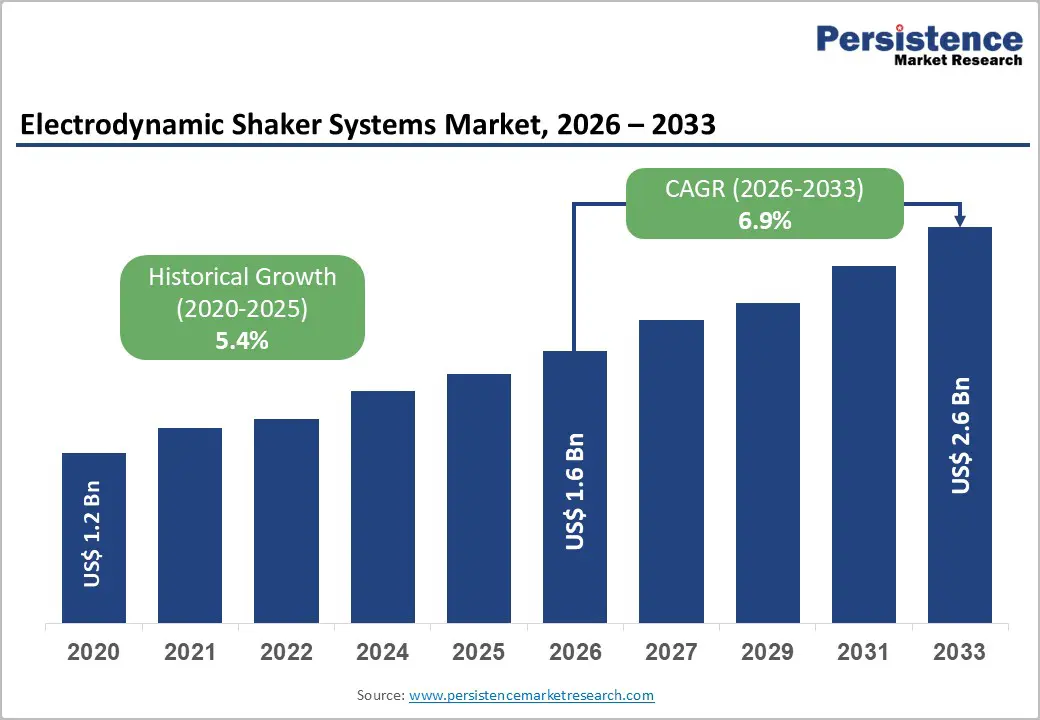
The global electrodynamic shaker systems market size is likely to be valued at US$ 1.6 Billion in 2026 and is expected to reach US$ 2.6 Billion by 2033, growing at a CAGR of 6.9% during the forecast period from 2026 to 2033.
Accelerating demand for product reliability, safety validation, and mandatory compliance with global testing standards is the principal force propelling the electrodynamic shaker systems market forward.
Key Market Highlights
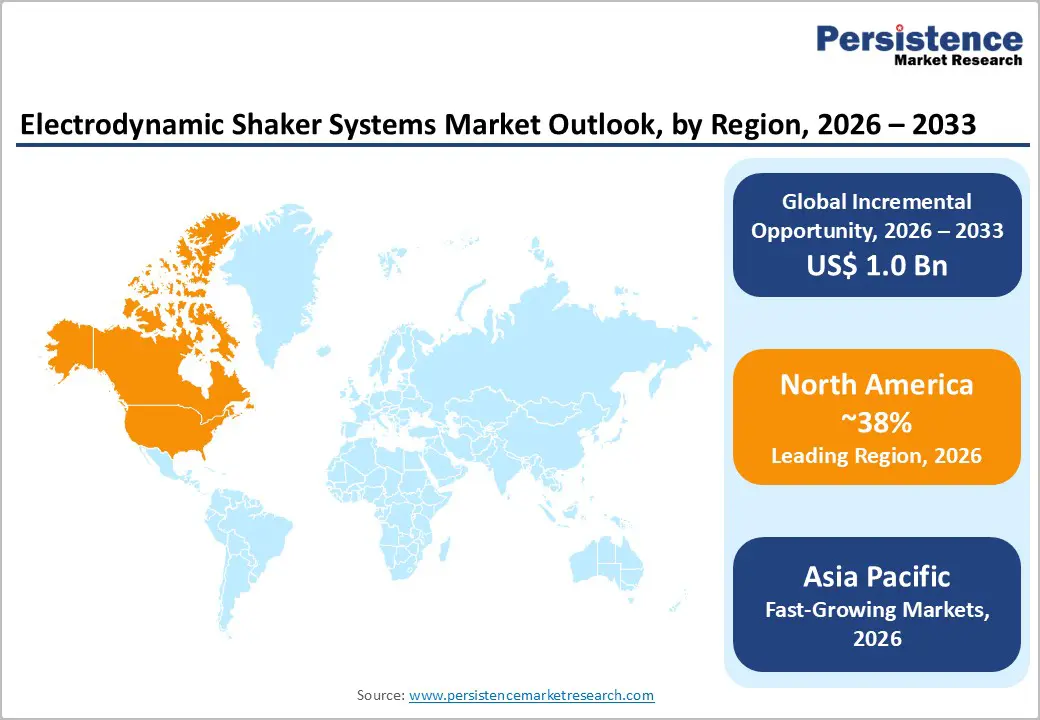
- Leading Region: North America: North America leads the global electrodynamic shaker systems market with 38% share, driven by its dominant aerospace, defense, and automotive industries, stringent compliance requirements under MIL-STD-810H, and an established network of ISO/IEC 17025-accredited vibration testing laboratories.
- Fastest Growing Region: Asia Pacific: Asia Pacific is the fastest-growing regional market withrising CAGR of 8.3%, powered by China's massive EV and electronics manufacturing scale, India's PLI-driven industrial investment, and Japan's precision vibration testing ecosystem anchored by IMV Corporation and EMIC Corporation.
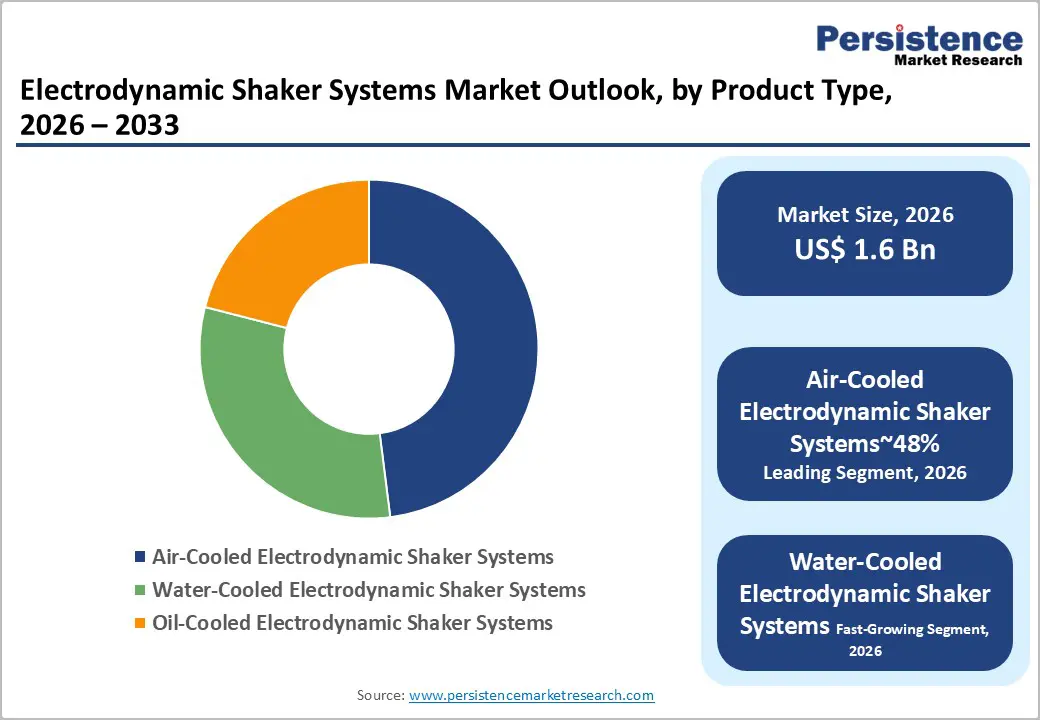
- Dominant Segment: Air-Cooled Electrodynamic Shakers: Air-cooled systems lead by product type, commanding approximately 48% of market share, driven by lower installation complexity, cost efficiency, and widespread adoption across electronics, semiconductor, and general-purpose testing environments globally.
- Fastest Growing Segment: Aerospace & Defense End-Use: The Aerospace & Defense end-use segment is the fastest growing, fueled by rising global defense budgets, next-generation aircraft development, and mandatory structural qualification compliance under EASA, FAA, and MIL-STD-810H standards.
- Key Market Opportunity: Renewable Energy Testing: Expanding wind energy and BESS testing requirements under IEC 61400 certification, with GWEC projecting record annual installations reaching 194 GW by 2030, present a high-value, underpenetrated opportunity for electrodynamic shaker system providers.
| Key Insights | Details |
|---|---|
| Electrodynamic Shaker Systems Market Size (2026E) | US$ 1.6 Billion |
| Market Value Forecast (2033F) | US$ 2.6 Billion |
| Projected Growth CAGR (2026 - 2033) | 6.9% |
| Historical Market Growth (2020 - 2025) | 5.4% |
Market Dynamics
Drivers - Surge in Aerospace & Defense Testing Requirements Under Global Regulatory Mandates
The aerospace and defense sector continues to be a major end-use driver for electrodynamic shaker systems, mainly due to strict compliance requirements set by international regulatory standards. The U.S. Department of Defense’s MIL-STD-810H requires military equipment to undergo rigorous vibration, shock, and environmental testing across defined frequency ranges from 5 Hz to 2,000 Hz, making electrodynamic shakers essential during defense procurement and qualification processes. Similarly, aviation authorities such as the European Union Aviation Safety Agency and the Federal Aviation Administration mandate comprehensive structural and functional testing for all airborne components before certification.
In addition, rising global defense budgets are strengthening demand. NATO member states are increasingly targeting defense spending above 2% of GDP, creating strong investments in testing infrastructure. Large aerospace programs, including maintenance expansion of the F-35 Lightning II and development of new commercial aircraft platforms, are further increasing the need for advanced vibration testing facilities. As a result, demand for high-force electrodynamic shaker systems is expected to grow steadily throughout the forecast period.
Rising Electric Vehicle Production Accelerating Automotive Component Testing Demand
The global transition toward electric mobility is becoming a powerful growth driver for the electrodynamic shaker systems market. According to the International Energy Agency, global electric vehicle sales reached approximately 14 million units in 2023, accounting for around 18% of total new car sales, compared to 14% in 2022. The agency also expects EVs to represent more than 40% of global new car sales by 2030.
Unlike traditional internal combustion engine vehicles, electric vehicles contain highly sensitive battery packs, power electronics, and electric drivetrains that must undergo extensive vibration and shock testing. These tests follow strict standards such as ISO 16750-3 and IEC 62133 to ensure durability under real-world road conditions. Automotive OEMs and Tier-1 suppliers are increasingly investing in in-house vibration testing facilities. Furthermore, the growing complexity of battery management systems, electric motors, regenerative braking systems, and ADAS technologies is increasing testing intensity per vehicle, which directly drives demand for electrodynamic shaker systems worldwide.
Restraints - High Capital Investment and Complex Installation Requirements Limiting SME Adoption
One of the key challenges limiting the wider adoption of electrodynamic shaker systems is the high capital investment required for purchasing, installing, and integrating these systems. A high-force water-cooled electrodynamic shaker capable of producing outputs above 100 kN can cost more than US$500,000 when including essential components such as power amplifiers, vibration controllers, and specialized test fixtures. For small and medium-sized enterprises (SMEs), especially in emerging markets across Latin America and Southeast Asia, this level of investment can be financially difficult to justify.
In addition to the purchase cost, these systems also require dedicated facility infrastructure for proper operation. This includes vibration-isolation foundations, cooling water circulation systems, and stable three-phase electrical power supply. The combined installation and operational requirements significantly increase the total cost of ownership. As a result, many smaller testing laboratories and contract manufacturers delay or avoid adopting these systems, limiting the overall market penetration of advanced electrodynamic shaker technologies.
Shortage of Skilled Vibration Test Engineers and Specialized Technical Workforce
Another major restraint affecting the electrodynamic shaker systems market is the shortage of highly skilled vibration testing professionals. Operating, calibrating, and maintaining these systems requires advanced expertise in vibration dynamics, signal processing, and structural mechanics. Industry organizations such as the Society for Experimental Mechanics and the Institute of Environmental Sciences and Technology have repeatedly highlighted the global shortage of certified vibration testing engineers.
As testing requirements become more sophisticated, the demand for specialized talent continues to increase. Modern testing procedures now involve multi-axis simultaneous testing, complex random vibration profiles, and real-time data acquisition systems integrated with digital monitoring platforms. These advanced requirements make it difficult for many organizations to recruit and retain qualified personnel. The ongoing talent shortage slows the implementation of new shaker installations and reduces operational efficiency. For companies investing in expensive high-force systems, the lack of skilled engineers can significantly delay returns on investment and limit system utilization.
Opportunities - Integration of Industry 4.0 and Digital Twin Technologies in Vibration Testing Systems
The integration of Industry 4.0 technologies with vibration testing infrastructure presents a significant growth opportunity for the electrodynamic shaker systems market. One of the most promising innovations is the use of Digital Twin technology, where a virtual model of a physical product replicates its real-world behavior. This approach allows manufacturers to design more precise vibration testing profiles, reducing test cycle times and minimizing material waste.
Companies are increasingly incorporating Internet of Things sensors and artificial intelligence-driven analytics into electrodynamic shaker systems to enable smarter testing environments. These systems can provide real-time monitoring, automated diagnostics, and predictive maintenance alerts. Manufacturers that integrate cloud connectivity, automated reporting systems, and advanced data analytics are able to offer more value-added solutions to their customers. Aerospace, electronics, and automotive OEMs are particularly interested in such capabilities because they help accelerate product validation and certification timelines. As digital testing ecosystems evolve, vendors offering integrated hardware-software solutions are expected to gain a strong competitive advantage.
Expanding Renewable Energy Sector Driving Demand for Structural and Component Testing
The rapid expansion of renewable energy infrastructure is creating a valuable opportunity for electrodynamic shaker system providers. In particular, the growing wind energy sector requires extensive structural and component testing to ensure long-term reliability and safety. Critical wind turbine components, including rotor blades, gearboxes, pitch control systems, yaw mechanisms, and tower structures, must undergo vibration and fatigue testing to meet certification requirements defined by the IEC 61400 standards.
According to the Global Wind Energy Council, a record 117 GW of new wind power capacity was installed worldwide in 2024. Annual installations are expected to reach around 194 GW by 2030, growing at a compound annual rate of approximately 8.8%. In addition to wind energy systems, photovoltaic inverters, battery energy storage systems, and offshore renewable energy structures also require environmental simulation testing. As renewable infrastructure expands globally, the need for reliable vibration testing solutions will continue to increase, creating strong long-term market opportunities.
Category-wise Analysis
By Product Type Insights
Among the product type segments, air-cooled electrodynamic shaker systems account for the leading share, approximately 48% of the global market. This leadership is mainly due to their lower installation complexity, cost-effectiveness, and strong operational flexibility for low-to-medium force output testing needs. Unlike water-cooled systems, air-cooled configurations do not require a dedicated water-cooling infrastructure, which significantly simplifies installation and reduces operational costs for laboratories and testing facilities.
As a result, they are widely preferred by academic institutions, industrial research laboratories, electronics testing centers, and general-purpose vibration testing facilities. The electronics & semiconductors industry particularly benefits from these systems, as they support high-frequency and precise vibration testing for components such as printed circuit boards (PCBs), microchips, and consumer electronic assemblies. Compact and modular air-cooled shaker systems developed by leading manufacturers are extensively used in small-to-mid-sized testing facilities across North America, Europe, and the Asia Pacific, further strengthening their strong position in the market.
By Application Insights
Vibration testing remains the leading application segment in the electrodynamic shaker systems market, accounting for approximately 38% of the total market share. This dominance is primarily because vibration testing is the core function of electrodynamic shaker systems. It helps simulate real-world dynamic environments to evaluate product durability, identify resonance frequencies, and detect structural weaknesses before products are launched commercially. Several international testing standards and regulatory frameworks make vibration testing a mandatory step in product qualification.
The IEC 60068-2-6 standard outlines sinusoidal vibration testing procedures, while MIL-STD-810H specifies environmental testing requirements for military equipment. Because of these regulations, vibration testing is widely used across multiple industries, including automotive, aerospace, consumer electronics, and industrial machinery. Additionally, emerging applications such as electric vehicle battery pack testing and satellite structural validation are increasing demand for advanced vibration testing systems, ensuring this segment continues to hold the largest and most stable market share throughout the forecast period.
By End-user Insights
The automotive sector represents the leading end-use segment in the electrodynamic shaker systems market, accounting for approximately 31% of the global market share. Automotive manufacturers and their extensive supplier networks must validate vehicle components under realistic operating conditions, including road vibration and mechanical shock. These tests ensure that vehicle parts perform reliably throughout their lifecycle. International testing standards such as ISO 16750-3, which defines environmental testing conditions for electrical and electronic equipment in road vehicles, and SAE J1455, which specifies heavy-duty vehicle vibration requirements, make vibration testing essential during vehicle development.
Components ranging from powertrain systems and suspension modules to infotainment electronics must undergo rigorous shaker testing. The rapid growth of electric vehicles has further increased testing demand, as EV battery packs, electric motors, onboard chargers, and advanced driver assistance systems require additional vibration validation. As a result, leading automotive manufacturers continue to expand their internal testing laboratories and invest in advanced electrodynamic shaker systems.
Regional Insights
North America Electrodynamic Shaker Systems Market Trends
North America continues to lead the electrodynamic shaker systems market due to its well-established aerospace and defense industry, advanced automotive manufacturing ecosystem, and strong government investment in research infrastructure. The region benefits from significant procurement of high-performance vibration testing systems for military and defense equipment. Government research organizations and defense agencies regularly invest in advanced testing capabilities to ensure equipment reliability under extreme operating conditions.
In addition, the presence of major aerospace programs and spacecraft development initiatives requires extensive vibration testing for structural components and mission-critical equipment. The region also has a strong network of independent testing laboratories that operate under internationally recognized quality standards, providing reliable testing services for multiple industries. Furthermore, the rapid growth of the domestic electric vehicle industry is increasing the need for advanced automotive testing systems. Continuous investments in aerospace innovation, defense modernization, and EV development are collectively strengthening North America’s leadership in the electrodynamic shaker systems market.
Europe Electrodynamic Shaker Systems Market Trends
Europe represents a technologically advanced and innovation-driven market for electrodynamic shaker systems, with countries such as Germany, the United Kingdom, France, and Sweden playing a major role in regional demand. Germany’s globally competitive automotive sector creates consistent demand for advanced vibration testing equipment, as manufacturers continuously test vehicle components and electronic systems to meet strict safety and performance standards.
Research organizations and government-supported innovation programs across Europe also invest heavily in advanced testing infrastructure to support the development of next-generation technologies such as lightweight materials, electric powertrains, and high-efficiency battery systems. In addition, strict regulatory frameworks across the European Union require environmental and vibration testing for many industrial and aerospace components before they can enter the market. Defense modernization programs and aviation equipment testing further support demand for high-precision shaker systems. European manufacturers are increasingly adopting high-force and water-cooled shaker configurations to test complex systems such as EV batteries and wind turbine structures.
Asia Pacific Electrodynamic Shaker Systems Market Trends
Asia Pacific is the fastest-growing regional market for electrodynamic shaker systems, supported by rapid industrial expansion, strong electronics manufacturing growth, and increasing government investments in aerospace and defense technologies. China plays a dominant role in the regional market due to its massive automotive production capacity and strong leadership in electric vehicle manufacturing. The country’s rapidly growing EV industry has significantly increased the demand for vibration testing infrastructure to validate battery systems, vehicle electronics, and structural components.
Japan also contributes significantly to regional growth through its advanced precision manufacturing sector, particularly in semiconductor production, robotics, and high-technology equipment testing. Meanwhile, India is emerging as a promising growth market as government initiatives encourage domestic electronics and battery manufacturing capabilities. South Korea’s semiconductor and display manufacturing industries also require continuous vibration testing to ensure product reliability. Additionally, expanding automotive and electronics manufacturing clusters across Southeast Asia are creating new opportunities for investment in vibration testing infrastructure.
Competitive Landscape
The global electrodynamic shaker systems market is moderately consolidated, with several established companies holding strong technological expertise and global service networks. Leading manufacturers have built their market positions through decades of engineering experience, continuous product innovation, and strong relationships with major industrial customers. These companies offer a wide range of shaker systems designed for different force outputs, frequency ranges, and testing applications.
Key factors that differentiate competitors in the market include system performance, cooling technology options, digital control capabilities, and the strength of after-sales support services. Manufacturers are also focusing on integrating advanced software solutions and intelligent control systems that improve testing accuracy and automation. Another important trend in the industry is the development of modular shaker systems that allow multi-axis and simultaneous testing, particularly for complex aerospace and automotive components. These technological advancements are helping companies strengthen their competitive positions and expand their presence in global testing markets.
Key Market Developments
- In September 2024: Brüel & Kjær introduced the LDS V8900 electrodynamic shaker series, designed for high-performance vibration and shock testing in aerospace and automotive sectors. The system incorporates advanced cooling architecture, digital control integration, and wide frequency capability, delivering up to ~80-90 kN force for testing complex structures and heavy payload assemblies.
- In June 2024: MTS Systems Corporation formed a strategic partnership with Siemens Digital Industries Software to integrate advanced simulation and digital testing tools with electrodynamic shaker platforms. The collaboration enables automated test scenario generation, improved data analytics, and enhanced validation capabilities for automotive manufacturers developing complex vehicle components.
Companies Covered in Electrodynamic Shaker Systems Market
- Brüel & Kjær
- Vibration Research Corp.
- Su Shi Testing Group
- IMV Corporation
- Thermotron
- MB Dynamics, Inc.
- Unholtz-Dickie
- TIRA GmbH
- EMIC Corporation
- Sentek Dynamics
- PCB Piezotronics
- LDS Test and Measurement
- Kistler Group
- Data Physics Corporation
- MTS Systems Corporation
- Team Corporation
- CSZ Testing
- Spectral Dynamics
- Labworks Inc.
Frequently Asked Questions
The global Electrodynamic Shaker Systems market is estimated to be valued at US$ 1.6 Billion in 2026 and is projected to reach US$ 2.6 Billion by 2033, expanding at a CAGR of 6.9% during the forecast period from 2026 to 2033.
The primary demand drivers include mandatory compliance with testing standards such as MIL-STD-810H and IEC 60068, the rapid global adoption of electric vehicles requiring battery and electronics validation under ISO 16750-3, growing aerospace and defense procurement programs, and the expanding renewable energy sector requiring structural fatigue and vibration qualification under IEC 61400.
Air-Cooled Electrodynamic Shaker Systems represent the leading product type segment, accounting for approximately 48% of global market share. Their lower installation cost, operational simplicity, and versatility across electronics and general-purpose vibration test applications make them the preferred choice for a majority of end-users worldwide.
North America is the leading regional market, driven by the United States' dominant aerospace and defense industrial base, strong regulatory compliance culture under MIL-STD-810H, active government investment through NASA and the U.S. Department of Defense, and a rapidly expanding domestic electric vehicle manufacturing ecosystem.
The expansion of renewable energy infrastructure, particularly wind energy and BESS systems requiring certification under IEC 61400, represents a high-value, largely underpenetrated opportunity. The Global Wind Energy Council (GWEC) projects annual global wind installations reaching 194 GW by 2030, driving sustained demand for vibration and fatigue testing of critical turbine and storage system components.
Prominent market participants include Brüel & Kjær (HBK), MTS Systems Corporation, LDS Test and Measurement, Kistler Group, PCB Piezotronics, IMV Corporation, TIRA GmbH, Vibration Research Corp., Data Physics Corporation, Unholtz-Dickie, Sentek Dynamics, EMIC Corporation, MB Dynamics, Inc., Thermotron, and Su Shi Testing Group, among others.


