




- Automotive
- Driving Apparel Market
Driving Apparel Market Size, Share, and Growth Forecast 2026 - 2033
Driving Apparel Market by Product Type (Clothing, Footwear, Protection Gear, Accessories), Material (Leather, Synthetic, Natural Fiber, Mesh Fabrics, Carbon Fiber), Distribution Channel (Online, Offline), End-user (Men, Women, Unisex), and Regional Analysis, 2026 - 2033

Driving Apparel Market Size and Trend Analysis
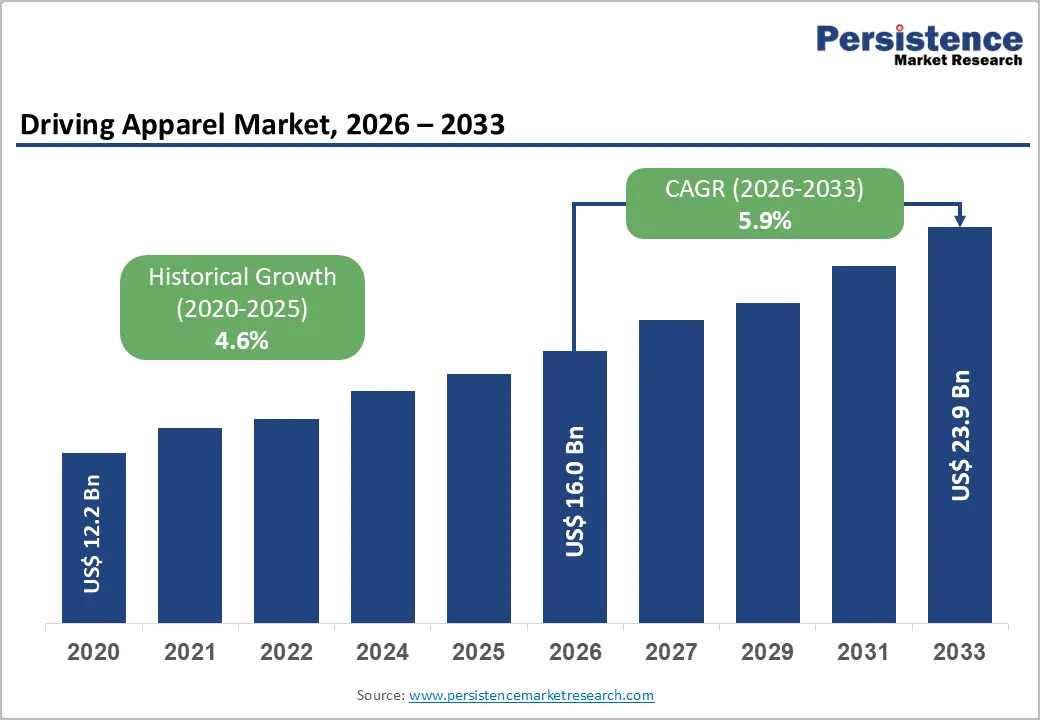
The global driving apparel market size is likely to be valued at US$ 16.0 Billion in 2026 and is expected to reach US$ 23.9 Billion by 2033, growing at a CAGR of 5.9% during the forecast period from 2026 to 2033.
The market's sustained expansion is primarily driven by escalating regulatory mandates for rider protective equipment, growing global motorcycle ownership, with the International Organization of Motor Vehicle Manufacturers (OICA) reporting over 200 million two-wheelers in active global circulation, and rising consumer awareness of road safety.
Key Market Highlights
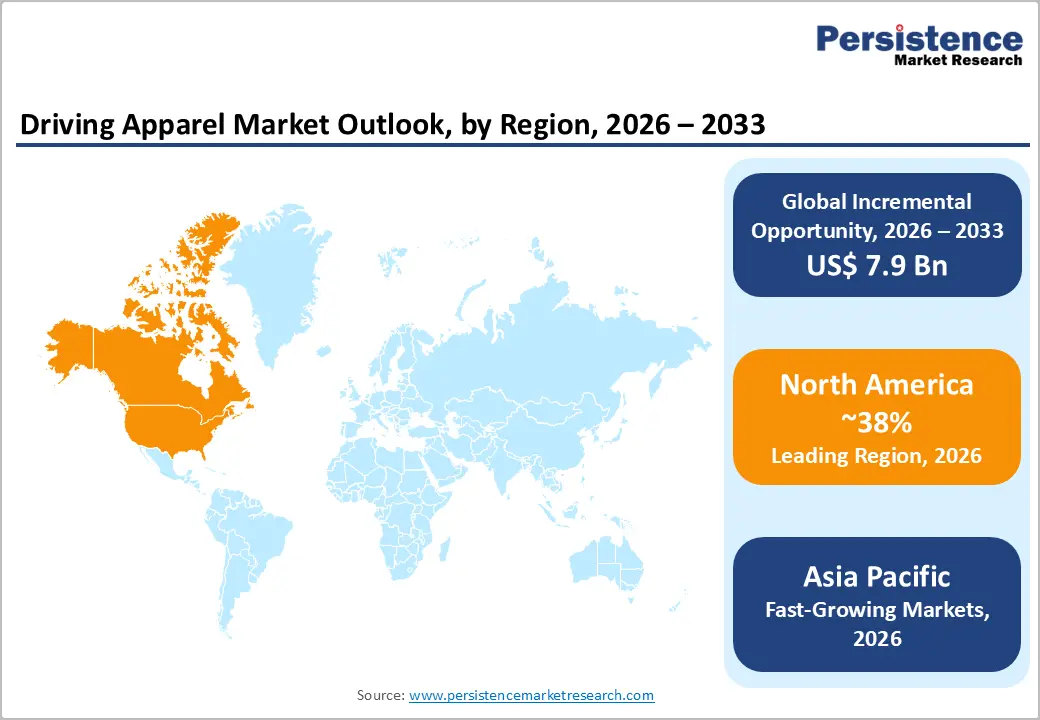
- Leading Region: North America leads the global driving apparel market holding 38% share, supported by over 10 million registered motorcycles in the U.S., strong consumer spending power, and DOT and CPSC-enforced safety compliance standards that drive consistent demand for certified premium protective gear.
- Fastest-Growing Region: Asia Pacific is the fastest-growing regional market with rising CAGR of 6.8%, with India's annual two-wheeler sales exceeding 21 million units and progressively enforced helmet mandates under the Motor Vehicles (Amendment) Act driving accelerated adoption of certified driving apparel across price-sensitive but high-volume demographics.
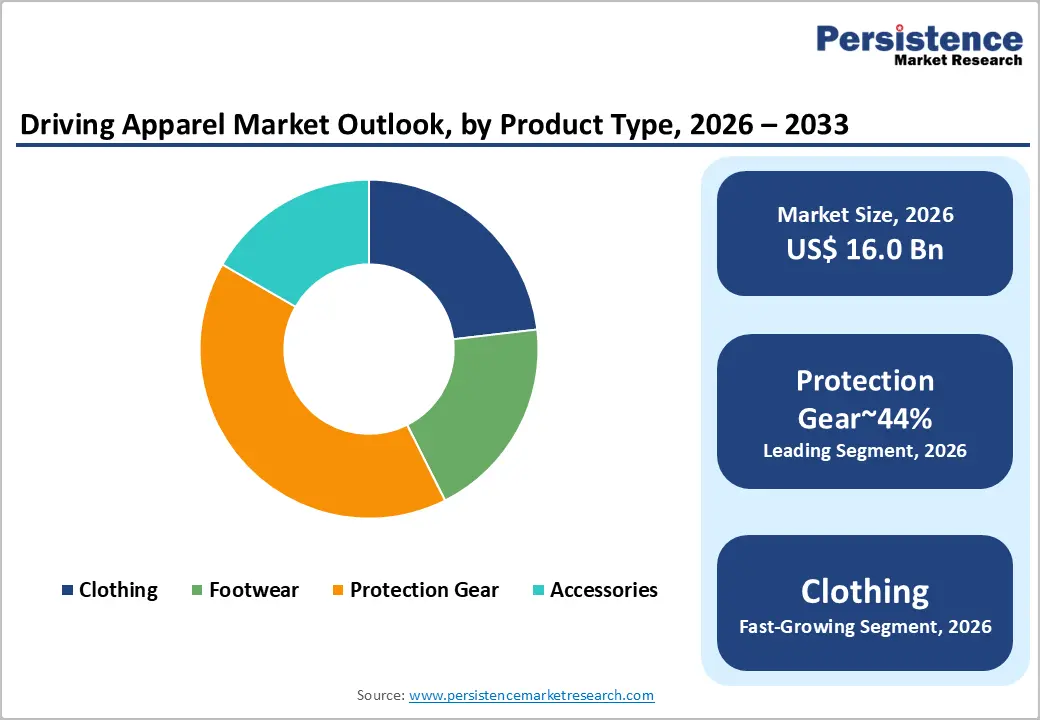
- Leading Segment: Protection gear dominates the product type segment at approximately 44% market share, underpinned by WHO-backed evidence that helmets reduce fatality risk by 42%, mandatory CE and DOT certification requirements, and continuous innovation in airbag, MIPS, and D3O impact protection technologies.
- Fastest-Growing Segment: Smart and connected driving apparel is the fastest-growing product innovation segment, with airbag-integrated jackets from Dainese and Alpinestars commanding price premiums of US$ 500-US$ 1,500 and AI-driven crash prediction systems entering commercialisation, redefining the value proposition of driving apparel beyond conventional PPE.
- Key Opportunity: Women's driving apparel represents the market's highest-growth end-use opportunity, with female motorcycle ownership in the U.S. rising from 8% in 1998 to over 19%, a demographic shift that is significantly underserved by current product offerings and that presents substantial first-mover revenue potential for brands investing in anatomically and aesthetically differentiated women-specific lines.
| Key Insights | Details |
|---|---|
| Driving Apparel Market Size (2026E) | US$ 16.0 Billion |
| Market Value Forecast (2033F) | US$ 23.9 Billion |
| Projected Growth CAGR (2026 - 2033) | 5.9% |
| Historical Market Growth (2020 - 2025) | 4.6% |
Market Dynamics
Drivers - Stringent Global Road Safety Regulations Mandating Protective Riding Gear
Regulatory frameworks across major economies are establishing a strong and mandatory demand base for the driving apparel market. The European Union’s General Safety Regulation (EU) 2019/2144 enforces advanced rider protection standards across member states, while the UNECE Regulation UN R22 governs helmet certification across more than 50 countries. In the Asia Pacific region, governments such as India’s Ministry of Road Transport and Highways (MoRTH) are strengthening two-wheeler safety norms under the Motor Vehicles (Amendment) Act, mandating BIS-certified helmets and protective gear.
According to the World Health Organization (WHO), motorcycle riders account for 28% of global road fatalities, highlighting the urgent need for safety regulations. These policies are directly driving demand for certified helmets, armoured jackets, gloves, and boots across both developed and emerging markets, creating a stable and long-term growth foundation for the industry.
Surging Motorcycle Ownership and Expanding Adventure Riding Culture
The continuous rise in global motorcycle ownership is significantly boosting demand for driving apparel across all product categories. Factors such as rapid urbanisation, fuel efficiency preferences, and increasing interest in two-wheelers are driving this trend. The Motorcycle Industry Council (MIC) reports that U.S. motorcycle registrations have surpassed 10 million units, while countries like India, Vietnam, Indonesia, and Thailand record millions of new two-wheeler sales annually. Each new vehicle adds to recurring demand for protective gear.
At the same time, the growing popularity of motorcycle tourism and adventure riding is reshaping consumer expectations. Routes such as the Trans-Siberian Highway, Patagonian Route, and Himalayan Circuit attract thousands of enthusiasts, increasing demand for durable, weather-resistant, and high-performance apparel. This shift is encouraging premium product adoption and supporting higher revenue generation for manufacturers globally.
Restraints - Premium Pricing Creating Significant Affordability Barriers Across Emerging Markets
Despite strong demand fundamentals, the high cost of certified driving apparel remains a major barrier, especially in price-sensitive regions. In markets such as Sub-Saharan Africa, South Asia, and Latin America, where two-wheelers are widely used, affordability is a key concern. A complete set of compliant gear, including helmet, jacket, gloves, trousers, and boots, can cost between US$ 500 and US$ 2,000. This represents several months of income in countries like Bangladesh, Nigeria, or Bolivia.
According to World Bank data, more than 3.5 billion people globally live on less than US$ 6.85 per day, making premium gear inaccessible to a large portion of riders. As a result, many consumers either delay purchases or opt for lower-cost alternatives, limiting the market reach of branded manufacturers. This affordability challenge continues to restrict adoption rates and slows overall market expansion in developing economies.
Proliferation of Counterfeit and Non-Compliant Products Undermining Market Integrity
The widespread availability of counterfeit and non-certified products is a major challenge affecting the global driving apparel market. These products are commonly found in online marketplaces and informal retail channels, particularly across Asia and Africa. They are often sold at significantly lower prices, making them attractive to cost-sensitive consumers while undercutting genuine brands. The International Chamber of Commerce (ICC) estimates that global trade in counterfeit goods could reach US$ 4.2 trillion, with protective equipment being one of the most affected categories.
Many fake helmets and jackets falsely display CE or DOT certification labels, misleading buyers and compromising safety. This situation creates an unfair competitive environment for legitimate manufacturers who invest heavily in quality and certification. Ultimately, the presence of counterfeit products reduces consumer trust and negatively impacts revenue growth for compliant and established brands.
Opportunities - Integration of Smart Textiles and Wearable Technology Unlocking a Premium Product Tier
The integration of wearable technology, IoT, and advanced textiles is creating a new premium segment within the driving apparel market. This innovation is transforming traditional protective gear into intelligent safety systems. For example, airbag-equipped jackets developed by companies like Dainese and Alpinestars use advanced sensors to detect crashes and deploy protection within milliseconds. These high-tech products can command price premiums of US$ 500 to US$ 1,500 above standard gear. Industry bodies such as EURATEX have identified smart textiles as a key innovation area, highlighting strong growth potential.
As technology becomes more affordable and consumer awareness increases, adoption is expected to expand beyond early adopters. This trend offers significant revenue opportunities for manufacturers investing in research and development. Companies that focus on innovation and technology partnerships are likely to gain a strong competitive advantage in this emerging high-value segment.
Rising Female Ridership Creating an Underserved, High-Growth Product Segment
The increasing number of female motorcycle riders is creating a valuable growth opportunity in the driving apparel market. This segment has traditionally been underserved, with most products designed primarily for men. According to the Motorcycle Industry Council (MIC), female motorcycle ownership in the U.S. increased from 8% in 1998 to over 19% by 2018, and the trend continues to rise globally. However, there remains a shortage of gear designed specifically for women in terms of fit, comfort, and style.
Brands that invest in women-focused products, featuring proper sizing, CE-rated protection, and appealing designs, are gaining strong customer loyalty. This segment also allows companies to command premium pricing due to limited competition. As more women take up motorcycling, demand for specialised apparel is expected to grow rapidly, making this a highly attractive and differentiated market opportunity.
Product Type Insights
Product Type Insights
Protection gear is the leading segment in the driving apparel market, accounting for around 44% of total market share. This dominance is largely due to regulatory requirements mandating the use of helmets, jackets, gloves, and other safety equipment. The World Health Organization identifies helmets as the most effective safety measure, reducing death risk by 42% and severe head injuries by 69%. This makes protective gear a non-optional purchase for riders.
Continuous innovation is also strengthening this segment, with technologies such as multi-density foam, MIPS helmet systems, D3O impact materials, and airbag protection gaining popularity. These advancements not only improve safety but also increase product value and replacement frequency. As a result, the protection gear segment continues to generate strong revenue and maintain its leading position in the global market.
Material Insights
Leather remains the most widely used material in the driving apparel market, holding approximately 54% market share in 2025. Its popularity is driven by its superior abrasion resistance, durability, and long-standing reputation among riders. Premium leather suits, particularly full-grain and top-grain types, offer exceptional protection during high-speed accidents, often exceeding 100 km/h conditions. This level of performance is difficult for synthetic materials to match consistently.
The Federation Internationale de Motocyclisme (FIM) mandates leather suits in professional racing events such as MotoGP and Superbike championships, further strengthening its credibility. Leather’s association with professional motorsports also enhances its premium appeal among consumers. Despite the emergence of advanced textiles, leather continues to dominate due to its proven safety performance, durability, and strong brand perception in both professional and consumer markets.
Distribution Channel Insights
Offline distribution channels continue to dominate the driving apparel market, accounting for approximately 58% of total revenue. These channels include specialised motorcycle gear retailers, flagship brand stores, dealership networks, and authorised service centres. Their strong position is driven by the high-touch and fit-sensitive nature of purchasing protective gear such as helmets, jackets, and riding suits.
Consumers typically prefer in-store experiences where they can assess fit, evaluate material quality, verify safety certifications, and receive expert guidance before making a purchase. This behaviour structurally favours physical retail over online platforms, particularly for high-value safety products. However, online channels are witnessing the fastest growth, supported by the increasing adoption of e-commerce. Digital platforms are gaining traction for accessories, entry-level apparel, and repeat purchases, where customers are already familiar with sizing and product specifications.
End-user Insights
Men represent the dominant end-use segment in the driving apparel market, accounting for approximately 72% of total demand. This reflects the historical composition of the global motorcycling population, where male riders have traditionally formed the majority across both recreational and commuter segments. Data from the Motorcycle Industry Council (MIC) indicates that men account for a significant share of motorcycle licence holders across key regions such as the United States, Europe, and Asia Pacific.
This directly translates into higher consumption of protective apparel, footwear, and accessories. However, the market is gradually evolving, with the gap between male and female consumers narrowing over time. Women’s driving apparel is emerging as the fastest-growing sub-segment, supported by increasing female participation in motorcycling, targeted product innovations, and the rise of female riding communities and events that are reshaping overall market dynamics.
Regional Insights
North America Driving Apparel Market Trends
North America remains the leading regional market for driving apparel, supported by high motorcycle ownership per capita, strong consumer spending capacity, and a well-established regulatory framework. Organisations such as the U.S. Consumer Product Safety Commission (CPSC) and the Department of Transportation (DOT) enforce strict safety standards for helmets and protective gear, ensuring consistent demand for certified products. The Motorcycle Industry Council (MIC) estimates that the United States alone has over 10 million registered motorcycles, forming a substantial demand base across product categories.
The region also benefits from a strong motorcycle event culture, including Sturgis Motorcycle Rally, Daytona Bike Week, and MotoAmerica racing events, which drive premium product sales. Additionally, Canada’s growing adventure touring segment and Mexico’s expanding urban commuter base contribute to regional demand. Leading brands such as Alpinestars, Icon Motosports, Klim, and Leatt Corporation maintain a strong presence, enhancing market competitiveness and innovation.
Europe Driving Apparel Market Trends
Europe is one of the most advanced and regulation-driven markets for driving apparel, supported by a strong motorcycling culture across countries such as Germany, France, Italy, Spain, and the United Kingdom. The European Commission has implemented strict standards, including EN 17092 for protective clothing and EU Regulation 2016/425 for personal protective equipment, which have significantly raised minimum safety requirements.
These regulations are driving product upgrades and increasing average selling prices across the region. Italy serves as a key manufacturing hub, home to globally recognised brands such as Dainese S.p.A., Spidi Sport S.r.l., and Alpinestars, known for innovation in airbag systems, advanced armour technologies, and smart gear. Germany’s strong adventure touring segment sustains demand for high-performance riding gear, while the United Kingdom is witnessing renewed demand from urban commuters seeking protective yet stylish apparel options.
Asia Pacific Driving Apparel Market Trends
Asia Pacific is the fastest-growing market for driving apparel, driven by the region’s large two-wheeler population, rising disposable incomes, and increasing enforcement of safety regulations. Countries such as India, China, Vietnam, Indonesia, and Thailand account for a significant share of global two-wheeler sales. India alone records annual sales exceeding 21 million units, according to the Society of Indian Automobile Manufacturers (SIAM), creating a vast addressable market.
Governments across the region are strengthening helmet laws and safety awareness initiatives, boosting demand for certified products. China’s motorcycle market continues to expand with infrastructure development, while Japan maintains strong demand for premium, technology-driven apparel. Additionally, the region benefits from cost-efficient manufacturing hubs in countries like Bangladesh, Vietnam, and Cambodia, enabling competitive pricing and supporting both domestic consumption and global exports across all product segments.
Competitive Landscape
The global driving apparel market is moderately consolidated at the premium level, with established brands holding strong positions due to advanced R&D capabilities, proprietary safety technologies, and long-standing consumer trust. At the same time, the market remains fragmented in the entry-level and mid-range segments, particularly across Asia and Latin America. Leading players such as Alpinestars, Dainese, REV'IT!, and Klim compete through innovation, motorsport partnerships, and premium brand positioning.
Key strategic priorities include the development of certified airbag systems, expansion of women-specific product lines, localisation of manufacturing to serve emerging markets, and integration of smart and connected features. In addition, new business models are gaining traction, including direct-to-consumer online sales, rental services for motorcycle tourism, and subscription-based gear replacement programmes targeting safety-conscious urban riders.
Key Market Developments
- In March 2025: Dainese S.p.A. partnered with Microsoft to embed AI-driven crash prediction into its Smart Jacket platform, enabling adaptive safety responses, real-time data processing, and cloud-connected analytics for both individual riders and fleet safety optimization.
- In September 2024: Alpinestars introduced the Tech-Air® 10 autonomous airbag system designed for road riders, offering extended dual-front and shoulder protection with a slim, integrated profile. The system meets CE Level 1 PPE certification standards under EU Regulation 2016/425.
- In November 2024: REV'IT! Sport International B.V. expanded its Vertical Series apparel line using recycled PET-based Hydratex membranes, enhancing sustainability efforts and aligning with EU Green Deal objectives while delivering waterproof, breathable, and environmentally responsible riding gear solutions.
Companies Covered in Driving Apparel Market
- Alpinestars
- Dainese S.p.A.
- Fox Racing Inc.
- REV'IT! Sport International B.V.
- Klim
- Icon Motosports
- Spidi Sport S.r.l.
- Held GmbH
- Rukka
- Furygan
- Belstaff
- RST Moto
- Leatt Corporation
- Shoei Co., Ltd.
- HJC Helmets
- AGV (Dainese Group)
- Arai Helmet Ltd.
- Oxford Products Ltd.
- Bering
- LS2 Helmets
Frequently Asked Questions
The global Driving Apparel Market is valued at US$ 16.0 Billion in 2026 and is projected to reach US$ 23.9 Billion by 2033, expanding at a forecast CAGR of 5.9% from 2026 to 2033, driven by rising safety regulations, growing motorcycle ownership, and technological advancement in protective materials and smart apparel integration.
The primary demand drivers include mandatory protective gear regulations enforced by bodies such as the European Union, WHO, U.S. DOT, and India's MoRTH, combined with rapidly growing global two-wheeler ownership, rising safety awareness among riders, and innovation in high-performance materials including airbag-integrated textiles, carbon fibre composites, and smart wearable technologies that are expanding both product utility and consumer willingness to invest in premium riding apparel.
Protection Gear leads the Driving Apparel Market with approximately 44% market share, driven by the mandatory and non-discretionary nature of certified helmets, armoured jackets, gloves, and back protectors across major regulatory frameworks, supported by WHO evidence that helmets alone reduce motorcycle fatality risk by 42% and the sustained innovation in advanced protection technologies including D3O materials, MIPS systems, and airbag-integrated garments.
North America is the leading region in the global Driving Apparel Market, supported by high per-capita motorcycle ownership exceeding 10 million registered units in the U.S. alone, strong consumer purchasing power, robust DOT and CPSC certification enforcement, and a vibrant premium riding culture anchored by events such as Sturgis Motorcycle Rally and Daytona Bike Week that consistently drive high-value apparel purchasing across all product categories.
The most significant growth opportunity lies in the smart and connected driving apparel segment, where AI-powered airbag systems, crash-detection sensors, and IoT-enabled garments from innovators such as Dainese S.p.A. and Alpinestars command price premiums of US$ 500-US$ 1,500 above conventional alternatives. As sensor costs decline and consumer technology adoption deepens, this premium segment is expected to transition from early adopter niche to mainstream market category throughout the forecast period.
Key players in the global Driving Apparel Market include Alpinestars, Dainese S.p.A., Fox Racing Inc., REV'IT! Sport International B.V., Klim, Icon Motosports, Spidi Sport S.r.l., Held GmbH, Rukka, Furygan, Belstaff, RST Moto, Leatt Corporation, Shoei Co., Ltd., and HJC Helmets, alongside emerging participants including AGV, Arai Helmet Ltd., Oxford Products Ltd., Bering, and LS2 Helmets that are expanding their global footprint through product innovation, e-commerce channel development, and strategic geographic market penetration.


