Chiplets Market Size, Share, and Growth Forecast 2026 - 2033

Chiplets Market by Processor Type (CPU Chiplets, GPU Chiplets, AI/ML Accelerators, FPGA Chiplets, APU Chiplets), by Packaging Technology (2.5D/3D Packaging, System-in-Package (SiP), Fan-Out Packaging, Multi-Chip Module (MCM), Flip-Chip Ball Grid Array (FCBGA)), by End-User, by Regional Analysis, 2026 - 2033

ID: PMRREP36343
Calendar

March 2026

245 Pages

Author : Sayali Mali

Chiplets Market Size and Trend Analysis

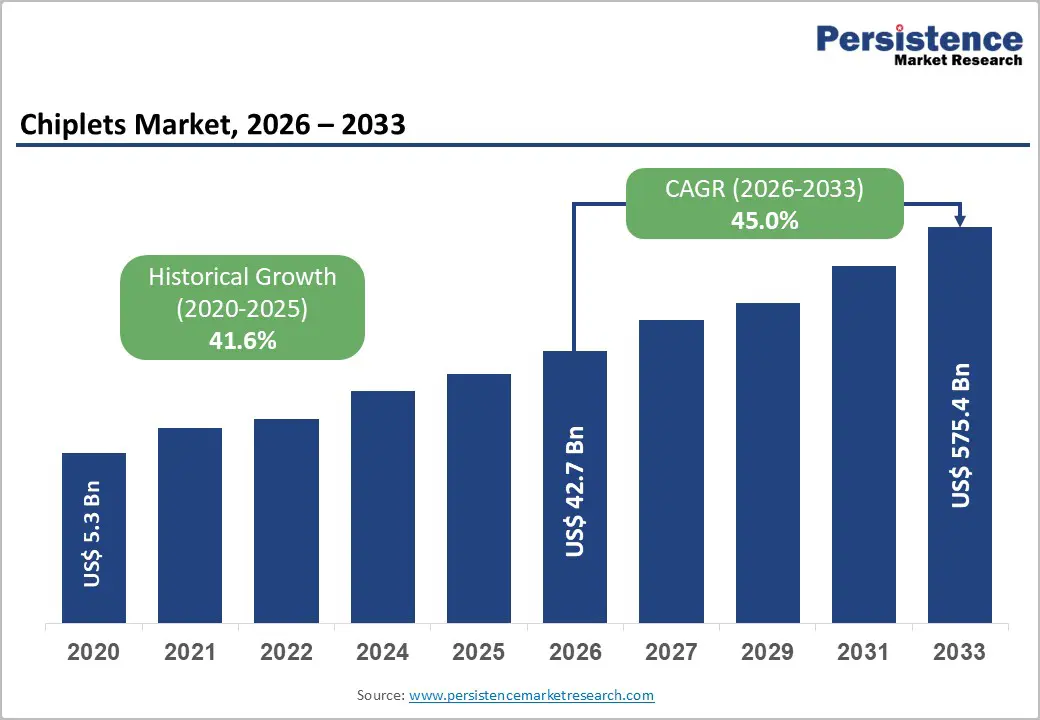
The global chiplets market size is likely to be valued at US$ 42.7 billion in 2026 and is expected to reach US$ 575.4 billion by 2033, growing at a CAGR of 45.0% during the forecast period from 2026 to 2033.

This exceptional trajectory is driven by the convergence of artificial intelligence computing demands, the physical limitations of monolithic chip scaling, and a global wave of government-led semiconductor investment that is reshaping advanced packaging and heterogeneous integration ecosystems.

Key Industry Highlights:

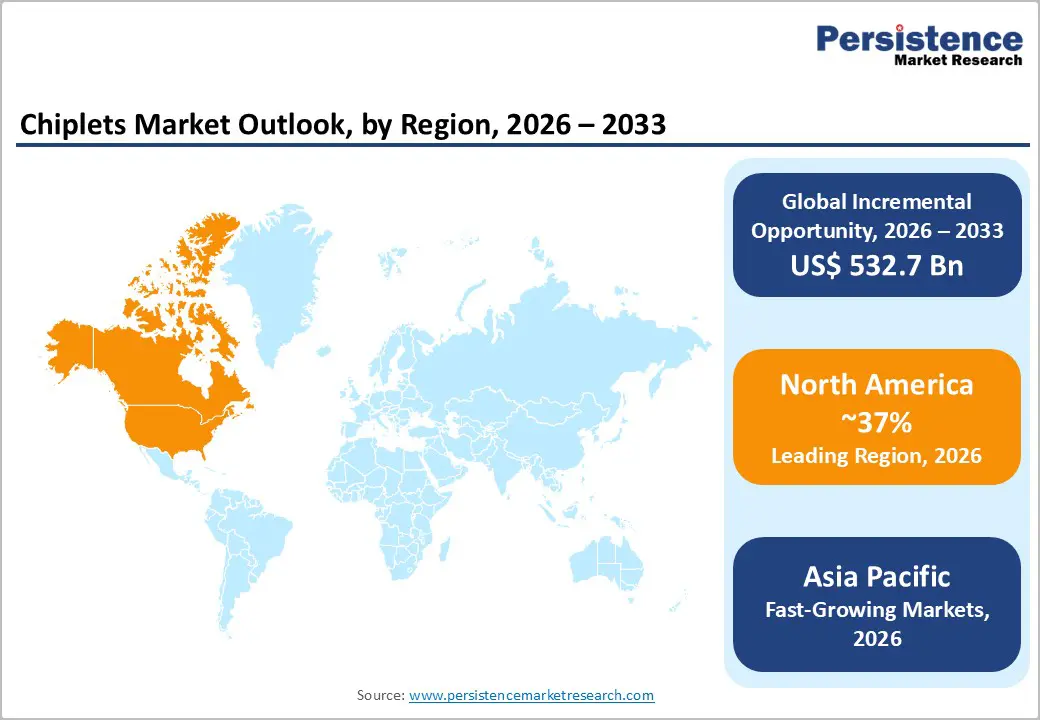
  • Leading Region: North America leads the Chiplets market with 37% share, supported by the U.S. CHIPS Act driving US$630 billion investments, including 17 fabs and 8 packaging facilities, aiming for 28% global advanced logic capacity by 2032.
  • Fastest-Growing Region: Asia Pacific is the fastest-growing region with 51.2% CAGR, driven by Taiwan Semiconductor Manufacturing Company CoWoS expansion, Japan’s Rapidus 2nm program, and Amkor Technology’s US$1.6 billion Vietnam chiplet packaging facility.
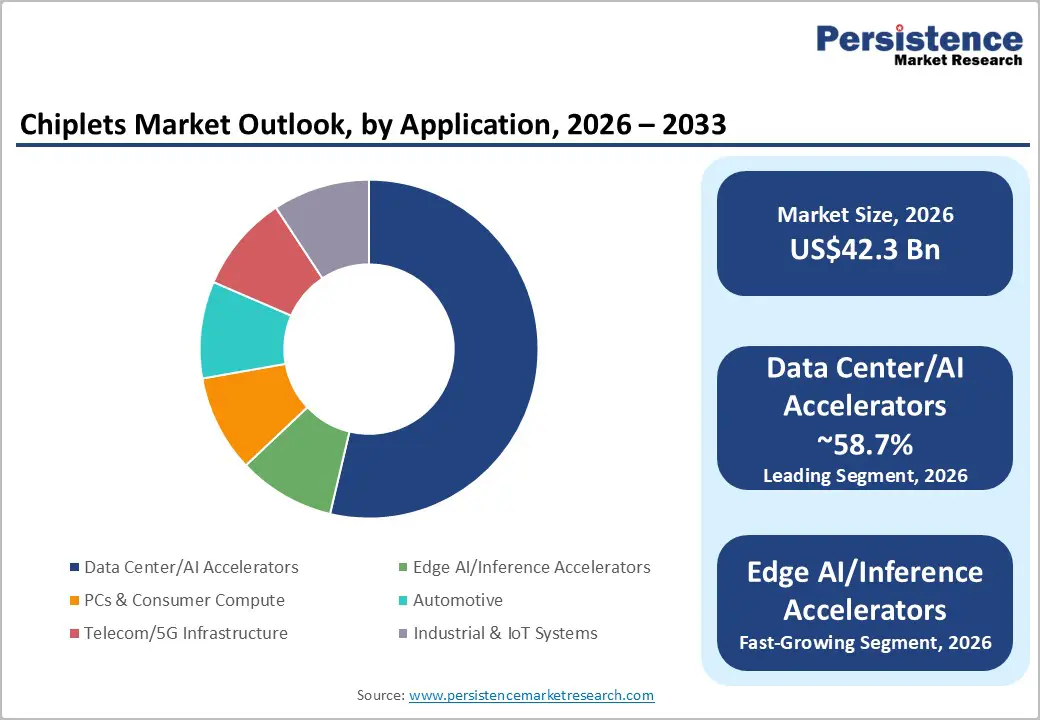
  • Leading Segment: AI/ML Accelerators lead processor types with 38% share, supported by NVIDIA’s Blackwell architecture, Advanced Micro Devices’ Instinct MI300X chiplet platform, and strong AI/HPC semiconductor demand growth exceeding 15% in 2025.
  • Fastest-Growing Segment: 2.5D/3D packaging is the fastest-growing technology segment, driven by Taiwan Semiconductor Manufacturing Company CoWoS demand and SoW-X innovation, alongside Intel expanding Foveros capacity by 30%.
  • Key Opportunity: The UCIe 3.0 open standard enabling 48-64 GT/s data rates creates a major opportunity for multi-vendor chiplet interoperability and modular chiplet ecosystems, potentially reshaping competition in the AI hardware market.
Key Insights Details
Chiplets Market Size (2026E) US$ 42.7 Billion
Market Value Forecast (2033F) US$ 575.4 Billion
Projected Growth CAGR (2026 - 2033) 45.0%
Historical Market Growth (2020 - 2025) 41.6%

chiplets-market-2026-2033

Market Dynamics

Drivers - Surging AI and HPC Workloads Accelerate Global Adoption of Chiplet-Based Architectures to Overcome Limits of Monolithic Semiconductor Designs

The rapid expansion of artificial intelligence (AI) training and inference workloads has become the primary commercial driver for the global Chiplets market. Traditional monolithic chip architectures are reaching physical and economic limits, making chiplet-based designs an attractive alternative. Major semiconductor companies are already adopting multi-die architectures to overcome these limitations. For example, NVIDIA, which controls nearly 80% of the AI accelerator market, has gradually incorporated chiplet-inspired designs into its data center GPUs.

AMD demonstrated the commercial success of chiplet architectures through its EPYC processor family and expects its MI300 AI accelerator series to generate more than US$ 2 billion in revenue in 2024. The International Data Corporation (IDC) also projects that global semiconductor demand driven by AI and HPC applications will grow by over 15% in 2025. Industry research suggests that by 2030, advanced packages containing more than 1 trillion transistors, 2-3 TB/s bandwidth, and over 10 HBM stacks will become common, which will be achievable only through chiplet-based integration.

Government Semiconductor Policies and Massive Capital Investments Strengthen Global Advanced Packaging Infrastructure Supporting Chiplet Manufacturing Ecosystems

Government-backed semiconductor development programs are significantly accelerating investments in chiplet-compatible manufacturing and advanced chip packaging infrastructure worldwide. The U.S. CHIPS and Science Act alone allocates US$ 52.7 billion for semiconductor manufacturing, research, and workforce development, along with US$ 24 billion in investment tax credits. As part of this initiative, Intel has received US$ 8.5 billion to develop four advanced semiconductor fabrication plants, while TSMC has secured US$ 6.6 billion to expand its Arizona facility for 2nm process production.

According to the Semiconductor Industry Association (SIA), these policies have already stimulated more than US$ 630 billion in total semiconductor supply chain investments in the United States, including eight advanced packaging facilities that directly support chiplet integration technologies. Similarly, the European Chips Act aims to increase Europe’s share of global semiconductor production to 20% by 2030, with investments supporting advanced packaging capabilities in Germany, France, and the Netherlands. These government initiatives create long-term manufacturing ecosystems that reduce investment risk and accelerate the large-scale commercialization of chiplet-based semiconductor architectures.

Restraints - Cross-Chiplet Communication Latency and Limited Industry Standardization Create Performance and Interoperability Challenges in Multi-Die Semiconductor Architectures

Despite the advantages of chiplet-based designs, cross-chiplet communication still presents performance challenges compared to traditional on-die interconnects. When multiple chiplets communicate within a package, latency can increase, which may affect performance in applications that require extremely fast response times, such as real-time processing, networking infrastructure, and edge computing systems. Technical studies indicate that communication between chiplets remains slower than signal transmission within a single monolithic die.

NVIDIA’s CUDA software framework was designed for conventional GPU structures and may require major architectural adjustments to efficiently support multi-die chiplet configurations. Another challenge is the lack of full industry alignment on open standards. While the Universal Chiplet Interconnect Express (UCIe) standard is gaining traction, some major companies have been cautious in adopting it, which creates potential ecosystem fragmentation and limits interoperability between chiplets developed by different vendors.

Limited Advanced Packaging Capacity and Thermal Management Challenges Increase Production Complexity for High-Density Chiplet Semiconductor Systems

Another significant challenge for the Chiplets market is the limited capacity of advanced semiconductor packaging technologies. High-performance chiplet architectures rely heavily on sophisticated packaging methods such as 2.5D and 3D integration, which require specialized manufacturing infrastructure. Currently, TSMC’s CoWoS packaging platform, widely used for AI accelerators, is fully booked through 2025 due to strong global demand.

Although the company is doubling production capacity annually, monthly output is expected to reach around 70,000 units only by late 2025, compared with approximately 34,000 units in 2024. In addition to capacity limitations, thermal management remains a complex engineering challenge. In 3D-stacked chiplet systems, vertically integrated dies generate concentrated heat, making efficient cooling more difficult. Technologies such as Intel’s Foveros stacking require advanced materials and specialized cooling architectures to manage heat dissipation effectively. These design complexities increase manufacturing costs and may reduce yield rates, which can slow the broader adoption of high-density chiplet systems.

Opportunities - Emergence of UCIe Open Standard Enables Multi-Vendor Chiplet Interoperability and Expands Opportunities for Modular Semiconductor Ecosystem Development

The growing adoption of the Universal Chiplet Interconnect Express (UCIe) standard represents a major opportunity for companies participating in the Chiplets market. As an open industry standard, UCIe enables chiplets developed by different vendors to communicate within a single package, encouraging the development of a modular and collaborative semiconductor ecosystem. In August 2025, the UCIe Consortium released the UCIe 3.0 specification, introducing faster data transfer speeds of 48 and 64 GT/s along with improved system manageability features.

Around the same time, the Open Compute Project Foundation introduced a universal link-layer specification aligned with UCIe to support flexible AI and HPC infrastructure deployments. Industry experts believe that these open standards will significantly lower design barriers for semiconductor companies, enabling faster product development and reducing overall design costs. Supporting this trend, Keysight Technologies launched Chiplet PHY Designer 2025, a verification tool compatible with UCIe 2.0 and Open Compute Project BoW interconnects, demonstrating the rapid development of design and testing tools supporting open chiplet ecosystems.

Rising Demand for Hyperscaler Custom AI Accelerators and Edge Inference Drives Major Growth Opportunities for Chiplet-Based Semiconductor Solutions

The increasing demand for custom AI silicon among hyperscale cloud providers presents one of the most promising growth opportunities in the Chiplets market. Major technology companies such as Google, Amazon, Microsoft, and Meta are developing proprietary AI accelerators to reduce reliance on third-party GPU suppliers and to optimize computing performance for their specific workloads. Examples include Google’s TPU v5, Amazon’s Trainium2, and Microsoft’s Maia 100 AI accelerator. Industry projections indicate that the global AI chip market could reach US$ 400 billion in annual revenue within the next five years, with hyperscaler-designed chips capturing a growing share of this market.

Chiplet-based architectures are particularly well suited for these custom silicon solutions because they allow modular scaling of computing power while maintaining cost efficiency. Intel’s Gaudi 3 accelerator and AMD’s EPYC chiplet platforms demonstrate how heterogeneous chiplet integration can deliver high performance while reducing manufacturing complexity. As AI inference expands to edge servers, autonomous vehicles, and industrial automation systems, demand for specialized chiplet accelerators optimized for energy efficiency and latency will continue to grow rapidly.

Category-wise Analysis

Processor Type Insights

AI/ML Accelerators represent the dominant and fastest-growing segment within the Chiplets market by processor type, accounting for approximately 38% of the total processor-type market share. The growing complexity of large language model training and advanced AI workloads has made it practically impossible to achieve the required computational density using traditional monolithic chip designs. As a result, chiplet-based architectures have become the preferred approach for building high-performance AI systems. NVIDIA, which holds nearly 80% of the AI accelerator market, introduced the Blackwell GPU architecture in March 2024.

This architecture integrates chiplet-based design improvements that significantly enhance performance and energy efficiency for large-scale AI training and inference workloads. Similarly, Advanced Micro Devices developed the Instinct MI300X processor specifically for large-scale AI applications, using chiplet architecture to improve computing efficiency and scalability. According to the Semiconductor Industry Association, AI and high-performance computing remain the strongest drivers of semiconductor demand, positioning AI/ML accelerator chiplets as a central product category throughout the forecast period.

Packaging Technology Insights

2.5D/3D packaging holds the leading position in the packaging technology segment of the Chiplets market, accounting for nearly 45% of the total market share. These advanced packaging approaches enable multiple semiconductor dies to be integrated into a single high-performance package, which is essential for modern AI and high-performance computing processors. Taiwan Semiconductor Manufacturing Company’s CoWoS (Chip-on-Wafer-on-Substrate) technology is currently the most mature and widely adopted 2.5D packaging platform in the industry.

Demand for CoWoS packaging is extremely strong, with production capacity fully booked through 2025. Monthly output is expected to increase from about 34,000 units in 2024 to nearly 70,000 units by late 2025. Intel provides major alternatives through its Foveros 3D stacking and EMIB 2.5D bridge technologies. Intel has announced a 30% expansion in Foveros production and a 150% increase in EMIB capacity at its New Mexico facility. In May 2025, TSMC also introduced SoW-X, a new CoWoS-based platform designed to deliver up to 40 times the computing power of current CoWoS systems, with volume production expected by 2027.

End-user Insights

Data Center and High-Performance Computing (HPC) represent the largest end-user segment in the Chiplets market, accounting for approximately 42% of the total market revenue. The increasing demand for advanced computing power to train large AI models, perform complex data analysis, and support scientific simulations has made data centers the primary destination for chiplet-based processors and AI accelerators. According to International Data Corporation, global semiconductor demand driven by AI and HPC workloads is expected to grow by more than 15% in 2025.

Major hyperscale cloud providers such as Google, Amazon Web Services, Microsoft, and Meta Platforms are investing billions of dollars to expand their data center infrastructure in order to support rapidly increasing AI workloads. These advanced computing environments require chiplet-integrated multi-die accelerator solutions for maximum performance and scalability. The continued expansion of hyperscale data centers and AI infrastructure strongly positions this segment as the primary commercial driver of the global Chiplets market through the forecast period.

chiplets-market-outlook-by-processor-type-2026-2033

Regional Insights

North America Chiplets Market Trends

The United States leads the global Chiplets market and holds the largest regional share, supported by a strong semiconductor policy framework and the presence of leading semiconductor design and manufacturing companies. Government initiatives such as the CHIPS and Science Act have already encouraged more than US$630 billion in semiconductor supply chain investments. These investments include plans for 17 new fabrication facilities and eight advanced packaging plants across 28 U.S. states, significantly strengthening chiplet-optimized manufacturing infrastructure for companies such as Intel, Taiwan Semiconductor Manufacturing Company, and GlobalFoundries.

According to the Information Technology and Innovation Foundation, the 25% Advanced Manufacturing Investment Credit under the CHIPS Act is expected to increase the U.S. share of advanced logic chip manufacturing capacity to nearly 28% of global production by 2032, compared with almost zero in 2022. Strong innovation clusters in Silicon Valley and Arizona also support the growth of chiplet design, electronic design automation tools, and advanced packaging technologies, reinforcing North America’s strategic role in the global chiplet ecosystem.

Europe Chiplets Market Trends

Europe is strengthening its position in the global Chiplets market through the implementation of the European Chips Act, which aims to increase Europe’s share of global semiconductor production to around 20% by 2030. The initiative includes major investments in advanced semiconductor manufacturing across Germany, France, the Netherlands, and Ireland. One of the most significant projects is Intel’s planned €30 billion semiconductor manufacturing facility in Magdeburg, Germany, which is expected to produce advanced chiplet-ready silicon using leading-edge process technologies.

European semiconductor companies such as NXP Semiconductors and STMicroelectronics are also developing chiplet-based system-in-package solutions and mixed-signal integration technologies for automotive and industrial applications. Demand for these technologies is supported by major European automotive manufacturers, including Volkswagen and Stellantis. Through strong industrial capabilities, supportive policies, and advanced research collaborations, Europe is gradually building a competitive semiconductor ecosystem that supports chiplet innovation and manufacturing growth.

Asia Pacific Chiplets Market Trends

Asia Pacific plays a critical role in the global Chiplets market because it hosts much of the world’s advanced semiconductor manufacturing and packaging infrastructure. Taiwan Semiconductor Manufacturing Company is a central player in the ecosystem, producing the advanced silicon dies used in chiplet architectures and providing leading packaging technologies such as CoWoS. The company is rapidly expanding its CoWoS capacity and has introduced the SoW-X platform, which aims to deliver up to 40 times the computing power of current solutions.

The company’s upcoming N2 (2-nanometer) manufacturing process will enable the next generation of chiplet-based processors. Memory manufacturers such as Samsung Electronics and SK Hynix provide high-bandwidth memory, a critical component required for high-performance AI chiplet packages. The region is also witnessing increasing semiconductor investment in China, Japan, and India, including government-supported initiatives and advanced packaging projects that further strengthen Asia Pacific’s central role in the global chiplet supply chain.

chiplets-market-outlook-by-region-2026-2033

Competitive Landscape

The global Chiplets market shows a moderately consolidated structure in the foundry and advanced packaging segment, while remaining highly fragmented in chiplet design and system development. Major manufacturing infrastructure providers such as Taiwan Semiconductor Manufacturing Company, Intel, and Samsung Electronics dominate the advanced packaging and semiconductor fabrication layer of the industry. However, the chiplet design ecosystem includes a large number of companies, including semiconductor startups, hyperscale technology firms, and integrated device manufacturers developing specialized architectures for different applications.

TSMC remains a critical infrastructure provider through advanced packaging platforms such as CoWoS and SoIC, while Intel differentiates itself with technologies like Foveros 3D stacking and EMIB 2.5D integration. Key competitive factors in the industry include compliance with the UCIe Consortium standard, access to advanced manufacturing nodes, availability of high-capacity packaging solutions, and strong electronic design automation ecosystems. Additionally, new business models such as chiplet-as-a-service platforms and collaborative chiplet design marketplaces are emerging across the industry.

Key Developments:

  • In August 2025: The UCIe Consortium released the UCIe 3.0 specification to strengthen open chiplet interoperability and enable higher-performance multi-die systems. The update introduced 48 and 64 GT/s data rates, doubling bandwidth over the previous generation, while adding enhanced manageability and power-efficiency features that support scalable System-in-Package (SiP) architectures for AI and high-performance computing deployments worldwide.
  • In May 2025: Taiwan Semiconductor Manufacturing Company introduced SoW-X, a next-generation system-on-wafer technology built on its CoWoS advanced packaging platform. The solution enables wafer-scale chiplet integration capable of delivering up to 40 times the computing power of existing CoWoS configurations, targeting future AI data center processors and high-performance computing systems with planned volume production by 2027.
  • In January 2025: Keysight Technologies launched Chiplet PHY Designer 2025, a design and verification tool that supports emerging chiplet interconnect standards such as UCIe 2.0 and the Open Compute Project Bunch of Wires (BoW). The platform helps semiconductor developers accelerate validation and interoperability testing for advanced 2.5D and 3D chiplet-based AI and data center processors.

Companies Covered in Chiplets Market

  • Intel Corporation
  • Advanced Micro Devices, Inc. (AMD)
  • Microchip Technology Inc.
  • IBM Corporation
  • Marvell Technology Group Ltd.
  • MediaTek, Inc.
  • Achronix Semiconductor Corporation
  • Renesas Electronics Corporation
  • GlobalFoundries
  • Apple Inc.
  • ASE Technology Holding Co., Ltd.
  • Silicon Box
  • Tower Semiconductor Ltd.
  • NVIDIA Corporation
  • Taiwan Semiconductor Manufacturing Company Limited (TSMC)
  • Qualcomm Incorporated
  • Samsung Electronics Co., Ltd.
  • Amkor Technology, Inc.
  • Broadcom Inc.
  • SK Hynix Inc.
Frequently Asked Questions

The global Chiplets market is estimated at US$ 42.7 Billion in 2026 and is projected to reach US$ 575.4 Billion by 2033, advancing at an extraordinary CAGR of 45.0% during the forecast period, driven by AI/ML accelerator demand, advanced packaging technology adoption, and the U.S. CHIPS Act's catalysis of over US$ 630 Billion in semiconductor supply chain investments.

The principal demand driver is the explosive growth of AI and HPC workloads requiring computational densities unachievable with monolithic chip architectures. With NVIDIA controlling approximately 80% of the AI accelerator market and IDC confirming over 15% semiconductor demand growth from AI in 2025, chiplet-based heterogeneous integration has become the architecturally mandated solution for next-generation compute systems.

2.5D/3D Packaging leads with approximately 45% technology market share. TSMC's CoWoS remains the industry's most widely deployed platform, fully booked through 2025 despite doubling capacity annually, while Intel's Foveros and EMIB technologies are scaling as competitive alternatives, and TSMC's SoW-X will deliver 40X current CoWoS computing power from 2027.

North America leads the global Chiplets market, supported by the U.S. CHIPS and Science Act's US$ 52.7 Billion semiconductor manufacturing fund, which has catalyzed over US$ 630 Billion in total supply chain investments, funded Intel's US$ 8.5 Billion award and TSMC's US$ 6.6 Billion grant, and is projected to raise the U.S. share of advanced logic manufacturing to 28% of global capacity by 2032.

The UCIe 3.0 open standard ecosystem, enabling multi-vendor chiplet interoperability at 48 and 64 GT/s data rates, is the highest-impact near-term opportunity. Endorsed by the Open Compute Project Foundation in August 2025 and supported by Keysight's Chiplet PHY Designer 2025, UCIe compliance creates a modular chiplet marketplace that could disrupt vertically integrated AI hardware architectures globally.

Leading participants include TSMC, NVIDIA Corporation, Intel Corporation, Advanced Micro Devices (AMD), Apple Inc., IBM Corporation, Marvell Technology, MediaTek, GlobalFoundries, ASE Technology, Samsung Electronics, Amkor Technology, Achronix Semiconductor, Renesas Electronics, Silicon Box, and Tower Semiconductor, among others.

Chiplets Market Report Scope
Report Attribute Details
Historical Data/Actuals 2020 - 2025
Forecast Period 2026 - 2033
Market Analysis Units Value: US$ Bn, Volume: Units
Geographical Coverage
  • North America
  • Europe
  • East Asia
  • South Asia and Oceania
  • Latin America
  • Middle East and Africa
Segmental Coverage
  • By Processor Type
  • By Packaging Technology
  • By End-User
Competitive Analysis
  • Intel Corporation
  • Advanced Micro Devices, Inc. (AMD)
  • Microchip Technology Inc.
  • IBM Corporation
  • Marvell Technology Group Ltd.
  • MediaTek, Inc.
  • Achronix Semiconductor Corporation
  • Renesas Electronics Corporation
  • GlobalFoundries
  • Apple Inc.
  • ASE Technology Holding Co., Ltd.
  • Silicon Box
  • Tower Semiconductor Ltd.
  • NVIDIA Corporation
  • Taiwan Semiconductor Manufacturing Company Limited (TSMC)
  • Qualcomm Incorporated
  • Samsung Electronics Co., Ltd.
  • Amkor Technology, Inc.
  • Broadcom Inc.
  • SK Hynix Inc.
Report Highlights
  • Market Forecast and Trends
  • Competitive Intelligence & Share Analysis
  • Growth Factors and Challenges
  • Strategic Growth Initiatives
  • Pricing Analysis
  • Future Opportunities and Revenue Pockets
  • Market Analysis Tools
Market Segmentation

By Processor Type

  • CPU Chiplets
  • GPU Chiplets
  • AI/ML Accelerators
  • FPGA Chiplets
  • APU Chiplets

By Packaging Technology

  • 2.5D/3D Packaging
  • System-in-Package (SiP)
  • Fan-Out Packaging
  • Multi-Chip Module (MCM)
  • Flip-Chip Ball Grid Array (FCBGA)

By End-user

  • Data Center & HPC
  • Telecom & IT
  • Automotive
  • Consumer & Enterprise
  • Industrial Automation
  • Aerospace & Defense
  • Healthcare & Medical

By Regions

  • North America
  • Europe
  • East Asia
  • South Asia & Oceania
  • Latin America
  • Middle East & Africa

Related Reports

  1. Executive Summary
    1. Global Chiplets Market Snapshot 2026 and 2033
    2. Market Opportunity Assessment, 2026-2033, US$ Bn
    3. Key Market Trends
    4. Industry Developments and Key Market Events
    5. Demand Side and Supply Side Analysis
    6. PMR Analysis and Recommendations
  2. Market Overview
    1. Market Scope and Definitions
    2. Value Chain Analysis
    3. Macro-Economic Factors
      1. Global GDP Outlook
      2. Global Telecom & IT Industry Overview
      3. Global Automotive Industry Overview
      4. Global Aerospace Industry Overview
      5. Global Healthcare Industry Overview
    4. Forecast Factors - Relevance and Impact
    5. COVID-19 Impact Assessment
    6. PESTLE Analysis
    7. Porter's Five Forces Analysis
    8. Geopolitical Tensions: Market Impact
    9. Regulatory and Technology Landscape
  3. Market Dynamics
    1. Drivers
    2. Restraints
    3. Opportunities
    4. Trends
  4. Price Trend Analysis, 2020 - 2033
    1. Region-wise Price Analysis
    2. Price by Segments
    3. Price Impact Factors
  5. Global Chiplets Market Outlook: Historical (2020 - 2025) and Forecast (2026 - 2033)
    1. Key Highlights
    2. Global Chiplets Market Outlook: Processor Type
      1. Introduction/Key Findings
      2. Historical Market Size (US$ Bn) and Volume (Units) Analysis by Processor Type , 2020-2025
      3. Current Market Size (US$ Bn) and Volume (Units) Forecast, by Processor Type , 2026-2033
        1. CPU Chiplets
        2. GPU Chiplets
        3. AI/ML Accelerators
        4. FPGA Chiplets
        5. APU Chiplets
      4. Market Attractiveness Analysis: Processor Type
    3. Global Chiplets Market Outlook: Packaging Technology
      1. Introduction/Key Findings
      2. Historical Market Size (US$ Bn) and Volume (Units) Analysis by Packaging Technology , 2020-2025
      3. Current Market Size (US$ Bn) and Volume (Units) Forecast, by Packaging Technology , 2026-2033
        1. 2.5D/3D Packaging
        2. System-in-Package (SiP)
        3. Fan-Out Packaging
        4. Multi-Chip Module (MCM)
        5. Flip-Chip Ball Grid Array (FCBGA)
      4. Market Attractiveness Analysis: Packaging Technology
    4. Global Chiplets Market Outlook: End-user
      1. Introduction/Key Findings
      2. Historical Market Size (US$ Bn) and Volume (Units) Analysis by End-user , 2020-2025
      3. Current Market Size (US$ Bn) and Volume (Units) Forecast, by End-user , 2026-2033
        1. Data Center & HPC
        2. Telecom & IT
        3. Automotive
        4. Consumer & Enterprise
        5. Industrial Automation
        6. Aerospace & Defense
        7. Healthcare & Medical
      4. Market Attractiveness Analysis: End-user
  6. Global Chiplets Market Outlook: Region
    1. Key Highlights
    2. Historical Market Size (US$ Bn) and Volume (Units) Analysis by Region, 2020-2025
    3. Current Market Size (US$ Bn) and Volume (Units) Forecast, by Region, 2026-2033
      1. North America
      2. Europe
      3. East Asia
      4. South Asia & Oceania
      5. Latin America
      6. Middle East & Africa
    4. Market Attractiveness Analysis: Region
  7. North America Chiplets Market Outlook: Historical (2020 - 2025) and Forecast (2026 - 2033)
    1. Key Highlights
    2. Pricing Analysis
    3. North America Market Size (US$ Bn) and Volume (Units) Forecast, by Country, 2026-2033
      1. U.S.
      2. Canada
    4. North America Market Size (US$ Bn) and Volume (Units) Forecast, by Processor Type , 2026-2033
      1. CPU Chiplets
      2. GPU Chiplets
      3. AI/ML Accelerators
      4. FPGA Chiplets
      5. APU Chiplets
    5. North America Market Size (US$ Bn) and Volume (Units) Forecast, by Packaging Technology , 2026-2033
      1. 2.5D/3D Packaging
      2. System-in-Package (SiP)
      3. Fan-Out Packaging
      4. Multi-Chip Module (MCM)
      5. Flip-Chip Ball Grid Array (FCBGA)
    6. North America Market Size (US$ Bn) and Volume (Units) Forecast, by End-user , 2026-2033
      1. Data Center & HPC
      2. Telecom & IT
      3. Automotive
      4. Consumer & Enterprise
      5. Industrial Automation
      6. Aerospace & Defense
      7. Healthcare & Medical
  8. Europe Chiplets Market Outlook: Historical (2020 - 2025) and Forecast (2026 - 2033)
    1. Key Highlights
    2. Pricing Analysis
    3. Europe Market Size (US$ Bn) and Volume (Units) Forecast, by Country, 2026-2033
      1. Germany
      2. Italy
      3. France
      4. U.K.
      5. Spain
      6. Russia
      7. Rest of Europe
    4. Europe Market Size (US$ Bn) and Volume (Units) Forecast, by Processor Type , 2026-2033
      1. CPU Chiplets
      2. GPU Chiplets
      3. AI/ML Accelerators
      4. FPGA Chiplets
      5. APU Chiplets
    5. Europe Market Size (US$ Bn) and Volume (Units) Forecast, by Packaging Technology , 2026-2033
      1. 2.5D/3D Packaging
      2. System-in-Package (SiP)
      3. Fan-Out Packaging
      4. Multi-Chip Module (MCM)
      5. Flip-Chip Ball Grid Array (FCBGA)
    6. Europe Market Size (US$ Bn) and Volume (Units) Forecast, by End-user , 2026-2033
      1. Data Center & HPC
      2. Telecom & IT
      3. Automotive
      4. Consumer & Enterprise
      5. Industrial Automation
      6. Aerospace & Defense
      7. Healthcare & Medical
  9. East Asia Chiplets Market Outlook: Historical (2020 - 2025) and Forecast (2026 - 2033)
    1. Key Highlights
    2. Pricing Analysis
    3. East Asia Market Size (US$ Bn) and Volume (Units) Forecast, by Country, 2026-2033
      1. China
      2. Japan
      3. South Korea
    4. East Asia Market Size (US$ Bn) and Volume (Units) Forecast, by Processor Type , 2026-2033
      1. CPU Chiplets
      2. GPU Chiplets
      3. AI/ML Accelerators
      4. FPGA Chiplets
      5. APU Chiplets
    5. East Asia Market Size (US$ Bn) and Volume (Units) Forecast, by Packaging Technology , 2026-2033
      1. 2.5D/3D Packaging
      2. System-in-Package (SiP)
      3. Fan-Out Packaging
      4. Multi-Chip Module (MCM)
      5. Flip-Chip Ball Grid Array (FCBGA)
    6. East Asia Market Size (US$ Bn) and Volume (Units) Forecast, by End-user , 2026-2033
      1. Data Center & HPC
      2. Telecom & IT
      3. Automotive
      4. Consumer & Enterprise
      5. Industrial Automation
      6. Aerospace & Defense
      7. Healthcare & Medical
  10. South Asia & Oceania Chiplets Market Outlook: Historical (2020 - 2025) and Forecast (2026 - 2033)
    1. Key Highlights
    2. Pricing Analysis
    3. South Asia & Oceania Market Size (US$ Bn) and Volume (Units) Forecast, by Country, 2026-2033
      1. India
      2. Southeast Asia
      3. ANZ
      4. Rest of SAO
    4. South Asia & Oceania Market Size (US$ Bn) and Volume (Units) Forecast, by Processor Type , 2026-2033
      1. CPU Chiplets
      2. GPU Chiplets
      3. AI/ML Accelerators
      4. FPGA Chiplets
      5. APU Chiplets
    5. South Asia & Oceania Market Size (US$ Bn) and Volume (Units) Forecast, by Packaging Technology , 2026-2033
      1. 2.5D/3D Packaging
      2. System-in-Package (SiP)
      3. Fan-Out Packaging
      4. Multi-Chip Module (MCM)
      5. Flip-Chip Ball Grid Array (FCBGA)
    6. South Asia & Oceania Market Size (US$ Bn) and Volume (Units) Forecast, by End-user , 2026-2033
      1. Data Center & HPC
      2. Telecom & IT
      3. Automotive
      4. Consumer & Enterprise
      5. Industrial Automation
      6. Aerospace & Defense
      7. Healthcare & Medical
  11. Latin America Chiplets Market Outlook: Historical (2020 - 2025) and Forecast (2026 - 2033)
    1. Key Highlights
    2. Pricing Analysis
    3. Latin America Market Size (US$ Bn) and Volume (Units) Forecast, by Country, 2026-2033
      1. Brazil
      2. Mexico
      3. Rest of LATAM
    4. Latin America Market Size (US$ Bn) and Volume (Units) Forecast, by Processor Type , 2026-2033
      1. CPU Chiplets
      2. GPU Chiplets
      3. AI/ML Accelerators
      4. FPGA Chiplets
      5. APU Chiplets
    5. Latin America Market Size (US$ Bn) and Volume (Units) Forecast, by Packaging Technology , 2026-2033
      1. 2.5D/3D Packaging
      2. System-in-Package (SiP)
      3. Fan-Out Packaging
      4. Multi-Chip Module (MCM)
      5. Flip-Chip Ball Grid Array (FCBGA)
    6. Latin America Market Size (US$ Bn) and Volume (Units) Forecast, by End-user , 2026-2033
      1. Data Center & HPC
      2. Telecom & IT
      3. Automotive
      4. Consumer & Enterprise
      5. Industrial Automation
      6. Aerospace & Defense
      7. Healthcare & Medical
  12. Middle East & Africa Chiplets Market Outlook: Historical (2020 - 2025) and Forecast (2026 - 2033)
    1. Key Highlights
    2. Pricing Analysis
    3. Middle East & Africa Market Size (US$ Bn) and Volume (Units) Forecast, by Country, 2026-2033
      1. GCC Countries
      2. South Africa
      3. Northern Africa
      4. Rest of MEA
    4. Middle East & Africa Market Size (US$ Bn) and Volume (Units) Forecast, by Processor Type , 2026-2033
      1. CPU Chiplets
      2. GPU Chiplets
      3. AI/ML Accelerators
      4. FPGA Chiplets
      5. APU Chiplets
    5. Middle East & Africa Market Size (US$ Bn) and Volume (Units) Forecast, by Packaging Technology , 2026-2033
      1. 2.5D/3D Packaging
      2. System-in-Package (SiP)
      3. Fan-Out Packaging
      4. Multi-Chip Module (MCM)
      5. Flip-Chip Ball Grid Array (FCBGA)
    6. Middle East & Africa Market Size (US$ Bn) and Volume (Units) Forecast, by End-user , 2026-2033
      1. Data Center & HPC
      2. Telecom & IT
      3. Automotive
      4. Consumer & Enterprise
      5. Industrial Automation
      6. Aerospace & Defense
      7. Healthcare & Medical
  13. Competition Landscape
    1. Market Share Analysis, 2025
    2. Market Structure
      1. Competition Intensity Mapping
      2. Competition Dashboard
    3. Company Profiles
      1. Intel Corporation
        1. Company Overview
        2. Product Portfolio/Offerings
        3. Key Financials
        4. SWOT Analysis
        5. Company Strategy and Key Developments
      2. Advanced Micro Devices, Inc.
      3. Microchip Technology Inc.
      4. IBM Corporation
      5. Marvell Packing Technology Group Ltd.
      6. MediaTek, Inc.
      7. Achronix Semiconductor Corporation
      8. Renesas Electronics Corporation
      9. Global Foundries
      10. Apple Inc.
      11. ASE Packing Technology Holding Co., Ltd.
      12. Silicon Box
      13. Tower Semiconductor Ltd.
      14. NVIDIA Corporation
      15. Taiwan Semiconductor Manufacturing Company Limited
  14. Appendix
    1. Research Methodology
    2. Research Assumptions
    3. Acronyms and Abbreviations

Research Methodology Framework for Market Research Excellence

At Persistence Market Research, we implement a comprehensive, validated, and multi-dimensional approachto market analysis that delivers actionable insights across complex market landscapes. Our methodology combines the analytical rigor of leading consulting firms with innovative research techniques, ensuring robust market assessments that guide strategic decision-making with confidence.

Core Research Philosophy

Our methodology is built on four foundational pillars:

Research Philosophy Image

At Persistence Market Research, our methodology is designed to transcend conventional market studies by combining analytical rigor, multi-source validation, and future-focused insights.

We integrate advanced research frameworks, robust data collection strategies, cutting-edge analytics, and innovative technologies to deliver a 360-degree view of complex markets.

We integrate advanced research frameworks, robust data collection strategies, cutting-edge analytics, and innovative technologies to deliver a 360-degree view of complex markets.

Each stage spanning from strategic scoping and hypothesis-building to competitive intelligence, quality validation, and actionable recommendations is engineered to provide clients with unmatched clarity, precision, and confidence in decision-making.

By embedding innovation and technology at the core, our approach ensures that insights are not only comprehensive but also predictive, empowering businesses to seize opportunities, mitigate risks, and achieve sustainable growth

Research Philosophy Image

Capturing Key Information and Events

During this phase, key research objectives focus on essential information and data points for assessing the market, including:

Research Philosophy Image

TAM-SAM-SOM Framework Implementation

We employ both top-down and bottom-up approaches to ensure accurate market sizing.

Top-Down Market SizingBottom-Up Market Sizing
Universe Definition: Total global/regional market identificationUnit Economics: Average transaction values, purchase frequencies, customer lifecycle
Segmentation Filters: Geographic, demographic, and behavioral constraintsCustomer Segmentation: Detailed buyer persona development and sizing
Market Share Analysis: Competitive landscape assessment and share allocationPenetration Analysis: Market penetration rates by segment and geography
Growth Rate Application: Historical trends and forward-looking growth assumptionsScaling Methodology: Extrapolation techniques with confidence intervals

Validation & Cross-Verification

  • Triangulation: Comparing top-down and bottom-up results for consistency
  • Sensitivity Analysis: Testing key assumptions and parameter variations
  • Peer Benchmarking: Comparison with analogous markets and industry benchmarks
  • Expert Review: External validation through industry specialist consultation

Research Philosophy Image

Forecasting & Projection Modeling

Our proprietary forecasting models incorporate multiple variables and scenarios.

Forecasting Components

  • Historical Trend Analysis: 10-year historical growth patterns and cyclical variations
  • Driver-Based Modeling: Economic indicators, demographic shifts, technology adoption
  • Scenario Planning: Base case, optimistic, and conservative projections
  • Monte Carlo Simulations: Probability-weighted outcomes and risk assessments

Model Validation

  • Back-Testing: Historical accuracy assessment over 3–5-year periods
  • Cross-Validation: Multiple modeling approaches for result comparison
  • External Benchmarking: Comparison with established market forecasts
  • Continuous Calibration: Quarterly model updates based on new data

Comprehensive Data Collection Strategy

Our secondary research phase establishes a robust knowledge base utilizing diverse, credible sources.

Secondary Data Sourcess

  • Industry Publications & Reports
  • Government & Regulatory Data
  • Financial Intelligence (filings & reports)
  • Academic Research & Digital Intelligence

Quality Assurance Protocol

  • Source credibility assessment and publication date validation
  • Data consistency checks across multiple sources
  • Bias identification and neutralization techniques
  • Information gap tracking for primary research prioritization

Research Philosophy Image

Primary Research Excellence

Our primary research methodology employs best-in-class techniques to capture unique market insights.

Quantitative Research Methods

  • Large-Scale Surveys: Statistically representative samples with 95% confidence intervals
  • Survey Methodology: Multi-channel deployment (online, telephone, in-person)
  • Question Architecture and Response Optimization

Qualitative Research Methods

  • Executive Interviews
  • Focus Groups
  • Expert Consultations

Quality Assurance & Validation Framework

Multi-Stage Validation Process

  • Source Verification and Consistency Testing
  • Outlier Detection and Bias Assessment
  • Peer Review Process and External Validation
  • Sensitivity Analysis and Confidence Intervals

Research Philosophy Image

Methodology Validation & Credibility

Our research methodology has been extensively validated through:

  • Academic Partnerships: Collaborations with top-tier business schools and research institutions
  • Client Success Stories: Documented case studies demonstrating research impact and ROI
  • Continuous Benchmarking: Performance comparison with leading global research firms

This comprehensive methodology framework positions Persistence Market Research at the forefront of market intelligence, combining the analytical sophistication of top-tier consulting firms with innovative research techniques. Our approach ensures that every market assessment delivers precise, actionable, and strategically valuable insights that drive business success in competitive market environments.

Ready to unlock your market potential? Contact our research experts to discuss how our validated methodology can transform your strategic decision-making with data-driven market intelligence.

Copyright © 2026 Persistence Market Research. All Rights Reserved

Connect With Us -