




- Medical Devices
- Dental Surgical Navigation Systems Market
Dental Surgical Navigation Systems Market Size, Share, Growth, and Regional Forecast, 2026 - 2033
Dental Surgical Navigation Systems Market by Product Type (Surgical Navigation Systems, Imaging Systems, Software Solutions), Technology (Optical Navigation Systems, Electromagnetic Navigation Systems), Application (Dental Implantology, Oral & Maxillofacial Surgery, Orthodontics, Others), End User (Dental Clinics, Hospitals, Academic & Research Institutes, Others), and Regional Analysis from 2026 - 2033

Dental Surgical Navigation Systems Market Share and Trends Analysis
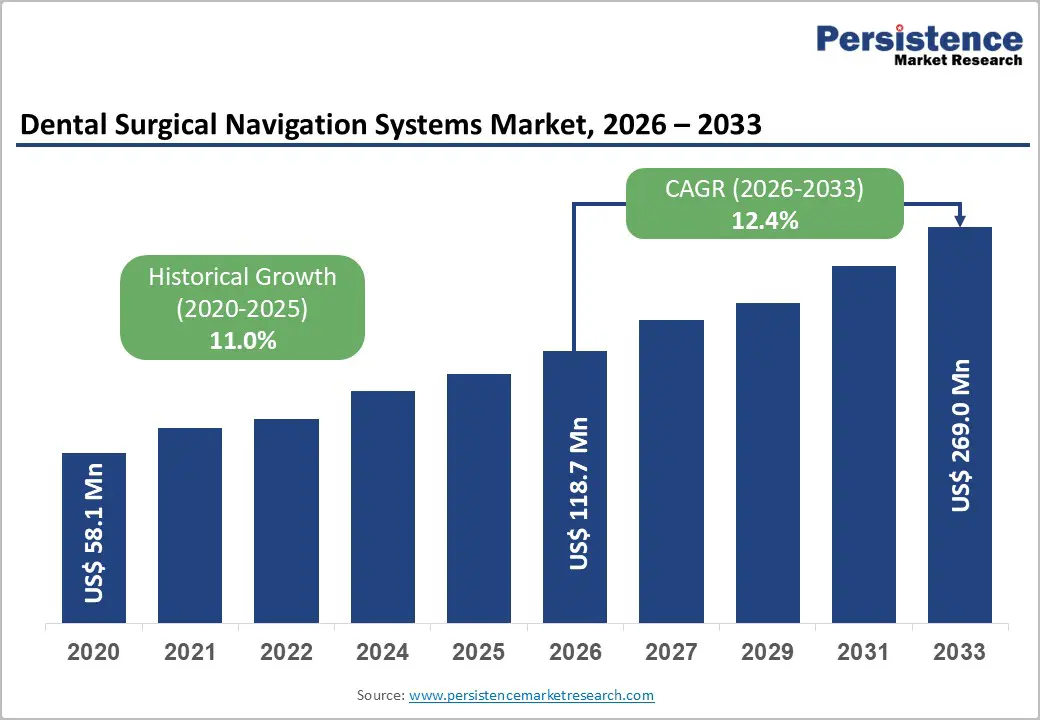
The global dental surgical navigation systems market is estimated to grow from US$ 118.7 million in 2026 to US$ 269.0 million by 2033. The market is projected to record a CAGR of 12.4% during the forecast period from 2026 to 2033.
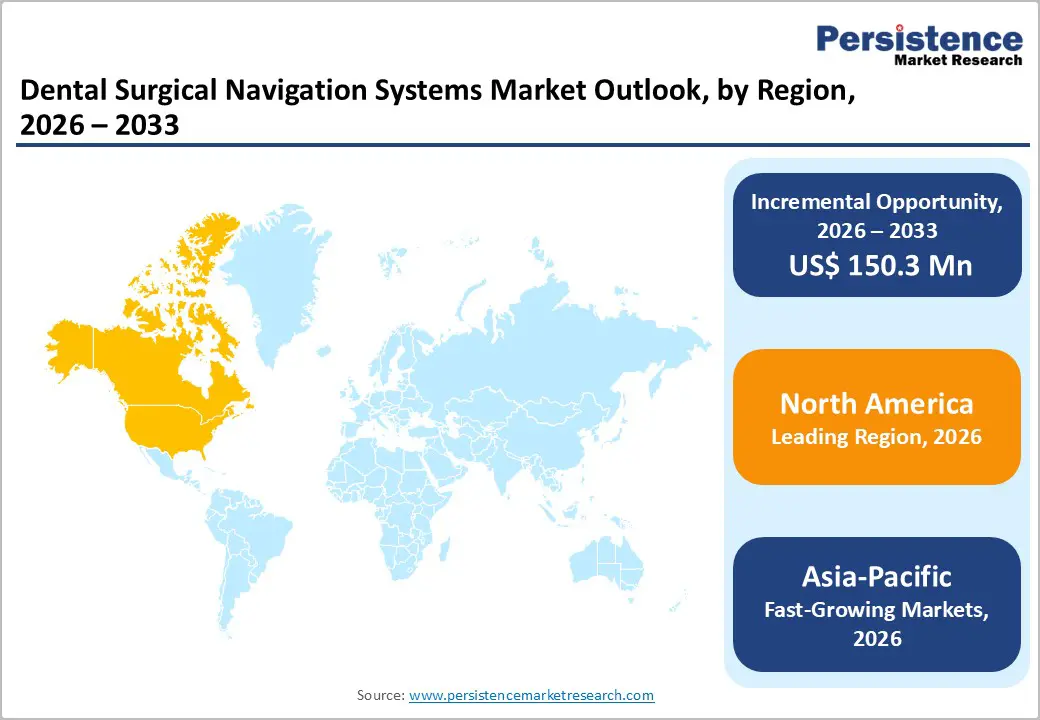
The global market is experiencing steady growth, driven by rising dental implant procedures, increasing demand for precise surgical guidance, and expanding adoption of digital dentistry technologies. North America leads due to advanced dental infrastructure and technology adoption. Asia Pacific is the fastest-growing region, supported by improving dental care access and growing dental tourism.
Key Industry Highlights:
- Dominant Segment: Optical navigation systems held the largest share in 2025, driven by their high accuracy, real-time tracking capability, and widespread use in dental implant surgeries and complex oral procedures, making them highly preferred in advanced dental clinics and hospitals.
- Dominant Region: North America led the dental surgical navigation systems market in 2025 with 38.7% share, supported by advanced dental infrastructure, high adoption of digital dentistry technologies, strong presence of key manufacturers, and increasing demand for precise implant placement procedures.
- Market Drivers: Growth is driven by rising dental implant procedures, increasing demand for minimally invasive and precision-guided surgeries, expanding adoption of CBCT imaging, and growing integration of digital workflows in dental practices.
- Market Opportunity: Opportunities exist in AI-enabled surgical navigation systems, integration with digital implant planning software, increasing dental tourism, and expanding adoption of advanced dental technologies across emerging markets, particularly in Asia-Pacific and Latin America.
| Key Insights | Details |
|---|---|
|
Global Dental Surgical Navigation Systems Market Size (2026E) |
US$ 118.7 Mn |
|
Market Value Forecast (2033F) |
US$ 269.0 Mn |
|
Projected Growth (CAGR 2026 to 2033) |
12.4% |
|
Historical Market Growth (CAGR 2020 to 2025) |
11.0% |
Market Dynamics
Driver: Increasing Demand for Accurate Dental Implant Placement
The growing burden of oral diseases and tooth loss worldwide is a major driver for the Dental Surgical Navigation Systems Market. According to the World Health Organization, oral diseases affect around 3.7 billion people globally, making them one of the most widespread health conditions. Untreated dental caries is considered the most common health condition worldwide, and severe gum disease affects nearly 1 billion people, often leading to tooth loss and the need for restorative procedures such as implants. As populations age and awareness of oral health improves, the demand for dental implants and restorative dentistry continues to increase, creating a strong need for precise surgical guidance technologies.
Accurate implant placement is critical for long-term success and patient outcomes, which is encouraging the adoption of navigation-guided surgical systems. Tooth loss remains a significant issue even in developed healthcare systems. Data from the Centers for Disease Control and Prevention shows that more than 15% of adults aged 65 years or older have lost all their natural teeth, while 26% of older adults have eight or fewer teeth, which significantly affects chewing and nutrition. These trends highlight the increasing demand for implant-based restorative procedures. Navigation systems enable real-time guidance during surgery, helping dentists place implants with higher precision, reducing complications, and improving clinical outcomes.
Restraint: Requirement for Specialized Training and Technical Expertise
Despite technological advancements, the adoption of dental surgical navigation systems is limited by the requirement for specialized training and clinical expertise. These systems integrate digital imaging, computer-guided navigation, and real-time instrument tracking, requiring dental professionals to learn new workflows and technologies. Studies indicate that digital dentistry tools such as AI-assisted imaging and navigation platforms require training in advanced imaging interpretation and software-based treatment planning. Additionally, many dental professionals still rely on traditional surgical approaches because learning navigation-based techniques involves additional time and investment in professional education and certification programs.
Evidence also shows that the transition toward digital dentistry is still ongoing and uneven across healthcare systems. Surveys indicate that only about 35% of dentists have implemented AI-based technologies in their practices, while many others remain in early adoption stages due to training requirements and technical barriers. Furthermore, about 58% of dentists who are not using AI cite cost and operational challenges as major barriers to adoption. These findings highlight how the need for technical expertise and workflow adaptation can slow the adoption of advanced surgical navigation platforms in dental clinics, particularly among smaller practices with limited resources.
Opportunity: Growing Adoption of AI-Enabled Dental Navigation Technologies
The integration of artificial intelligence into dental imaging and surgical planning represents a major opportunity for the Dental Surgical Navigation Systems Market. AI technologies are increasingly used to analyze radiographs, identify anatomical structures, and support treatment planning for implant procedures. Research examining regulatory approvals found that more than 50 AI-based dental devices have been cleared by the U.S. Food and Drug Administration, many of which are used in oral radiology and implant planning. These AI-driven technologies improve image analysis, automate surgical planning processes, and support real-time decision-making during procedures.
Adoption of AI tools in dentistry is accelerating globally, creating opportunities for navigation-guided surgical systems integrated with intelligent planning software. Surveys show that 72% of dental practices are adopting AI tools to improve diagnostic accuracy, and AI-assisted diagnostic systems have improved detection rates for dental conditions by up to 35–40% in clinical studies. In addition, over 80% of dental professionals consider AI an important component of future dental practice, highlighting strong industry acceptance of digital technologies. As AI continues to enhance diagnostic accuracy, surgical planning, and workflow automation, it is expected to significantly increase the demand for advanced navigation-assisted dental surgery systems.
Category-wise Analysis
By Product Type Insights
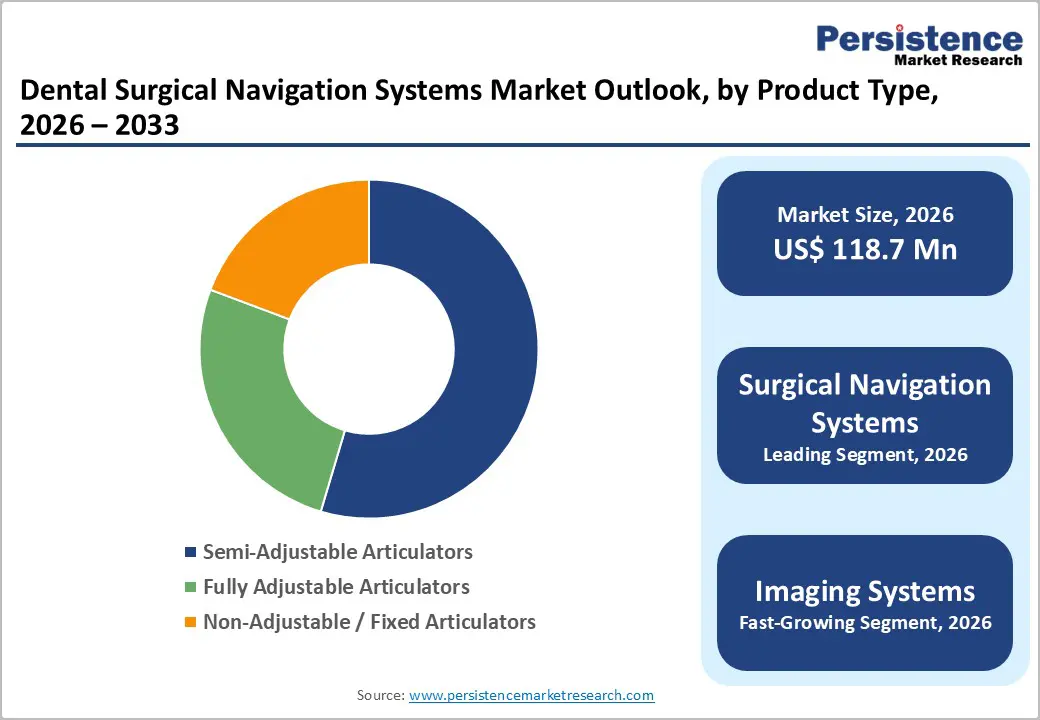
Surgical navigation systems dominate the dental surgical navigation systems market with 65.1% share because they form the core hardware platform that enables real-time tracking and guidance during implant procedures. Dental implants require extremely accurate placement to avoid complications such as nerve damage, sinus perforation, or implant failure. Clinical research shows that dental implants generally achieve over 90–96% long-term survival rates, but outcomes depend strongly on precise surgical technique and planning. This has increased the need for navigation systems that guide drill position, angulation, and depth during surgery.
Studies also show that implant positioning errors are common when procedures rely solely on manual techniques. One radiographic study analyzing 500 CBCT scans found positioning errors in about 56.6% of implants, highlighting the need for image-guided surgical assistance. Surgical navigation systems integrate imaging, tracking cameras, and navigation consoles, allowing dentists to monitor implant placement in real time and reduce surgical deviations. Because these systems are essential for performing navigation-guided implant surgery, they represent the largest and most valuable component segment in the market.
By Technology Insights
Optical navigation systems dominate the dental surgical navigation systems market because they provide high-precision tracking using infrared cameras and reflective markers, enabling accurate monitoring of surgical instruments during dental procedures. Implant surgery requires millimeter-level precision because small deviations can affect bone integration and long-term implant stability. Clinical research comparing surgical techniques found that freehand implant placement may produce deviations of about 1.22 mm at the coronal level and angular deviations of nearly 7.9°, while computer-assisted approaches significantly reduce these errors.
Optical navigation technologies are widely used because they deliver stable real-time tracking and high spatial accuracy, which are critical for complex implant procedures. Advanced navigation or robotic-assisted implant surgery can even reduce placement deviations to sub-millimeter levels, improving patient safety and reducing the need for corrective procedures. These performance advantages make optical systems the preferred technology in dental navigation platforms, particularly for high-precision implantology and maxillofacial surgical applications.
Regional Insights
North America Dental Surgical Navigation Systems Market Trends
North America dominates the dental surgical navigation systems market primarily due to its advanced dental infrastructure, high adoption of digital dentistry technologies, and strong demand for implant procedures. Oral health data from the Centers for Disease Control and Prevention (CDC) shows that tooth loss remains a significant issue in the United States. About 26% of adults aged 65 or older have eight or fewer teeth, while more than 15% have lost all their natural teeth, indicating a large population requiring restorative treatments such as dental implants.
Additionally, the region benefits from well-established dental care systems and high utilization of professional dental services. Studies also show that tooth loss and periodontal diseases increase with age, and aging populations in the U.S. continue to drive demand for advanced implant procedures. These factors encourage the adoption of precision-guided technologies such as dental surgical navigation systems, which improve implant placement accuracy and reduce surgical complications.
Europe Dental Surgical Navigation Systems Market Trends
Europe represents an important region in the dental surgical navigation systems market due to its high prevalence of oral diseases and strong dental healthcare systems. According to the World Health Organization (WHO), the European region has the highest prevalence of major oral diseases globally, with about 50.1% of adults affected by significant oral health conditions. Additionally, dental caries in permanent teeth affect around 33.6% of the population, representing nearly 335 million cases across the region.
This high disease burden increases the demand for restorative dental procedures such as implants and oral surgeries. Europe also benefits from a well-developed dental technology ecosystem and strong clinical research activity in digital dentistry. The presence of advanced dental clinics, increasing adoption of computer-guided implant procedures, and growing dental tourism across countries such as Hungary and Turkey further support the use of navigation-assisted surgical technologies.
Asia-Pacific Dental Surgical Navigation Systems Market Trends
Asia-Pacific is the fastest-growing region in the dental surgical navigation systems market due to rapid expansion of dental care infrastructure, increasing healthcare spending, and rising dental tourism. Several countries in the region have become major destinations for dental procedures because of affordable treatment and skilled dental professionals. For example, Thailand alone receives around 2 million international dental patients annually, highlighting the strong demand for advanced dental treatments.
Demographic trends also contribute to growth. The region has a rapidly aging population; China alone is expected to have more than 400 million people aged 60 or older by 2035, significantly increasing the prevalence of tooth loss and demand for implant procedures. As dental clinics modernize and adopt digital imaging and guided surgery technologies, demand for navigation-assisted implant systems is expanding rapidly across Asia Pacific.
Competitive Landscape
The dental surgical navigation systems market is highly competitive, led by companies such as ClaroNav, X-Nav Technologies, Nobel Biocare, EPED, and Image Navigation Ltd.. These players focus on advanced navigation technologies, real-time surgical guidance, integration with digital dentistry workflows, continuous product innovation, and expanding global distribution to support the increasing demand for precise dental implant procedures.
Key Industry Developments:
- In October 2025, Zeta Surgical received U.S. FDA 510(k) clearance for its AI-powered Transcranial Magnetic Stimulation (TMS) Navigation System, marking an important advancement in non-invasive brain therapy technologies. The system uses artificial intelligence and advanced imaging algorithms to accurately map brain regions and guide TMS procedures.
- In September 2024, Navident EVO received clearance from the U.S. Food and Drug Administration for use in guided endodontic procedures, expanding the capabilities of dynamic dental navigation technology. The system was developed by ClaroNav and is designed to provide real-time navigation during root canal procedures. With this clearance, dentists were able to use the platform to precisely locate calcified canals, guide access preparation, and improve treatment accuracy while minimizing unnecessary removal of tooth structure.
Companies Covered in Dental Surgical Navigation Systems Market
- EPED
- ClaroNav
- Navigate Surgical Technologies Inc.
- Image Navigation Ltd.
- Nobel Biocare Services AG
- X-Nav Technologies
- Others
Frequently Asked Questions
The global dental surgical navigation systems market is projected to be valued at US$ 118.7 Mn in 2026.
Rising dental implant procedures, growing digital dentistry adoption, demand for precision surgery, and advanced imaging integration.
The global dental surgical navigation systems market is poised to witness a CAGR of 12.4% between 2026 and 2033.
AI integration, expanding dental tourism, emerging market adoption, digital dentistry growth, and advanced implant navigation technologies.
EPED, ClaroNav, Navigate Surgical Technologies Inc., Image Navigation Ltd., Nobel Biocare Services AG, X-Nav Technologies.


