




- Hardware & Software IT Services
- Database Automation Market
Database Automation Market Size, Share, and Growth Forecast, 2026 - 2033
Database Automation Market by Component Type (Solutions, Services), Industry Vertical (Consumer Goods & Retail, Healthcare, Banking, Financial Services & Insurance (BFSI), Manufacturing, Telecom & IT), and Regional Analysis for 2026 - 2033

Database Automation Market Size and Trends Analysis
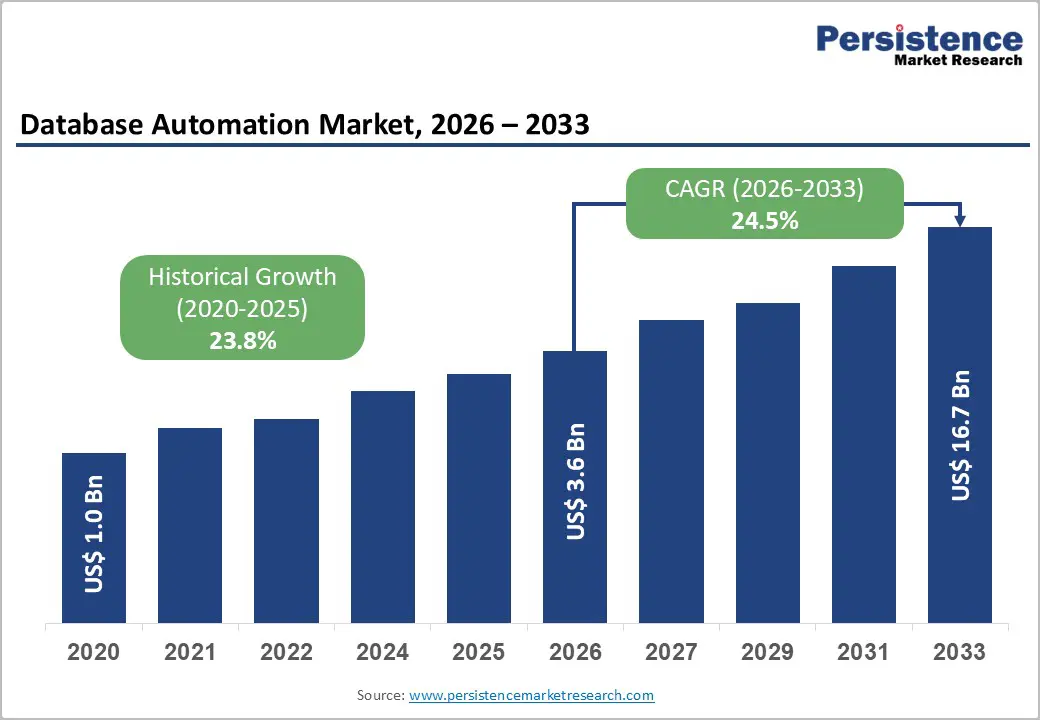
The global database automation market size is likely to be valued at US$3.6 billion in 2026 and is expected to reach US$16.7 billion by 2033, growing at a CAGR of 24.5% during the forecast period from 2026 to 2033, driven by the increasing complexity and volume of data across industries, along with the growing demand for efficient and reliable database management solutions.
Organizations are increasingly adopting automation to streamline repetitive and time-consuming tasks such as provisioning, patching, monitoring, performance tuning, and backup, which enhances operational efficiency and minimizes the risk of human error. The widespread adoption of cloud and hybrid environments is accelerating this trend, as businesses require scalable and flexible solutions capable of managing distributed and multi-cloud databases. The integration of AI and ML into database automation enables predictive maintenance, self-tuning, and anomaly detection, optimizing performance and ensuring security and compliance.
Key Industry Highlights:
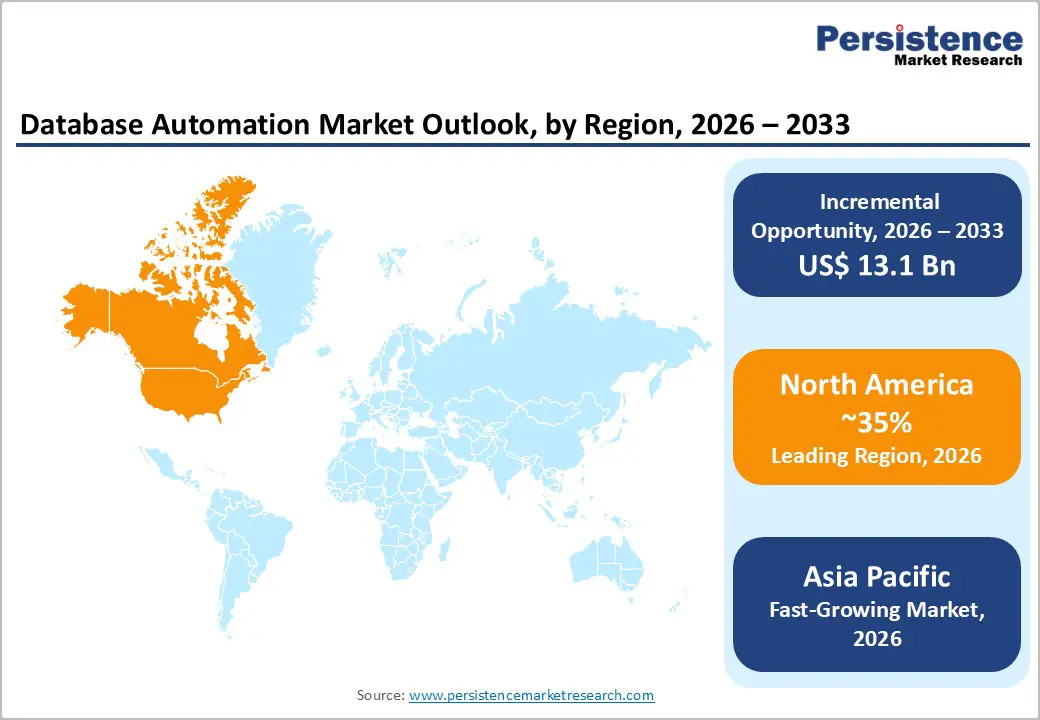
- Leading Region: North America, accounting for a market share of 35% in 2026, driven by early cloud adoption, AI integration, and a mature technology ecosystem.
- Fastest-growing Region: Asia Pacific, supported by rapid cloud adoption, digital transformation initiatives, and government support for technology deployment.
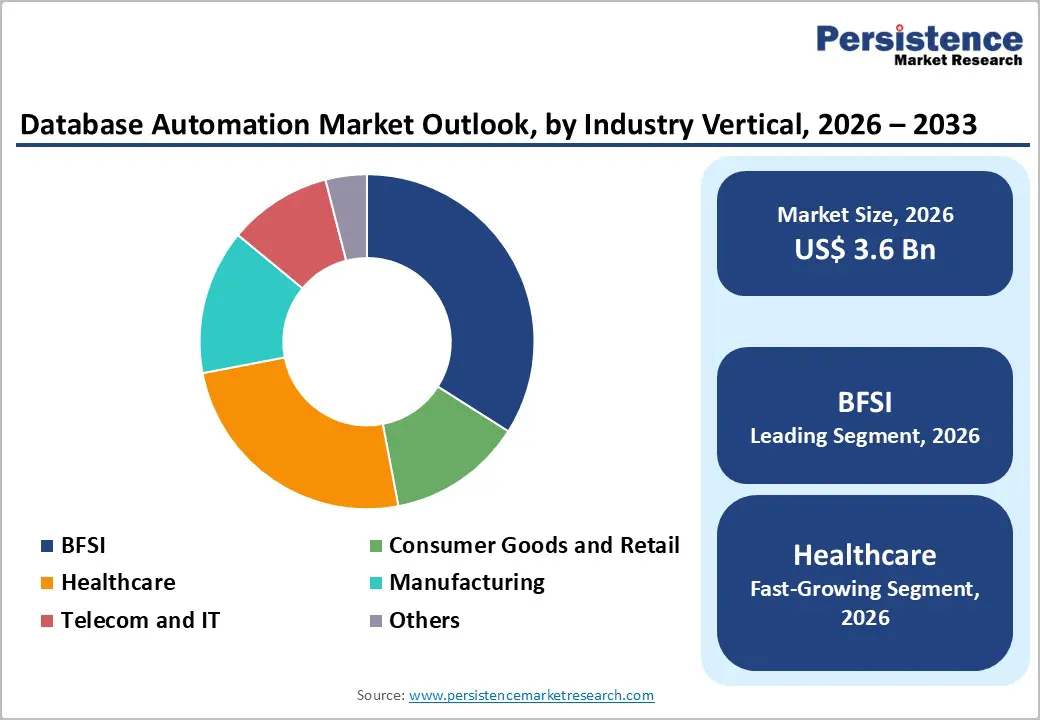
- Leading Component Type: Solutions, accounting for 60% of the revenue share, driven by its provision of core tools for provisioning, backup, and security automation.
- Leading Industry Vertical: BFSI, accounting for over 40% of the revenue share in 2026, supported by high data sensitivity and regulatory requirements favoring automation for compliance and security.
| Key Insights | Details |
|---|---|
|
Database Automation Market Size (2026E) |
US$3.6 Bn |
|
Market Value Forecast (2033F) |
US$16.7 Bn |
|
Projected Growth (CAGR 2026 to 2033) |
24.5% |
|
Historical Market Growth (CAGR 2020 to 2025) |
23.8% |
Market Factors - Growth, Barriers, and Opportunity Analysis
Growth Analysis-Escalating Data Volumes and Complexity
The rapid expansion of data generation across industries such as BFSI, healthcare, retail, and manufacturing is reshaping how organizations manage information. Companies now handle vast amounts of both structured and unstructured data, making manual database management increasingly inefficient and prone to errors. Automation helps streamline key tasks like provisioning, monitoring, backups, and performance optimization within complex database environments. By integrating AI and machine learning, these solutions support real-time analytics, detect anomalies, and enable predictive maintenance, ensuring consistent database performance. Moreover, the growing adoption of digital platforms, IoT, and smart applications is further driving the need for automated tools to efficiently manage rising data complexity.
Multi-cloud and hybrid infrastructures are becoming common, increasing database heterogeneity and operational challenges. Database automation tools address these challenges by providing centralized control, reducing human intervention, and ensuring consistent performance across diverse environments. Automation also supports faster deployment of new applications, smooth scaling, and efficient resource utilization. Industries such as telecom and IT, which generate high transactional data, benefit from automated provisioning and self-healing capabilities.
Adoption of Cloud Computing and Hybrid Environments
Enterprises increasingly rely on public, private, and hybrid clouds to store, process, and manage their data. Managing distributed databases manually across these environments is challenging, driving the need for automated solutions. Automation tools facilitate seamless provisioning, monitoring, and migration of databases to cloud platforms while ensuring optimal performance and minimizing downtime. Automated solutions integrate with DevOps pipelines, enabling continuous deployment and scaling in cloud environments, making operations more agile, resilient, and cost-efficient for businesses of all sizes and sectors.
Hybrid environments combine on-premises and cloud infrastructures, creating diverse configurations and operational complexities. Database automation tools provide centralized visibility and management across these systems, enabling consistent policies for backup, security, and compliance. Enterprises in sectors such as banking, financial services, and insurance (BFSI), healthcare, and retail, which handle sensitive information, leverage automated solutions to manage multi-cloud operations while ensuring regulatory compliance. Automation reduces manual errors and operational overhead, accelerating digital transformation initiatives.
Barrier Analysis - Data Privacy and Security Concerns
Enterprises face strict regulations such as GDPR, HIPAA, and CCPA, which impose heavy obligations on data protection, storage, and access. Automated solutions may inadvertently expose sensitive information or create vulnerabilities if not properly configured, leading to compliance risks and reputational damage. Many organizations hesitate to fully adopt automation for critical database operations due to fears of data breaches, insider threats, and cyberattacks. Ensuring secure authentication, access controls, and encrypted communications adds complexity to deployment, slowing adoption despite the operational benefits of database automation.
Multi-cloud and hybrid environments amplify security challenges, as data moves across different platforms with varying policies. Automation increases efficiency but may propagate errors or unauthorized changes faster than manual processes if mismanaged. Organizations must implement robust monitoring, auditing, and anomaly detection alongside automation tools to mitigate security risks. Smaller enterprises may lack the resources or expertise to deploy fully secure automated solutions, restraining market growth. Data privacy and security concerns remain a key barrier, prompting vendors to integrate advanced encryption, access governance, and compliance-focused features to encourage broader adoption in regulated industries.
Integration Challenges with Legacy Systems
Older databases and applications often lack modern APIs, standardized protocols, or compatibility with contemporary automation tools. Integrating automated solutions with these legacy environments can require significant customization, increasing deployment costs and timelines. Legacy systems may contain mission-critical data, making organizations cautious about automating operations that could disrupt business continuity. Resistance from IT teams familiar with traditional processes slows adoption. Integration challenges with legacy infrastructures act as a restraint, limiting the full potential and scalability of database automation solutions across enterprises with mixed environments.
Complex data migration from legacy systems to modern, automated platforms can also cause operational downtime, data inconsistency, or compliance risks. Many organizations need hybrid approaches, where automation is gradually applied to specific workflows while legacy systems continue to operate manually. This phased adoption slows overall market growth and increases the need for professional services and consulting. Companies must invest in training personnel to manage integrated systems effectively. Vendors addressing these integration challenges by providing flexible, backward-compatible solutions and migration support can reduce this barrier, but legacy system constraints remain a notable restraint in widespread database automation adoption.
Opportunity Analysis - Technological Convergence with AI, Edge Computing, and DevOps
Technological convergence presents a major opportunity for the Database Automation Market, especially the integration of AI, edge computing, and DevOps practices. AI-enabled automation enhances predictive maintenance, performance tuning, and anomaly detection, allowing databases to self-optimize in real time. Edge computing extends database operations closer to data sources, improving latency and enabling real-time analytics for IoT and industrial applications. Integration with DevOps pipelines facilitates continuous deployment, version control, and automated testing, improving operational efficiency and agility.
Enterprises adopting this convergence benefit from reduced operational costs, enhanced decision-making, and faster time to market for applications. AI-driven insights assist in capacity planning and risk management, while edge computing supports decentralized operations for industries such as telecom, manufacturing, and healthcare. DevOps integration ensures that automated processes align with software development and deployment lifecycles, fostering collaboration between IT and development teams. Vendors that leverage these converging technologies can differentiate their offerings with advanced features, attracting organizations seeking modernized database management.
Support for Regulatory Compliance, Data Sovereignty, and Self-Healing Capabilities
Database automation provides significant opportunities by supporting regulatory compliance, data sovereignty, and self-healing capabilities. Automated solutions streamline adherence to standards such as GDPR, HIPAA, and regional data residency requirements, ensuring audit readiness and reducing human error. Self-healing capabilities allow databases to detect anomalies, recover from failures, and optimize performance automatically, minimizing downtime and operational risks. Organizations in BFSI, healthcare, and government sectors, where compliance is critical, can leverage these features to maintain data integrity while improving efficiency.
Automated compliance monitoring allows enterprises to enforce consistent policies across multi-cloud and hybrid environments, addressing the growing complexity of operations. Data sovereignty requirements drive the adoption of localized automated solutions that ensure sensitive data remains within prescribed regions. Self-healing databases improve resilience against unexpected disruptions, providing organizations with business continuity assurance. Vendors that integrate these capabilities into their automation platforms can capture demand from compliance-focused industries, creating a strong market opportunity.
Category-wise Analysis
Component Type Insights
Solutions are expected to lead the database automation market, accounting for approximately 60% of revenue in 2026, driven by rising demand for automated provisioning, performance optimization, security management, and AI-enabled database operations across multi-cloud environments. Enterprises prioritize solutions because they deliver immediate efficiency gains, reduce manual errors, and enhance operational reliability across complex database environments. For example, Oracle Autonomous Database offers AI-driven automation capabilities, enabling automatic patching, backup, and performance optimization without manual intervention.
Services are likely to represent the fastest-growing segment, supported by the increasing complexity of database deployments and the growing adoption of hybrid and multi-cloud environments. Services include implementation, consulting, managed support, and training, addressing skill gaps within organizations and ensuring seamless integration of automation tools with existing infrastructures. For example, Datavail provides managed database automation services that help enterprises deploy, monitor, and maintain automated databases while optimizing performance and ensuring compliance.
Industry Vertical Insights
The BFSI segment is projected to lead the market, capturing around 40% of the revenue share in 2026, supported by high regulatory requirements, stringent data security standards, and the criticality of real-time financial transactions. For example, JPMorgan Chase leverages automated database solutions to streamline data management, ensure compliance, and monitor performance across multiple branches and operations. BFSI institutions handle massive volumes of sensitive data, including transaction records, customer information, and risk models, making automation vital for uptime, accuracy, and efficiency.
The healthcare segment is likely to be the fastest-growing, driven by increasing digitalization of patient records, adoption of electronic health records (EHRs), and the integration of smart hospital and IoT devices. Automation enables real-time data processing, predictive analytics, and compliance with stringent health regulations such as HIPAA. For example, Mayo Clinic uses automated database solutions to manage clinical data, streamline research workflows, and enhance patient care through timely insights. The rapid growth in this segment is driven by the need for efficient handling of massive volumes of clinical, diagnostic, and operational data while reducing human error and operational downtime.
Regional Insights
North America Database Automation Market Trends
North America is anticipated to be the leading region, accounting for a market share of 35% in 2026, driven by early adoption of cloud computing, strong digital transformation initiatives, and the presence of major technology vendors. The region benefits from mature IT infrastructure, high enterprise IT spending, and rapid integration of AI-driven automation capabilities such as self-healing databases and predictive performance monitoring. For example, Amazon Web Services offers automated database services that enable organizations to streamline provisioning, patching, backup, and scaling across distributed environments.
Organizations are increasingly investing in automation to reduce manual workloads, enhance uptime, and improve performance optimization across real-time data environments. Growth is also supported by rising cybersecurity concerns and demand for automated compliance monitoring solutions. For example, Oracle Corporation provides autonomous database solutions that leverage AI for automated tuning, patching, and threat detection, enabling enterprises to strengthen operational resilience.
Europe Database Automation Market Trends
Europe is likely to be a significant market for database automation in 2026, due to strict regulatory frameworks, increasing cloud adoption, and enterprise-wide digital transformation initiatives. Organizations across BFSI, healthcare, manufacturing, and government sectors are prioritizing database automation to ensure compliance with data protection laws such as GDPR while maintaining operational efficiency. The region’s strong emphasis on data sovereignty and privacy has accelerated the deployment of automated compliance monitoring, encrypted backup management, and real-time auditing capabilities.
Germany, the U.K., and France are among the leading contributors to regional growth, supported by strong industrial bases and expanding cloud infrastructure investments. Enterprises are integrating automation tools to manage complex data environments, particularly in smart manufacturing and financial services. For example, SAP SE provides database management and automation capabilities through its enterprise platforms, enabling organizations to streamline data provisioning, enhance performance optimization, and maintain compliance across distributed environments.
Asia Pacific Database Automation Market Trends
The Asia Pacific region is likely to be the fastest-growing region, driven by rapid digital transformation, expanding cloud infrastructure, and increasing enterprise data generation across industries. Countries such as China, India, Japan, and South Korea are investing heavily in cloud computing, artificial intelligence, and 5G technologies, which require highly scalable and automated database management solutions. Enterprises in telecom, BFSI, manufacturing, and e-commerce are adopting automation to manage complex hybrid and multi-cloud environments while improving operational efficiency and reducing manual intervention.
China and India are particularly strong growth engines within the region, supported by expanding data centers and rising enterprise IT investments. Organizations are leveraging automation to optimize database performance, ensure compliance with evolving data localization regulations, and support high-volume transactional workloads. For example, Alibaba Cloud provides automated database services that enable businesses to manage scaling, backup, and performance tuning efficiently across cloud-native environments.
Competitive Landscape
The global database automation market exhibits a moderately fragmented structure, driven by the presence of a mix of large technology giants and specialized software vendors competing to deliver advanced automation capabilities across cloud, on-premises and hybrid deployments. Companies are also forming alliances and acquiring niche startups to strengthen cloud-native and data-ops capabilities, expanding support for multi-cloud architectures and scalable automation workflows.
With key leaders including SAP SE, BMC Software, Redgate Software Ltd., Percona LLC, Quest Software Inc., Datavail, and IDERA, Inc., these players collectively advance innovation and expand market penetration. These players compete through continuous product innovation, strategic partnerships, and enhanced integration with DevOps and AI ecosystems to differentiate their offerings and capture a greater share. Investment in research and development enables real-time monitoring, predictive analytics, and self-healing automation features that meet evolving enterprise demands.
Key Industry Developments:
- In January 2026, Oracle Corporation announced the release of Oracle GoldenGate 26ai, along with GoldenGate Stream Analytics 26ai and Veridata 26c, introducing AI-driven automation, broader platform compatibility, and simplified enterprise data operations. The update features an embedded AI Microservice that enables AI-powered data enrichment, embedding generation, and support for bring-your-own models to enhance real-time data movement. The release also introduces automatic schema evolution to reduce manual intervention, expanded heterogeneous database support including PostgreSQL, YugabyteDB, and Google Cloud Spanner, and enhanced compare-and-repair capabilities.
- In September 2025, Adeptia announced the rebranding of its flagship Connect platform to Adeptia Automate, introducing enhanced AI-powered data automation capabilities. The upgraded platform features AI-guided data mapping, a modern user experience, and a scalable architecture designed to streamline enterprise data integration and eliminate IT bottlenecks. The solution supports deployments across Amazon EKS, Azure EKS, OpenShift ARO, and on-premises environments, while incorporating enterprise-grade security standards, including HIPAA, SOC 2, and ISO/IEC 27001 compliance.
Companies Covered in Database Automation Market
- IBM Corporation
- Oracle Corporation
- Microsoft Corporation
- CA Technologies (Broadcom)
- BMC Software Inc.
- Datavail
- Micro Focus
- HelpSystems LLC
- Amazon Web Services
- Percona LLC
- Redgate Software Ltd.
- WhereScape Inc.
- Quest Software Inc.
Frequently Asked Questions
The global database automation market is projected to reach US$3.6 billion in 2026.
Escalating data volumes, rapid cloud and hybrid adoption, and the need to reduce manual errors while improving efficiency, security, and compliance.
The database automation market is expected to grow at a CAGR of 24.5% from 2026 to 2033.
Key market opportunities lie in AI-driven self-managing databases, multi-cloud and hybrid automation, regulatory compliance solutions, and integration with DevOps and edge computing environments.
IBM Corporation, Oracle Corporation, Microsoft Corporation, and BMC Software Inc. are the leading players.


