Cream Cheese Market Size, Share, Growth, and Regional Forecast, 2026 to 2033

Cream Cheese Market is segmented by Source (Dairy-Based, Plant-Based), by Flavor (Plain, Savory Flavors, Sweet Flavors), End-user (Foodservice, Industrial / Food Manufacturing, Household / Retail), and Regional Analysis, 2026 - 2033

ID: PMRREP36321
Calendar

March 2026

200 Pages

Author : Amol Patil

Key Industry Highlights:

  • Leading Region: North America, holding 37% market share, supported by strong bagel and cheesecake consumption culture, well-developed retail infrastructure, and the dominant presence of major dairy brands such as The Kraft Heinz Company.
  • Fastest-Growing Region: Asia Pacific, driven by rapid westernization of diets, expanding café and bakery chains, and growing consumer interest in premium desserts like cheesecakes and cheese-based beverages.
  • Fastest-Growing Source Segment: Plant-Based cream cheese is gaining strong traction due to rising vegan diets, lactose intolerance awareness, and innovations using almond, cashew, oat, and coconut-based formulations.
  • Market Drivers: Expanding global demand for premium bakery and confectionery products is significantly increasing the use of cream cheese in pastries, desserts, and café-style breakfast menus.
  • Opportunities: Development of functional cream cheese with probiotics and health-focused formulations offers new premium positioning opportunities in the growing gut-health and functional dairy segment.
  • Key Developments: In February 2026, Philadelphia Cream Cheese launched the Really Philly Good brand platform developed by Johannes Leonardo to reposition cream cheese as an everyday kitchen staple. In July 2025, Cremeitalia introduced a range of bold-flavored cream cheese variants targeting evolving consumer demand for premium flavored dairy spreads.
Key Insights Details
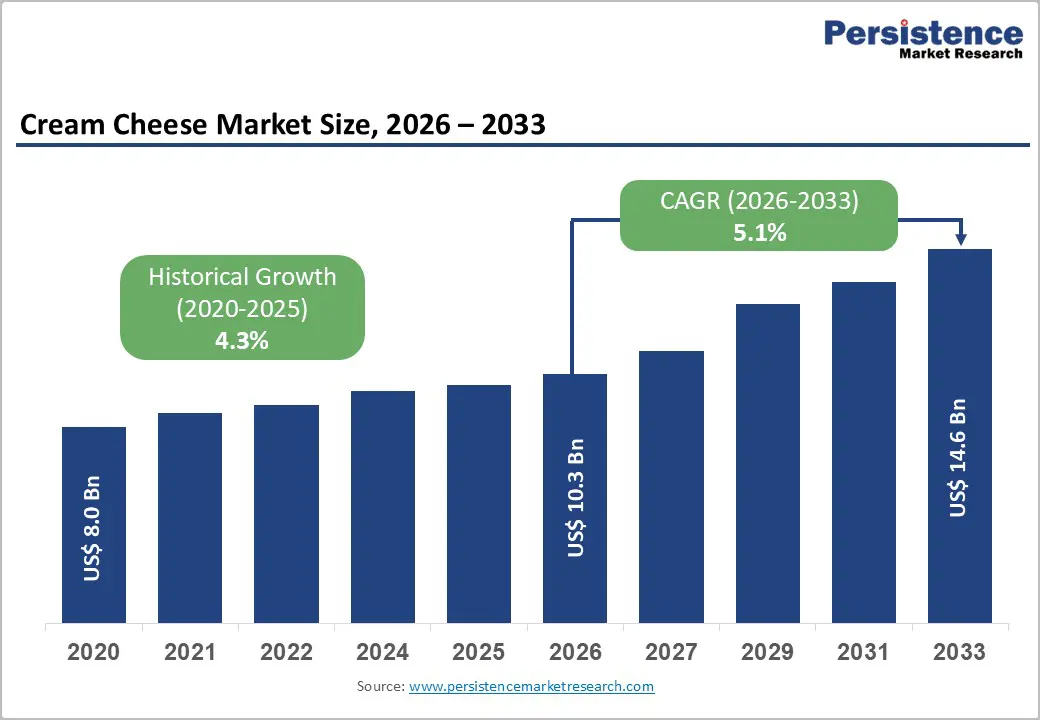
Global Cream Cheese Market Size (2026E) US$ 10.3 Bn
Market Value Forecast (2033F) US$ 14.6 Bn
Projected Growth (CAGR 2026 to 2033) 5.1%
Historical Market Growth (CAGR 2020 to 2025) 4.3%

cream-cheese-market-size-2026-2033

Market Dynamics

Driver - Rising Demand for Premium Bakery and Confectionery Products

A primary driver of the cream cheese industry is its essential role in the global bakery market. The demand for indulgent, high-quality baked goods has increased significantly, especially in the post-pandemic era where consumers seek permissible indulgence. Cream cheese is a vital functional ingredient, offering the right texture and acidity for cheesecakes, pastries, and artisanal frostings. As global coffee shop chains and bakery franchises expand in developing regions, the demand for cream cheese-based spreads and fillings has grown. Companies like The Kraft Heinz Company, with its well-known Philadelphia brand, have successfully capitalized on this trend by partnering with foodservice leaders to incorporate cream cheese into mainstream breakfast and dessert menus worldwide.

Restraints - Rising Prevalence of Lactose Intolerance and Vegan Dietary Shifts

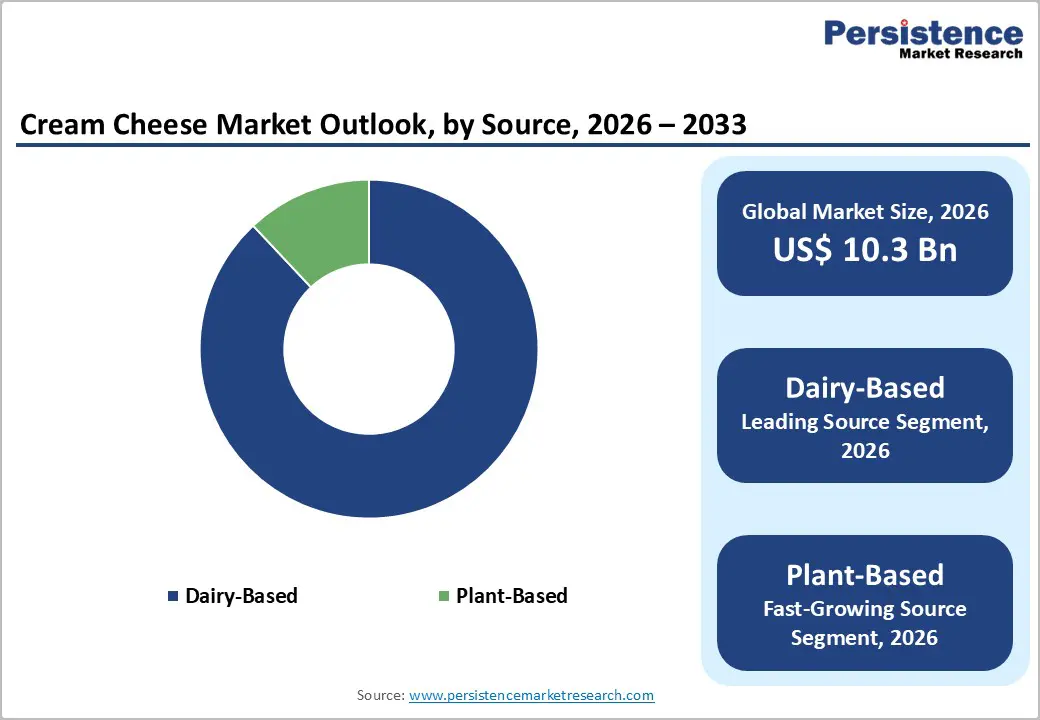
The growing awareness of lactose intolerance and the mainstreaming of veganism pose a substantial challenge to traditional dairy-based cream cheese consumption. Statistics from the National Institutes of Health (NIH) indicate that a significant percentage of the global population has a reduced ability to digest lactose, leading many to seek non-dairy alternatives. The plant-forward dietary shift, championed by organizations like the Vegan Society, has accelerated the demand for almond, cashew, and oat-based spreads. While dairy-based products still hold an 88% market share in 2025, the rapid growth of the Plant-Based segment led by innovators like Oatly Group AB and Danone S.A. directly competes for shelf space and consumer attention. This necessitates constant innovation from traditional dairy players to maintain their market dominance against increasingly sophisticated dairy-free mimics.

Opportunity - Expansion into the Functional and Probiotic Dairy Segment

There is a burgeoning opportunity for cream cheese to be positioned as a functional health food. As gut health becomes a top priority for global consumers, the integration of live active cultures and specific probiotic strains into cream cheese spreads is expected to generate significant demand. According to the World Gastroenterology Organisation, the probiotic market is expanding beyond supplements into everyday dairy staples. Manufacturers can capitalize on this by launching fortified cream cheese variants that offer immune-boosting or digestive benefits. This strategy is particularly effective in the Asia Pacific region, where there is a strong cultural affinity for fermented foods. By aligning cream cheese with the broader trend of food as medicine, companies can justify premium pricing and differentiate their products in a crowded retail landscape dominated by plain, unfortified options.

Category-wise Analysis

Source Insights

The Dairy-Based segment remains the dominant force in the market, capturing a substantial 88% market share in 2025. This leadership is attributed to the long-standing consumer trust in traditional dairy, its superior flavor profile, and its established role in traditional culinary recipes. Dairy cooperatives like Fonterra Co-operative Group and GCMMF (Amul) play a pivotal role in maintaining this dominance through massive production capacities and deep distribution networks. However, the Plant-Based segment is identified as the fastest growing segment through 2033. This rapid rise is fueled by the escalating number of flexitarian consumers and the increasing availability of high-quality dairy-free alternatives made from cashews, coconut oil, and soy, which are increasingly mimicking the sensory experience of traditional dairy cream cheese.

End-user Insights

The Plain flavor segment continues to hold the leading market share in 2025 due to its unparalleled versatility in both home and professional kitchens. It serves as the primary base for cheesecakes, frostings, and diverse cooking applications, making it a must-have item in the Industrial / Food Manufacturing sector. Conversely, Savory Flavors and Sweet Flavors are the fastest-growing segments in the retail space. This growth is driven by the rising demand for ready-to-use spreads that eliminate the need for additional seasoning. Innovation in this category is spearheaded by brands like Franklin Foods and Land O'Lakes Inc., which are consistently launching seasonal and limited-edition flavors to engage adventurous consumers and drive impulse purchases in supermarkets.
cream-cheese-market-outlook-by-source-2026-2033

Regional Insights

North America Cream Cheese Market Trends and Insights

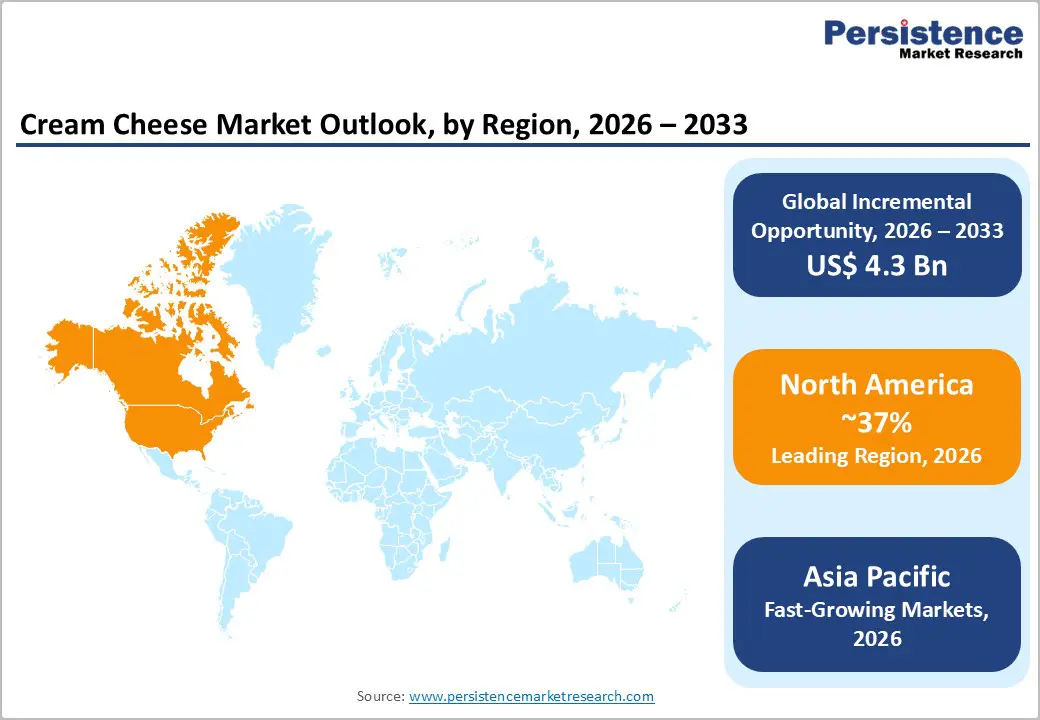
North America is the leading region in the global cream cheese market, holding a 37% market share in 2025. The region's leadership is underpinned by a deeply ingrained bagel culture and the high consumption of cheesecakes. The United States leads the region in terms of both production and consumption, with a highly developed retail infrastructure and a strong presence of global market leaders like The Kraft Heinz Company.

The innovation ecosystem in the U.S. is particularly focused on clean-label and artisanal cream cheese products. Regulatory frameworks managed by the Food and Drug Administration (FDA) ensure high safety and labeling standards, which fosters consumer trust. Furthermore, the region is a hub for plant-based innovation, with several startups and established dairy players launching oat and nut-based cream cheese alternatives to cater to the rising vegan population in major metropolitan areas. The high disposable income and the established habit of using cream cheese as a primary breakfast spread ensure that North America will maintain its dominant position throughout the forecast period.

Asia Pacific Cream Cheese Market Trends and Insights

Asia Pacific is identified as the fastest growing segment for the cream cheese market through 2032. This rapid expansion is primarily driven by the westernization of diets in China, India, and Japan. As the middle class expands and urbanization increases, there is a marked surge in the popularity of western-style bakeries and coffee chains. China is a major engine of growth, where the cheese-tea phenomenon and the increasing adoption of cheesecakes as premium desserts have created a massive demand for imported cream cheese.

Growth dynamics in India are also noteworthy, with local giants like GCMMF (Amul) launching affordable cream cheese spreads to tap into the urban breakfast market. The region benefits from significant manufacturing advantages and a young, adventurous population that is eager to experiment with international flavors. The expansion of modern retail chains and the booming e-commerce sector in Southeast Asia have made cream cheese more accessible to a wider demographic. As international players like Fonterra Co-operative Group increase their regional investments, the Asia Pacific region is poised to become a central pillar of the global cream cheese industry.
cream-cheese-market-outlook-by-region-2026-2033

Competitive Landscape

The global cream cheese market exhibits a consolidated structure at the top tier, where a few multinational dairy giants hold significant influence over global supply chains and brand recognition. Companies like The Kraft Heinz Company, Lactalis Group, and Arla Foods amba dominate the retail and foodservice channels through massive marketing budgets and economies of scale. However, the market remains fragmented at the regional level, with local dairy cooperatives and artisanal players catering to specific cultural palates and farm-to-table trends. Key differentiators employed by market leaders include the mastery of specialized filtration technologies and the development of proprietary stabilizer systems that ensure consistent texture across various temperatures. Emerging business model trends show a shift toward co-innovation, where cream cheese producers collaborate with global bakery franchises to create customized flavor profiles and application-specific formulations, thereby securing long-term supply contracts.

Key Developments:

  • In February 2026, Philadelphia Cream Cheese introduced a new brand platform titled Really Philly Good, developed by Johannes Leonardo. The campaign features 19 creative spots and introduces a new brand character, Phillyboy, aiming to reposition cream cheese as an everyday kitchen staple rather than just a breakfast spread.
  • In July 2025, Cremeitalia, an Indian clean-label cheese brand, launched a new range of bold-flavored cream cheese variants, targeting evolving consumer preferences for innovative flavors and premium dairy spreads in the domestic market.

Companies Covered in Cream Cheese Market

  • The Kraft Heinz Company
  • Danone S.A.
  • Royal FrieslandCampina N.V.
  • Arla Foods amba
  • Fonterra Co-operative Group
  • Lactalis Group
  • Saputo Inc.
  • Oatly Group AB
  • GCMMF
  • Franklin Foods
  • Land O'Lakes Inc.
  • Others
Frequently Asked Questions

The global Cream Cheese market is projected to be valued at US$ 10.3 Bn in 2026.

Rising Demand for Premium Bakery and Confectionery Products is a major factor driving global Cream Cheese market.

The Global Cream Cheese market is poised to witness a CAGR of 5.1% between 2026 and 2033.

Expansion into the Functional and Probiotic Dairy Segment is a significant opportunity in the Cream Cheese market.

Major players in the Global Cream Cheese market include The Kraft Heinz Company, Danone S.A., Royal FrieslandCampina N.V., Arla Foods amba, Fonterra Co-operative Group, Lactalis Group, Saputo Inc. and others.

Cream Cheese Market Report Scope
Report Attributes Details
Historical Data/Actuals 2020 - 2025
Forecast Period 2026 - 2033
Market Analysis Value: US$ Bn
Geographical Coverage
  • North America
  • Europe
  • East Asia
  • South Asia and Oceania
  • Middle East and Africa
  • Latin America
Segmental Coverage
  • Source
  • Flavor
  • End-user
  • Region
Competitive Analysis
  • The Kraft Heinz Company
  • Danone S.A.
  • Royal FrieslandCampina N.V.
  • Arla Foods amba
  • Fonterra Co-operative Group
  • Lactalis Group
  • Saputo Inc.
  • Oatly Group AB
  • GCMMF
  • Franklin Foods
  • Land O'Lakes Inc.
  • Others
Report Highlights
  • Market Forecast and Trends
  • Competitive Intelligence & Share Analysis
  • Growth Factors and Challenges
  • Strategic Growth Initiatives
  • Future Opportunities and Revenue Pockets
  • Market Analysis Tools
Market Segmentation

By Source

  • Dairy-Based
  • Plant-Based

By Form

  • Plain
  • Savory Flavors
  • Sweet Flavors

By End-user

  • Foodservice
  • Industrial / Food Manufacturing
  • Household / Retail

By Region

  • North America
  • Europe
  • East Asia
  • South Asia and Oceania
  • Latin America
  • Middle East and Africa

Related Reports

  1. Executive Summary
    1. Global Cream Cheese Market Snapshot 2026 and 2033
    2. Market Opportunity Assessment, 2026-2033, US$ Bn
    3. Key Market Trends
    4. Industry Developments and Key Market Events
    5. Demand Side and Supply Side Analysis
    6. PMR Analysis and Recommendations
  2. Market Overview
    1. Market Scope and Definitions
    2. Market Dynamics
      1. Driver
      2. Restraint
      3. Opportunities
      4. Trends
    3. Macro-Economic Factors
    4. Forecast Factors - Relevance and Impact
    5. COVID-19 Impact Assessment
  3. Value Added Insights
    1. Value Chain analysis
    2. Key Market Players
    3. Product Adoption Analysis
    4. Key Promotional Strategies by key players
    5. PESTLE Analysis
    6. Porter's Five Forces Analysis
    7. Regulatory and Technology Landscape
  4. Price Trend Analysis, 2025
    1. Region-wise Price Analysis
    2. Price by Segments
    3. Price Impact Factors
  5. Global Cream Cheese Market Outlook: Historical (2020 - 2025) and Forecast (2026 - 2033)
    1. Key Highlights
    2. Global Cream Cheese Market Outlook: Source
      1. Introduction/Key Findings
      2. Historical Market Size (US$ Bn) Analysis by Source, 2020-2025
      3. Current Market Size (US$ Bn) Forecast, by Source, 2026-2033
        1. Dairy-Based
        2. Plant-Based
      4. Market Attractiveness Analysis: Source
    3. Global Cream Cheese Market Outlook: Flavor
      1. Introduction/Key Findings
      2. Historical Market Size (US$ Bn) Analysis by Flavor, 2020-2025
      3. Current Market Size (US$ Bn) Forecast, by Flavor, 2026-2033
        1. Plain
        2. Savory Flavors
        3. Sweet Flavors
      4. Market Attractiveness Analysis: Flavor
    4. Global Cream Cheese Market Outlook: End Use
      1. Introduction/Key Findings
      2. Historical Market Size (US$ Bn) Analysis by End Use, 2020-2025
      3. Current Market Size (US$ Bn) Forecast, by End Use, 2026-2033
        1. Foodservice
        2. Industrial / Food Manufacturing
        3. Household / Retail
      4. Market Attractiveness Analysis: End Use
  6. Global Cream Cheese Market Outlook: Region
    1. Key Highlights
    2. Historical Market Size (US$ Bn) Analysis by Region, 2020-2025
    3. Current Market Size (US$ Bn) Forecast, by Region, 2026-2033
      1. North America
      2. Europe
      3. East Asia
      4. South Asia & Oceania
      5. Latin America
      6. Middle East & Africa
    4. Market Attractiveness Analysis: Region
  7. North America Cream Cheese Market Outlook: Historical (2020 - 2025) and Forecast (2026 - 2033)
    1. Key Highlights
    2. Pricing Analysis
    3. North America Market Size (US$ Bn) Forecast, by Country, 2026-2033
      1. U.S.
      2. Canada
    4. North America Market Size (US$ Bn) Forecast, by Source, 2026-2033
      1. Dairy-Based
      2. Plant-Based
    5. North America Market Size (US$ Bn) Forecast, by Flavor, 2026-2033
      1. Plain
      2. Savory Flavors
      3. Sweet Flavors
    6. North America Market Size (US$ Bn) Forecast, by End Use, 2026-2033
      1. Foodservice
      2. Industrial / Food Manufacturing
      3. Household / Retail
  8. Europe Cream Cheese Market Outlook: Historical (2020 - 2025) and Forecast (2026 - 2033)
    1. Key Highlights
    2. Pricing Analysis
    3. Europe Market Size (US$ Bn) Forecast, by Country, 2026-2033
      1. Germany
      2. Italy
      3. France
      4. U.K.
      5. Spain
      6. Russia
      7. Rest of Europe
    4. Europe Market Size (US$ Bn) Forecast, by Source, 2026-2033
      1. Dairy-Based
      2. Plant-Based
    5. Europe Market Size (US$ Bn) Forecast, by Flavor, 2026-2033
      1. Plain
      2. Savory Flavors
      3. Sweet Flavors
    6. Europe Market Size (US$ Bn) Forecast, by End Use, 2026-2033
      1. Foodservice
      2. Industrial / Food Manufacturing
      3. Household / Retail
  9. East Asia Cream Cheese Market Outlook: Historical (2020 - 2025) and Forecast (2026 - 2033)
    1. Key Highlights
    2. Pricing Analysis
    3. East Asia Market Size (US$ Bn) Forecast, by Country, 2026-2033
      1. China
      2. Japan
      3. South Korea
    4. East Asia Market Size (US$ Bn) Forecast, by Source, 2026-2033
      1. Dairy-Based
      2. Plant-Based
    5. East Asia Market Size (US$ Bn) Forecast, by Flavor, 2026-2033
      1. Plain
      2. Savory Flavors
      3. Sweet Flavors
    6. East Asia Market Size (US$ Bn) Forecast, by End Use, 2026-2033
      1. Foodservice
      2. Industrial / Food Manufacturing
      3. Household / Retail
  10. South Asia & Oceania Cream Cheese Market Outlook: Historical (2020 - 2025) and Forecast (2026 - 2033)
    1. Key Highlights
    2. Pricing Analysis
    3. South Asia & Oceania Market Size (US$ Bn) Forecast, by Country, 2026-2033
      1. India
      2. Southeast Asia
      3. ANZ
      4. Rest of SAO
    4. South Asia & Oceania Market Size (US$ Bn) Forecast, by Source, 2026-2033
      1. Dairy-Based
      2. Plant-Based
    5. South Asia & Oceania Market Size (US$ Bn) Forecast, by Flavor, 2026-2033
      1. Plain
      2. Savory Flavors
      3. Sweet Flavors
    6. South Asia & Oceania Market Size (US$ Bn) Forecast, by End Use, 2026-2033
      1. Foodservice
      2. Industrial / Food Manufacturing
      3. Household / Retail
  11. Latin America Cream Cheese Market Outlook: Historical (2020 - 2025) and Forecast (2026 - 2033)
    1. Key Highlights
    2. Pricing Analysis
    3. Latin America Market Size (US$ Bn) Forecast, by Country, 2026-2033
      1. Brazil
      2. Mexico
      3. Rest of LATAM
    4. Latin America Market Size (US$ Bn) Forecast, by Source, 2026-2033
      1. Dairy-Based
      2. Plant-Based
    5. Latin America Market Size (US$ Bn) Forecast, by Flavor, 2026-2033
      1. Plain
      2. Savory Flavors
      3. Sweet Flavors
    6. Latin America Market Size (US$ Bn) Forecast, by End Use, 2026-2033
      1. Foodservice
      2. Industrial / Food Manufacturing
      3. Household / Retail
  12. Middle East & Africa Cream Cheese Market Outlook: Historical (2020 - 2025) and Forecast (2026 - 2033)
    1. Key Highlights
    2. Pricing Analysis
    3. Middle East & Africa Market Size (US$ Bn) Forecast, by Country, 2026-2033
      1. GCC Countries
      2. South Africa
      3. Northern Africa
      4. Rest of MEA
    4. Middle East & Africa Market Size (US$ Bn) Forecast, by Source, 2026-2033
      1. Dairy-Based
      2. Plant-Based
    5. Middle East & Africa Market Size (US$ Bn) Forecast, by Flavor, 2026-2033
      1. Plain
      2. Savory Flavors
      3. Sweet Flavors
    6. Middle East & Africa Market Size (US$ Bn) Forecast, by End Use, 2026-2033
      1. Foodservice
      2. Industrial / Food Manufacturing
      3. Household / Retail
  13. Competition Landscape
    1. Market Share Analysis, 2025
    2. Market Structure
      1. Competition Intensity Mapping
      2. Competition Dashboard
    3. Company Profiles
      1. The Kraft Heinz Company
        1. Company Overview
        2. Product Portfolio/Offerings
        3. Key Financials
        4. SWOT Analysis
        5. Company Strategy and Key Developments
      2. Danone S.A.
      3. Royal FrieslandCampina N.V.
      4. Arla Foods amba
      5. Fonterra Co-operative Group
      6. Lactalis Group
      7. Saputo Inc.
      8. Oatly Group AB
      9. GCMMF
      10. Franklin Foods
      11. Land O'Lakes Inc.
      12. Others
  14. Appendix
    1. Research Methodology
    2. Research Assumptions
    3. Acronyms and Abbreviations

Research Methodology Framework for Market Research Excellence

At Persistence Market Research, we implement a comprehensive, validated, and multi-dimensional approachto market analysis that delivers actionable insights across complex market landscapes. Our methodology combines the analytical rigor of leading consulting firms with innovative research techniques, ensuring robust market assessments that guide strategic decision-making with confidence.

Core Research Philosophy

Our methodology is built on four foundational pillars:

Research Philosophy Image

At Persistence Market Research, our methodology is designed to transcend conventional market studies by combining analytical rigor, multi-source validation, and future-focused insights.

We integrate advanced research frameworks, robust data collection strategies, cutting-edge analytics, and innovative technologies to deliver a 360-degree view of complex markets.

We integrate advanced research frameworks, robust data collection strategies, cutting-edge analytics, and innovative technologies to deliver a 360-degree view of complex markets.

Each stage spanning from strategic scoping and hypothesis-building to competitive intelligence, quality validation, and actionable recommendations is engineered to provide clients with unmatched clarity, precision, and confidence in decision-making.

By embedding innovation and technology at the core, our approach ensures that insights are not only comprehensive but also predictive, empowering businesses to seize opportunities, mitigate risks, and achieve sustainable growth

Research Philosophy Image

Capturing Key Information and Events

During this phase, key research objectives focus on essential information and data points for assessing the market, including:

Research Philosophy Image

TAM-SAM-SOM Framework Implementation

We employ both top-down and bottom-up approaches to ensure accurate market sizing.

Top-Down Market SizingBottom-Up Market Sizing
Universe Definition: Total global/regional market identificationUnit Economics: Average transaction values, purchase frequencies, customer lifecycle
Segmentation Filters: Geographic, demographic, and behavioral constraintsCustomer Segmentation: Detailed buyer persona development and sizing
Market Share Analysis: Competitive landscape assessment and share allocationPenetration Analysis: Market penetration rates by segment and geography
Growth Rate Application: Historical trends and forward-looking growth assumptionsScaling Methodology: Extrapolation techniques with confidence intervals

Validation & Cross-Verification

  • Triangulation: Comparing top-down and bottom-up results for consistency
  • Sensitivity Analysis: Testing key assumptions and parameter variations
  • Peer Benchmarking: Comparison with analogous markets and industry benchmarks
  • Expert Review: External validation through industry specialist consultation

Research Philosophy Image

Forecasting & Projection Modeling

Our proprietary forecasting models incorporate multiple variables and scenarios.

Forecasting Components

  • Historical Trend Analysis: 10-year historical growth patterns and cyclical variations
  • Driver-Based Modeling: Economic indicators, demographic shifts, technology adoption
  • Scenario Planning: Base case, optimistic, and conservative projections
  • Monte Carlo Simulations: Probability-weighted outcomes and risk assessments

Model Validation

  • Back-Testing: Historical accuracy assessment over 3–5-year periods
  • Cross-Validation: Multiple modeling approaches for result comparison
  • External Benchmarking: Comparison with established market forecasts
  • Continuous Calibration: Quarterly model updates based on new data

Comprehensive Data Collection Strategy

Our secondary research phase establishes a robust knowledge base utilizing diverse, credible sources.

Secondary Data Sourcess

  • Industry Publications & Reports
  • Government & Regulatory Data
  • Financial Intelligence (filings & reports)
  • Academic Research & Digital Intelligence

Quality Assurance Protocol

  • Source credibility assessment and publication date validation
  • Data consistency checks across multiple sources
  • Bias identification and neutralization techniques
  • Information gap tracking for primary research prioritization

Research Philosophy Image

Primary Research Excellence

Our primary research methodology employs best-in-class techniques to capture unique market insights.

Quantitative Research Methods

  • Large-Scale Surveys: Statistically representative samples with 95% confidence intervals
  • Survey Methodology: Multi-channel deployment (online, telephone, in-person)
  • Question Architecture and Response Optimization

Qualitative Research Methods

  • Executive Interviews
  • Focus Groups
  • Expert Consultations

Quality Assurance & Validation Framework

Multi-Stage Validation Process

  • Source Verification and Consistency Testing
  • Outlier Detection and Bias Assessment
  • Peer Review Process and External Validation
  • Sensitivity Analysis and Confidence Intervals

Research Philosophy Image

Methodology Validation & Credibility

Our research methodology has been extensively validated through:

  • Academic Partnerships: Collaborations with top-tier business schools and research institutions
  • Client Success Stories: Documented case studies demonstrating research impact and ROI
  • Continuous Benchmarking: Performance comparison with leading global research firms

This comprehensive methodology framework positions Persistence Market Research at the forefront of market intelligence, combining the analytical sophistication of top-tier consulting firms with innovative research techniques. Our approach ensures that every market assessment delivers precise, actionable, and strategically valuable insights that drive business success in competitive market environments.

Ready to unlock your market potential? Contact our research experts to discuss how our validated methodology can transform your strategic decision-making with data-driven market intelligence.

Copyright © 2026 Persistence Market Research. All Rights Reserved

Connect With Us -