




- Nutraceuticals & Functional Foods
- Collagen Market
Collagen Market Size, Share, Growth, and Regional Forecast, 2026 to 2033
Collagen Market is segmented by Source (Bovine, Porcine, Poultry, Marine, Plant), by Form (Dry, Liquid), by End Use (Food & Beverages, Nutraceuticals & Dietary Supplements, Cosmetics & Personal Care, Animal Feed, Others), and by Regional Analysis, 2026 - 2033

Collagen Market Share and Trends Analysis
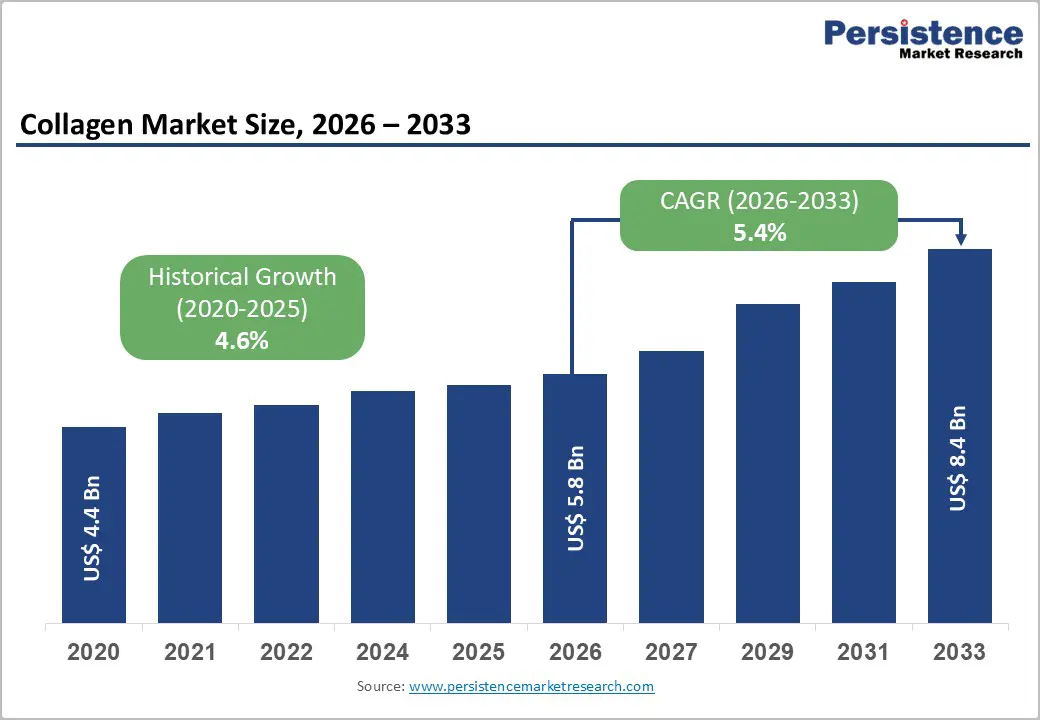
The global collagen market size is expected to be valued at US$ 5.8 billion in 2026 and projected to reach US$ 8.4 billion by 2033, growing at a CAGR of 5.4% between 2026 and 2033.
Market growth is primarily driven by the growing use of collagen in regenerative medicine and the surging popularity of ingestible beauty products. As the global geriatric population is growing, the demand for collagen-based supplements for bone and joint health has intensified. Furthermore, the expansion of the clean-label trend in the food industry has positioned collagen as a multifunctional protein source, gaining significant traction among health-conscious consumers seeking natural, functional ingredients.
Key Industry Highlights:
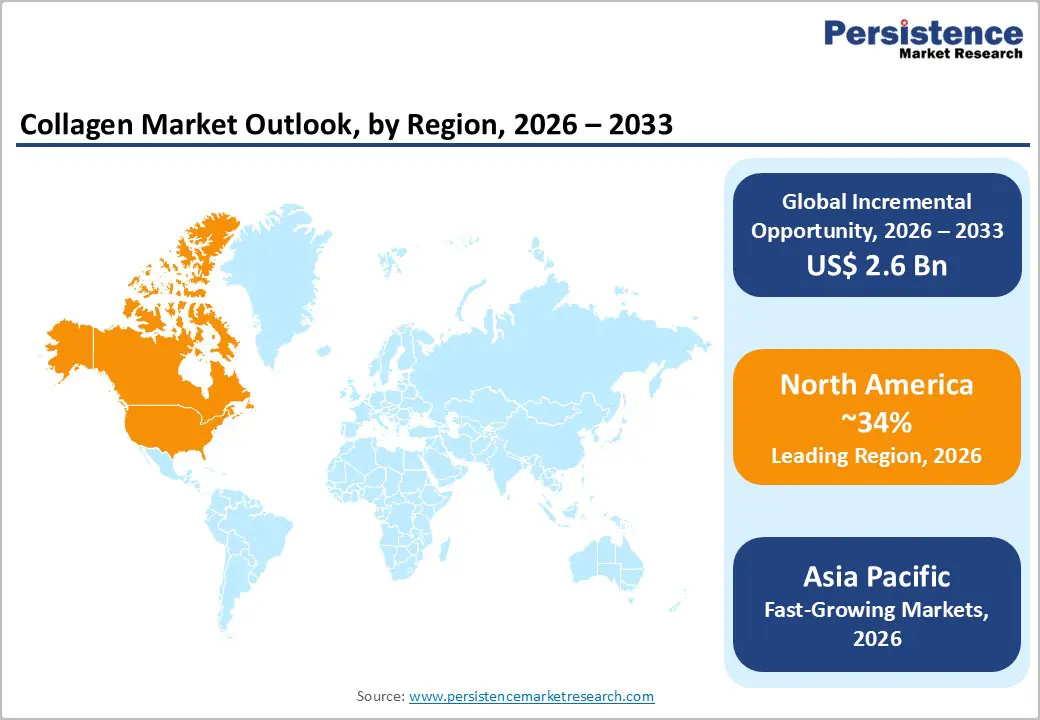
- Leading Region: North America, holding 34% market share in 2025, supported by high dietary supplement penetration, strong beauty-from-within positioning, advanced regulatory clarity, and the presence of major players such as Darling Ingredients Inc. and Kenvue Inc.
- Fastest-Growing Region: Asia Pacific, driven by deep-rooted nutricosmetics culture in Japan and South Korea, expanding middle-class demand in China and India, and strong marine collagen innovation.
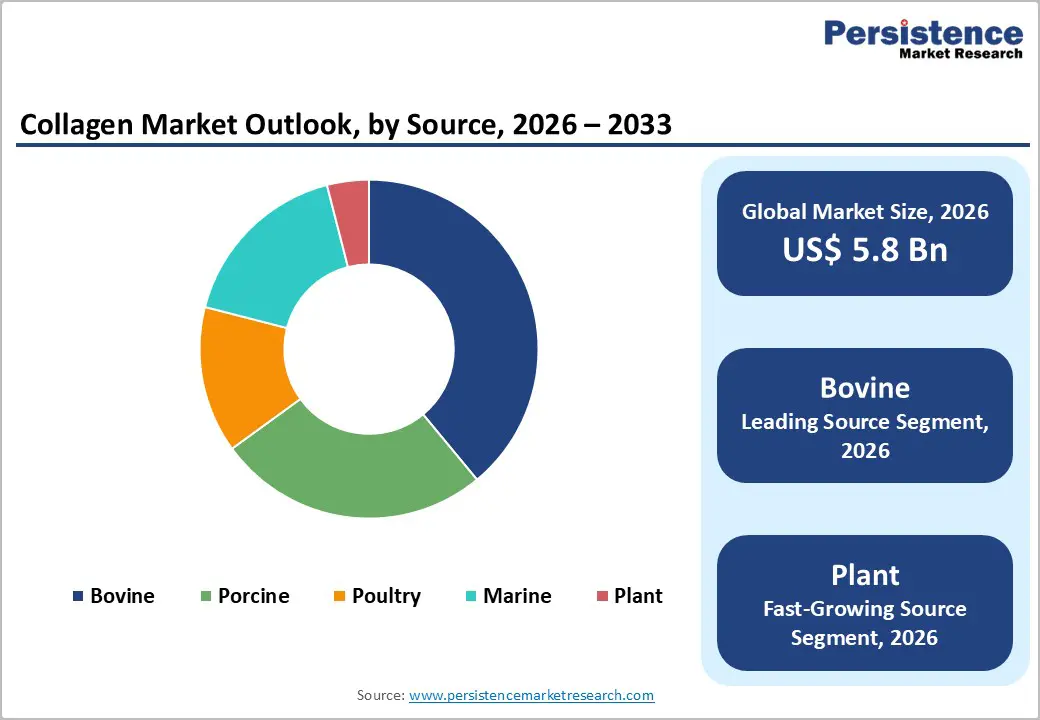
- Fastest-Growing Source Segment: Plant-based collagen alternatives, fueled by vegan lifestyle adoption and advances in fermentation-derived bio-identical collagen technologies.
- Market Driver: Rising demand for functional foods and nutraceuticals, aligned with preventive healthcare trends and increasing clinical validation of collagen benefits.
- Market Opportunity: Emergence of vegan and bio-designed collagen through precision fermentation, addressing sustainability, ethical sourcing, and next-generation clean beauty demands.
- Key Developments: In February 2026, Rousselot announced the showcase of Peptan and Nextida GC at Natural Products Expo West in the US. In September 2025, Evonik Industries AG launched VECOLLAN®, a recombinant animal-free collagen for clinical applications.
| Key Insights | Details |
|---|---|
| Collagen Market Size (2026E) | US$ 5.8 Bn |
| Market Value Forecast (2033F) | US$ 8.4 Bn |
| Projected Growth (CAGR 2026 to 2033) | 5.4% |
| Historical Market Growth (CAGR 2020 to 2025) | 4.6% |
Market Dynamics
Driver - Rising Demand for Functional Food and Nutraceuticals
The primary driver of the global market is a fundamental shift in consumer behavior toward preventive healthcare. According to the World Health Organization (WHO), the rise in chronic lifestyle diseases has encouraged consumers to seek out fortified food products. Collagen peptides are increasingly integrated into protein bars, functional beverages, and gummies due to their high bioavailability and health benefits. Scientific research published in journals such as Nutrients highlights collagen's role in improving skin elasticity and reducing joint pain, which has resonated deeply with the aging population. This has led to a surge in product launches by companies like DSM-Firmenich and Darling Ingredients Inc., which are targeting the beauty-from-within segment through advanced hydrolyzed collagen formulations.
Restraints - Stringent Regulatory Frameworks and Safety Concerns
A significant barrier to market expansion is the complex regulatory landscape surrounding animal-derived proteins. Concerns about Bovine Spongiform Encephalopathy (BSE) and other zoonotic diseases have led to strict import and export regulations and rigorous safety testing protocols. The European Food Safety Authority (EFSA) maintains high standards for the traceability of raw materials used in collagen production. These compliance requirements often result in higher operational costs for manufacturers. Additionally, cultural and religious dietary restrictions (such as Halal or Kosher requirements) limit the use of porcine-derived collagen in several key markets, forcing companies to invest in more expensive alternative sourcing or advanced purification technologies to maintain market access.
Opportunity - Emergence of Vegan and Plant-Based Collagen Alternatives
The fastest-growing opportunity lies in developing plant-based collagen builders and bio-designed vegan collagen. While traditional collagen is exclusively animal-derived, the rise of veganism has spurred innovation in producing collagen-like proteins using biotechnology via yeast and bacterial fermentation. Companies like Evonik Industries AG are investing heavily in microbial fermentation to produce non-animal collagen that mimics the human type III collagen profile. This addresses the ethical and sustainability concerns of Gen Z and Millennial consumers. As the clean beauty movement gains momentum, brands offering sustainable, cruelty-free alternatives are expected to capture a significant share of the Cosmetics & Personal Care segment, particularly in North America and Europe.
Category-wise Analysis
Source Insights
The Bovine segment is the leading source in the market, holding a dominant 39% market share in 2026. Bovine collagen is highly favored due to its abundance, cost-effectiveness, and similarity to human types I and III collagen, which are crucial for skin and bone health. Its established supply chain through the cattle industry makes it the primary choice for mass-market nutraceuticals. Conversely, the Plant segment is the fastest-growing segment through 2033. This is fueled by the explosive growth of the vegan lifestyle and the demand for ethical alternatives. While these are often collagen boosters containing amino acids and antioxidants, the development of fermented, bio-identical vegan collagen is set to revolutionize this category.
End-user Insights
The Nutraceuticals & Dietary Supplements segment is the leading end-user of collagen, accounting for the largest share of the market value. This is driven by the widespread adoption of collagen for joint support and anti-aging. Meanwhile, the Cosmetics & Personal Care segment is emerging as a powerful secondary driver, with collagen being a hero ingredient in luxury anti-wrinkle creams and hair treatments. The Food & Beverages industry is also seeing significant growth as manufacturers incorporate collagen into everyday items like yogurt and snacks. Lastly, the Medical end-use (included in Others) remains a high-value, steady segment due to the indispensable nature of collagen in modern surgical and wound care products.
Regional Insights
North America Collagen Market Trends and Insights
North America remains the leading region in the global collagen market, holding a 34% market share in 2025. The region's dominance is anchored by the United States, where health supplements are highly penetrated, and the beauty-from-within market is mature. American consumers are early adopters of premium hydrolyzed collagen brands. The presence of major industry players like Darling Ingredients Inc. and Kenvue Inc. (formerly a Johnson & Johnson company) ensures a steady stream of product innovation and aggressive marketing.
The regulatory environment in the U.S., managed by the FDA, provides a clear framework for dietary supplements, fostering consumer trust. Furthermore, the strong focus on fitness and the high prevalence of sports-related injuries have made collagen a standard part of the athletic recovery regimen. The innovation ecosystem in Silicon Valley and other tech hubs is also driving the development of bio-synthetic collagen, positioning North America as a leader in both traditional animal-sourced and next-generation vegan collagen alternatives.
Asia Pacific Collagen Market Trends and Insights
Asia Pacific is identified as the fastest-growing segment globally, with a projected high CAGR through 2033. This expansion is fueled by the rising disposable income and the deep-rooted Nutricosmetics culture in Japan, South Korea, and China. In these markets, collagen consumption is not just a trend but a standard part of the beauty and diet routine. Japan is a pioneer in the marine collagen segment, with companies like Nitta Gelatin Inc. leading the way in high-absorption peptide technology.
Regional growth is further supported by the burgeoning middle classes in India and ASEAN countries, who are increasingly influenced by Western health trends. China's large manufacturing base provides a cost advantage in raw material processing. As local brands in Korea (K-Beauty) continue to dominate the global skincare landscape, the integration of collagen into innovative formats such as sheet masks and jelly sticks is expected to drive significant volume growth across the Asia Pacific region.
Competitive Landscape
The global collagen Market is moderately consolidated, with a few large-scale ingredient manufacturers controlling the majority of the raw material supply. Giants like Darling Ingredients Inc. and Tessenderlo Group dominate the global landscape through massive production capacities and international distribution networks. However, the market remains dynamic due to the presence of specialized players like Nitta Gelatin Inc. and Amicogen Inc., who focus on high-purity medical and marine collagen. Market leaders are increasingly employing vertical integration strategies to secure raw material supplies and ensure quality control. Emerging business models are shifting toward Direct-to-Consumer (DTC) branding and social media-led marketing, allowing smaller, agile brands to disrupt the retail space with innovative, lifestyle-oriented collagen products.
Key Developments:
- In February 2026, Rousselot announced that it would showcase its collagen peptide brands Peptan and Nextida GC at Natural Products Expo West in Anaheim, California, US.
- In September 2025, Evonik Industries AG announced the launch of VECOLLAN®, a recombinant, animal-free collagen designed specifically for clinical research applications.
Companies Covered in Collagen Market
- Darling Ingredients Inc.
- Tessenderlo Group
- Evonik Industries AG
- dsm-firmenich
- Kenvue Inc.
- Nitta Gelatin Inc.
- Weishardt Group
- Ashland
- Amicogen Inc.
- Titan Biotech
- Others
Frequently Asked Questions
The global Collagen market is projected to be valued at US$ 5.8 Bn in 2026.
Rising Demand for Functional Food and Nutraceuticals is a major factor driving global Collagen market.
The Global Collagen market is poised to witness a CAGR of 5.4% between 2026 and 2033.
Emergence of Vegan and Plant-Based Collagen Alternatives is a significant opportunity in the Collagen market.
Major players in the Global Collagen market include Darling Ingredients Inc., Tessenderlo Group, Evonik Industries AG, dsm-firmenich, Kenvue Inc., Nitta Gelatin Inc., Ashland. and others.


