




- Semiconductor Materials & Components
- Co-Packaged Optics (CPO) Market
Co-Packaged Optics (CPO) Market Size, Share, and Growth Forecast, 2026 - 2033
Co-Packaged Optics (CPO) Market by Data Rate (800G and Below, 1.6T, 3.2T and Above), Component (Optical Engines, Photodetectors), Architecture, Application and Regional Analysis for 2026 - 2033

Co-Packaged Optics (CPO) Market Size and Trends Analysis
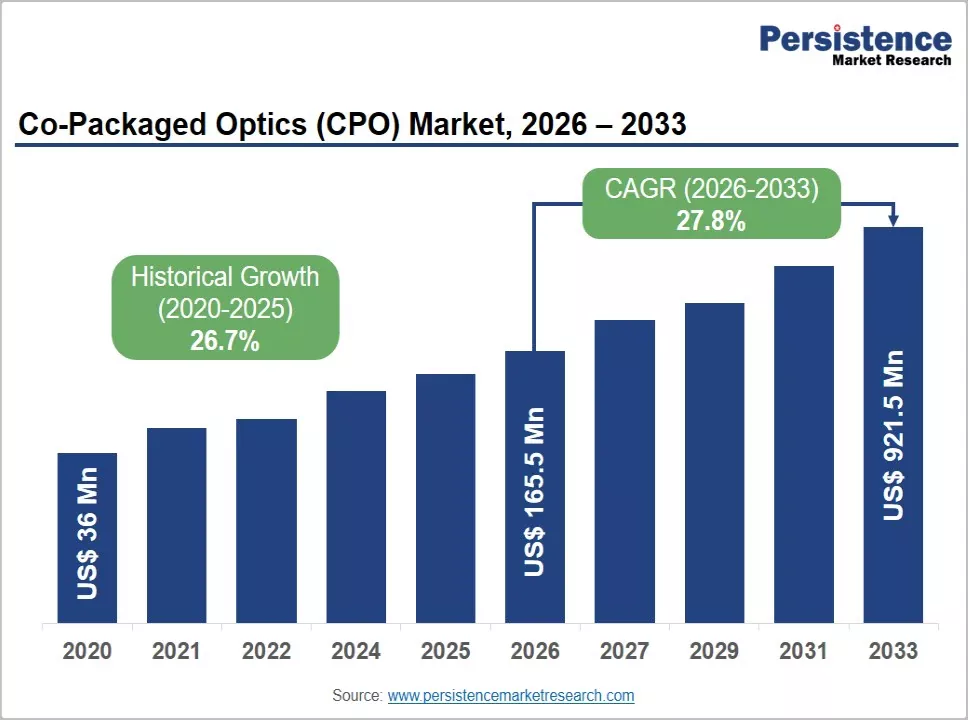
The global co-packaged optics (CPO) market size is likely to be valued at US$ 165.5 million in 2026 and is expected to reach US$ 921.5 million by 2033, growing at a CAGR of 27.8% between 2026 and 2033, driven by rising AI cluster bandwidth requirements, power constraints in data centers, and the commercialization of silicon photonics.
Switch and accelerator designs are increasingly placing optical engines beside processing silicon, which shortens electrical paths, lowers power per bit, and removes the digital signal processing used in pluggable transceivers.
Key Industry Highlights
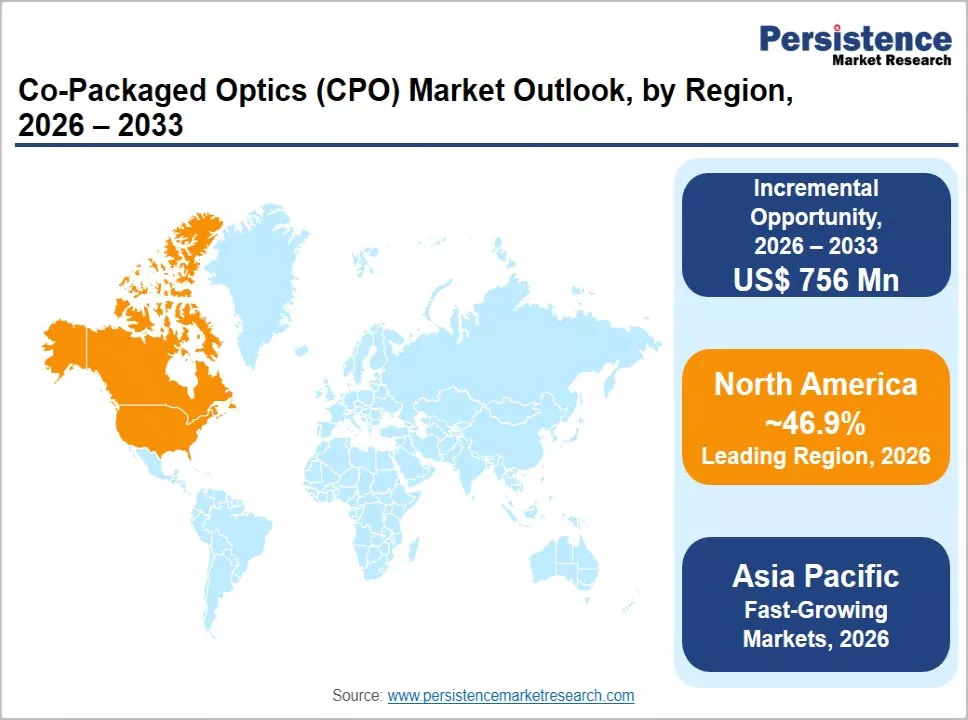
- Leading Region: North America, anticipated to account for 46.9% of the market share, supported by hyperscale AI infrastructure investment, leading switch silicon and GPU developers, and early commercial deployment of CPO switches.
- Fastest-growing Region: Asia Pacific, driven by silicon photonics foundry capacity, advanced packaging, optical component manufacturing, and expanding AI infrastructure investment.
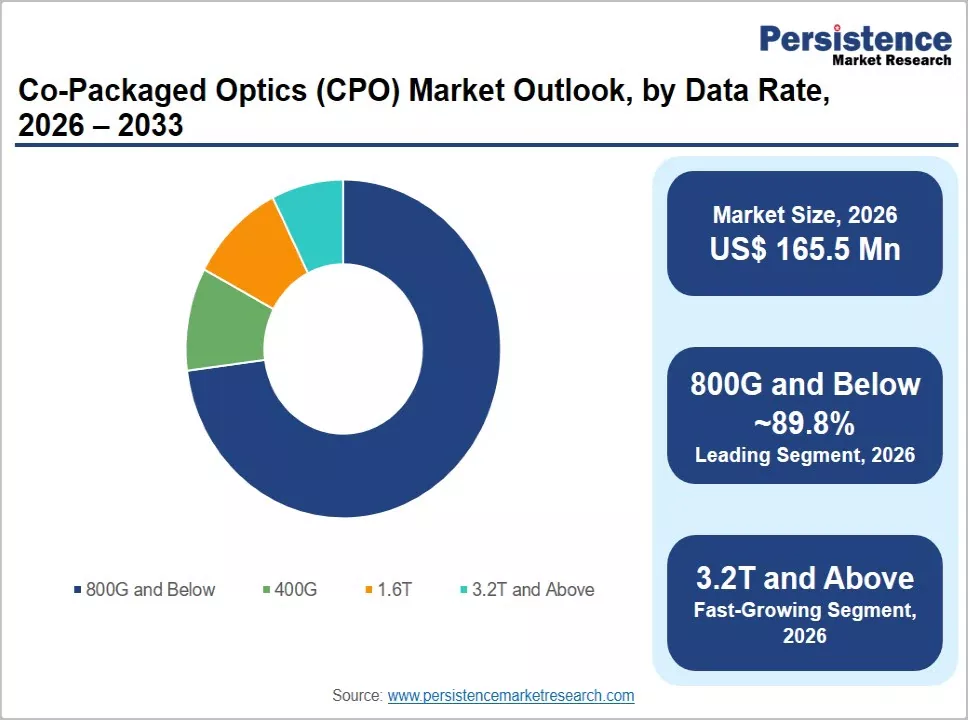
- Dominant Data Rate: 800G and below, anticipated to account for approximately 89.8% of port-speed revenue in 2026, supported by 400G and 800G ports on first-generation CPO switches.
- Leading Component: Optical engines, anticipated to hold approximately 51.3% of the market share, driven by their role as the core electro-optical conversion element placed beside switch and accelerator silicon.
DRO Analysis
Drivers - AI Cluster Scaling Is Raising Demand for Power-Efficient Optical Interconnects
Artificial intelligence training and inference clusters are increasing the volume of data exchanged between accelerators and switches. Conventional pluggable transceivers require high-power electrical signaling between the switch chip and the faceplate, and each port adds a separate laser, digital signal processor, and connector. As port speeds rise, power consumption and the number of potential failure points increase across large fabrics.
CPO addresses these constraints by placing optical engines on the same package as the switch ASIC. AI and HPC networking is anticipated to account for approximately 50% of the market in 2026. NVIDIA reports that its Spectrum-X Ethernet Photonics platform delivers 5x lower power, 4x fewer lasers, and 10x higher mean time between incidents than pluggable deployments, while Broadcom reports up to 70% lower power for its Tomahawk 6 - Davisson switch. These gains are encouraging hyperscalers and AI cloud operators to qualify CPO for production networks.
Silicon Photonics Manufacturing Maturity and Foundry Investment Are Expanding Commercial Supply
Silicon photonics is the dominant CPO architecture, anticipated to hold 86.7% of the market in 2026, because modulators, waveguides, and photodetectors are fabricated on standard semiconductor wafers. Foundries are investing to scale this capability. TSMC supports CPO through its Compact Universal Photonic Engine (COUPE) platform, which is used in Broadcom's third-generation CPO switch.
Additional capacity is entering the market. In July 2026, UMC reported delivery of mass-produced silicon photonic chips on 300 mm wafers at its Singapore fab, and Samsung formally entered the silicon photonics market in March 2026 after completing a process design kit. Intel stated at the 2026 Open Compute Project Global Summit that it is positioned to supply 300 mm indium phosphide silicon photonics at high volume. These investments are expected to broaden the supplier base and support the transition from pilot production to volume manufacturing.
Restraint - Laser Supply, Advanced Packaging Capacity, and Serviceability Constraints Slow Deployment
Supply constraints remain a significant challenge for the CPO market. Every silicon photonics platform still requires an indium phosphide laser, and Lumentum reported in May 2026 that the supply-demand imbalance for electro-absorption modulated lasers exceeds 30%. The U.S. Geological Survey estimates that China produced approximately 760 of the roughly 1,100 tons of global primary refined indium in 2025, which adds export-control exposure. Advanced 2.5D and 3D packaging capacity used for AI processors is also required for CPO switches, which limits near-term volume expansion.
Cost and serviceability add further barriers. Integrating optics beside the switch chip raises thermal management requirements and makes field replacement more complex than swapping a pluggable module. Vendors are responding with replaceable external laser modules, but alternative approaches also compete for adoption. In September 2026, Huawei positioned near-packaged optics, which retain modularity and repairability, as a lower-cost alternative to CPO, indicating that pluggable and near-packaged optics are expected to remain competitive in several deployments.
Opportunities - Scale-Up Optical Interconnects Create a New Addressable Segment Beyond Scale-Out Switching
One of the most significant opportunities in the market is the extension of CPO from scale-out switching to scale-up accelerator fabrics. Copper links inside racks are limited in reach, which restricts the number of accelerators operating as a single domain. Optical interconnects placed beside accelerators are anticipated to expand these domains while lowering energy per bit.
Marvell completed its acquisition of Celestial AI in February 2026 to enter this segment and expects Photonic Fabric revenue to reach a US$ 500 million annualized run rate by the fourth quarter of fiscal 2028, doubling to US$1 billion by the fourth quarter of fiscal 2029. 3D CPO architectures, which stack electronic and photonic dies, are anticipated to be the fastest-growing architecture as designs raise bandwidth density. Telecommunications and networking is anticipated to be the fastest-growing application as operators evaluate CPO switches for high-capacity optical networks.
Category-wise Analysis
Data Rate Insights
The 800G and below segment is anticipated to account for approximately 89.8% of port-speed revenue in 2026. It includes 400G and 800G ports used on first-generation CPO switches. For example, NVIDIA's Quantum-X Photonics InfiniBand switch provides 144 ports at 800 Gb/s, and Spectrum-X Photonics configurations include 128 ports at 800 Gb/s or 512 ports at 200 Gb/s. Switches based on Broadcom's 51.2 Tb/s Bailly platform, such as the Micas Networks product, offer 128 ports at 400G, which supports the leading position of lower port speeds during 2026.
The 3.2T and above segment is anticipated to be the fastest-growing data rate category, driven by the transition from 200G toward higher per-lane speeds and the rising bandwidth requirements of scale-up fabrics. Broadcom's Davisson optical engines already deliver 6.4 Tb/s each, and its 102.4 Tb/s switch aggregates sixteen engines. Future 204.8 Tb/s switch generations are expected to require higher bandwidth per optical port, and research at Fraunhofer IZM on 2.5D CPO designs targets 6.4 Tb/s per port toward switch ASICs of that class.
Component Insights
Optical engines are anticipated to account for approximately 51% of the market share in 2026. The segment includes the photonic and electronic dies that convert electrical signals to optical signals and back, together with modulators, waveguides, and fiber coupling interfaces. For example, Broadcom's TH6-Davisson uses sixteen 6.4 Tb/s optical engines built with TSMC's COUPE process, and NTT Innovative Devices has developed a 6.4 Tb/s optical engine for a 102.4 Tb/s CPO switch module. Each switch generation increases the number and bandwidth of engines, which supports the leading position of this segment.
Photodetectors are anticipated to be the fastest-growing component category, as every receive channel in an optical engine requires a detector and channel counts rise with each switch generation. A 102.4 Tb/s switch with sixteen engines requires detector arrays across all receive lanes, and higher per-lane speeds require detectors with greater bandwidth and lower noise. Silicon photonics platforms integrate germanium photodetectors on the same wafer as modulators and waveguides, which supports volume manufacturing.
Regional Insights
North America Co-Packaged Optics Market Trends
North America is anticipated to account for approximately 46.9% of the market share, with the U.S. representing the largest share of regional demand. Hyperscale cloud operators, AI infrastructure providers, and leading switch silicon and GPU developers are accelerating adoption of CPO to reduce network power consumption in large AI clusters.
U.S. Co-Packaged Optics Market Trends
The U.S. remains the dominant market in North America due to its concentration of AI infrastructure developers and switch silicon suppliers. The CHIPS and Science Act continues to support domestic semiconductor manufacturing and advanced packaging capacity. In October 2025, Broadcom announced shipments of its Tomahawk 6 - Davisson switch, which delivers 102.4 Tb/s of optically enabled switching capacity. In August 2026, NVIDIA announced that Spectrum-X Ethernet Photonics entered full production, with CoreWeave, Lambda, and Oracle among the first customers.
In February 2026, Marvell completed its acquisition of Celestial AI, adding Photonic Fabric technology for scale-up connectivity. Such developments are accelerating investment in optical engines, lasers, and advanced packaging.
Canada Co-Packaged Optics Market Trends
Canada represents an important secondary market, supported by compound semiconductor and photonics fabrication capabilities. The National Research Council's Canadian Photonics Fabrication Centre is collaborating with the UK's Compound Semiconductor Applications Catapult and the Centre de Collaboration MiQro Innovation on a co-packaged optical engine, with the UK side funded by GBP 400,000 from the UKRI Technology Missions Fund. Canadian developers, including Ranovus, are also active in CPO platforms for data center interconnects.
Europe Co-Packaged Optics Market Trends
Europe is an emerging market characterized by strong research capabilities in photonics, packaging, and compound semiconductors, and growing interest in domestic supply chains for AI infrastructure. Research institutes and specialized component manufacturers are shaping regional participation.
Germany Co-Packaged Optics Market Trends
Germany represents a major European market because of its strong photonics and laser manufacturing base. According to Germany Trade & Invest, the country's optical and photonic technologies industry employs approximately 188,000 people and generates revenue of about EUR 50 billion. Companies such as TRUMPF, Jenoptik, and ams OSRAM support the regional supply chain for laser and optical components.
In July 2026, Innolume GmbH announced that it is coordinating the HiPER CPO research project, funded by the German Federal Ministry of Research, Technology and Space, to develop high-power laser sources for CPO. Fraunhofer IZM is also researching 2.5D co-packaged optical solutions targeting 6.4 Tb/s per port.
U.K. Co-Packaged Optics Market Trends
The U.K. remains an important market for silicon photonics research and early-stage commercialization. The CORNERSTONE Photonics Innovation Centre at the University of Southampton operates an open-access silicon photonics prototyping foundry, and a 2026 survey conducted by the centre found that 67% of respondents are confident in the country's ability to benefit from the silicon photonics opportunity.
In December 2025, the Compound Semiconductor Applications Catapult announced a UK-Canada co-packaged optical engine project. In October 2026, UK-based Salience Labs raised US$125 million in a Series B round to expand development of silicon photonics optical circuit switches for AI data centers.
Asia Pacific Co-Packaged Optics Market Trends
Asia Pacific is anticipated to be the fastest-growing regional market due to its concentration of silicon photonics foundries, advanced packaging providers, and optical component manufacturers. Expanding AI infrastructure investment and domestic technology initiatives are increasing demand for high-bandwidth, power-efficient networking.
China Co-Packaged Optics Market Trends
China continues to expand its optical module and photonics ecosystem. Zhongji InnoLight has established a dedicated CPO production line and begun small-volume production of 800G CPO optical modules. In July 2026, Huawei, Baidu, and industry partners launched China's first multi-source agreement for near-packaged optics, and in September 2026 Huawei introduced a near-packaged optics engine in mass production.
These developments indicate that Chinese companies are pursuing both CPO and near-packaged approaches to support greater autonomy in advanced computing infrastructure, while expanding domestic capacity for high-speed optical components.
Japan Co-Packaged Optics Market Trends
Japan is emerging as a significant market through NTT's IOWN initiative, which targets lower power consumption in data center and telecom networks. NTT Innovative Devices, Broadcom, and Accton are developing a 102.4 Tb/s CPO switch, with commercial samples targeted for the fourth quarter of 2026 and a targeted power reduction of about 50% at the switch level.
In September 2026, the NTT IOWN AI Fund made its first investment in iPronics, which develops programmable optical circuit switches, as part of a US$125 million Series B round alongside NVIDIA and other investors.
Competitive Landscape
The global co-packaged optics market is moderately consolidated at the platform level, with competition among switch silicon providers, foundries, laser suppliers, optical engine developers, and system integrators. Broadcom and NVIDIA lead commercial CPO switch deployments, supported by TSMC's COUPE platform for silicon photonics and packaging. Lumentum, Coherent, and other laser suppliers hold critical positions in the laser supply chain. Competition is based on power efficiency, reliability, bandwidth density, manufacturing yield, and supply chain readiness.
Leading companies are focusing on product innovation, supply chain integration, strategic investments, and ecosystem partnerships. Competitive differentiation increasingly depends on the ability to control silicon photonics design, optical engine manufacturing, and advanced packaging, and to secure laser capacity. Companies are also introducing replaceable laser modules and liquid-cooled switch designs to address serviceability requirements.
Key Industry Developments
- In February 2026, Marvell completed its acquisition of Celestial AI, adding Photonic Fabric optical interconnect technology to strengthen its position in scale-up connectivity for AI data centers.
- In March 2026, NVIDIA committed US$2 billion each to Lumentum and Coherent, with purchase commitments and future capacity access, to support laser supply for AI data center interconnects.
- In August 2026, NVIDIA announced that Spectrum-X Ethernet Photonics entered full production with a named five-vendor CPO supply chain, delivering 4x fewer lasers and 5x lower power consumption than pluggable deployments.
Companies Covered in Co-Packaged Optics (CPO) Market
- Broadcom Inc.
- NVIDIA Corporation
- Taiwan Semiconductor Manufacturing Company Limited
- Marvell Technology, Inc.
- Intel Corporation
- Lumentum Holdings Inc.
- Coherent Corp.
- Ayar Labs, Inc.
- Lightmatter, Inc.
- Zhongji InnoLight Co., Ltd.
- GlobalFoundries Inc.
- Ranovus Inc.
- Samsung Electronics Co., Ltd.
- United Microelectronics Corporation
- NTT Innovative Devices Corporation
Frequently Asked Questions
The global co-packaged optics market is projected to be valued at US$ 165.5 million in 2026.
The market is expected to reach US$ 921.5 million by 2033.
Key trends include the commercialization of CPO switches, silicon photonics foundry expansion, higher per-port bandwidth, replaceable external laser modules, scale-up optical interconnects, and competition from near-packaged optics.
Optical engines are anticipated to remain the leading component segment, accounting for approximately 51.3% of the market.
The market is projected to expand at a CAGR of 27.8% between 2026 and 2033.
Major companies include Broadcom, NVIDIA, TSMC, Marvell, and Lumentum.


