




- Biotechnology
- Cell Therapy Monitoring Kits Market
Cell Therapy Monitoring Kits Market Size, Share, and Growth Forecast, 2026 - 2033
Cell Therapy Monitoring Kits Market by Type of Cell (T-Cell Therapies, Stem Cell Therapies, Others), Technology (Flow Cytometry, Others), Application (Oncology, Others), End-use (Hospitals & Clinics, and Regional Analysis for 2026 - 2033

Cell Therapy Monitoring Kits Market Size and Trends Analysis
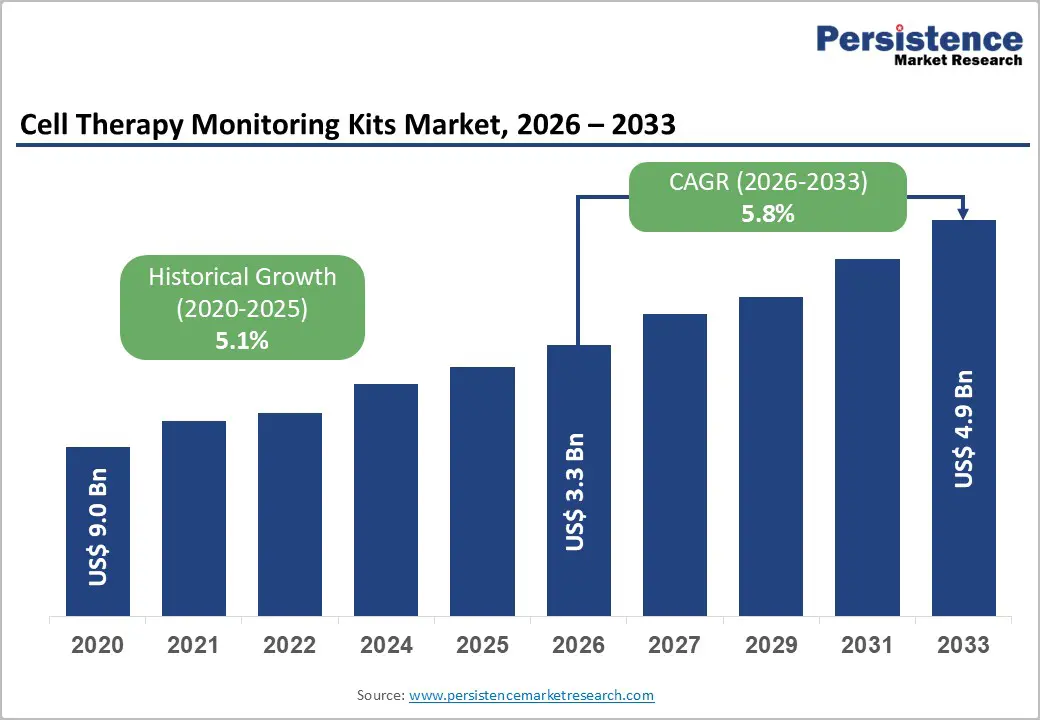
The global cell therapy monitoring kits market size is likely to be valued at US$3.3 billion in 2026, and is expected to reach US$4.9 billion by 2033, growing at a CAGR of 5.8% during the forecast period from 2026 to 2033, driven by the rapid expansion of cell therapy approvals, rising adoption of advanced monitoring solutions for safety and efficacy assessment, and increasing investment in personalized medicine and regenerative therapies. Increasing demand for precise, real-time monitoring of cell viability, potency, and immune response in clinical and research settings remains a major driver of market growth.
Key Industry Highlights:
- Leading Region: North America, anticipated to account for a 42% market share in 2026, driven by a high concentration of cell therapy clinical trials and advanced healthcare infrastructure in the U.S.
- Fastest-growing Region: Asia Pacific, fueled by growing biotechnology investments, rising healthcare expenditure, and expanding clinical research in China and India.
- Dominant Technology: Flow cytometry, with approximately 48% market share, as it remains the gold standard for detailed cell characterization and monitoring.
- Leading Application: Oncology, poised to dominate amid a surge in CAR-T and other cell-based cancer therapies.
| Key Insights | Details |
|---|---|
|
Cell Therapy Monitoring Kits Market Size (2026E) |
US$3.3 Bn |
|
Market Value Forecast (2033F) |
US$4.9 Bn |
|
Projected Growth CAGR (2026-2033) |
5.8% |
|
Historical Market Growth (2020-2025) |
5.1% |
Market Factors - Driver, Restraint, and Opportunity Analysis
Driver Analysis - Rapid Growth in Cell and Gene Therapy R&D and Clinical Trials
The expanding pipeline of advanced therapies is significantly increasing the need for precise and reliable monitoring solutions throughout development and clinical use. As cell and gene therapies move from early discovery to late-stage clinical trials, continuous assessment of parameters such as cell viability, potency, immune response, and safety becomes essential. Monitoring kits play a critical role in ensuring consistency across manufacturing batches and tracking patient outcomes during and after treatment.
The growing number of clinical studies further reinforces this demand. According to the National Institutes of Health, over 5,000 gene therapy trials are registered, reflecting a sharp rise in experimental therapies entering clinical evaluation. According to ClinicalTrials.gov, more than 577,716 studies are registered globally as of 2024, indicating a vast and expanding clinical research ecosystem. This surge in trial activity increases the complexity of data generation and regulatory scrutiny, making standardized monitoring tools indispensable. Advancements such as CAR-T cell therapies and gene editing approaches require real-time tracking of biological responses, further driving reliance on specialized kits.
Stringent Regulatory and Quality Control Requirements
Regulatory oversight plays a critical role in shaping the adoption and development of cell therapy monitoring kits, as these products are closely tied to the safety and efficacy of advanced therapies. Authorities such as the U.S. Food and Drug Administration and the European Medicines Agency require comprehensive validation of analytical methods used to monitor cell identity, purity, potency, and stability. This necessitates the use of highly sensitive, reproducible, and standardized monitoring kits throughout the product lifecycle from preclinical stages to post-market surveillance.
Manufacturers must comply with Good Manufacturing Practice (GMP) and Good Laboratory Practice (GLP) guidelines, which increase both operational complexity and costs. Any variability in monitoring results can delay approvals or lead to product recalls, making consistent quality control essential. The evolving nature of cell therapies, particularly autologous and personalized treatments, further complicates regulatory pathways, as each therapy batch may require individualized assessment. According to the U.S. Food and Drug Administration, over 30 cell and gene therapies had been approved in the U.S. by 2023, reflecting increasing regulatory scrutiny alongside market growth. Meanwhile, the National Institutes of Health reports more than 2,500 active cell therapy clinical trials globally, underscoring the scale of regulatory oversight required. These stringent frameworks, while essential for patient safety, act as a barrier by extending timelines and increasing compliance costs.
Restraint Analysis - Lack of Standardization Across Assays and Platforms
Variability in analytical methods and testing platforms creates significant challenges in ensuring consistent and comparable results across laboratories. Different monitoring kits often use diverse technologies such as flow cytometry, PCR, or ELISA with varying sensitivities, markers, and protocols. This leads to discrepancies in measuring key parameters such as cell viability, potency, and identity, making it difficult to establish uniform benchmarks for therapy evaluation.
The absence of universally accepted reference standards further complicates data interpretation, particularly in multicenter clinical trials where results must be harmonized. Inconsistent assay performance can also impact regulatory submissions, as authorities expect reproducible and validated data across different settings. Frequent updates in assay technologies introduce compatibility issues with existing systems, increasing operational complexity for laboratories.
Need for Skilled Personnel and Specialized Infrastructure
Effective use of cell therapy monitoring kits depends heavily on technical expertise and advanced laboratory capabilities. These kits often involve complex procedures such as flow cytometry analysis, molecular assays, and biomarker interpretation, all of which require trained professionals with specialized knowledge in cell biology and analytical techniques. Improper handling or misinterpretation of results can lead to inaccurate assessments of cell quality, safety, and therapeutic efficacy.
Laboratories must be equipped with sophisticated instruments, controlled environments, and compliance systems aligned with Good Manufacturing Practice (GMP) standards. Establishing and maintaining such infrastructure demands substantial capital investment, which can be challenging for smaller healthcare facilities and research centers. Limited access to skilled personnel, particularly in emerging regions, further restricts the widespread adoption of these monitoring solutions.
Opportunity Analysis - Technological Advancements in Monitoring Technologies
Continuous innovation in analytical tools is significantly enhancing the efficiency and precision of cell therapy monitoring. Advanced techniques, such as high-parameter flow cytometry, now enable simultaneous analysis of dozens of cellular markers at the single-cell level, improving the detection of subtle changes in cell phenotype and function. Modern systems can analyze over 40 parameters per cell, allowing deeper insights into immune responses and therapeutic performance.
Integration with complementary technologies, such as mass spectrometry, genomics, and single-cell analysis, further expands the scope of monitoring by providing multidimensional data on cell behavior, viability, and molecular characteristics. Innovations in reagents, including highly specific antibodies and fluorochromes, enhance sensitivity and accuracy, enabling better identification of rare cell populations. Automation and artificial intelligence are also transforming workflows by simplifying complex data analysis and reducing human error. Emerging microfluidics and lab-on-chip platforms are enabling faster, cost-effective, and point-of-care testing, making monitoring more accessible.
Outsourcing of R&D and Clinical Testing
Biopharmaceutical companies are increasingly relying on external partners such as contract research organizations (CROs) and contract development and manufacturing organizations (CDMOs) to manage complex research and clinical workflows. This shift is driven by the need to reduce operational costs, accelerate timelines, and access specialized expertise that may not be available in-house. Cell therapy development involves intricate processes, including cell isolation, expansion, characterization, and monitoring, which require advanced capabilities and regulatory compliance.
Specialized service providers are often equipped with state-of-the-art technologies and experienced personnel, enabling high-quality and standardized testing. By outsourcing monitoring activities, companies can focus on core competencies, such as drug discovery and commercialization, while ensuring critical analytical requirements are handled efficiently. This approach also supports scalability, allowing firms to manage fluctuating workloads across different stages of clinical trials.
Category-wise Analysis
Type of Cell Insights
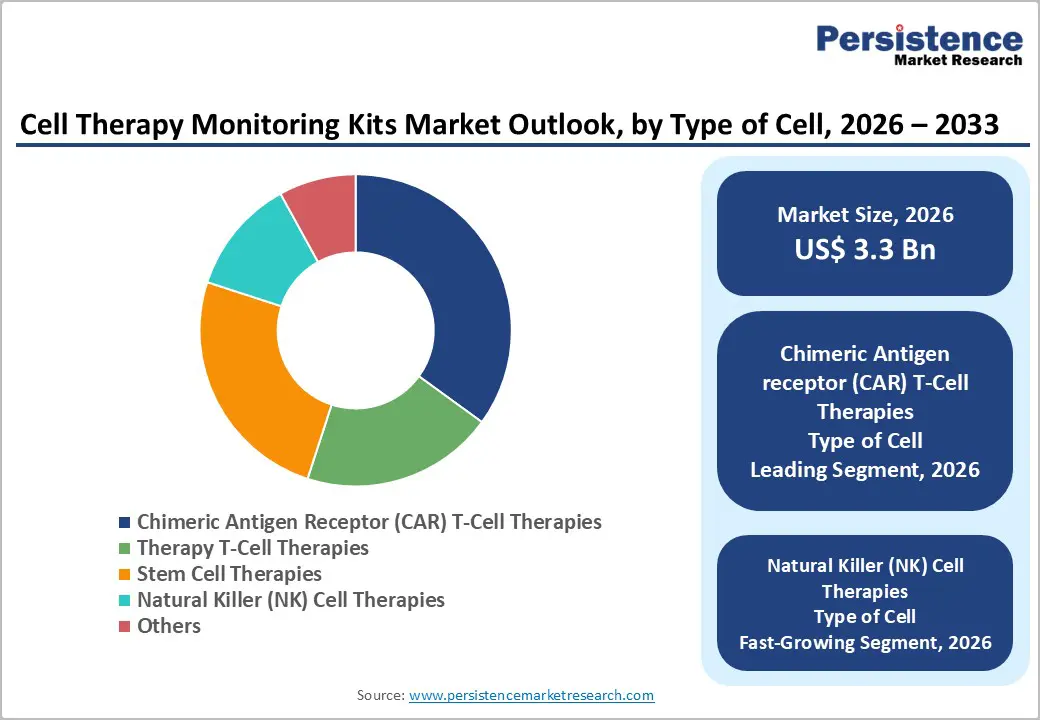
Chimeric antigen receptor (CAR) T-cell therapies are anticipated to dominate, with nearly 50% share in 2026, driven by their widespread clinical adoption and complex monitoring requirements. These therapies involve genetic modification of patient T-cells, necessitating continuous assessment of cell expansion, persistence, and safety biomarkers, thereby driving high demand for advanced monitoring kits. Their strong clinical success in hematological cancers and the increasing number of approvals further strengthen their dominance. Kymriah, developed by Novartis, was the first CAR-T cell therapy approved by the U.S. Food and Drug Administration in 2017 for treating certain leukemias and lymphomas. The therapy requires comprehensive monitoring throughout its lifecycle, starting from T-cell collection and genetic modification to post-infusion follow-up. Clinicians must consistently assess critical parameters such as CAR-T cell expansion, persistence within the patient’s body, and immune response markers to ensure both therapeutic effectiveness and patient safety.
Natural killer (NK) cell therapies represent the fastest-growing segment, fueled by their unique ability to target and destroy abnormal cells without prior sensitization. Unlike T-cell therapies, NK cells do not require strict donor matching, enabling the development of off-the-shelf treatments that are easier to scale and administer. They also exhibit a lower risk of severe side effects such as cytokine release syndrome, improving safety profiles. CYNK-001, an allogeneic NK cell therapy developed by Celularity Inc., is designed as an “off-the-shelf” treatment derived from placental cells. This approach enables large-scale production and immediate availability, offering a more scalable and accessible alternative to patient-specific therapies.
Technology Insights
Flow cytometry is expected to dominate, with over 48% share in 2026, owing to its ability to provide rapid, high-precision, and multi-parameter analysis at the single-cell level. It enables simultaneous measurement of cell surface markers, viability, phenotype, and function, making it essential for characterizing complex cell therapies such as CAR-T and NK cells. The BD FACSCanto II Flow Cytometer, developed by BD (Becton, Dickinson and Company), is widely utilized in clinical and research laboratories for immunophenotyping and advanced cell analysis, including applications in CAR-T and stem cell therapies. It enables simultaneous multi-parameter evaluation of cells, allowing precise assessment of surface markers, viability, and functional characteristics, thereby supporting accurate and efficient cell therapy monitoring.
PCR technology is emerging as the fastest-growing segment, supported by its high sensitivity, specificity, and ability to detect low levels of genetic material. It plays a critical role in identifying transgenes, monitoring gene expression, and quantifying cell persistence in therapies such as CAR-T. Real-time and digital PCR techniques enable accurate and rapid analysis, even in complex biological samples. PCR-based methods support standardized and reproducible results, which are essential for regulatory compliance. The QuantStudio 6 Pro Real-Time PCR System, developed by Thermo Fisher Scientific, is extensively used for gene expression analysis and nucleic acid quantification in advanced research and clinical settings. In cell and gene therapy workflows, real-time PCR (qPCR) and digital PCR technologies are applied at multiple stages, including cell identification, verification of genetic modifications, contamination detection, and overall quality control, ensuring accurate and reliable monitoring outcomes.
Regional Insights
North America Cell Therapy Monitoring Kits Market Trends
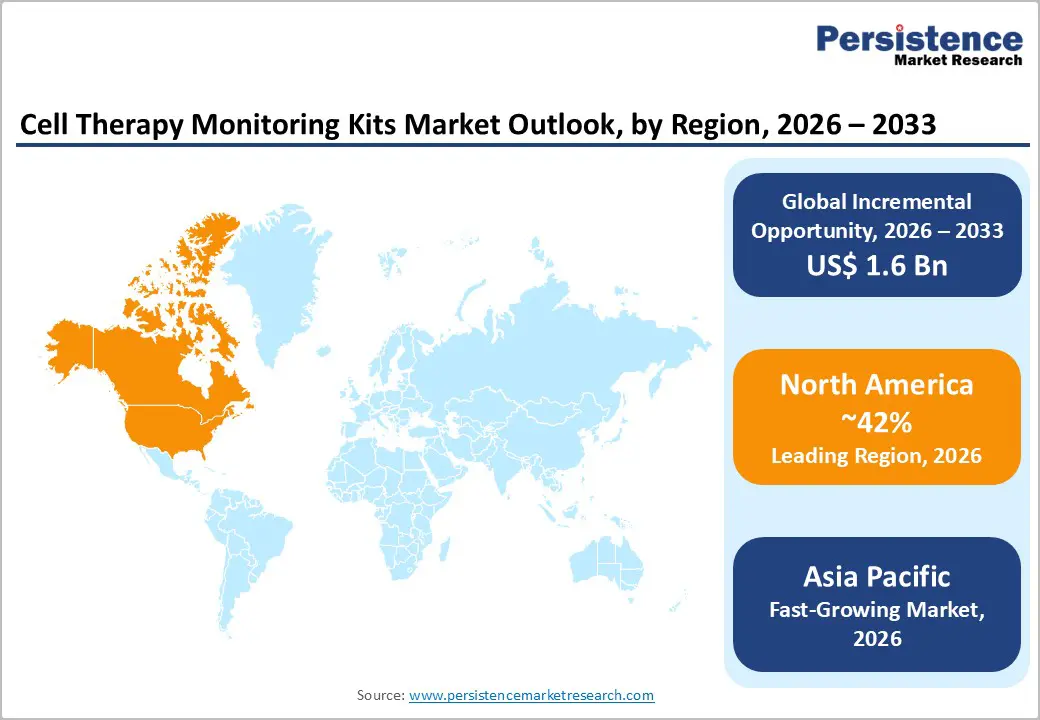
North America is projected to dominate, capturing 42% revenue in 2026, driven by a highly advanced biotechnology ecosystem and increasing adoption of cell and gene therapies. The U.S. dominates the region due to its robust clinical research infrastructure, presence of leading biopharmaceutical companies, and early adoption of innovative therapies. A significant trend is the rising number of clinical trials, with the U.S. accounting for over 3,500 cell therapy trials globally, highlighting strong research activity and demand for monitoring solutions.
The growing number of regulatory approvals and expanding indications for therapies such as CAR-T, which require continuous monitoring for safety and efficacy. Regulatory agencies are also emphasizing long-term patient follow-up and real-time data tracking, increasing the need for advanced and reliable monitoring kits. Technological integration is further shaping the market, with increasing use of automation, digital analytics, and high-throughput platforms to improve accuracy and efficiency in cell analysis.
Europe Cell Therapy Monitoring Kits Market Trends
Europe is emerging as a significant hub for cell therapy monitoring kits, driven by a well-structured regulatory framework and a strong research ecosystem. The role of the European Medicines Agency is central, as all advanced therapies are regulated under the Advanced Therapy Medicinal Products (ATMP) pathway, ensuring strict quality and post-treatment monitoring requirements. This has led to increased demand for reliable monitoring kits across clinical and commercial stages.
Growing adoption of CAR-T and stem cell therapies across major countries such as Germany, the UK, and France is supported by expanding certified treatment centers and hospital-based manufacturing models. Europe’s “hospital exemption” framework also allows customized therapies at the national level, increasing the need for flexible and precise monitoring solutions. Strong public and institutional funding for research. Programs such as EU-backed initiatives are accelerating innovation and clinical translation, contributing to rising clinical trial activity and demand for advanced analytical tools.
Asia Pacific Cell Therapy Monitoring Kits Market Trends
Asia Pacific is likely to be the fastest-growing region, powered by expanding clinical research activity and strong government support. Countries such as China, Japan, South Korea, and India are investing heavily in regenerative medicine, which is accelerating the adoption of cell therapies and associated monitoring solutions. The region is witnessing a surge in clinical trials, supported by large and diverse patient pools and cost-effective research environments, making it an attractive destination for global studies.
The presence of favorable regulatory reforms, particularly in Japan and South Korea, where expedited approval pathways for regenerative medicine are encouraging faster commercialization. Governments are actively funding research initiatives and establishing frameworks to ensure safety and quality, which increases the need for reliable monitoring kits. Technological advancements in stem cell research, gene editing, and cell engineering are further driving innovation, while growing awareness of personalized medicine is boosting adoption.
Competitive Landscape
The global cell therapy monitoring kits market is moderately consolidated, with a mix of established life sciences companies and emerging players competing to strengthen their positions. Leading firms are actively focusing on product innovation, particularly in areas such as high-sensitivity assays, multi-parameter analysis, and integration with advanced technologies such as automation and digital analytics. Strategic partnerships, collaborations with research institutions, and acquisitions are common approaches used to expand technological capabilities and geographic reach.
Companies are also investing in broadening their product portfolios to cater to diverse applications across cell and gene therapy workflows. A strong emphasis on regulatory compliance is essential, as manufacturers must align their products with stringent quality and validation standards to ensure acceptance in clinical and commercial settings. Efforts toward assay standardization are helping improve consistency and reproducibility across laboratories.
Key Industry Developments:
- In March 2026, Lineage Cell Therapeutics, Inc. announced the expansion of its cell transplant pipeline by launching COR1, a corneal endothelial cell (CEnC) therapy program in preclinical development for corneal endothelial disease, targeting indications such as Fuchs Endothelial Corneal Dystrophy (FECD) and Bullous Keratopathy. The company developed COR1 using its AlloSCOPE™ platform and successfully manufactured off-the-shelf corneal endothelial cells that met initial identity, morphological, and functional criteria, supporting further advancement into preclinical testing.
- In January 2025, CellFE announced the launch of its CellFE T-Rest (“Resting T Cell Kit”), a first-in-class cell manufacturing transfection media product designed for resting (quiescent) T-cell workflows. The company introduced the kit to support an optimized gene editing process using resting T cells as the starting material, enabling cell therapy manufacturers to develop safer and more potent therapies compared to traditional approaches.
Companies Covered in Cell Therapy Monitoring Kits Market
- STEMCELL Technologies Inc.
- Lonza Group
- Thermo Fisher Scientific
- Merck KGaA
- BD Biosciences
- Miltenyi Biotec
- Sartorius AG
- PerkinElmer Inc.
- Cell Biolabs Inc.
Frequently Asked Questions
The global cell therapy monitoring kits market is projected to reach US$3.3 billion in 2026.
The cell therapy monitoring kits market is primarily driven by the increasing number of approved cell therapies, especially CAR-T therapies in oncology, and the growing requirement for standardized monitoring of cell viability, potency, and persistence.
The cell therapy monitoring kits market is poised to witness a CAGR of 5.8% from 2026 to 2033.
Key opportunities in the cell therapy monitoring kits market include the development of automated and multiplexed kits, expansion into non-oncology applications such as autoimmune and neurological disorders, and penetration into emerging biotechnology markets in Asia Pacific through cost-effective solutions and local partnerships.
Key players in the cell therapy monitoring kits market include Thermo Fisher Scientific, BD Biosciences, Miltenyi Biotec, Merck KGaA, Lonza Group, and STEMCELL Technologies Inc.


