




- Automotive
- Car Washing System Market
Car Washing System Market Size, Share, and Growth Forecast, 2026 – 2033
Car Washing System Market by Product Type (Self-Service Car Washing, In-Bay Automatic Car Washing System, Tunnel Automatic Car Washing System), Process (Cloth Friction Car Washing, Touchless Car Washing), Sales Channel (Original Equipment Manufacturers (OEMs), Aftermarket), and Regional Analysis for 2026-2033

Car Washing System Market Share and Trends Analysis
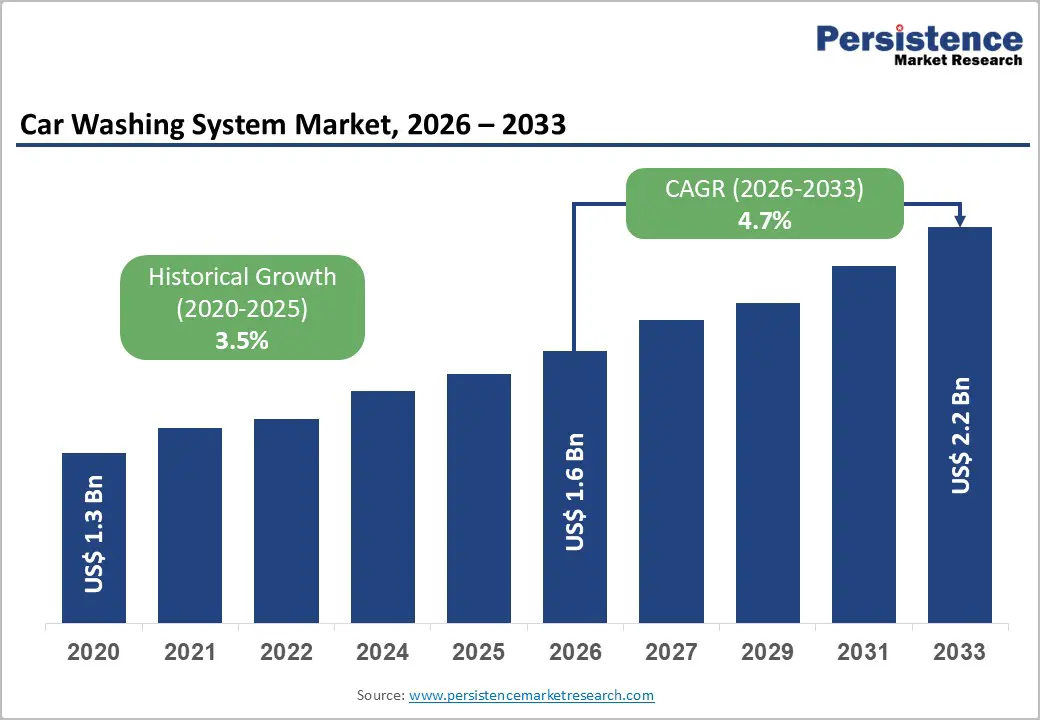
The global car washing system market size is likely to be valued at US$ 1.6 billion in 2026, and is projected to reach US$ 2.2 billion by 2033, growing at a CAGR of 4.7% during the forecast period 2026−2033.
The market demonstrates stable expansion driven by structural changes in urban mobility, increasing vehicle density in metropolitan areas, and heightened emphasis on vehicle appearance and asset preservation. Rising consumer awareness regarding paint protection, resale value retention, and environmental compliance directly increases demand for automated and semi-automated washing solutions across commercial and institutional settings. Expanding adoption of time-efficient service models supports preference for automated systems over manual washing, particularly in high-traffic urban zones. Technological integration within car washing infrastructure improves water efficiency, chemical dosing accuracy, and service throughput, reinforcing system-level adoption among fleet operators, fuel stations, and independent service providers. Environmental regulations related to water discharge, chemical runoff, and wastewater recycling encourage replacement of informal washing practices with regulated systems. Infrastructure modernization across developing economies further accelerates installation of standardized washing facilities within organized retail and mobility hubs.
Key Industry Highlights
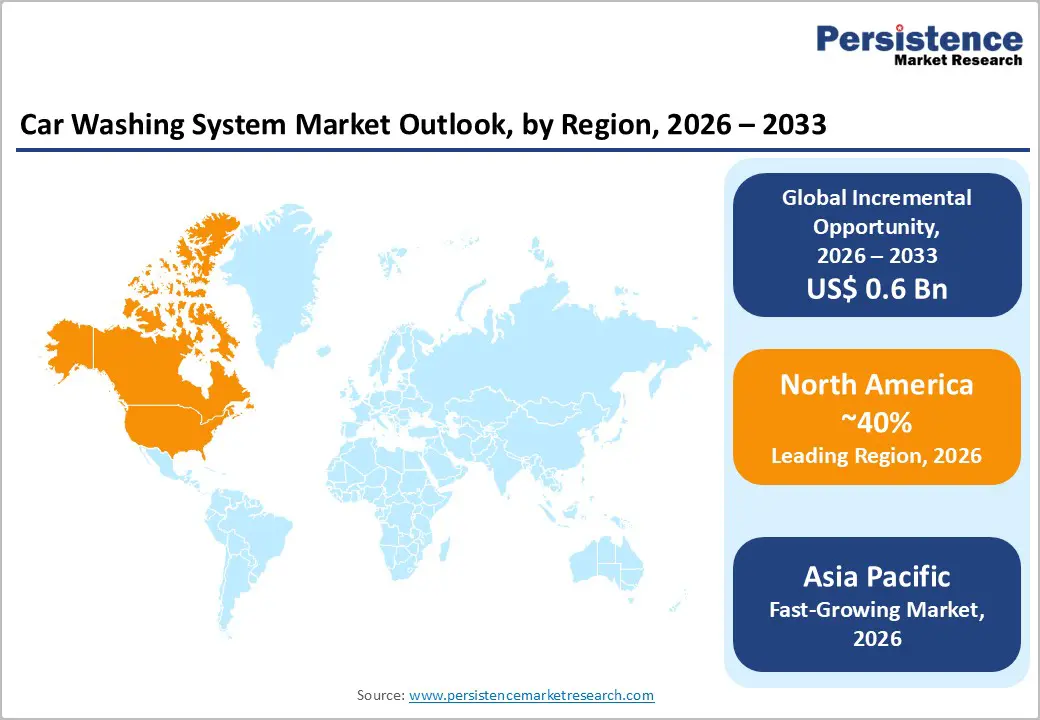
- Dominant Region: North America is set to dominate in 2026 with a 40% share, driven by high vehicle density, advanced automated installations, and strong regulatory compliance.
- Fastest-growing Regional Market: Asia Pacific is projected to be the fastest-growing market through 2033, driven by surging vehicle ownership and rising adoption of automated car-washing systems.
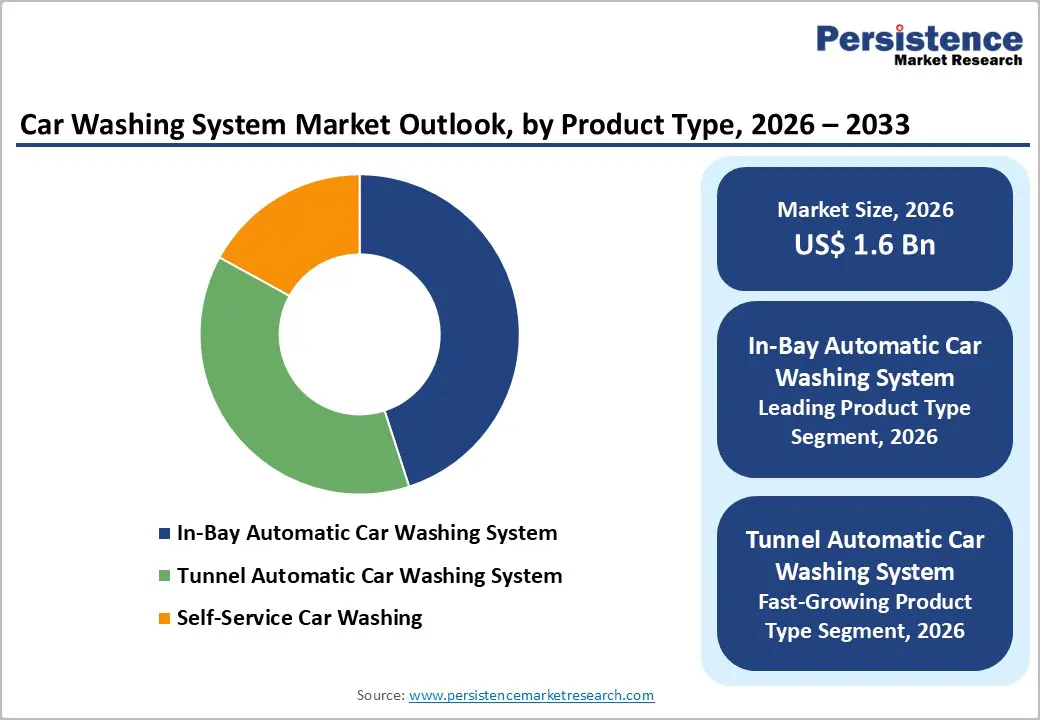
- Leading Product Type: In-bay automatic systems are poised to lead with a 45% share in 2026, driven by their compact design, integrated wash processes, and operational simplicity.
- Fastest-growing Product Type: The tunnel automatic system is expected to grow the fastest from 2026 to 2033, propelled by high throughput, scalability, and operational efficiency.
| Key Insights | Details |
|---|---|
| Car Washing System Market Size (2026E) | US$ 1.6 Bn |
| Market Value Forecast (2033F) | US$ 2.2 Bn |
| Projected Growth (CAGR 2026 to 2033) | 4.7% |
| Historical Market Growth (CAGR 2020 to 2025) | 3.5% |
Market Factors – Growth, Barriers, and Opportunity Analysis
Urban Vehicle Concentration and Demand for Time-Efficient Services
The growing concentration of vehicles in cities reshapes vehicle maintenance behavior by increasing operational stress on both owners and infrastructure. Urban mobility patterns involve dense traffic, limited parking availability, and continuous exposure to dust, emissions, and road residues, which accelerate vehicle exterior degradation. At the same time, residential layouts in cities rarely support on-site washing due to space constraints, regulatory limits on water use, and shared parking. These conditions shift cleaning from a personal activity to a service requirement, positioning professional washing solutions as a functional necessity rather than a discretionary expense. The structural mismatch between vehicle ownership levels and household infrastructure directly channels demand toward organized service providers.
Rising preference for time-efficient services further strengthens this demand by aligning vehicle care with modern urban lifestyles. City consumers operate under compressed schedules where discretionary time holds measurable economic value, influencing purchasing decisions across routine services. Fast, automated, or on-demand washing systems reduce task duration, eliminate physical effort, and provide predictable outcomes within narrow time windows. For business users such as fleet operators and mobility service providers, shorter service cycles support higher vehicle availability and operational continuity. Investment in streamlined systems enables service providers to handle higher volumes without proportional increases in labor or space requirements.
Operational Complexity and Maintenance Dependency
High system integration requirements elevate operational burden across automated and semi-automated washing installations. These solutions rely on the synchronized operation of mechanical conveyors, high-pressure pumps, water-recycling modules, sensors, programmable logic controllers (PLCs), and chemical dosing units. Any deviation in calibration, timing, or component health disrupts throughput and service consistency. Site operators face challenges in managing software updates, alignment of moving parts, and compatibility between hardware supplied by different vendors. Limited availability of trained technicians further intensifies complexity, particularly in regions where technical service ecosystems remain underdeveloped. Downtime resulting from minor faults directly affects daily vehicle handling capacity, revenue predictability, and customer satisfaction, making operational continuity a persistent concern for owners and franchise operators.
Maintenance dependency compounds this restraint through frequent servicing requirements and costly maintenance cycles. Continuous exposure to water, detergents, and abrasive particles accelerates wear of brushes, seals, valves, and electronic connectors. Preventive maintenance schedules demand regular inspections, part replacements, and system diagnostics, increasing reliance on specialized service providers. Spare part availability often depends on original equipment manufacturers, which extends repair timelines and raises lifecycle costs. Energy efficiency systems and water reclamation units require precise monitoring to maintain regulatory compliance and performance standards. Smaller operators and new entrants face barriers in sustaining these maintenance obligations without scale advantages. Capital investment risk increases when long-term operating expenditure remains uncertain, influencing purchase decisions and slowing adoption in price-sensitive markets.
Adoption of Eco-Friendly and Touchless Innovations
Rising environmental accountability across commercial facilities positions sustainable and touchless technologies as a high-impact growth avenue. Water scarcity concerns, stricter wastewater discharge standards, and rising utility costs are driving operators to seek systems that minimize water consumption and chemical runoff. Advanced recycling units, biodegradable detergents, and precision-controlled spray mechanisms align operations with environmental compliance while supporting long-term cost optimization. Corporate sustainability targets across fleet operators, retail service providers, and urban infrastructure projects further reinforce demand. Investment preference increasingly favors solutions that demonstrate measurable reductions in resource usage and emissions, strengthening brand credibility and regulatory acceptance across diverse regions.
Shifting consumer behavior significantly elevates the relevance of contact-free cleaning solutions. Vehicle owners increasingly prioritize surface protection, hygiene assurance, and service consistency, particularly in urban environments with high service throughput. Automated, sensor-driven platforms reduce the risk of paint damage, eliminate variability in manual handling, and enhance perceived service quality. Labor constraints and rising wage structures amplify the appeal of automation, improving operational scalability and margin stability. Integration with digital payment systems and data-driven maintenance tools enhances customer convenience and reliability of uptime.
Category-wise Analysis
Product Type Insights
In-bay systems are poised to lead with an estimated 45% of the car washing system revenue share in 2026, owing to balanced capital requirements, compact footprint, and suitability for diverse site formats. These systems integrate washing, rinsing, and drying within a single bay, aligning with fuel stations, dealerships, and convenience retail locations. Operational simplicity and lower staffing dependency enhance adoption across small and mid-scale operators. Standardized wash cycles improve service consistency and customer confidence. Regulatory compliance benefits arise from integrated water recycling and chemical management modules. Equipment durability and predictable maintenance schedules further reinforce preference among operators prioritizing operational control and regulatory alignment.
The tunnel automatic car washing system is anticipated to be the fastest-growing segment between 2026 and 2033, fueled by high throughput capacity and scalability advantages. These systems support continuous vehicle flow, optimizing revenue per square meter in high-traffic locations. Fleet operators and urban service hubs increasingly favor tunnel formats due to efficiency and automation depth. Technological innovation in brush materials, drying mechanisms, and conveyor systems enhances vehicle safety and wash quality. Investment viability improves through high utilization rates, positioning tunnel systems as preferred infrastructure for large-scale operations.
Process Insights
Cloth friction car washing is likely to dominate with a projected 60% market share in 2026, due to its superior cleaning effectiveness and strong consumer trust. Soft cloth materials enable deep removal of dust, road salts, and organic residues while maintaining surface safety standards required by high-volume service centers. Proven performance across sedans, sport utility vehicles, and light commercial vehicles supports widespread deployment. Long operating history builds operator familiarity, simplifying training and maintenance planning. Equipment configurations allow customization for throughput and space constraints, improving asset utilization. Consistent wash outcomes reinforce customer satisfaction metrics, sustaining repeat service demand across urban and suburban locations.
Touchless car washing is expected to witness the fastest growth between 2026 and 2033, powered by rising preference for minimal contact solutions. High-pressure water jets combined with advanced surfactant chemistry deliver effective cleaning while reducing mechanical interaction with vehicle surfaces. Premium vehicle segments increasingly favor these systems for paint longevity assurance and finish preservation. Fleet operators view contact-free platforms as a method to standardize quality and reduce downtime related to wear management. Integration with automated payment, mobile applications, and subscription-based access models improves service convenience. Technology-driven positioning supports scalability across smart infrastructure and digitally enabled service networks.
Sales Channel Insights
The original equipment manufacturer (OEM) segment is expected to hold a dominant position, accounting for 65% of revenue in 2026, driven by direct system integration, warranty support, and compliance certification. Integrated delivery models simplify procurement and commissioning, reducing deployment risks for operators managing high-capacity installations. Standardized quality benchmarks and factory-tested components improve operational predictability and uptime performance. Access to certified spare parts and trained service teams supports long-term reliability. Alignment with safety, environmental, and electrical standards strengthens regulatory confidence across regions. Continuous product enhancements and software updates delivered through original channels increase lifecycle efficiency and protect capital investment value.
The aftermarket is forecasted to be the fastest-growing end-user segment between 2026 and 2033, boosted by retrofit demand and cost optimization initiatives. Existing operators increasingly prioritize incremental upgrades rather than full system replacement to manage capital expenditure. Demand is rising for smart controllers, advanced nozzles, and water-recycling components that improve efficiency metrics. Independent service providers expand customization options tailored to site-specific requirements. Digital platforms enable faster diagnostics, remote monitoring, and predictive maintenance scheduling.
Regional Insights
North America Car Washing System Market Trends
North America is expected to account for approximately 40% of the car washing system market share in 2026, reflecting a structurally advanced service ecosystem supported by high vehicle density and professionalized maintenance practices. Automated installations are widely integrated into fuel retail outlets, convenience centers, and large commercial service chains, enabling consistent throughput and high asset utilization. Consumers demonstrate strong willingness to pay for time-efficient and quality-assured services, supporting premium pricing models. High wash frequency per vehicle sustains recurring demand, while operator access to capital encourages early adoption of advanced equipment and system upgrades, reinforcing scale-driven competitive advantages.
Market leadership is further sustained by strong commercial and institutional demand patterns that favor automation and standardization. Fleet operators across logistics, rental services, municipal transport, and corporate mobility programs prioritize reliability, compliance alignment, and operational efficiency, strengthening demand for high-capacity systems. Regulatory focus on water conservation and wastewater control accelerates replacement of informal washing practices with regulated, technology-enabled solutions. Digital subscription models and integrated payment platforms stabilize revenue streams and improve customer retention. Dense service networks and mature aftersales capabilities reduce operational risk, supporting long-term dominance through efficiency, consistency, and monetization strength.
Europe Car Washing System Market Trends
Europe represents a mature market for car washing systems, characterized by high penetration of automated and semi-automated installations across urban and suburban areas. Demand is supported by dense vehicle ownership, strong environmental regulations, and established service networks emphasizing operational efficiency and water conservation. Operators increasingly prioritize systems that integrate closed-loop water recycling, biodegradable cleaning agents, and energy-efficient equipment to comply with strict wastewater discharge and sustainability standards. Well-developed infrastructure allows deployment of high-capacity automated bays capable of handling large vehicle volumes, ensuring consistent service quality and repeat business. Consumer preference for reliable, time-efficient washing solutions sustains steady demand across both passenger and commercial vehicle segments, reinforcing overall market stability.
Growth is further shaped by technological innovation and regulatory alignment that encourages modernization of legacy installations. Touchless systems and sensor-driven platforms are increasingly adopted to protect paintwork and improve hygiene standards, particularly among premium vehicle owners and fleet operators. Integration with digital service platforms, including mobile booking, contactless payments, and subscription-based models, enhances convenience and customer retention. Equipment manufacturers focus on modular, adaptable designs to meet varied lot sizes and operational requirements, improving scalability for service providers. Sustainability initiatives, coupled with rising awareness of operational efficiency and surface protection, continue to drive incremental upgrades, supporting long-term value creation.
Asia Pacific Car Washing System Market Trends
Asia Pacific is slated to emerge as the fastest-growing market for car washing systems during the 2026-2033 forecast system, driven by rapid urbanization and accelerating vehicle ownership across metropolitan centers. Rising middle-income populations are increasing demand for convenient, time-efficient cleaning solutions, creating a shift from informal hand-wash methods to organized, automated installations. Expansion of ride-hailing fleets, commercial logistics vehicles, and light commercial transport amplifies recurring service requirements, making high-throughput automated systems economically attractive for operators. Developers are investing in modular and scalable platforms that can adapt to varied infrastructure and lot sizes, enabling faster deployment in emerging urban hubs. Increasing environmental awareness and government initiatives promoting water efficiency encourage adoption of systems with closed-loop recycling, precise detergent dosing, and energy-efficient pumps, creating a favorable regulatory environment for modern installations.
Market growth in the region is also getting fueled by digital integration and service innovation tailored to consumer behavior in dense urban corridors. Mobile app-based booking, contactless payment, and subscription models improve customer engagement while supporting operational predictability for service providers. Independent operators leverage automation to reduce labor dependency, enhance throughput, and extend equipment lifecycle, improving return on investment. Adoption of smart monitoring, IoT-enabled diagnostics, and predictive maintenance tools further reduces downtime and operational costs, making technology-driven installations highly scalable. Corporate and commercial fleet operators increasingly prioritize standardized cleaning protocols and surface protection, favoring automated, touchless systems over manual methods.
Competitive Landscape
The global car washing system market exhibits a moderately fragmented structure, combining the presence of global equipment manufacturers with specialized regional service providers. Leading players such as Kärcher Cleaning System Pvt. Ltd., WashTec AG, ISTOBAL, MacNeil, and Babcox Media Inc. collectively hold a significant share, leveraging technological innovation, brand reputation, and integrated service capabilities. Global operators focus on delivering high-capacity automated systems, touchless technologies, and environmentally compliant solutions, targeting both commercial and fleet operators. Regional suppliers complement this by offering tailored solutions aligned with local infrastructure, regulatory requirements, and consumer behavior. Market fragmentation allows multiple entry points, fostering innovation while enabling smaller operators to capture niche opportunities across urban and suburban installations.
Competitive positioning within the market emphasizes reliability, regulatory alignment, and strength of service networks. Equipment uptime, ease of installation, and adaptability to varied vehicle types are critical differentiators for leading players. Compliance with environmental regulations, including water recycling standards and chemical management protocols, reinforces credibility among fleet and commercial customers. Service network coverage, including preventive maintenance, spare parts availability, and technical support, strengthens customer retention and lifecycle value. Regional suppliers benefit from agile deployment and localized customization, ensuring responsiveness to emerging demand patterns.
Key Industry Developments
- In December 2025, Flagstop Car Wash announced the completion of three strategic acquisitions and the opening of a new site in Ashland, Virginia, strengthening its regional footprint in Central Virginia. The company now operates 29 locations, reinforcing its position as a leading express car wash operator in the Richmond market.
- In November 2025, Sharma Garages Group unveiled a new Big Bertha car wash installation at its Bush Service Station in Sutton Coldfield, marking a £255,000 investment in advanced wash technology from Christ Wash Systems supplied by Wilcomatic.
- In August 2025, Parkin Company PJSC and CAFU launched the Middle East’s first integrated on-demand fuel delivery and car wash service across Parkin’s parking facilities in Dubai, allowing parked vehicles to be refueled or cleaned without leaving the lot. The service aims to increase customer convenience, reduce unnecessary trips to fuel stations and wash bays, cut traffic congestion, lower emissions, and support water-saving goals.
Companies Covered in Car Washing System Market
- Kärcher Cleaning System Pvt. Ltd.
- WashTec AG
- ISTOBAL
- MacNeil
- Babcox Media Inc.
- D&S Car Wash Supply.
- Christ Wash Systems
- Ceccato S.p.A
- Tommy Car Wash Systems
Frequently Asked Questions
The global car washing system market is projected to reach US$ 1.6 billion in 2026.
Market growth is driven by rising vehicle ownership, demand for time-efficient cleaning, environmental regulations, and fleet service expansion.
The market is poised to witness a CAGR of 4.7% from 2026 to 2033.
Key opportunities include adoption of eco-friendly and touchless technologies, fleet automation, digital service integration, and expansion in high-growth urban regions.
Some of the key market players include Kärcher Cleaning System Pvt. Ltd., WashTec AG, ISTOBAL, MacNeil, and Babcox Media Inc.


