




- Pharmaceuticals
- Cannabidiol Supplements Market
Cannabidiol Supplements Market Size, Share, and Growth Forecast, 2026 - 2033
Cannabidiol Supplements Market by Product Type (Food and Beverages, Medicines and Therapeutics, Skincare Products), Form (Oil & Tinctures, Gummies & Confectionery, Others), Application (Pain Management, Others), and Regional Analysis 2026 - 2033

Cannabidiol Supplements Market Size and Trends Analysis
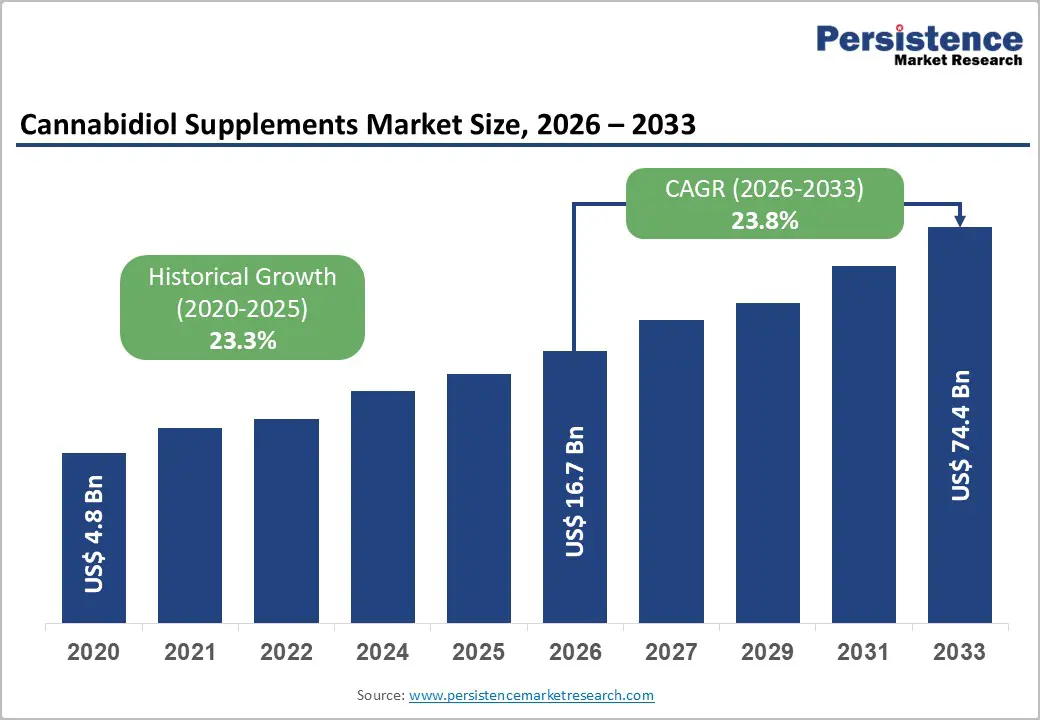
The global cannabidiol supplements market size is likely to be valued at US$16.7 billion in 2026 and is expected to reach US$74.4 billion by 2033, growing at a CAGR of 23.8% during the forecast period from 2026 to 2033, driven by growing consumer awareness regarding preventative healthcare. This trajectory is likely to be reinforced by rising institutional acceptance of cannabinoid-based therapies.
Rising consumer awareness of natural wellness solutions propels primary expansion. Regulatory clarity in key regions accelerates product accessibility through diverse channels. Integration of advanced extraction technologies continues to enhance product purity and standard consumer safety levels. Digital retail channels are set to provide broader accessibility for emerging health-conscious demographics. E-commerce penetration strengthens distribution reach, while formulation innovations sustain uptake across demographics. This trajectory positions the market for sustained momentum amid evolving health preferences.
Key Industry Highlights:
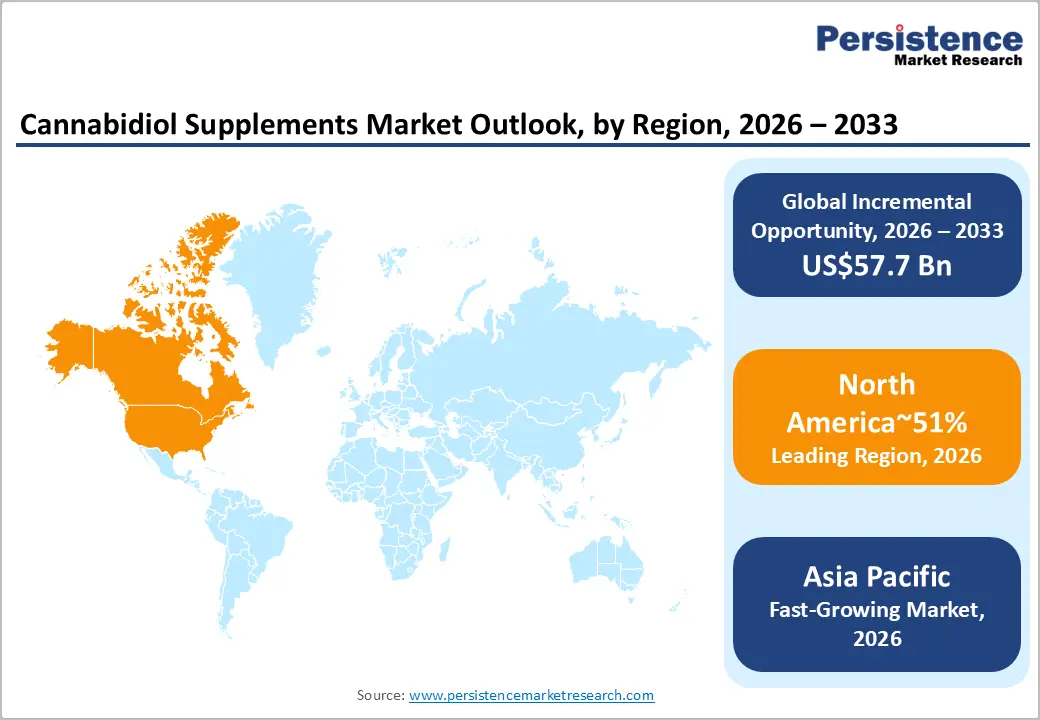
- Leading Region: North America is projected to lead, accounting for approximately 51% share in 2026, supported by established legal frameworks, high consumer purchasing power, and mature retail infrastructure.
- Fastest Growing Region: Asia Pacific is anticipated to grow the fastest, driven by rapid urbanization, expanding middle-class wellness adoption, and supportive policy shifts toward natural supplements.
- Leading Form: Oil & tinctures are projected to dominate, holding approximately 39% share in 2026, driven by precise dosing capabilities and established consumer familiarity.
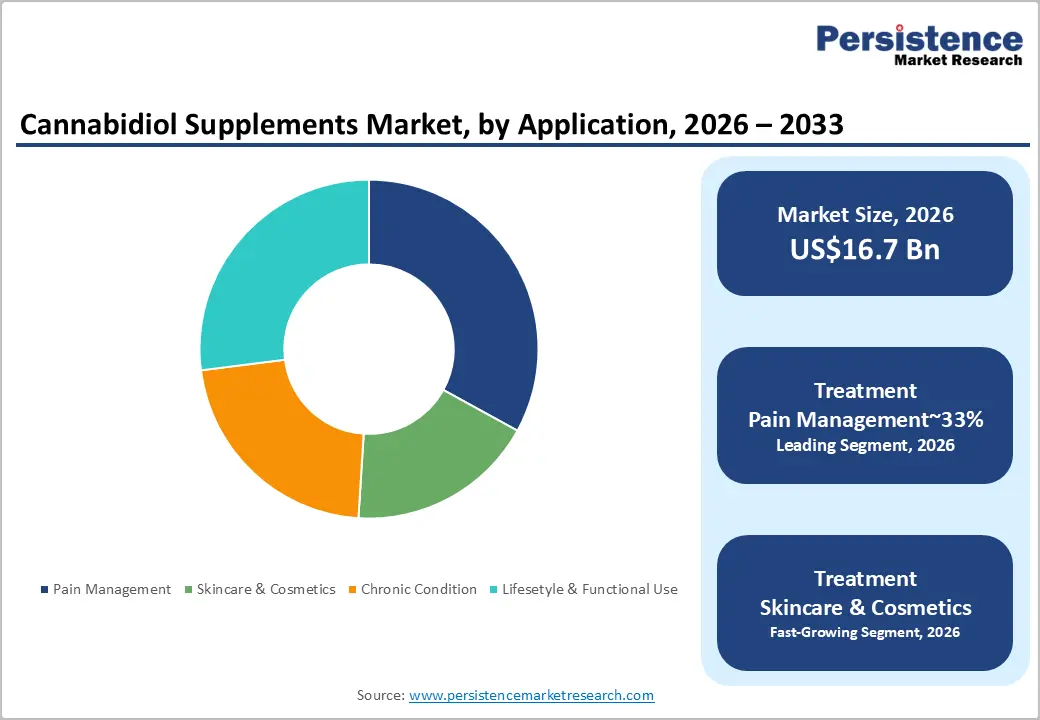
- Leading Application: Pain management is anticipated to dominate, accounting for approximately 33% share in 2026, anchored by widespread demand for non-opioid alternatives and aging population needs.
| Key Insights | Details |
|---|---|
| Cannabidiol Supplements Market Size (2026E) | US$16.7 Bn |
| Market Value Forecast (2033F) | US$74.4 Bn |
| Projected Growth (CAGR 2026 to 2033) | 23.8% |
| Historical Market Growth (CAGR 2020 to 2025) | 23.3% |
DRO Analysis
Driver - Shift toward Preventive Holistic Wellness
The rising emphasis on preventative healthcare drives sustained demand for natural and plant-based supplement alternatives globally. Consumers increasingly prioritize long-term wellness over reactive treatment approaches for minor physical and mental conditions. This behavioral transition positions botanical compounds as integral components within daily nutritional and wellness routines. Heightened interest in standardized hemp extracts reinforces procurement across regulated supplement and functional health markets. Regulatory frameworks gradually accommodate alternative medicinal practices supported by safety and efficacy validation standards. Cost structures evolve toward quality sourcing, extraction technologies, and clinical validation investments. These dynamics collectively sustain the expansion of holistic wellness-driven product ecosystems.
Charlotte's Web Holdings with Stay Asleep CBD Gummies targets specific health outcomes, such as sleep support through functional ingredient integration. Product development strategies emphasize clinically supported formulations to enhance credibility within regulated wellness markets. Manufacturers leverage scientific validation to strengthen consumer trust across diverse demographic segments. Targeted formulations align with personalized wellness goals, supporting repeat consumption patterns. Distribution channels expand across digital and specialty retail platforms, catering to health-conscious consumers. These interdependencies reinforce sustained growth within preventative and holistic wellness segments.
Formulation Innovation Push in Cannabinoid Delivery Systems
Advancements in extraction technologies enhance product purity and bioavailability across cannabinoid-based therapeutic formulations globally. Improved stability profiles enable integration into diverse delivery formats without compromising potency or functional performance. This technical evolution supports adoption among precision-focused consumers seeking consistent and reliable therapeutic outcomes. Manufacturers scale production capabilities to maintain uniform quality across expanding product portfolios and distribution channels. Regulatory scrutiny on formulation standards reinforces demand for validated and reproducible processing techniques. Cost structures shift toward advanced extraction systems and quality assurance infrastructure investments. These dynamics collectively accelerate innovation and adoption within specialized cannabinoid product segments.
Joy Organics with CBD Softgels exemplifies refined delivery mechanisms designed to optimize absorption efficiency within therapeutic applications. Product formats align with consumer demand for convenient, standardized dosing and predictable performance outcomes. Manufacturers emphasize formulation consistency to strengthen trust within regulated wellness and supplement markets. Integration across multiple delivery systems expands accessibility for varied consumer preferences and usage scenarios. Distribution strategies support broader penetration through digital and specialty retail channels. These interdependencies reinforce sustained growth and value chain expansion within cannabinoid formulation ecosystems.
Restraint - Perception Skepticism Barriers in Cannabinoid Adoption
Lingering stigma associated with cannabinoid origins continues to dampen mainstream acceptance across conservative consumer demographics globally. Misinformation regarding efficacy and safety perpetuates hesitation, particularly within non-medical and family-oriented consumption contexts. This perceptual gap slows penetration into broader retail channels that prioritize trust and regulatory clarity. Marketing strategies increasingly focus on education, yet require sustained expenditure without immediate measurable returns. Regulatory ambiguity in certain regions further complicates the communication of validated product benefits.
Skepticism persists across key distribution channels influenced by entrenched perceptions. Targeted outreach strategies encounter limitations in effectively converting hesitant consumer segments. Cost structures expand due to compliance-driven labeling and consumer awareness initiatives. Retailers exercise caution in product placement within conservative and regulated environments. Demand growth remains uneven due to varying levels of consumer education and acceptance. These interdependencies collectively slow expansion across cannabinoid product value chains.
Persistence of Raw Material Quality Inconsistency
Variability in hemp cultivation conditions leads to inconsistent cannabinoid profiles across raw extract inputs globally. Soil composition, climate variability, and agricultural practices directly influence chemical consistency within harvested biomass. Maintaining uniform concentration levels across production batches requires advanced filtration and standardization technologies. These technical requirements increase operational complexity and elevate production costs for manufacturers. Inconsistent product performance risks undermining consumer trust and repeat purchase behavior within wellness markets. Regulatory expectations for potency accuracy further intensify quality control requirements across supply chains. These factors collectively hinder standardization and scalability within cannabinoid-based product ecosystems.
Extract Labs with Daily Support CBD Tincture highlights the role of vertical integration in maintaining consistent product quality. Companies controlling cultivation, extraction, and formulation processes reduce exposure to contamination and variability risks. However, establishing integrated supply chains requires significant capital investment and operational expertise. Smaller players face barriers in replicating such controlled production environments at scale. Cost pressures associated with premium cultivation methods constrain profitability within price-sensitive segments. These dynamics collectively limit uniform quality assurance across the broader cannabinoid market.
Opportunity - Integration into Functional Food and Beverages
The convergence of supplement and beverage industries creates new consumption pathways for cannabinoid-infused functional products globally. Consumers increasingly seek beverages delivering relaxation or focus without reliance on sugar, alcohol, or caffeine. CBD-infused sparkling waters and teas gain traction as socially acceptable alternatives within urban consumption environments. This trend aligns with mindful drinking movements emphasizing balanced lifestyle choices among younger demographics. Beverage formats provide accessible entry points for new users exploring cannabinoid-based wellness solutions. Regulatory frameworks gradually adapt to accommodate infused consumables within controlled distribution channels. These dynamics collectively expand commercial opportunities within functional beverage segments.
CV Sciences with +PlusCBD Reserve Collection illustrates portfolio diversification into beverage-compatible cannabinoid formulations. Scaling production capabilities supports alignment with mass-market beverage distribution requirements and quality standards. Strategic collaborations with bottling and distribution partners enhance market penetration across retail and hospitality channels. Product positioning leverages social consumption contexts to build brand familiarity and user engagement. Distribution expansion into experiential venues strengthens visibility and repeat usage patterns. These interdependencies reinforce sustained investment momentum within cannabinoid-infused beverage ecosystems.
Personalized Wellness Customization in Cannabinoid Products
Rising demand for tailored supplementation creates specialized niches for customized cannabidiol formulations across wellness markets globally. Integration of genetic insights and lifestyle data enables precise matching of efficacy with individual user requirements. This capability aligns with broader technology-driven personalization trends shaping consumer health and nutrition ecosystems. Regulatory frameworks increasingly recognize personalized dosing approaches supported by validated data inputs. Cost structures evolve toward data analytics platforms and flexible manufacturing systems, enabling product customization. These dynamics collectively strengthen premium positioning within personalized cannabinoid product segments.
Product development emphasizes customization capabilities that enhance consumer engagement and perceived efficacy. Manufacturers leverage personalization to build stronger brand loyalty and repeat purchasing behavior. Adaptive delivery formats support varied consumer preferences across dosage forms and consumption methods. Digital interfaces facilitate data collection and continuous refinement of individualized product offerings. These interdependencies reinforce premium pricing potential and sustained growth within personalized wellness ecosystems.
Category-wise Analysis
Form Insights
Oil & tinctures are expected to lead, accounting for approximately 39% share in 2026, underpinned by dosing flexibility and established consumer familiarity across wellness routines. Adoption remains anchored by predictable absorption kinetics and rapid onset through sublingual delivery mechanisms. Users prioritize precision titration and formulation transparency, reinforcing repeat consumption within experienced consumer cohorts. Extract Labs Daily Support CBD Tincture and Lazarus Naturals High Potency CBD Tincture exemplify standardized potency benchmarks. Continuous improvements in carrier oils and flavor masking enhance usability without altering pharmacokinetic reliability. This convergence of formulation stability, consumer trust, and scalable production sustains segmental dominance within structured consumption patterns.
The gummies & confectionery segment is expected to be the fastest-growing segment, driven by sensory optimization and discreet consumption formats across expanding user demographics. Growth is catalyzed by taste-masking technologies and portion-controlled dosing, improving adherence among first-time users. Garden of Life Dr. Formulated CBD Sleep Gummies and Charlotte’s Web Stay Asleep Gummies integrate functional benefits with palatable delivery. Manufacturing scalability enables rapid flavor diversification, aligning with evolving consumer preference heterogeneity across urban markets. Advancements in vegan matrices and sugar-free formulations address cost, health, and sustainability considerations simultaneously. This alignment between convenience, formulation innovation, and retail visibility accelerates adoption beyond traditional supplement consumption frameworks.
Application Insights
Pain management is projected to lead, accounting for approximately 33% share in 2026, underpinned by escalating demand for opioid-sparing analgesic alternatives across clinical and home care settings. Adoption remains anchored in anti-inflammatory efficacy and multimodal delivery supporting both localized and systemic relief pathways. Healthcare providers prioritize predictable safety profiles and non-addictive properties, reinforcing integration into chronic pain management protocols. CV Sciences PlusCBD Oil and Joy Organics CBD Softgels exemplify standardized dosing frameworks enabling consistent therapeutic outcomes. Advancements in bioavailability and faster onset kinetics further enhance clinical reliability and patient adherence rates. This convergence of therapeutic validation, accessibility, and functional recovery alignment sustains segmental dominance across high-burden indications.
Skincare & cosmetics are projected to be the fastest-growing, driven by rising demand for bioactive topicals addressing inflammation, sensitivity, and visible aging concerns. Growth is catalyzed by dermal delivery innovations that enhance cannabinoid absorption and localized efficacy outcomes. Consumers increasingly prioritize plant-derived formulations, aligning with clean-label expectations and dermatological safety benchmarks. NuLeaf Naturals CBD Balm and CBDfx CBD Face Cream demonstrate integration of cannabinoids into structured skincare regimens. Formulation advancements incorporating liposomal carriers and emulsification technologies improve penetration and stability profiles. This alignment between cosmetic science innovation, wellness positioning, and retail channel expansion accelerates adoption trajectories.
Regional Insights
North America Cannabidiol Supplements Market Trends
North America is expected to remain the leading regional market, accounting for approximately 51% share in 2026, supported by established legal frameworks and high consumer wellness spending. The region's dominance is anchored in a mature retail ecosystem that facilitates the distribution of diverse product formats across multiple channels. High levels of institutional investment continue to drive innovation in extraction and formulation technologies. Sophisticated marketing strategies effectively target specific demographics, from athletes to the aging population, ensuring broad market penetration.
The U.S. is expected to anchor regional momentum through sustained regulatory progress and high levels of brand concentration. Recent updates in federal oversight are anticipated to provide clearer guidelines for the manufacturing and labeling of ingestible hemp products. Charlotte's Web with Stay Asleep CBD Gummies is expected to benefit from extensive domestic retail partnerships and strong consumer brand recognition. Ongoing clinical research within the country is projected to further validate the use of cannabinoids in mainstream healthcare. This alignment between policy and industry innovation sustains the competitive advantage of the American market.
Europe Cannabidiol Supplements Market Trends
Europe is expected to remain a mature and structurally stable regional market, with demand primarily anchored in high-quality standards and pharmaceutical integration. The regional market is characterized by strict safety regulations that prioritize consumer protection and product transparency. Rising interest in organic and sustainably sourced botanical ingredients is driving the procurement of premium supplement lines. Strategic partnerships between wellness brands and traditional pharmacies are expected to enhance the credibility of hemp-derived products.
The U.K. is expected to lead regional market evolution through its proactive approach to novel food regulations for cannabinoid products. Clearer compliance pathways are anticipated to encourage more mainstream retailers to stock a wider variety of specialized supplements. Elixinol with CBD + Melatonin Capsules is poised to expand its presence through adherence to these rigorous regional safety standards. Increased consumer education regarding the benefits of hemp extracts is projected to drive higher penetration in the wellness sector. This focus on regulatory clarity and product quality maintains steady growth across the British market.
Asia Pacific Cannabidiol Supplements Market Trends
Asia Pacific is expected to register the fastest growth trajectory, as expanding middle-class populations and increasing urbanization accelerate market expansion for wellness products. The region is witnessing a gradual shift in regulatory attitudes toward hemp-derived ingredients, opening new opportunities for international and local vendors. Growing awareness of the link between nutrition and mental health is driving demand for stress-relief supplements. Digital health platforms enhance product discovery, particularly for beverages and gummies within digitally engaged populations. Expanding e-commerce infrastructure across emerging economies provides a vital channel for reaching a massive and diverse consumer base.
India is expected to anchor regional acceleration through regulatory alignment and expanding domestic formulation capabilities within cannabidiol supplements. FSSAI approvals for infused foods are anticipated to formalize product categories and standardize quality benchmarks. Wellness retreats and integrative health centers are projected to expand demand for skincare and therapeutic applications. Vendor strategies are likely to emphasize localized sourcing, compliance integration, and digital-first consumer engagement models. This alignment between regulatory clarity, institutional adoption, and channel expansion is expected to deepen market penetration.
Competitive Landscape
The global cannabidiol supplements market is moderately fragmented, with leadership dispersed among wellness brands and specialized cannabinoid manufacturers such as Charlotte’s Web and CV Sciences. These firms exert influence through advanced extraction technologies, regulatory compliance expertise, and established retail distribution networks. Their products set benchmarks for purity, traceability, and third-party validation across mainstream consumer channels. The operational scale supports consistent supply amid evolving regulatory environments. This structure enables coexistence between large-scale producers and niche innovators across diverse product categories.
Competitive positioning reflects vertical differentiation through delivery technologies and formulation complexity, targeting specific wellness outcomes. Premium participants emphasize enhanced bioavailability systems such as nano-emulsions and multi-ingredient blends. Companies such as Garden of Life and Medterra advance targeted solutions addressing sleep, stress, and recovery applications. Platform evolution increasingly integrates traceability tools and sustainable sourcing practices aligned with regulatory scrutiny. Forward-looking strategies prioritize compliance, formulation innovation, and ecosystem partnerships across expanding wellness markets.
Key Industry Developments:
- In March 2026, Charlotte's Web transitioned approximately 75% of its total gummy production to in-house manufacturing facilities. This internalisation significantly improves gross margins and ensures the highest level of cGMP compliance, giving them a quality-control advantage over competitors relying on third-party manufacturers.
- In August 2025, High Tide Inc. accelerated its European expansion by acquiring Remexian AG, a licensed German medical cannabis wholesaler. This allows the North American leader to establish a direct retail and wholesale footprint in Germany’s rapidly liberalizing market.
Companies Covered in Cannabidiol Supplements Market
- Charlotte's Web
- CV Sciences
- Medterra
- CBDistillery
- Green Roads
- NuLeaf Naturals
- Joy Organics
- Garden of Life
- Elixinol
- Bluebird Botanicals
- Extract Labs
- Lazarus Naturals
- Endoca
- CBDfx
- PharmaHemp
- Irwin Naturals
Frequently Asked Questions
The global cannabidiol supplements market is projected to be valued at US$16.7 billion in 2026 and is expected to reach US$74.4 billion by 2033, driven by rising demand for plant-based wellness products and expanding regulatory acceptance of cannabinoid-based formulations.
The growing emphasis on preventative healthcare is a primary driver, as consumers increasingly adopt cannabidiol supplements for long-term wellness management, stress reduction, and pain relief, shifting demand toward natural, non-opioid, and functional health solutions supported by improving clinical validation.
The cannabidiol supplements market is forecast to grow at a CAGR of 23.8% from 2026 to 2033, reflecting rapid adoption across nutraceuticals, functional foods, and therapeutic applications.
North America is the leading regional market, accounting for approximately 51% share in 2026, supported by established legal frameworks, high consumer awareness, advanced retail infrastructure, and strong presence of major cannabinoid product manufacturers.
The cannabidiol supplements market is moderately fragmented, with key players including Charlotte’s Web, CV Sciences, Medterra, CBDistillery, Green Roads, NuLeaf Naturals, Joy Organics, Garden of Life, Elixinol, and Extract Labs. These companies compete through formulation innovation, quality standardization, and expanding retail and e-commerce distribution networks.


