




- Automotive Components & Materials
- Bicycle Shaft Drive System Market
Bicycle Shaft Drive System Market Size, Share, and Growth Forecast 2026 - 2033
Bicycle Shaft Drive System Market by Bicycle Type (Hybrid & City Bicycles, Electric Bicycles), Application (Personal Use, Bike Sharing and Rental), Sales Channel (Specialty Stores, Online Stores), and Regional Analysis, 2026 - 2033

Bicycle Shaft Drive System Market Size and Trends Analysis
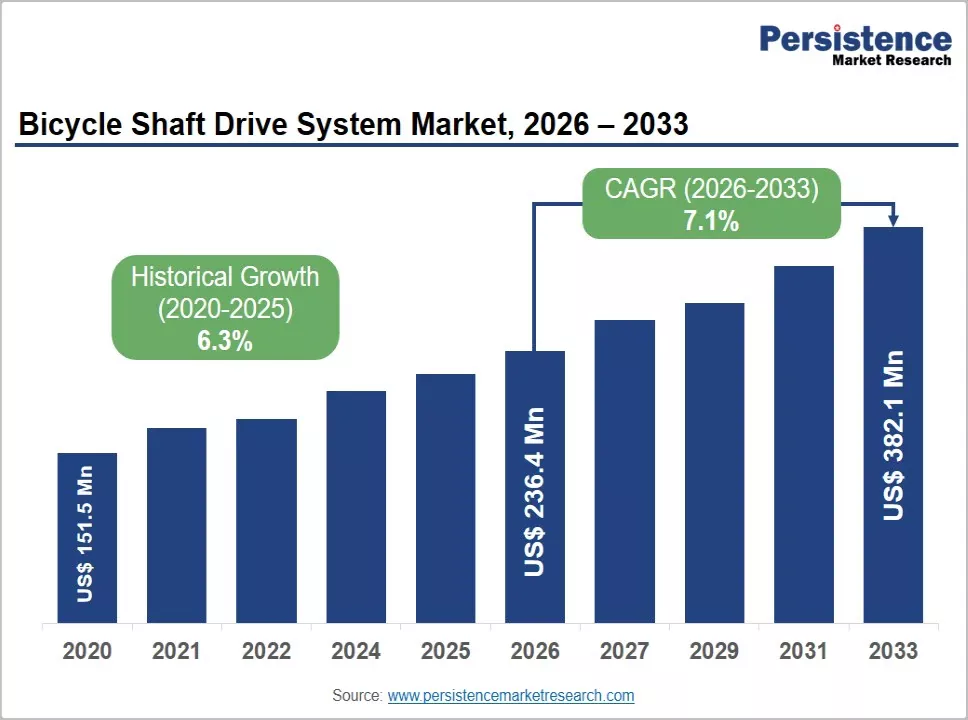
The global bicycle shaft drive system market size is likely to be valued at US$236.4 million in 2026 and is estimated to reach US$382.1 million by 2033, growing at a CAGR of 7.1% during the forecast period from 2026 to 2033, driven by rising demand for low-maintenance commuter bicycles and growing e-bike adoption. Interest in enclosed drivetrains is also encouraging new product development.
Key Industry Highlights
- Leading Bicycle Type: Hybrid and city bicycles, about 36.8% share in 2026, as daily riders value clean, quiet, and low-maintenance drivetrains.
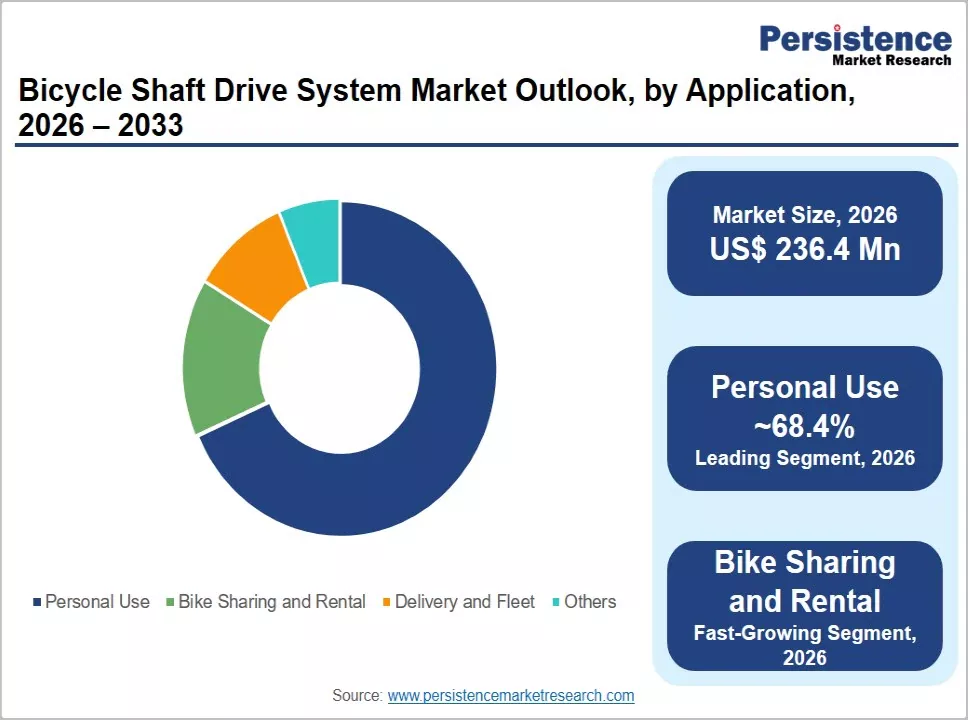
- Dominant Application: Personal use, around 68.4% share in 2026, as commuters and leisure riders prefer enclosed drives that protect clothing and need little adjustment.
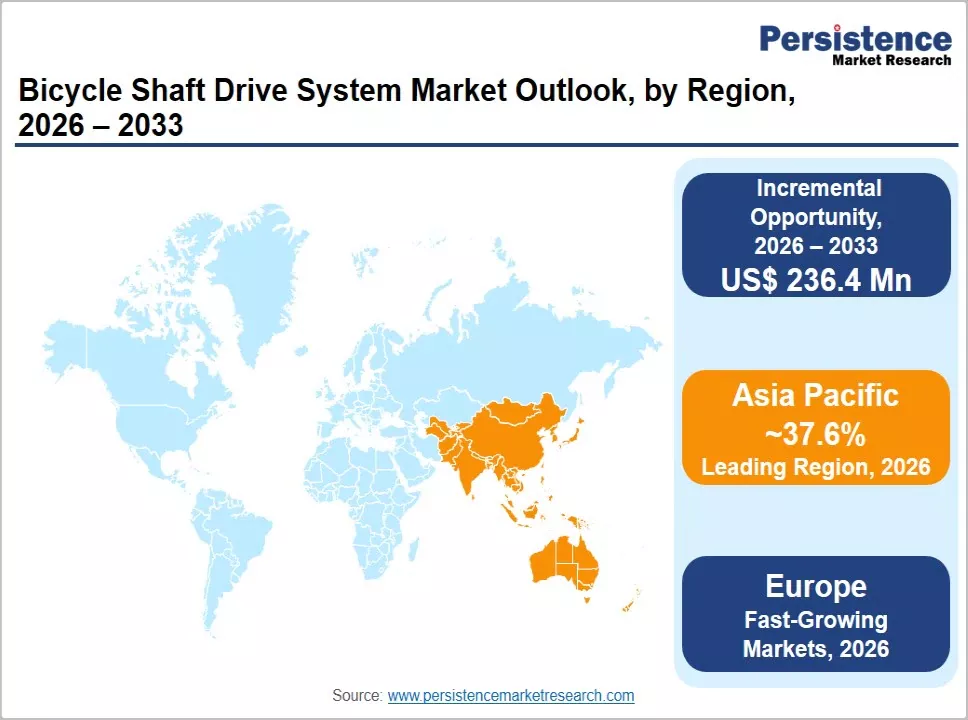
- Leading Region: Asia Pacific, with about 37.6% share in 2026, owing to large-scale bicycle manufacturing, a vast rider base, and strong e-bike policy support.
- Fastest-growing Region: Europe, backed by premium e-bike demand, dense cycling networks, and rising interest in enclosed drive systems.
- Latest Development: In April 2026, JATCO announced the market launch of the FESGLIDE electric-assist bicycle by THIRDBIKES, a sports bicycle brand owned by HODAKA Corporation. The bicycle incorporates JATCO's GLIDE AXCEL drive unit, which integrates a 250-watt assist motor and an internally geared three-speed transmission into a compact rear-hub assembly.
DRO Analysis
Driver - Rising Demand for Low-maintenance Commuting to Push Adoption
Daily riders want bicycles that stay clean and need little care. A shaft drive replaces the exposed chain with an enclosed shaft and bevel gears. This design protects clothing from grease and keeps dirt out of the drivetrain. It also removes the need for frequent chain adjustment. Dynamic Bicycles states that its shaft drive can run up to 5,000 miles with only added grease or oil. This is a manufacturer claim, but it reflects the core appeal of the technology.
A wider rider base also supports demand. China's bicycle output reached 110.8 million units in 2025, up 11.3% year on year, according to the China Bicycle Association. More than 12.5 million e-bikes were sold in the country through its trade-in policy. China also held 101 cycling races nationwide in 2025, up 23% from 2024. Larger rider volumes expand the pool of buyers who may choose low-maintenance drivetrains.
Enclosed Drivetrain Innovation to Strengthen Premium E-bike Appeal
E-bike makers want drivetrains that handle high torque with little service. Driven Technologies unveiled its Orbit Drive in June 2023. The system powers the rear wheel through a driveshaft and claims a 10,000-mile maintenance interval as it is fully enclosed. Pinion's integrated motor-gearbox units reflect similar thinking. Flyer's Upstreet TR:CF uses one, and its oil change is due only after 10,000 km, according to t-online.
Riese & Müller is widening this approach. Its 2026 lineup includes the Charger5 and Nevo5 with Pinion MGU drive units. Deliveries were expected from October 2025 and February 2026, respectively. These launches show that premium brands see enclosed drivetrains as a point of difference. Shaft-drive suppliers can benefit as buyers grow used to sealed, low-service systems.
Restraint - High Cost and Low Efficiency May Limit Mass Adoption
Shaft drives cost more to make than chain systems. They need high-quality bevel gears with small radii. This calls for heavier frame construction. Efficiency can also be lower than a well-lubricated chain, possibly owing to imprecise gear machining or alignment. Early chainless bicycles lost roughly 8% in the gearing. Modern designs have improved, but price and weight remain concerns for performance riders.
Service is another barrier. Removing the rear wheel after a flat is more complex than on a chain bike. Not all hub gears are shaft-compatible, which limits gearing choice. Dynamic Bicycles states that its 8-speed hub covers about 90% of a 21-speed range, with larger gaps between gears. Weak demand in the U.S. adds pressure. Non-electric bicycle imports in 2025 were the lowest in units this century, according to trade data reported by Bicycle Retailer.
Opportunity - Bike-sharing and Fleet Demand to Open Low-service Use Cases
Fleet operators need bicycles that survive heavy daily use with little service. An enclosed shaft resists dirt and weather and avoids chain-related breakdowns. China reported an average of 120 million daily shared-bike rides in 2025, according to Xinhua and the China Bicycle Association.
Even a small share of such fleets shifting to enclosed drives would add steady volume. Fewer service visits can also reduce operating costs for fleet owners. However, adoption depends on unit price, spare-part supply, and repair training for local mechanics.
Integrated E-bike Drive Systems to Create New Product Platforms
Bolt-on drive systems are creating new product platforms. Driven Technologies offers a fully enclosed direct drive, plus chain and belt options, around its Orbit unit. Schaeffler introduced its Free Drive system in September 2021. This "bike-by-wire" design has no mechanical link between the pedals and the wheel motor.
Such concepts widen the chainless design space for bicycle makers. They also lower the barrier for brands that lack in-house drivetrain expertise. Commercial success will depend on cost, field validation, and reliable supply.
Category-wise Analysis
Bicycle Type Insights
Hybrid and city bicycles are predicted to lead with a share of about 36.8% in 2026, as commuters value clean, quiet, and low-maintenance drivetrains. These bicycles run on paved roads at moderate speeds. This limits the efficiency concerns that matter more to racing cyclists. The enclosed shaft also keeps trousers and skirts free of grease. Shaft drives are usually paired with internal gear hubs, which suit upright city riding.
Electric bicycles are estimated to be the fastest-growing type over the forecast period, as e-bike buyers expect long drivetrain life and little service. Motors add stress to open drivetrains, so enclosed designs are gaining attention. Driven Technologies says its Orbit Drive offers up to 90 Nm of assist with stepless gearing. The Zweirad-Industrie-Verband (ZIV) reported 500,000 e-bikes sold in Germany in the first quarter of 2025, against 385,000 non-electric bicycles.
Application Insights
Personal use is anticipated to dominate with a share of around 68.4% in 2026, as individual riders buy most bicycles for commuting, errands, and leisure. Low maintenance is a clear value for riders who lack time for chain care. The segment also benefits from organized cycling. China had more than 80,000 amateur cycling clubs in 2025.
Bike sharing and rental is expected to be the fastest-growing application over the forecast period, as operators seek durable, low-service bicycles. Enclosed drives can lower service visits and cut chain failures. Adoption still depends on unit cost and fleet repair practices.
Regional Insights
Asia Pacific Bicycle Shaft Drive System Market Trends
Asia Pacific is anticipated to lead globally in 2026 with a share of around 37.6%, due to its extensive bicycle manufacturing infrastructure, large consumer base, and expanding electric bicycle industry. China, India, Japan, and other regional markets offer manufacturers access to established component suppliers, skilled production workforces, and diverse consumer segments. These advantages can support the commercialization of alternative drivetrain technologies once manufacturers establish sufficient demand.
China Bicycle Shaft Drive System Market Trends
China will likely lead in Asia Pacific in 2026 with a share of about 51.8%, supported by its extensive bicycle manufacturing capacity and established export network. Policy measures aimed at upgrading the electric bicycle industry are another important factor. E-bike trade-in initiatives can encourage consumers to replace older vehicles, while mandatory safety standards increase the importance of compliant designs and reliable components. These changes may create opportunities for manufacturers to differentiate products through durability, integrated engineering, and reduced maintenance requirements.
India Bicycle Shaft Drive System Market Trends
In 2026, India is projected to account for a share of just about 14.2% in Asia Pacific, as the country's large domestic bicycle industry provides a potential foundation for drivetrain innovation. The expansion of premium bicycles, electric bicycles, and urban commuting solutions is anticipated to gradually create demand for low-maintenance drivetrain technologies. Shaft drives may appeal to consumers who want clean operation and less frequent chain-related maintenance, mainly in daily-use bicycles exposed to dust, rain, and demanding road conditions. However, the technology must overcome high initial costs and limited availability of replacement parts and specialist repair services.
Europe Bicycle Shaft Drive System Market Trends
Europe is anticipated to be the fastest-growing region globally in 2026 with a share of roughly 27.9%. The region's established premium bicycle industry, growing use of electric bicycles, and consumer interest in convenient, low-maintenance mobility solutions support demand for alternative drivetrain technologies. Germany, the Netherlands, Denmark, and other cycling-oriented markets provide opportunities for manufacturers targeting commuters, recreational riders, and customers purchasing higher-value electric bicycles.
The Confederation of the European Bicycle Industry (CONEBI) reported in July 2025 that bicycle sales in 2024 were settling back toward pre-pandemic levels, while electric bicycles continued to attract strong interest. This normalization makes product differentiation important for manufacturers competing in a developed market.
Germany Bicycle Shaft Drive System Market Trends
In Europe, Germany is predicted to register a substantial share of approximately 33.7% in 2026, supported by a substantial electric bicycle market, an established bicycle component industry, and consumer demand for premium mobility products. Germany's premium bicycle network offers a favorable environment for alternative drivetrain technologies. Consumers purchasing high-value electric trekking bikes, urban commuters, and touring bicycles may place greater emphasis on reliability, low maintenance, and long-term ownership costs. Shaft drives can appeal to these buyers as the transmission components are enclosed and the system does not require conventional chain cleaning or lubrication.
U.K. Bicycle Shaft Drive System Market Trends
In Europe, a share of nearly 16.9% is predicted to be held by the U.K. in 2026. Although cycling represents a relatively small proportion of total daily travel, continued interest in active mobility and practical commuting solutions provides a potential growth avenue for advanced bicycle components. According to the National Travel Survey figures provided, cycling accounted for 2% of trips in England in 2024, while average cycling distance per person increased by 12% to 53 miles. These figures indicate an opportunity to improve the practicality of bicycles used for regular journeys.
North America Bicycle Shaft Drive System Market Trends
North America is predicted to account for a global share of approximately 20.4% in 2026, supported by increasing interest in electric bicycles, premium commuter models, and low-maintenance mobility solutions. The U.S. represents the region's principal demand center, while Canada offers additional opportunities as electric bicycle adoption expands. Shaft drive systems can appeal to modern consumers who prioritize durability, clean operation, and reduced routine maintenance. Their enclosed transmission mechanism limits direct exposure to dirt, moisture, and road debris, making them potentially suitable for commuter bicycles, recreational e-bikes, and utility models.
U.S. Bicycle Shaft Drive System Market Trends
A share of nearly 78.6% is expected to be held by the U.S. in 2026 in North America, backed by its large cycling population, growing electric bicycle segment, and demand for premium mobility products. According to PeopleForBikes, approximately 112 million Americans rode a bicycle at least once in 2024. The organization also reported in June 2026 that direct-to-consumer e-bike sales in 2024 accounted for around 450,000 units worth US$800 million, highlighting the importance of online distribution alongside traditional bicycle retailers. The expansion of electric commuting, recreational cycling, and utility bicycles creates opportunities for shaft drive systems in the U.S. market.
Competitive Landscape
The global bicycle shaft drive system market is fragmented, with specialist shaft-drive brands, premium e-bike makers, and drivetrain technology firms. Dynamic Bicycles, Biomega, and Brik Bikes are modern chainless bicycle makers. Pinion, Driven Technologies, and Schaeffler are developing enclosed or chainless drive systems. Shimano, SRAM, Rohloff, and Sturmey-Archer supply the internal gear hubs that many shaft-driven bicycles use.
Competition is shifting from simple chain replacement toward system integration. Pinion's gearboxes still use a chain or belt, but they share the enclosed, low-service appeal. Brands now compete on service intervals, weight, efficiency, and e-bike compatibility. Driven Technologies claims a 10,000-mile maintenance interval for Orbit Drive. Such claims are company statements and need field validation.
Key Industry Developments
- In May 2026, Pinion and FIT E-Bike Systems expanded support for specialty retailers with regional representatives. This followed a reorganization under Rotax Bike Technology AG.
- In March 2026, Pinion and FIT E-Bike Systems reported a positive conclusion to their 2025/2026 dealer training tour. The tour ran 46 dates at 35 locations across Germany, Austria, Switzerland, France, the Netherlands, and Belgium. Around 1,000 specialist dealers took part in the courses.
- In 2025, Riese & Müller added Pinion MGU options to its Charger5 and Nevo5 models. Deliveries were expected from October 2025 and February 2026, respectively. The Pinion versions weigh from 29.4 kg for the Charger5 and 28.4 kg for the Nevo5.
Companies Covered in Bicycle Shaft Drive System Market
- Dynamic Bicycles
- Biomega
- Brik Bikes
- Driven Technologies
- CeramicSpeed
- Schaeffler
- Pinion
- Riese & Müller
- Shimano
- SRAM
- Rohloff
- Sturmey-Archer
- Others
Frequently Asked Questions
The global bicycle shaft drive system market is projected to be valued at US$236.4 million in 2026.
The bicycle shaft drive system market is expected to reach US$382.1 million by 2033.
Key market trends include rising demand for low-maintenance commuter bicycles, growing integration of enclosed drivetrains with e-bike drive units, and surging interest from bike-sharing fleets.
Hybrid and city bicycles are expected to be the leading bicycle type with a share of around 36.8% in 2026, due to their surging use in daily commuting.
The bicycle shaft drive system market is expected to grow at a CAGR of 7.1% from 2026 to 2033.
Dynamic Bicycles, Biomega, and Brik Bikes are a few key market players.


