




- Electric Mobility
- Hybrid Electric Vehicle Market
Hybrid Electric Vehicle Market
Hybrid Electric Vehicle Market by Powertrain (Mild Hybrid, Full Hybrid), Drive Type (Front-Wheel Drive, Rear-Wheel Drive, All-Wheel Drive/e-AWD), Vehicle Type (Hatchbacks, Sedans, SUVs, Luxury, Light Commercial Vehicle, Heavy Commercial Vehicle), and Region Analysis for 2026 to 2033

Hybrid Electric Vehicle Market Trends & Analysis
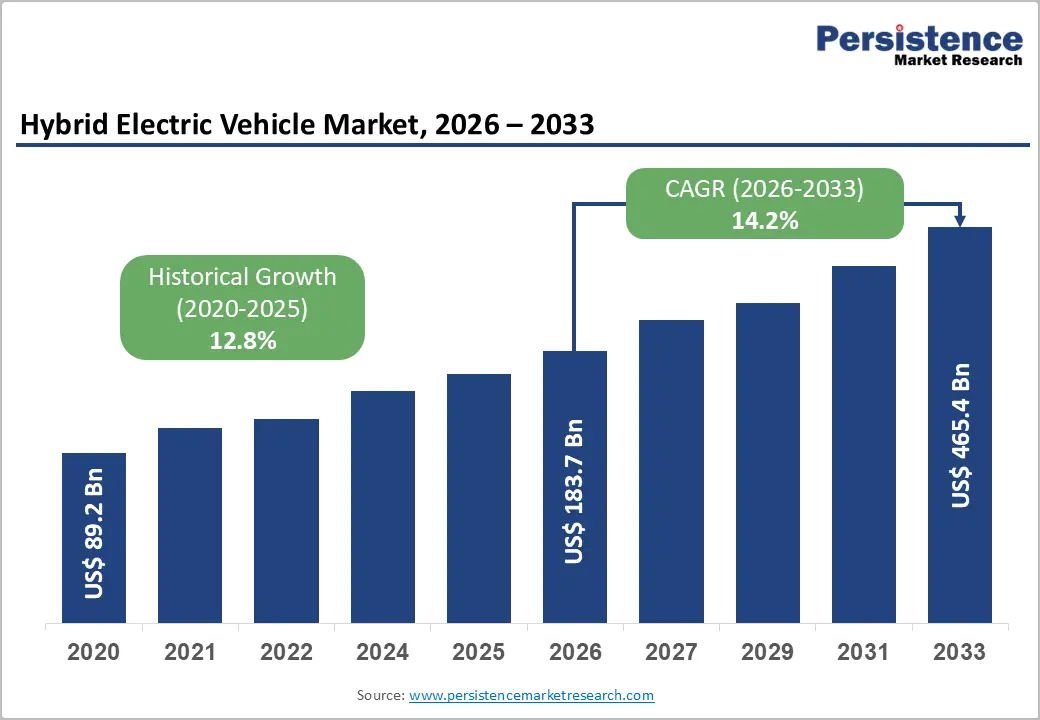
The global hybrid electric vehicle market size is anticipated at US$ 183.7 Bn in 2026 and is projected to reach US$ 465.4 Bn by 2033, growing at a CAGR of 14.2% between 2026 and 2033.
Market expansion is propelled by tightening emission mandates, cost-competitive powertrain advancements, and rising fuel-efficiency awareness among consumers globally. Asia Pacific's manufacturing dominance, coupled with aggressive government incentives across the U.S. and Europe, positions HEVs as the critical bridging technology between conventional ICE vehicles and full battery-electric mobility.
Key Highlights Summary
- Full Hybrid Dominance: Full Hybrid (Series-Parallel/Power-Split) leads the powertrain segment with 65.5% share and the fastest growth at 15.8% CAGR, driven by Toyota, Honda, and Hyundai platform expansions.
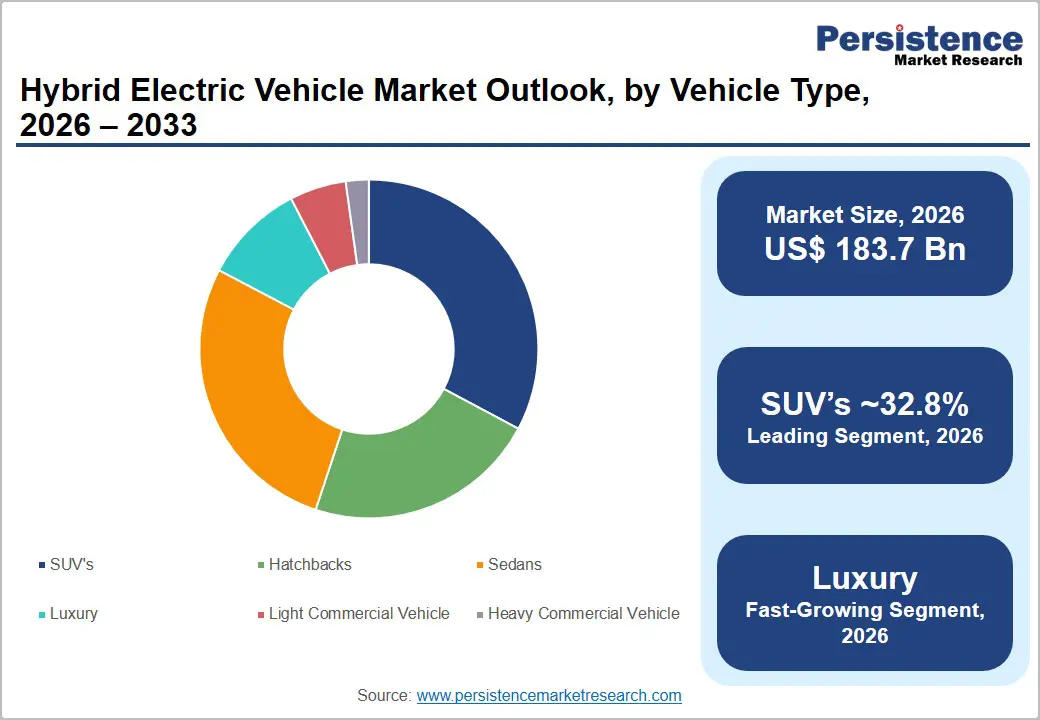
- SUV Market Leadership: SUVs dominate the vehicle type segment with a 32.8% share and highest growth at 18.6% CAGR, reflecting strong global consumer shift toward utility-oriented hybrid vehicles.
- AWD/e-AWD Growth Acceleration: AWD/e-AWD is the fastest-growing drive type with a 19.1% CAGR, supported by SUV electrification and increasing adoption of dual-motor and rear-axle electric systems.
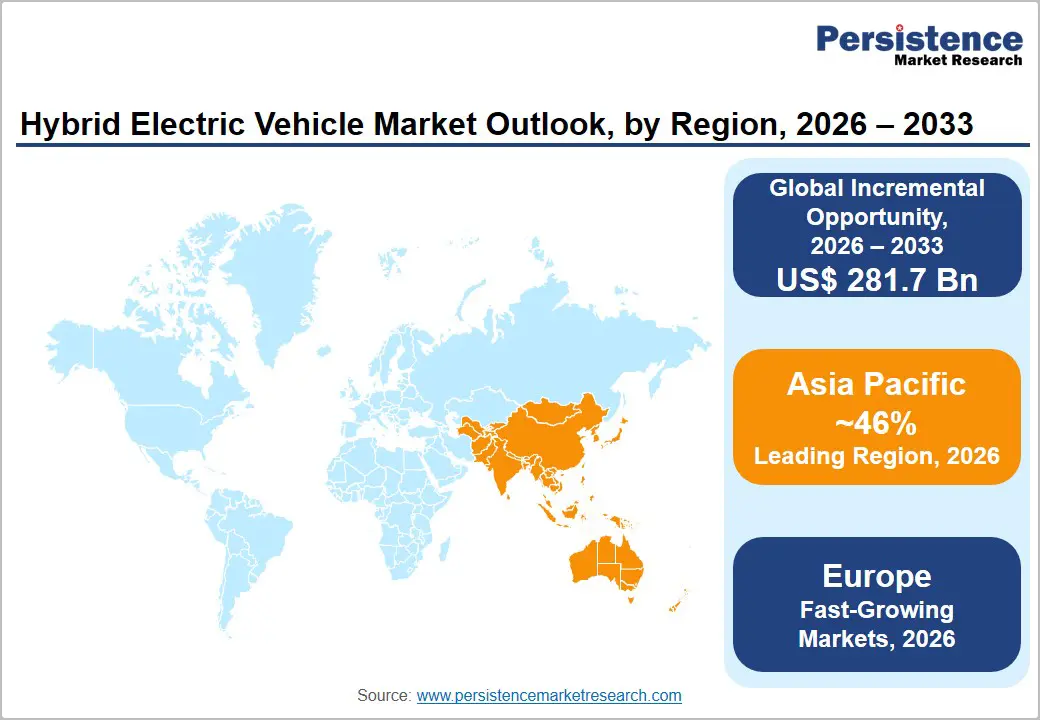
- Asia Pacific Market Dominance: Asia Pacific holds the largest regional share at 46%, led by China (US$ 31.3 Bn) and supported by India’s expanding hybrid ecosystem (US$ 3.1 Bn in 2026).
- Europe Growth Momentum: Europe is the fastest-growing region with a 15.2% CAGR, driven by stringent CO2 regulations, strong OEM electrification roadmaps, and rising hybrid penetration across Germany, France, and the UK.
- Competitive Disruption Intensification: BYD’s DM-i platform and the VW-Rivian JV (US$ 5 Bn) are accelerating competitive disruption across value and premium hybrid segments globally through 2033.
Market Dynamics Analysis
Market Drivers
Stringent Global Emission Regulations and Policy Mandates
Governments worldwide are enforcing progressively stringent vehicular emission standards, creating a structural tailwind for the HEV segment. The European Union's Euro 7 standard and the United States Corporate Average Fuel Economy (CAFE) regulations compel automakers to significantly reduce fleet-wide CO2 outputs. The EU mandates a 55% reduction in new car CO2 emissions by 2030 (relative to 2021 levels), making hybrid powertrains the most cost-efficient compliance pathway for mainstream OEMs.
In parallel, China's NEV dual-credit policy mandates a growing proportion of electrified vehicles in domestic production, directly stimulating HEV deployment. According to the BCG, HEV sales are set to increase from 15% of global vehicle sales in 2025 to 28% by 2030, representing a 2.8x surge versus 2024 figures. These regulatory frameworks reduce market uncertainty and incentivize capital allocation toward hybrid drivetrain R&D and manufacturing scale-up.
Technological Advancements in Hybrid Powertrain and Battery Systems
Continuous innovation in power-split drivetrain architectures, particularly Series-Parallel (Power-Split) systems, has significantly elevated HEV value propositions. Modern hybrid systems deliver fuel efficiency improvements of 25-40% compared to conventional ICE counterparts, translating directly into lower total cost of ownership. Advances in nickel-metal hydride (NiMH) and lithium-ion battery chemistries have simultaneously reduced battery pack costs while improving cycle life and energy density.
Toyota's 20,000+ electrification patents and Honda's dual-motor i-MMD system exemplify how incremental innovation in power electronics, regenerative braking calibration, and thermal management directly boosts consumer utility. The increasing integration of 48V mild-hybrid systems across mainstream vehicle platforms further lowers adoption barriers, enabling cost-effective electrification even in entry-level segments, thereby expanding the total addressable market.
Market Restraints
Competition from Battery Electric Vehicles (BEVs)
Battery electric vehicles represent the most direct competitive threat to HEV adoption, especially as BEV range anxiety subsides and charging infrastructure expands. In key markets like Norway and the Netherlands, BEV penetration already exceeds 80% of new car sales, effectively bypassing the HEV transition phase. As BEV total cost of ownership approaches parity with combustion vehicles, projected for multiple segments by 2027-2028, consumer preference could rapidly shift away from hybrid solutions, constraining HEV long-term volume growth in mature markets.
Supply Chain Constraints for Electrified Components
The HEV market faces structural supply challenges tied to critical mineral availability, particularly lithium, cobalt, and rare earth elements essential for electric motors and battery packs. Geopolitical concentration of mineral reserves in China and the DRC creates supply vulnerabilities for global OEMs. Disruptions in semiconductor supply chains, as evidenced during 2021-2023, continue to create production bottlenecks, particularly for power electronics and hybrid control units, limiting manufacturers' ability to fully capitalize on elevated demand signals.
Market Opportunities
Expanding HEV Adoption in Emerging Markets
South Asia, Southeast Asia, and Latin America present significant untapped potential for hybrid adoption, driven by rising middle-class income levels, escalating fuel prices, and urban air quality concerns. India's hybrid vehicle market alone was valued at approximately US$ 13.0 Bn in 2025 and is projected to reach US$ 105.6 Bn by 2034 at a CAGR of 25.30%, underscoring the scale of opportunity. Government policy evolution, such as India's potential GST rationalization for hybrid vehicles, could unlock mass-market demand in a country currently dominated by ICE vehicles.
ASEAN markets including Thailand, Indonesia, and Vietnam are accelerating EV and hybrid roadmaps supported by bilateral investment agreements with Japanese and Korean OEMs. Thailand, for instance, has set a target of 30% zero-emission vehicle production by 2030. These market-creation dynamics offer first-mover advantages for automakers willing to localize hybrid production, establish service ecosystems, and form strategic distribution partnerships in high-growth corridors.
Hybrid Technology Integration in Commercial Vehicle Segments
The commercial vehicle segment, encompassing light commercial vehicles (LCVs) and heavy commercial vehicles (HCVs), remains significantly underpenetrated relative to passenger cars, offering a high-value growth avenue. Fleet operators are increasingly receptive to hybrid drivetrains given their demonstrated fuel savings and reduced maintenance cycles, particularly for stop-start urban logistics applications. Regulatory pressure on commercial vehicle emissions in the EU (targeting a 45% CO2 reduction for trucks by 2030) further accelerates fleet electrification investment, where full BEV payload-range constraints make hybridization a pragmatic near-term solution.
Category-wise Insights
Powertrain Analysis
Full Hybrid, encompassing Series Hybrid, Parallel Hybrid, and the dominant Series-Parallel (Power-Split) architecture, commands 65.5% market share in 2026, positioning it as the unequivocal segment leader. Its superiority stems from the ability to operate in pure electric mode at low speeds while seamlessly engaging the ICE at higher loads, delivering optimal fuel efficiency without requiring external charging infrastructure. This self-sufficiency appeals to mainstream consumers across urban and suburban use cases.
Toyota's Prius and RAV4 Hybrid, both utilizing the Power-Split system, remain globally bestselling HEV models, reinforcing Full Hybrid's structural dominance. A shift toward Mild Hybrid dominance remains unlikely near-term given entrenched Full Hybrid ecosystems.
Full Hybrid also represents the fastest-growing powertrain segment, registering a CAGR of 15.8%, driven by OEM platform expansions across compact, SUV, and luxury tiers, alongside growing consumer preference for charge-free electrified mobility.
Drive Type Analysis
Front-Wheel Drive (FWD) holds the leading position in the HEV market with a 57.8% share, reflecting its cost, packaging, and efficiency advantages in compact and mid-size vehicles, the core HEV volume segments globally. FWD powertrains reduce drivetrain complexity, lower vehicle weight, and align naturally with transversely mounted hybrid systems. Compared to AWD and RWD configurations, FWD offers lower manufacturing costs and superior traction for urban driving profiles.
The dominance of FWD is reinforced by high-volume markets in Asia Pacific and Europe where compact passenger cars dominate fleet composition. While AWD is gaining ground, a structural shift from FWD dominance is unlikely before 2028-2030.
All-Wheel Drive (AWD / e-AWD) is the fastest-growing drive type at a CAGR of 19.1%, propelled by surging SUV adoption globally, growing consumer preference for all-weather performance, and the technology's compatibility with electric rear axle configurations in hybrid platforms.
Vehicle Type Analysis
SUVs lead the HEV vehicle type segment with a 32.8% market share in 2026, reflecting the global structural shift toward sport utility vehicles across all price bands. SUVs benefit disproportionately from hybrid powertrains, as their larger body mass and higher energy demands amplify fuel efficiency gains relative to sedans or hatchbacks. Models such as the Toyota RAV4 Hybrid, Ford Escape Hybrid, and Hyundai Tucson Hybrid have driven mass-market SUV hybridization across North America, Europe, and Asia Pacific.
Compared to sedans and hatchbacks, SUVs deliver higher transaction values and stronger OEM margin profiles, incentivizing continued model expansion. A demand shift away from SUV dominance is not anticipated through the forecast horizon.
SUVs are also the fastest-growing vehicle type with an 18.6% CAGR, fueled by e-AWD integration, premium feature adoption, growing family utility preference, and expanding model availability in both mainstream and luxury tiers.
Regional Market Insights
Asia Pacific leads the region at 46% share in 2026, while North America grows fastest at 27.4% CAGR.
North America
North America represents a major growth opportunity in the global HEV market, with the region projected to expand at a robust CAGR of 27.4% through 2033. Growth is being fueled by supportive policy frameworks, increasing investments in vehicle electrification, and rising consumer demand for hybrid SUVs and pickup trucks. As automakers broaden their electrified vehicle portfolios, North America is expected to remain a key contributor to the next phase of HEV market expansion.
U.S. Hybrid Electric Vehicle Market
The United States HEV (Hybrid Electric Vehicle) market is projected to reach nearly US$44.1 billion in 2026, making it the largest revenue contributor in North America. Strong government support through federal incentives, including tax credits for qualifying hybrid vehicle purchases, continues to encourage consumer adoption across multiple income groups. Increasingly stringent fuel-efficiency regulations are driving automakers to expand hybrid offerings across SUVs, pickup trucks, and passenger cars.
Leading manufacturers such as Ford Motor Company, General Motors, and Stellantis N.V. are accelerating hybrid platform development, while the success of hybrid pickup trucks and electrified SUVs is expanding HEV adoption beyond traditional passenger vehicle segments. Growing preference for fuel-efficient vehicles and a hybrid-first strategy among several OEMs continue to strengthen market growth.
Canada further supports regional demand through its long-term vehicle electrification roadmap, including targets for 100% zero-emission vehicle sales by 2035. Combined with expanding consumer awareness, improving hybrid technology, and ongoing investments in automotive electrification, these initiatives provide a stable foundation for continued HEV market growth across North America.
Europe
Europe is emerging as one of the fastest-growing HEV markets, projected to expand at a strong CAGR of 15.2% through 2033. Growth is being driven by increasingly stringent emissions regulations, including Euro 7 standards, alongside government-backed purchase incentives that encourage hybrid vehicle adoption. The continued expansion of low-emission zones (LEZs) across major cities is further accelerating demand, positioning Europe as a key growth engine in the global HEV market.
Germany Hybrid Electric Vehicle Market
The Germany HEV (Hybrid Electric Vehicle) market is projected to reach nearly US$11 billion in 2026, making it the largest national hybrid vehicle market in Europe. Strong demand for fuel-efficient vehicles, a mature automotive manufacturing ecosystem, and aggressive electrification strategies from leading automakers continue to support market expansion. Major manufacturers such as BMW Group, Volkswagen AG, and Mercedes-Benz Group AG are rapidly expanding premium and luxury hybrid portfolios to align with the European Union’s long-term emissions reduction objectives.
Germany’s strong export capabilities, advanced engineering expertise, and extensive dealer-service infrastructure further reinforce its position as Europe’s benchmark market for hybrid vehicle technology and adoption.
The France and Spain are experiencing robust growth in compact hybrid vehicle sales, supported by urban low-emission zone requirements and national vehicle incentive programs. Meanwhile, the United Kingdom continues to maintain strong hybrid demand through ULEZ enforcement policies and its planned 2035 phaseout of new internal combustion engine vehicle sales, creating sustained replacement demand for hybrid-powered passenger vehicles across the market.
Asia Pacific
Asia Pacific dominates the global HEV market, accounting for approximately 46% of total revenue in 2026. The region’s leadership is powered by the unrivaled manufacturing strength and technological expertise of China and Japan, which together serve as key hubs for hybrid vehicle production and innovation. Strong government incentives, supportive electrification policies, and robust domestic demand continue to accelerate HEV adoption, reinforcing Asia Pacific’s position as the driving force behind global market growth.
China & India Hybrid Electric Vehicle Market
China's HEV market stands at US$ 31.3 Bn in 2026, making it the world's single largest national HEV market by both volume and revenue. BYD's DM-i Super Hybrid platform has fundamentally shifted the competitive dynamic within China, enabling fuel efficiency benchmarks that rival Japanese incumbents at significantly lower price points. China's NEV dual-credit system mandates an escalating percentage of electrified vehicle production annually, sustaining structural OEM investment into hybrid drivetrain development across domestic brands. SAIC, Geely, and Chery are scaling hybrid offerings, expanding the competitive field beyond BYD and Toyota in the world's most contested HEV market.
India's HEV market is valued at approximately US$ 3.1 Bn in 2026 and is one of the fastest-growing HEV markets globally. EY identifies India's hybrid sector as positioned for transformational growth, supported by rising petrol prices, congested urban mobility patterns, and potential government policy reform toward hybrid-favorable GST restructuring. Toyota's Urban Cruiser Hyryder and Maruti Suzuki's Grand Vitara strong hybrid variants have demonstrated that Power-Split technology resonates with Indian consumers at accessible price points.
Competitive Landscape
The global HEV market exhibits a moderately consolidated structure, with the top five players, Toyota, Honda, Hyundai-Kia, BYD, and Ford, collectively accounting for over 65% of global hybrid sales by volume. Toyota's first-mover advantage, backed by 25+ years of HEV engineering and 20,000+ electrification patents, establishes an exceptionally high barrier to entry. Key differentiators deployed by market leaders include proprietary powertrain architectures, vertical battery integration, and established dealer-service networks optimized for hybrid maintenance.
The dominant strategic themes shaping competition are technology innovation (advanced power-split systems, 48V mild-hybrid platforms), cost leadership through manufacturing scale and supply chain localization, and geographic market expansion into South Asia, ASEAN, and Latin America. Chinese OEMs, led by BYD with its DM-i super hybrid technology, are aggressively disrupting both domestic and export markets through superior price-performance positioning.
Strategic Developments
- In May 2024, BYD unveiled its fifth-generation DM-i Super Hybrid technology, promising class-leading fuel efficiency improvements and extended electric-only range of 120+ km, directly challenging Toyota's Power-Split dominance.
- In November 2024, Volkswagen Group and Rivian formalized a joint venture with an initial investment of US$ 5.8 Bn to co-develop hybrid and electric vehicle software-defined architectures, enabling shared platform investment across both OEM portfolios.
Companies Covered in Hybrid Electric Vehicle Market
- Toyota Motor Corporation
- Honda Motor Co., Ltd.
- Hyundai Motor Company
- BYD Company Ltd.
- Ford Motor Company
- Kia Corporation
- BMW Group
- Volkswagen AG
- General Motors
- Nissan Motor Corporation
- Mercedes-Benz Group AG
- Mazda Motor Corporation
- Stellantis NV
- AB Volvo
- Subaru Corporation
Frequently Asked Questions
The global HEV market is valued at US$ 183.7 Bn in 2026, projected to reach US$ 465.4 Bn by 2033.
Stringent emission regulations (Euro 7, CAFE), rising fuel costs, advancing Power-Split powertrain technology, and expanding government incentive programs are the primary demand catalysts.
The HEV market is projected to grow at a CAGR of 14.2% from 2026 to 2033, underpinned by strong regional demand across Asia Pacific and North America.
Emerging markets in South Asia and ASEAN (India at 25.3% CAGR) and the commercial vehicle hybrid segment offer the highest-growth, underserved opportunity pockets.
Toyota, Honda, Hyundai, BYD, and Ford lead globally, with Volkswagen, BMW, Nissan, Kia, and Stellantis as strong challengers across regional markets.


