




- Automotive Components & Materials
- Automotive Shaft Collars Market
Automotive Shaft Collars Market Size, Share, and Growth Forecast 2026 - 2033
Automotive Shaft Collars Market by Collar Type (Set Screw, One-piece Clamp, Two-piece Clamp Collars), Material (Steel, Stainless Steel, Aluminum), Vehicle Type (Passenger Cars, Commercial Vehicles, Two-wheelers), and Regional Analysis for 2026 - 2033

Automotive Shaft Collars Market Size and Trends Analysis
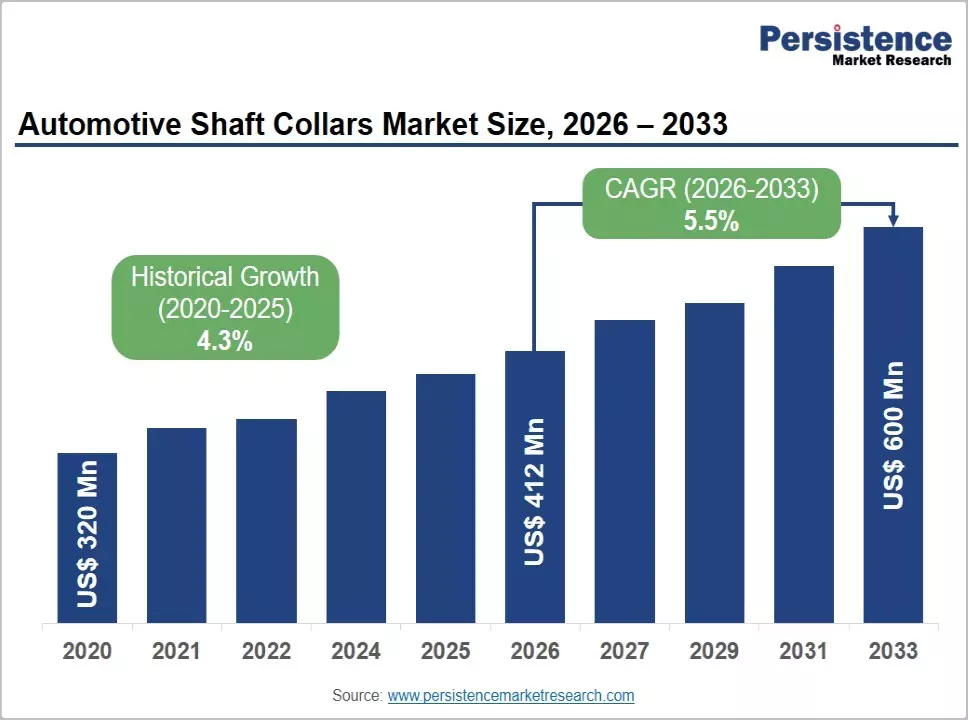
The global automotive shaft collars market is expected to be valued at US$ 412 million in 2026 and is estimated to reach US$ 600 million by 2033, growing at a CAGR of 5.5% during the forecast period from 2026 to 2033.
Market growth is primarily driven by rising vehicle production and the shift toward electric drivetrains, which use multiple shaft-mounted components. Demand for precise, easy-to-install positioning components is also increasing.
Key Industry Highlights
- Leading Collar Type: Set screw collars account for about 43.5% of the market share in 2026, supported by their low cost, simple installation, and widespread use on small shafts.
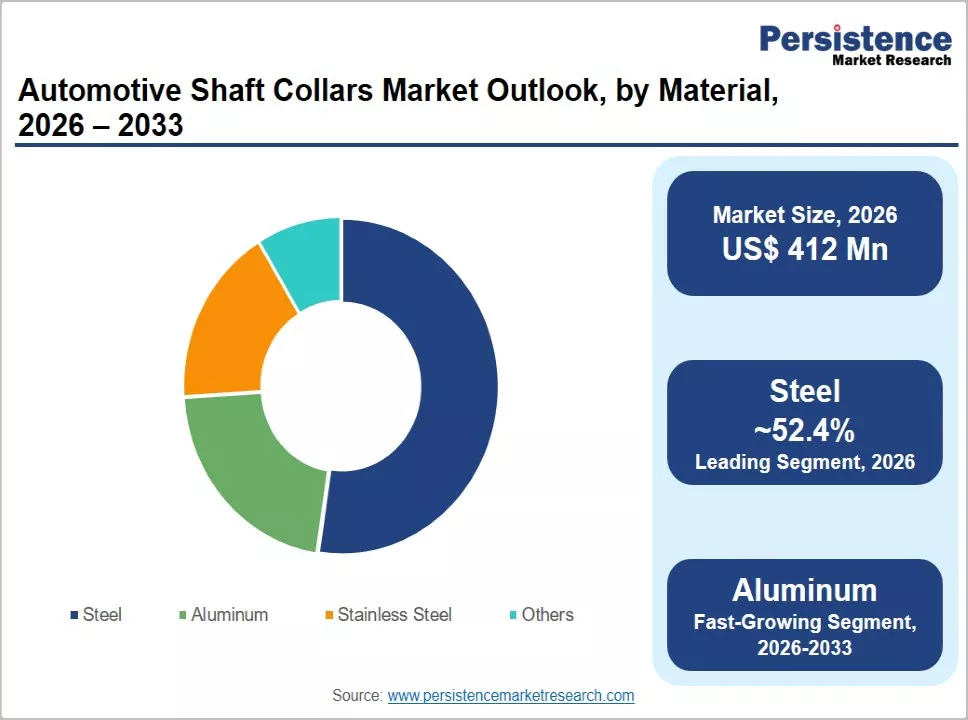
- Dominant Material: Steel is the dominant material category, accounting for around 52.4% of the market share in 2026, owing to its high holding strength and cost-effectiveness.
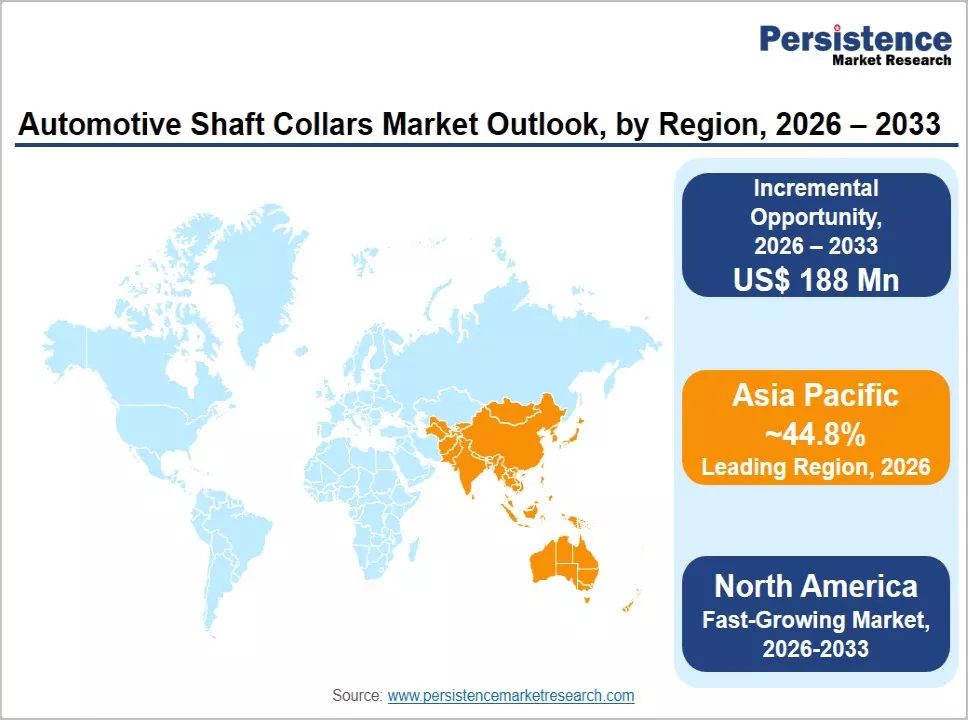
- Leading Region: Asia Pacific is expected to lead the global market by holding around 44.8% share in 2026, supported by its position as the world's largest vehicle production hub.
- Fastest-Growing Region: North America is expected to record the fastest growth through 2033, driven by rising vehicle production in the U.S. and the expansion of new-energy vehicles.
- Latest Product: In June 2025, Stafford Manufacturing introduced a broad range of standard and custom shaft collars, rigid couplings, and mounting devices for automation, robotics, and packaging equipment. The portfolio included flanged collars, quick-adjust collars, and precision clamping components made from aluminum, steel, and stainless steel. These components secure sensors, control arms, and drive-system elements, making them relevant to automated automotive production lines and assembly equipment, although the announcement did not specifically identify vehicle-mounted applications.
Market Dynamics
Drivers – Rising Global Vehicle Production to Fuel Component Demand
Rising vehicle production worldwide is a major factor driving the market growth. A shaft collar is a ring fitted around a shaft to hold bearings, gears, and sprockets in position. It also functions as a mechanical stop and is used in motor and gearbox assemblies. Automakers value shaft collars for their simple installation and lightweight designs. OICA reports that global vehicle production reached 96.4 million units in 2025, an increase of 3.9%, while sales rose 4.7% to 99.8 million units. Ruland notes that shaft collars are available in bore sizes ranging from small diameters to 6 inches, with metric sizes spanning 3 to 150 millimeters. Common materials include aluminum, steel, stainless steel, and engineered plastics.
Asia Pacific remains the largest vehicle production hub. The region manufactured about 59.2 million vehicles in 2025, an increase of 7.6%, representing more than 61% of global output. China produced 34.53 million vehicles, followed by Japan at 8.41 million and India at 6.49 million. Higher production volumes increase the number of vehicle assemblies requiring shaft-positioning components. Asia Pacific's stronger production growth compared with Europe and the Americas further shifts demand toward the region.
Electric Vehicle Growth to Augment Long-Term Market Growth
Electric vehicle adoption is a key growth driver for the automotive shaft collars market. The International Energy Agency (IEA) reports that more than 20 million electric cars were sold in 2025, an increase of about 20%, accounting for roughly one-quarter of global car sales. The IEA projects sales of about 23 million electric cars in 2026, representing 28% of the total. Europe reached a 28% electric-car sales share, with sales increasing by more than 30%, while the U.S. share remained just below 10%. Wider adoption across regions is expanding demand for components used in electric drivetrains.
Electric drivetrains incorporate motors, reduction gears, and pump shafts that require accurate axial positioning. China produced nearly 75% of the world's electric cars and more than 80% of battery cells. According to OICA, China's new-energy vehicle production increased 29% to 16.626 million units in 2025, supporting demand for precision shaft collars. The IEA also noted the introduction of the first 1,000-volt electric vehicle models in 2025. Higher-voltage systems and high-speed motors increase the importance of precise shaft positioning and tight-tolerance components.
Restraint – Tariffs and Weak Output in Mature Markets to Slow Market Growth
Trade-related costs present a challenge for automotive component suppliers. The U.S. introduced a 25% Section 232 tariff on imported automobiles effective April 3, 2025, with many automotive parts covered from May 3, 2025. An import offset equivalent to 3.75% of a vehicle's price applied from April 2025 to April 2026, declining to 2.5% from May 2026 to April 2027. These measures can increase sourcing costs and create pricing pressure across automotive supply chains.
Declining production in some mature markets also constrains demand. OICA reports that European vehicle production fell 0.8% to 17.2 million units in 2025, while production in the Americas declined 2.1% to 18.74 million units. The IEA reported that electric-car sales in the first quarter of 2026 were about 8% below the year-earlier quarter. Such fluctuations can delay component orders and reduce short-term procurement volumes. Lower output in these regions therefore limits near-term demand from automakers.
Opportunities – Quick-Fit Collar Designs to Support Assembly Efficiency
Manufacturers increasingly prioritize assembly efficiency and ease of maintenance. Clamp collars are generally faster to install than set screw collars and avoid direct screw contact with the shaft surface. Two-piece clamp collars can also be installed without removing adjacent components, simplifying maintenance and assembly. Ruland introduced quick-clamping lever collars with bore sizes up to 3 inches. These collars allow tool-free installation and rapid position adjustments, using levers sourced from Otto Ganter GmbH. The products are manufactured in Marlborough, Massachusetts, with metric bore sizes available up to 80 millimeters.
Material innovation also creates opportunities for differentiation. Ruland offers collars made from 2024 aluminum, lead-free 1215 steel, and 303 and 316 stainless steel. Aluminum reduces component weight, while stainless steel provides corrosion resistance. Suppliers that match material properties to operating conditions can strengthen their position in new designs for automakers and equipment manufacturers. Stafford recommends a shaft tolerance of +0 to -0.002 inch for high-performance applications. Accurate shaft dimensions support secure collar fitting and improve holding performance.
Growth in Emerging Markets to Create New Demand Pools
India represents an important growth opportunity as vehicle production and sales expand. The Society of Indian Automobile Manufacturers (SIAM) reported that automotive wholesale volumes in fiscal 2025–26 reached 28,265,519 units, up 10.4%. Two-wheeler wholesales increased 10.7% to 21,705,974 units, while vehicle exports rose 24% to 6,647,685 units. India's market expansion is led by two-wheelers, with exports reaching a record 5.18 million units. Passenger-vehicle sales exceeded 4.6 million units, alongside sales of more than 1 million trucks and buses. Higher manufacturing volumes create opportunities for shaft collar suppliers serving original equipment manufacturers and replacement-part channels.
Africa also presents a developing opportunity, although its market remains smaller than those of established automotive regions. OICA reports that African vehicle sales increased 22% to 1.29 million units in 2025. Growth in local assembly and vehicle servicing creates additional demand for shaft components and replacement parts. Suppliers offering standard collars in a range of sizes can serve varied shaft requirements across automotive production, maintenance, and repair applications.
Category-wise Analysis
Which Collar Type Leads the Market?
Set screw collars are expected to lead the market, accounting for about 43.5% share in 2026, supported by their low cost and simple installation. The screw presses into the shaft to secure the collar, with holding power varying by screw size. According to Stafford, a 1/4-28 screw tightened to 162 in-lb provides about 1,450 lb of axial holding force on a steel collar. However, set screw collars can damage the shaft surface, encouraging users who need to protect shafts to choose clamp-type designs. Despite this limitation, their affordability supports widespread use.
Clamp collars are estimated to be the fastest-growing collar type segment during the forecast period, driven by demand for faster installation and shaft protection. One-piece clamp collars offer quick installation, while two-piece designs allow installation without removing adjacent components and provide greater holding power in certain applications. This growth outlook reflects our analyst view, as publicly available sales breakdowns by collar type remain limited. Their installation flexibility also supports maintenance and repair operations.
Material Insights
Steel is the leading material category, accounting for around 52.4% of the market share in 2026, owing to its high holding strength and cost-effectiveness. Stafford data indicate that 1215 steel collars provide greater holding force than stainless steel collars on stainless steel shafts. A 1/2-20 screw tightened to 1,428 in-lb provides about 8,550 lb of holding force. Steel is therefore suitable for demanding drivetrain applications, while stainless steel collars are better suited to wet or corrosive environments. Stafford also warns that galling can occur when stainless steel components contact other stainless steel surfaces.
Aluminum is expected to be the fastest-growing material during the forecast period, driven by automakers' focus on lightweight components. Stafford reports that 2024 aluminum collars provide about half the holding force of 1215 steel collars, making them suitable for applications with lower load requirements. This growth outlook reflects our analyst view, as publicly available data on market shares by material remain limited.
Regional Analysis
North America Automotive Shaft Collars Market Trends
North America is expected to be the fastest-growing regional market, driven by its large vehicle fleet and established automotive and industrial equipment base. OICA reports that vehicle production in the Americas declined 2.1% to 18.74 million units in 2025, while sales increased 2.9% to 24.86 million units. Stronger sales support demand for replacement components. Tariffs on imported automotive parts also increase sourcing costs and encourage suppliers to reassess regional procurement strategies.
U.S. Automotive Shaft Collars Market Trends
The U.S. is expected to account for nearly 81.5% of the North American market revenue in 2026, supported by its large automotive market and extensive vehicle fleet. OICA reports that the country produced 10.24 million vehicles and sold 16.7 million in 2025. The IEA notes that electric cars accounted for just under 10% of U.S. vehicle sales. Trade measures also influence sourcing decisions, with a 25% Section 232 tariff applying to covered imported automotive parts. These measures are expected to encourage greater consideration of domestic and regional suppliers.
Asia Pacific Automotive Shaft Collars Market Trends
Asia Pacific is expected to maintain leadership in the global automotive shaft collars market while holding around 44.8% share in 2026, supported by rising vehicle production. The region produced about 59.2 million vehicles in 2025, an increase of 7.6% and more than 61% of global output. Regional automakers are also expanding electric vehicle production, supporting demand for precision components used in electric drivetrains. This assessment reflects our analyst view. The region's extensive supplier networks for fasteners, machined parts, and automotive components further support market development.
China Automotive Shaft Collars Market Trends
China is expected to lead the Asia Pacific market in 2026, accounting for about 52.7% of the regional market. The country produced 34.53 million vehicles in 2025, including 16.626 million new-energy vehicles, an increase of 29%. The IEA reports that China accounted for about 55% of global electric-car sales and nearly 75% of global electric-car production. The introduction of the first 1,000-volt electric vehicle models in 2025 also highlights the growing need for precision drivetrain components. China's extensive automotive manufacturing and component supplier base further supports demand for shaft collars.
India Automotive Shaft Collars Market Trends
India is projected to hold about 14.8% share of the Asia Pacific market in 2026, supported by rising vehicle production and exports. OICA reports that India manufactured 6.49 million vehicles in 2025. The Society of Indian Automobile Manufacturers (SIAM) reported record two-wheeler exports of 5.18 million units in fiscal 2025–26. Domestic passenger-vehicle sales exceeded 4.6 million units, while total vehicle exports increased 24% to 6,647,685 units. Growing domestic production and export volumes increase the need for reliable component supply across automotive manufacturing and aftermarket channels.
Europe Automotive Shaft Collars Market Trends
Europe is expected to account for around 21.7% of the global market share in 2026, supported by established premium automakers and continued vehicle electrification. OICA reports that regional vehicle production declined 0.8% to 17.2 million units in 2025, while sales fell 0.4% to 18.63 million units. According to the IEA, electric cars accounted for 28% of vehicle sales in Europe. Electrification supports demand for components used in electric drivetrains, partly offsetting the effects of weaker overall production and sales.
Germany Automotive Shaft Collars Market Trends
Germany is anticipated to account for about 27.3% of the European market revenue in 2026, supported by its established automotive manufacturing base and growing electric vehicle production. The German Association of the Automotive Industry (VDA) reports that passenger-car production increased 2% to 4,151,800 units in 2025, while electric-car registrations rose 50% to 856,600 units. VDA expects passenger-car production to decline about 1% to 4.11 million units in 2026. Germany exported 3,174,900 passenger cars in 2025, broadly unchanged from the previous year. German brands are expected to increase overseas production by about 1% to 9.2 million units in 2026, highlighting the continued importance of international manufacturing networks.
U.K. Automotive Shaft Collars Market Trends
The U.K. is projected to hold nearly 12.4% of the European market share in 2026, supported by its established premium vehicle manufacturing base and expanding electrified vehicle output. The Society of Motor Manufacturers and Traders (SMMT) reports that vehicle production declined 15.5% to 764,715 units in 2025, although electrified vehicle output reached a record 298,813 units. Jaguar Land Rover (JLR) production fell 21.7% to 201,283 units after a cyberattack disrupted operations for six weeks. SMMT forecasts that car production will grow by more than 10% in 2026, reaching about 790,000 units.
Competitive Landscape
The global automotive shaft collars market is fragmented, with specialist collar makers and industrial component suppliers. Ruland Manufacturing, Stafford Manufacturing, and Climax Metal Products supply collars in many sizes. Misumi supplies factory automation parts. No public data show shaft collar revenue by company.
Competition centers on holding power, material choice, and lead times. Suppliers that publish clear torque and holding data are better placed. Makers that offer metric and inch sizes win wider use. Quick delivery and tight bore tolerances are also key. Stafford notes that holding power values are static guides, not guarantees. Buyers therefore test collars in real duty.
Key Industry Developments
- In March 2026, Stafford Manufacturing Corp. introduced customizable Accu-Flange shaft collars featuring an integral clamp and a machinable flange that allows original equipment manufacturers (OEMs) to specify custom mounting-hole patterns and surfaces. Available in steel, stainless steel, and aluminum, the collars are designed to maintain perpendicular alignment while providing secure, non-marring shaft attachment. The launch supports manufacturers that need application-specific mounting components for mechanical assemblies, although Stafford did not identify automotive applications as the primary target market.
- In February 2026, Stafford Manufacturing introduced a double-wide shaft collar range designed to provide approximately twice the axial holding power of standard-width collars without increasing their outside diameter. Available in one-piece and two-piece steel configurations, the products are intended for assemblies where radial clearance is limited, but stronger axial retention is required.
- In October 2025, Stafford Manufacturing introduced a range of customizable flange shaft collars with an integral clamping mechanism and a machinable mounting face. The products allow users to modify standard collars to incorporate application-specific holes, threads, and mounting features, while maintaining alignment and avoiding damage to the shaft surface. The development supports OEMs and maintenance teams seeking customized shaft-positioning and mounting components without designing an entirely new part from scratch.
Companies Covered in Automotive Shaft Collars Market
- Ruland Manufacturing
- Stafford Manufacturing
- Climax Metal Products
- Misumi
- Others
Frequently Asked Questions
The global automotive shaft collars market is projected to be valued at US$ 412 million in 2026.
The market is expected to reach US$ 600 million by 2033.
Key market trends include rising vehicle production, growing electric vehicle output, and demand for quick-fit clamp collars and lightweight materials.
Set screw collars are expected to be the leading collar type, holding a share of around 43.5% in 2026, due to their low cost and simple fit.
The market is expected to grow at a CAGR of 5.5% from 2026 to 2033.
Ruland Manufacturing, Stafford Manufacturing, and Climax Metal Products are among the key market players.


