




- Automotive Components & Materials
- Automotive Hinges Market
Automotive Hinges Market Size, Share, and Growth Forecast, 2026 - 2033
Automotive Hinges Market by Product Type (Door, Cabinet, Hood), Vehicle Type (Passenger Cars, Commercial Vehicles), and Regional Analysis for 2026 - 2033

Automotive Hinges Market Size and Trends Analysis
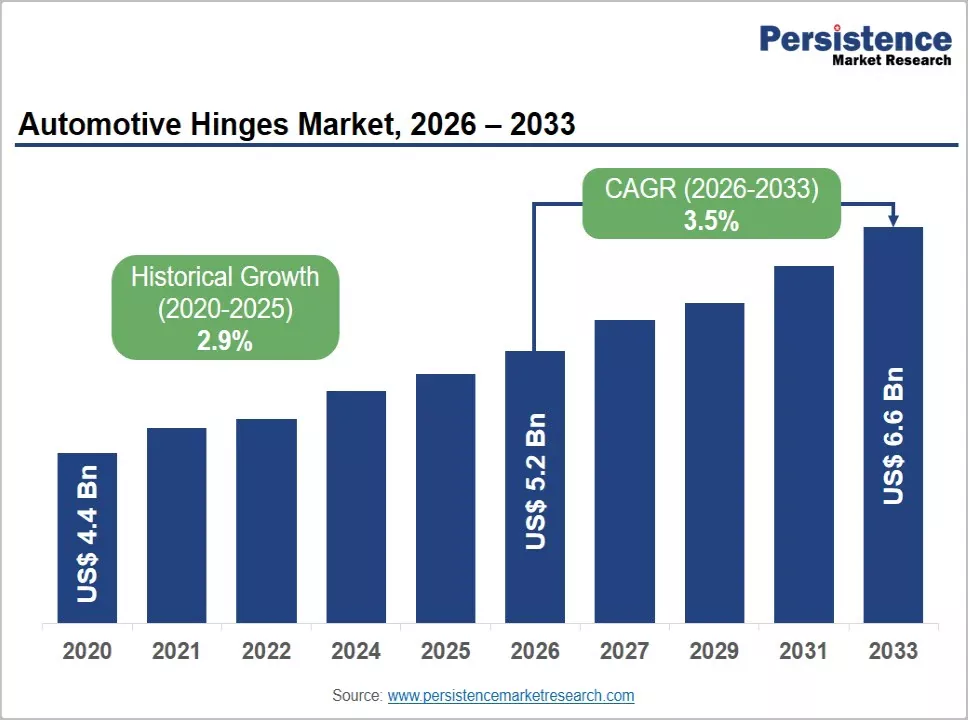
The global automotive hinges market size is likely to be valued at US$5.2 billion in 2026 and is expected to reach US$6.6 billion by 2033, growing at a CAGR of 3.5% during the forecast period from 2026 to 2033, driven by steady vehicle production, increasing adoption of lightweight vehicle structures, and growing requirements for durable door, hood, and cabinet mechanisms across passenger and commercial vehicles.
The transition toward electric vehicles is also influencing hinge design, with manufacturers focusing on lightweight, compact, corrosion-resistant, and high-strength components.
Key Industry Highlights:
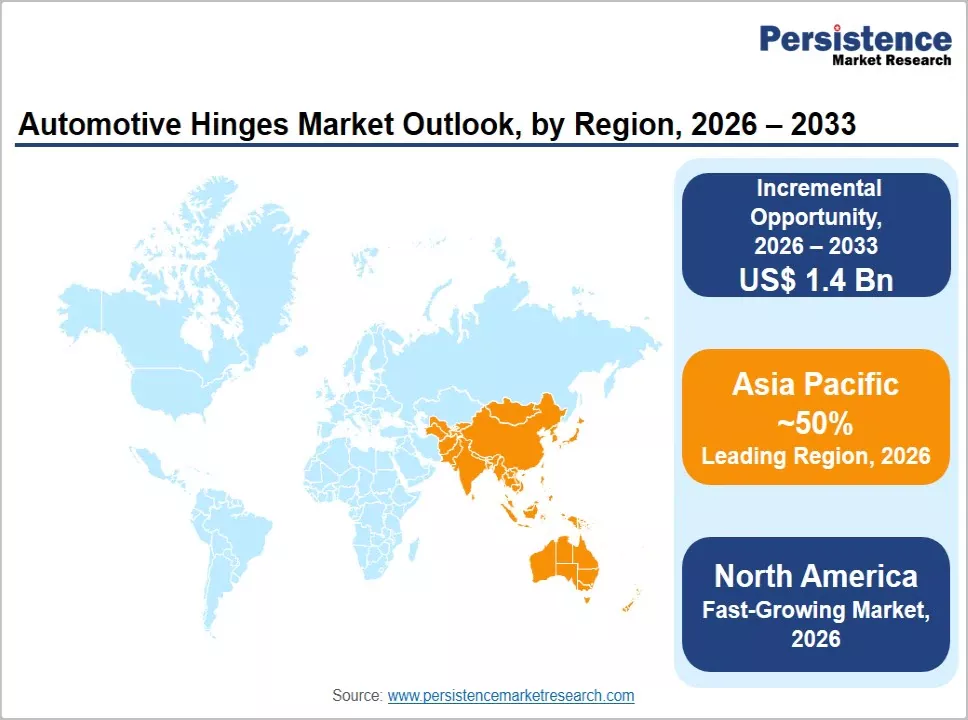
- Leading Region: Asia Pacific is expected to lead, accounting for 50% of the market share in 2026, driven by large-scale vehicle production, expanding EV manufacturing, and increasing automotive component localization.
- Fastest-growing Region: North America is likely to be the fastest-growing region, supported by vehicle production, EV manufacturing, lightweight component adoption, and stringent automotive safety standards.
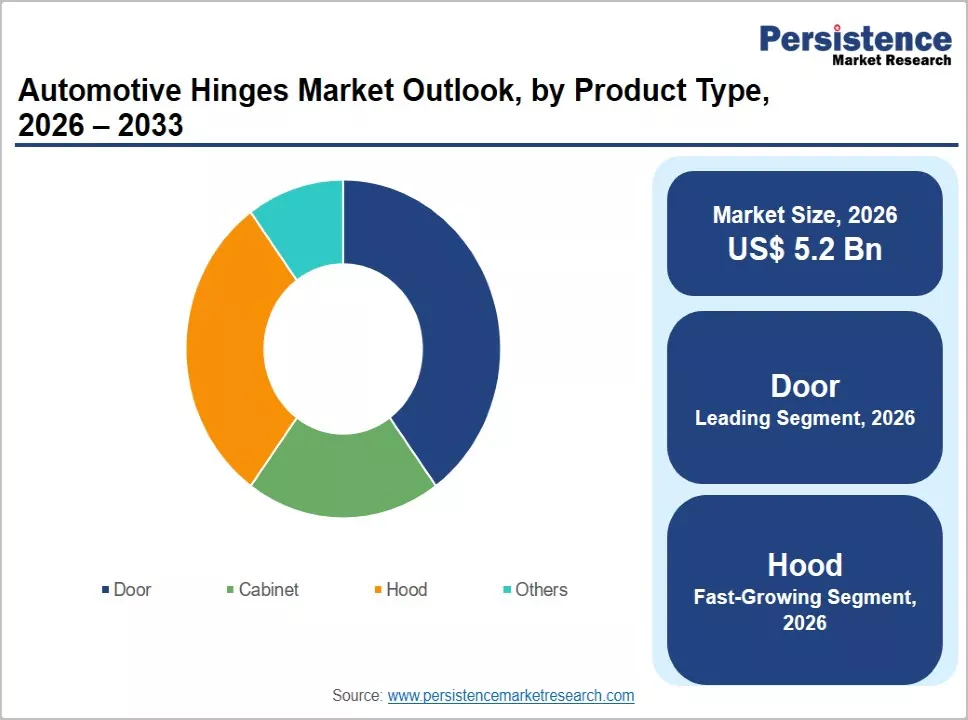
- Leading Product Type: Door hinges are projected to represent the leading product type in 2026, accounting for 45% of the revenue share, due to their widespread use across passenger and commercial vehicles.
- Leading Vehicle Type: Passenger cars are anticipated to be the leading vehicle type, accounting for over 75% of the revenue share in 2026, supported by higher vehicle production and greater hinge requirements across multiple doors.
- Key Opportunity: Growing vehicle electrification and lightweighting are creating opportunities for advanced automotive hinge systems that combine lightweight materials, durability, smart functionality, and integration with powered closure technologies.
DRO Analysis
Driver - Shift toward Lightweight Materials and Electrification
Automotive manufacturers are increasingly adopting lightweight materials to improve vehicle efficiency, reduce energy consumption, and support electric-vehicle range targets. This trend directly influences hinge design, as door, hood, and cabinet hinges must deliver structural strength while minimizing component weight. Aluminum, advanced steel grades, and hybrid material constructions are gaining attention as manufacturers optimize body-in-white architectures.
Electrification strengthens this requirement as reducing vehicle mass can help offset battery weight and improve overall energy efficiency. Hinge suppliers are therefore developing compact geometries, optimized load paths, and corrosion-resistant materials that meet durability requirements without adding unnecessary mass across passenger and commercial vehicle platforms.
The expansion of electric-vehicle production is also encouraging greater integration of hinges with electronically controlled body functions. Power-operated doors, powered hoods, charging-access systems, and automated opening mechanisms require hinges capable of supporting additional sensors, actuators, and wiring interfaces. Automotive suppliers are consequently focusing on lightweight hinge assemblies that maintain precise movement, strength, and long-term reliability.
Restraint - Technological Transition Risks
Rapid technological changes create transition risks for automotive hinge manufacturers, particularly as vehicle architectures evolve toward electrification, automation, and electronically controlled body systems. Conventional hinge designs may require substantial redesign to accommodate sensors, actuators, wiring, and new packaging constraints. These changes can increase engineering complexity, testing requirements, tooling investments, and qualification timelines. Suppliers must also maintain established mechanical performance while introducing new materials and technologies.
Another challenge arises from increasingly complex material and manufacturing requirements. Lightweight aluminum and hybrid constructions can require different joining methods, surface treatments, machining processes, and quality-control procedures compared with conventional steel hinges. Manufacturers must ensure that these components maintain durability under repeated opening cycles, vibration, temperature variation, corrosion, and crash-related loads. Integration of electronic features introduces additional reliability considerations and potential component dependencies.
Opportunity - Lightweight and Smart Hinge Integration
Lightweight and smart hinge integration presents an opportunity for automotive suppliers to develop higher-value components rather than conventional mechanical hinge assemblies. Manufacturers can combine optimized aluminum or high-strength steel structures with sensors, actuators, position monitoring, and electronically controlled opening mechanisms. Such systems can support powered doors, automated access functions, active hood systems, and advanced vehicle convenience features.
Integration can also reduce packaging requirements by combining multiple functions within a single assembly. As vehicle platforms increasingly prioritize weight optimization and electronic functionality, suppliers with expertise in materials engineering, mechatronics, and precision manufacturing can develop differentiated hinge solutions for passenger and commercial vehicle applications.
Smart hinge systems can also contribute to vehicle safety, serviceability, and functional monitoring by providing information about movement, position, or operating conditions. Connected components could support predictive maintenance approaches by identifying abnormal resistance, excessive movement, or mechanical degradation before failures occur. Lightweight designs can additionally help manufacturers meet efficiency objectives while preserving required structural performance.
Category-wise Analysis
Product Type Insights
Door hinges are expected to lead, accounting for 45% of revenue in 2026, due to their universal requirement across passenger cars and commercial vehicles. These hinges must provide reliable articulation, structural support, durability, and consistent alignment throughout repeated vehicle operation. Growing adoption of powered doors and advanced body systems is also encouraging manufacturers to improve hinge precision and packaging efficiency. Magna International supplies automotive body and structural systems, including door-related components, to vehicle manufacturers.
Hood hinges are likely to represent the fastest-growing segment, supported by increasing emphasis on lightweight vehicle structures, hood positioning, pedestrian protection, and integration with modern engine compartments. Automakers are increasingly seeking compact hinge designs that provide strength while reducing unnecessary mass and supporting precise hood movement.
Vehicle Type Insights
Passenger cars are projected to lead the market, capturing around 75% of the revenue share in 2026, supported by their broad production base and requirement for multiple hinge assemblies across doors, hoods, and other closure systems. Increasing SUV adoption, vehicle customization, premium features, and electrification are creating additional requirements for durable and lightweight hinge systems. Aisin supplies automotive body and closure components to passenger-vehicle manufacturers, supporting applications requiring reliable hinge mechanisms.
Commercial vehicles are likely to be the fastest-growing vehicle type due to expanding logistics activity, fleet modernization, urban delivery requirements, and increasing demand for durable components capable of handling intensive operating conditions. Manufacturers require robust hinges for frequent door and hood operation while maintaining reliability across demanding environments. Huf develops vehicle access and body hardware technologies serving commercial-vehicle applications and other automotive platforms.
Regional Insights
North America Automotive Hinges Market Trends
North America is likely to be the fastest-growing region, supported by a large vehicle manufacturing base, continued investments in electric vehicles lightweight body structures, and advanced closure technologies. Demand for hinges is increasingly influenced by weight optimization, electronically controlled doors, powered closures, and improved durability requirements.
U.S. Automotive Hinges Market Trends
The U.S. is expected to dominate the regional market, accounting for approximately 80% of the market share in 2026. EV and hybrid vehicle manufacturing is encouraging suppliers to develop lighter closure components. Automakers are also adopting electronically assisted doors and advanced access systems. These technologies increase requirements for precise and durable hinge assemblies. Lightweight materials are gaining importance as manufacturers optimize vehicle efficiency. Commercial-vehicle production also supports demand for heavy-duty hinge applications.
Canada Automotive Hinges Market Trends
Canada is likely to be a significant market for automotive hinges and holds approximately 20% of the market share in 2026. The country is strengthening its position in electric-vehicle and battery-related automotive manufacturing. New vehicle-program investments are supporting demand for locally supplied components. Lightweighting is encouraging greater attention to efficient closure and structural components. Door and hood hinge suppliers benefit from Canada’s integration with the broader North American automotive supply chain.
Europe Automotive Hinges Market Trends
Europe is likely to be a significant market for automotive hinges in 2026, due to established vehicle manufacturing, electrification, lightweighting, and stringent safety and efficiency requirements. ACEA reported that global car production increased in 2025 while European production remained broadly stable, reflecting the region’s ongoing industrial transition. Germany remains a major manufacturing center, while the United Kingdom continues to transition toward electrified vehicle production.
U.K. Automotive Hinges Market Trends
The U.K. is likely to be a significant market for automotive hinges, accounting for 15% of Europe market share in 2026. New EV model production is increasing the demand for lightweight and technologically advanced vehicle components. Door and hood hinge suppliers are therefore adapting to changing vehicle architectures. Export-oriented manufacturing remains important for the British automotive industry. Advanced closure systems can benefit from increasing electrification and vehicle automation.
Germany Automotive Hinges Market Trends
Germany is anticipated to dominate the regional market, accounting for around 37% of the Europe market share in 2026. Germany remains one of Europe’s largest automotive manufacturing centers and an important market for automotive hinges. This transition is encouraging lightweight hinge designs and compact closure mechanisms. Premium vehicle production also supports demand for sophisticated door and hood systems.
Asia Pacific Automotive Hinges Market Trends
The Asia Pacific region is anticipated to be the leading region, accounting for a global market share of 50% in 2026. Rapid EV adoption, expanding automotive production, localization, and increasing demand for advanced vehicle features are supporting hinge development. Manufacturers are focusing on lightweight structures, durability, compact packaging, and electronically enabled closures.
China Automotive Hinges Market Trends
China is projected to dominate the regional market, holding around a 30% share of the Asia Pacific market in 2026. EV manufacturers increasingly require lightweight and compact closure components. Growing adoption of powered doors and electronic access systems is creating additional technology requirements. Domestic automotive brands are expanding both local and export production. Suppliers are therefore developing advanced hinge solutions suited to electric and premium vehicles.
India Automotive Hinges Market Trends
India is expected to emerge as a significant market, accounting for approximately a 22% share in 2026. Rising passenger-car and commercial-vehicle production is supporting demand for door and hood hinges. Expanding vehicle exports are also encouraging manufacturers to improve component quality and localization. Electric mobility is gradually influencing vehicle-platform and component development. Suppliers are focusing on cost-efficient designs while maintaining durability and safety requirements.
Competitive Landscape
The global automotive hinges market exhibits a moderately fragmented structure, driven by the presence of established automotive component manufacturers, specialized hinge suppliers, and diversified Tier-1 suppliers serving original equipment manufacturers. Competition is shaped by demand for lightweight components, improved durability, precise closure operation, and integration with evolving vehicle architectures.
The key leaders include Gestamp Automoción, Aisin Seiki Co., Ltd., Magna International Inc., Huf Hülsbeck & Fürst GmbH & Co. KG, and Valeo SA; these companies maintain their positions through broad OEM relationships, engineering capabilities, manufacturing networks, and specialized closure technologies.
Key Industry Developments:
- In August 2026, Magna highlighted advances in software-defined vehicle access, integrating powered doors, sensing, obstacle detection, actuators, latches, and control architectures.
Companies Covered in Automotive Hinges Market
- Gestamp Automoción
- Thyssenkrupp AG
- Aisin Seiki Co., Ltd.
- Magna International Inc.
- Huf Hülsbeck & Fürst GmbH & Co. KG
- Mitsubishi Electric Corporation
- Schaeffler AG
- Valeo SA
Frequently Asked Questions
The global automotive hinges market is projected to reach US$5.2 billion in 2026.
Rising vehicle production, lightweighting, electrification, and increasing demand for advanced closure systems drive the market.
The automotive hinges market is expected to grow at a CAGR of 3.5% from 2026 to 2033.
Lightweight materials, smart hinge integration, powered closures, and advanced hinge solutions for electric vehicles present key opportunities.
Gestamp Automoción, Thyssenkrupp AG, Aisin Seiki Co., Ltd., Magna International Inc., and Mitsubishi Electric Corporation are the leading players.


