




- Automotive Components & Materials
- Automotive Gas Spring Market
Automotive Gas Spring Market Size, Share, and Growth Forecast, 2026 - 2033
Automotive Gas Spring Market by Product Type (Lift Gas Springs, Lockable Gas Springs, Swivel Chair Gas Springs, Gas Traction Springs, Others), Vehicle Type (Passenger Cars, Commercial Vehicles, Others), Distribution Channel (OEMs, Aftermarket), and Regional Analysis for 2026 - 2033

Automotive Gas Spring Market Size and Trends Analysis
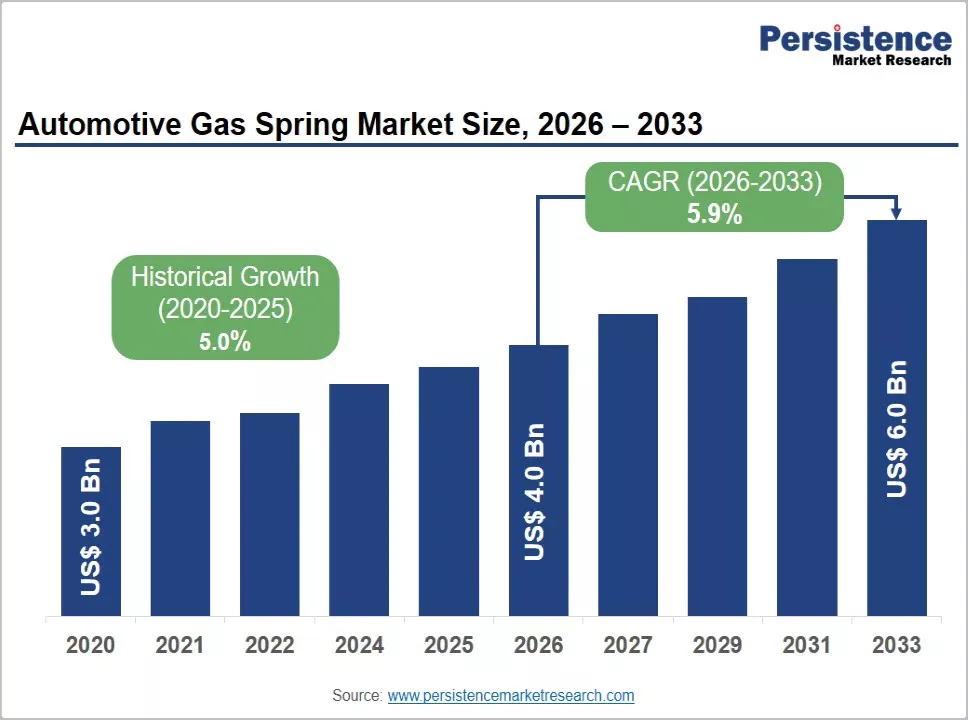
The global automotive gas spring market size is estimated at US$ 4.0 billion in 2026 and is projected to reach US$ 6.0 billion by 2033, growing at a CAGR of 5.9% during the forecast period from 2026 to 2033. The market is driven by rising vehicle production, electrification-led redesign of closure systems, safety and convenience requirements, and the expansion of organized aftermarket channels.
Growth is expected to be supported by the integration of gas springs into tailgates, trunk lids, hoods, seats, and electric-vehicle frunks. Global vehicle production rose from 92.7 million units in 2024 to 96.4 million units in 2025, creating a larger installed base for closure, seating, and related actuation components. Demographic shifts toward urbanization and aging populations are increasing demand for assisted opening, adjustable seating, and ergonomic vehicle access. Regulatory programs focused on lower emissions and improved vehicle efficiency are encouraging lightweight designs, durable components, and longer maintenance intervals.
Key Industry Highlights
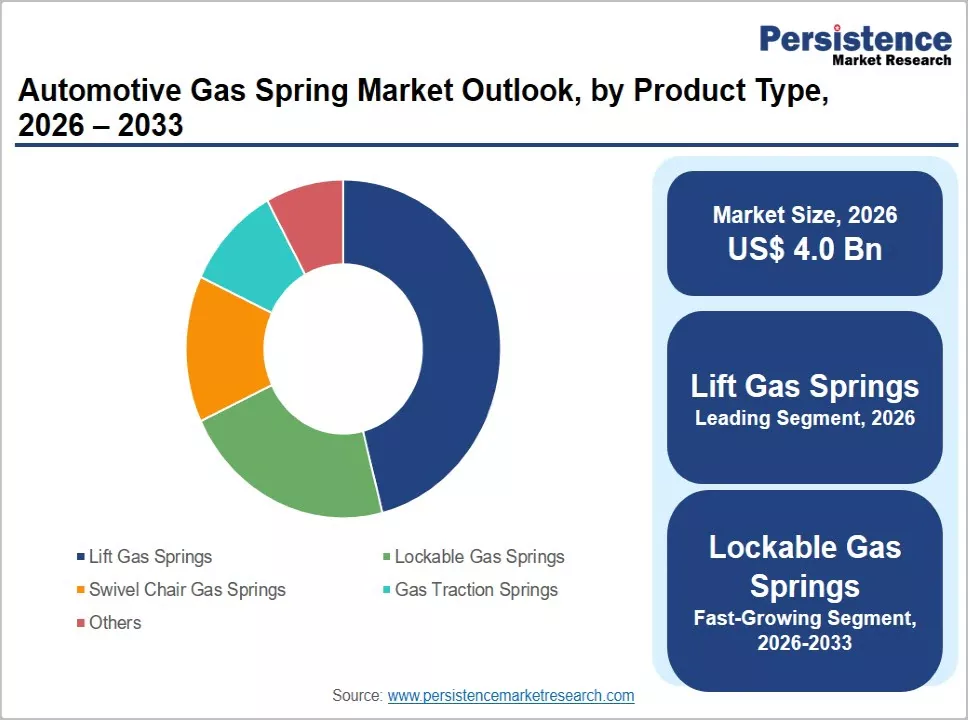
- Leading Product Type: Lift gas springs represent the leading product type, holding around 46% market share in 2026, driven by their widespread use in tailgates, trunk lids, and hoods.
- Fastest-Growing Product Type: Lockable gas springs are projected to be the fastest-growing segment, driven by safety requirements in commercial and specialty vehicles.
- Leading Vehicle Type: Passenger cars are estimated to hold around 64% market share in 2026, driven by high production volumes and multiple closure applications.
- Fastest-Growing Vehicle Type: Commercial vehicles are projected to be the fastest-growing segment, driven by logistics expansion and higher fleet utilization.
- Leading Distribution Channel: OEMs are likely to account for around 71% of market revenue in 2026, driven by design-in requirements during vehicle platform development.
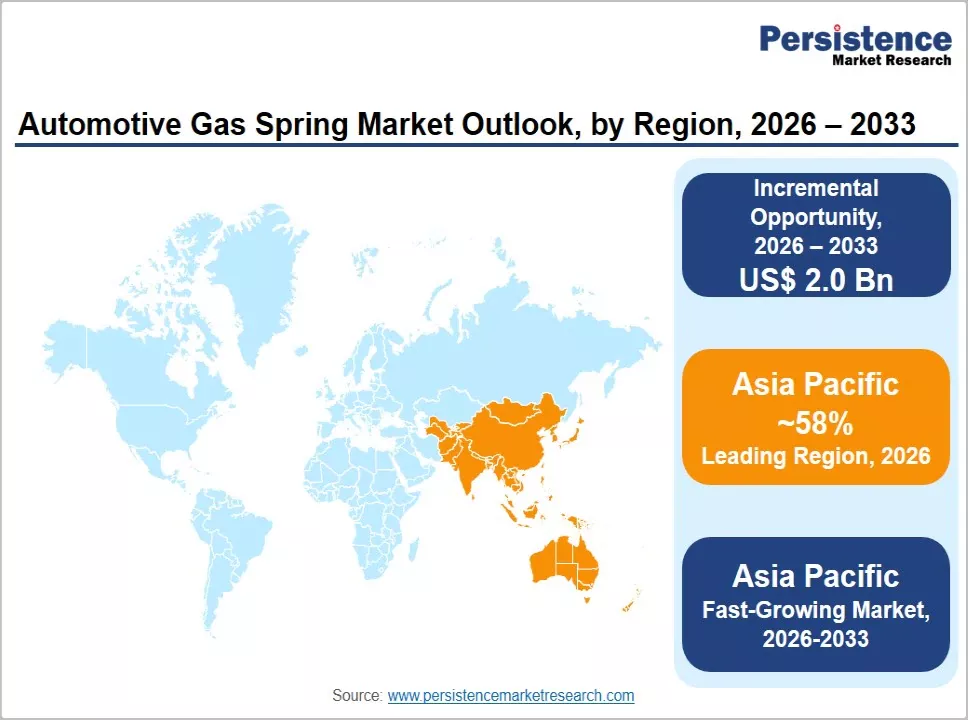
- Regional Leadership: Asia Pacific is projected to capture around 58% of market share in 2026, driven by concentrated vehicle manufacturing and expanding EV platforms.
- Innovation Trends: Suppliers are prioritizing EV frunk applications, low-noise closure control, corrosion resistance, and predictive aftermarket replacement programs.
Market Dynamics
Driver - Electrification, Safety Regulation, and Convenience-Led Design
Regulatory pressure is reshaping vehicle architectures and component requirements. The U.S. Environmental Protection Agency finalized multi-pollutant standards for light-duty and medium-duty vehicles beginning with model year 2027, with implementation extending through model year 2032. These requirements encourage manufacturers to adopt efficiency-oriented designs, durable lightweight components, and systems suited to electrified platforms. Gas springs support these objectives by providing controlled motion through comparatively simple mechanical energy storage, reducing reliance on powered actuators in selected applications.
Electrification is expanding functional requirements. Battery-electric vehicles often feature front trunks, revised tailgate geometries, and underbody service panels, creating new closure-assist applications. In the European Union, battery-electric cars reached 17.4% of new-car registrations in 2025, up from 13.6% in 2024. This shift increases the number of closure points per vehicle and strengthens demand for precise, low-noise, corrosion-resistant gas springs. Safety expectations also influence supplier selection. NHTSA reported 5,763,797 vehicles involved in recalls in its 2025 annual reporting context, reinforcing the importance of traceable, validated components and robust supplier quality systems.
Restraint - Price Pressure from Vehicle Manufacturers and Platform Consolidation
Automotive OEMs apply annual cost-reduction targets and multi-sourcing strategies to control bill-of-material costs. Gas spring suppliers face pressure to maintain performance while reducing weight, packaging size, and component count. This dynamic limits pricing power, particularly for standardized lift springs used across high-volume platforms.
Platform consolidation intensifies this pressure. When an OEM standardizes a closure design across regions, it can concentrate volume among one or two qualified suppliers while strengthening its bargaining power. Suppliers must absorb engineering, testing, and tooling costs while accepting lower unit prices, constraining margin expansion and slowing capacity investment.
Opportunity - Aftermarket Modernization and Predictive Replacement
The aftermarket offers a scalable expansion opportunity because gas springs are wear components with predictable replacement cycles. Distributors, fleet operators, and independent workshops can use vehicle age, mileage, climate exposure, and operating-cycle data to schedule replacements before failure. This reduces roadside incidents, protects cargo integrity, and improves customer satisfaction.
A practical approach involves catalog digitization, vehicle identification number (VIN)-based part matching, and fleet-service agreements. OEM-backed replacement programs can strengthen customer trust and reduce counterfeit risks, while certified distributors can expand coverage in emerging vehicle markets. Predictive replacement converts a transactional parts sale into recurring service revenue. Policy attention to vehicle safety and recall completion further supports this approach, as traceable replacement components and documented installation practices improve fleet compliance and reduce warranty exposure.
Category-wise Analysis
Which Product Type Leads the Market?
Lift gas springs are expected to lead the automotive gas spring market, accounting for 46% of revenue in 2026. These springs support tailgates, trunk lids, hoods, and rear doors, making them a standard fitment across passenger and commercial vehicle platforms. A typical sport utility vehicle uses lift gas springs to control tailgate opening and closing with consistent force. Their standardized geometry, established safety performance, and compatibility with manual and powered closure systems sustain OEM adoption. High production volumes and broad replacement demand are expected to reinforce their revenue position through 2033.
Lockable gas springs represent the fastest-growing product type segment, driven by demand for controlled positioning in commercial vehicles, specialty transport, and adjustable seating. These springs lock at defined positions, improving safety during loading, maintenance, and occupant adjustment. A delivery van with a lockable rear-door support, for example, can keep the door securely positioned during parcel handling. Growth is supported by rising safety expectations, accessibility requirements, and the need to prevent unintended movement in mobile work environments. Both OEM specifications and aftermarket upgrades are expected to support adoption.
Vehicle Type Insights
Passenger cars represent the leading segment, capturing around 64% of the market share in 2026. Passenger cars account for a large share of global vehicle production and use gas springs in tailgates, trunks, hoods, seats, and selected storage compartments. A compact electric car with a front trunk, for example, can require an additional closure-assist application compared with a conventional model. Rising comfort expectations, lightweight design programs, and electrification-driven body redesign are expected to sustain demand. The broad vehicle base also generates steady aftermarket replacement volumes across multiple regions.
Commercial vehicles are likely to be the fastest-growing segment, fueled by logistics expansion, last-mile delivery fleets, and higher utilization of vans, trucks, and buses. Commercial platforms require durable gas springs for cargo doors, driver seats, engine covers, and access panels. A refrigerated delivery van, for example, depends on reliable rear-door support during frequent loading cycles. Higher annual mileage accelerates replacement demand. Fleet operators increasingly favor certified components that reduce downtime, supporting OEM specifications and organized aftermarket distribution.
Distribution Channel Insights
OEMs are expected to lead the automotive gas spring market by holding around 71% share in 2026, owing to design-in requirements at the vehicle development stage. Gas springs are required to meet force, stroke, durability, temperature, and safety specifications before platform approval. A global automaker, for example, can qualify a supplier for a tailgate spring across several vehicle lines, creating multi-year volume visibility. OEM channels benefit from engineering collaboration, validation protocols, and long-term supply agreements. This structure supports stable revenue and encourages investment in automated assembly and testing.
The aftermarket segment is projected to register the fastest growth throughout the forecast period, fueled by an aging vehicle fleet, fleet maintenance programs, and demand for verified replacement components. Gas springs gradually lose force over time and can require replacement after repeated cycling or exposure to harsh climates. A fleet operator replacing tailgate springs before failure can avoid cargo delays and safety incidents. Digital catalogs, VIN-based part selection, and certified distribution networks improve availability. Growth is reinforced by commercial fleets seeking predictable maintenance costs and consumers seeking reliable repair options.
Regional Analysis
North America Automotive Gas Spring Market Trends
North America is anticipated to hold about 27% share of the global market in 2026, supported by large light-truck and sport utility vehicle production, established replacement-part infrastructure, and regulatory emphasis on vehicle efficiency. The U.S. Environmental Protection Agency finalized standards for light-duty and medium-duty vehicles beginning with model year 2027, with implementation extending through 2032. These rules encourage manufacturers to optimize vehicle mass, aerodynamics, and component durability. Gas springs support these objectives through controlled closure motion, reduced mechanical complexity, and compatibility with lightweight body structures.
U.S. Automotive Gas Spring Market Insights
The U.S. dominates the North American market by capturing nearly 88% share in 2026. Demand is supported by high vehicle ownership, extensive commercial fleets, and a developed repair ecosystem. NHTSA's recall reporting framework emphasizes traceability and completion tracking, increasing the value of documented, certified replacement components. Fleet operators in parcel delivery, utilities, rental services, and field operations depend on vans and trucks with frequent door and cargo-access cycles. This usage pattern accelerates gas spring wear and creates recurring demand.
Canada Automotive Gas Spring Market Insights
Canada is projected to hold around 12% share of the North American market in 2026, supported by integrated North American vehicle production, cold-climate operating conditions, and expanding logistics corridors. Low temperatures, road salt, and moisture increase corrosion and sealing challenges, raising the importance of coated rods, durable seals, and validated force retention. Gas springs used in tailgates, hoods, and commercial-vehicle doors require reliable performance across wide temperature ranges.
Europe Automotive Gas Spring Market Trends
Europe is expected to hold about 33% share of the market in 2026, driven by stringent emissions regulations, high vehicle-quality expectations, and rapid electrification. EU new-car registrations rose 1.8% in 2025, while battery-electric cars reached 17.4% of the market, up from 13.6% in 2024. This transition is changing closure-system requirements as manufacturers introduce frunks, redesigned tailgates, and lightweight body structures. Gas spring suppliers are expected to deliver low-noise operation, corrosion resistance, and precise force control to meet premium-vehicle requirements.
Germany Automotive Gas Spring Market Insights
Germany is projected to lead the European market, accounting for 26% of market share in 2026, fueled by its dense premium-vehicle manufacturing base, engineering supplier network, and export-oriented production. German automakers emphasize durability, acoustics, and precise motion control, creating demand for high-specification gas springs in tailgates, trunk lids, seats, and other closure systems. Stabilus, headquartered in Germany, identifies gas springs and dampers for tailgates, trunk lids, frunks, and side doors as core automotive applications. Expected growth is tied to electric-vehicle platform development, lightweight construction, and premium convenience features.
France Automotive Gas Spring Market Insights
France is anticipated to hold about 11% share of the European market in 2026, supported by domestic vehicle manufacturing, electrification incentives, and commercial-fleet renewal. French OEMs and tier suppliers are expected to increase the use of gas springs in compact vehicles, electric models, vans, and light commercial platforms. Growth in hybrid and battery-electric vehicles across Europe creates opportunities for suppliers capable of supporting new body architectures and closure designs. Urban delivery activity increases van utilization, accelerating wear in rear doors, cargo partitions, and driver seats.
Asia Pacific Automotive Gas Spring Market Trends
Asia Pacific is expected to dominate the global automotive gas spring market by capturing around 58% share in 2026. The region’s dominance is supported by concentrated vehicle manufacturing, large domestic demand, export-oriented supply chains, and expanding commercial-vehicle fleets. China, Japan, India, and South Korea host major vehicle and component production bases, creating proximity between gas spring suppliers and OEM assembly plants. This proximity shortens development cycles and lowers logistics costs. Electrification programs and infrastructure investment are expected to support new vehicle platforms with additional closure applications.
China Automotive Gas Spring Market Insights
China is expected to dominate the Asia Pacific market by commanding around 34% of regional market revenue in 2026, driven by its manufacturing scale, EV transition, and extensive commercial-vehicle base. Domestic automakers are introducing electric sedans, sport utility vehicles, and vans with revised closure systems, including front trunks and powered or assisted tailgates. This design shift increases gas spring content per vehicle in selected models. China's supplier base is likely to expand capacity in precision tube processing, robotic welding, gas charging, and force calibration to meet domestic and export requirements.
Japan Automotive Gas Spring Market Insights
Japan is estimated to hold nearly 12% share of the Asia Pacific market in 2026, supported by high OEM quality standards, strong export vehicle production, and a mature vehicle fleet. Japanese automakers emphasize reliability, compact packaging, and long service life, creating demand for gas springs with consistent force output and corrosion resistance. Suppliers are likely to focus on compact designs for limited engine-bay and trunk space, along with durable components for high-mileage vehicles. Japan's commercial and specialty-vehicle segments also require dependable door, seat, and equipment-access support.
Competitive Landscape
The global automotive gas spring market is moderately fragmented, with a small group of global motion-control specialists operating alongside regional manufacturers and OEM-affiliated suppliers. Scale advantages arise from automated manufacturing, gas-charging precision, validation capability, and global logistics networks. Stabilus, Suspa, Bansbach Easylift, ACE Gas Springs, and Lesjöfors are prominent participants with automotive and industrial motion-control capabilities.
Competition centers on OEM design-in positions, durability validation, cost efficiency, and aftermarket coverage. Regional suppliers compete through proximity, customization, and responsive service. Global suppliers compete through platform scale, engineering support, and multi-region manufacturing. Supplier selection is likely to depend on quality consistency, traceability, and ability to support electrified vehicle platforms.
Key Industry Developments
- In May 2026, Turkas Gas Springs announced its Power Liftgate product offering ahead of Automechanika Istanbul, held from May 19-22, 2026. The company showcased the new solution alongside its existing gas springs, locking systems, heavy-vehicle cab dampers, and industrial damping products. The announcement expanded its product portfolio into powered liftgate applications, supporting growing demand for automated vehicle access and enhanced convenience in the automotive aftermarket.
Companies Covered in Automotive Gas Spring Market
- Stabilus GmbH
- Suspa GmbH
- Bansbach Easylift GmbH
- Hahn Gasfedern GmbH
- ACE Controls Inc.
- Camloc Motion Control Ltd.
- Dictator Technik GmbH
- Industrial Gas Springs Ltd.
- Lant Inc.
- AVM Industries LLC
Frequently Asked Questions
The automotive gas spring market is projected to reach US$ 4.0 billion in 2026.
The market is driven by rising global vehicle production, electrification-led closure and frunk applications, safety and convenience requirements, and expanding commercial-fleet utilization.
The market is poised to grow at a CAGR of 5.9% from 2026 to 2033.
Key market opportunities include EV-specific frunk and tailgate applications, lightweight and corrosion-resistant product innovation, predictive aftermarket replacement programs, and expansion across commercial-vehicle and logistics fleets.
Some of the key market players include Stabilus GmbH, Suspa GmbH, Bansbach Easylift GmbH, Hahn Gasfedern GmbH, ACE Controls Inc., and Camloc Motion Control Ltd.


