




- Automotive Components & Materials
- Automotive Camshaft Pushrod Market
Automotive Camshaft Pushrod Market Size, Share, and Growth Forecast, 2026 - 2033
Automotive Camshaft Pushrod Market by Product Type (Hydraulic Pushrods, Solid Pushrods, Roller Pushrods), Vehicle Type (Passenger Cars, Light Commercial Vehicles, Heavy Commercial Vehicles), and Regional Analysis for 2026 - 2033

Automotive Camshaft Pushrod Market Size and Trends Analysis
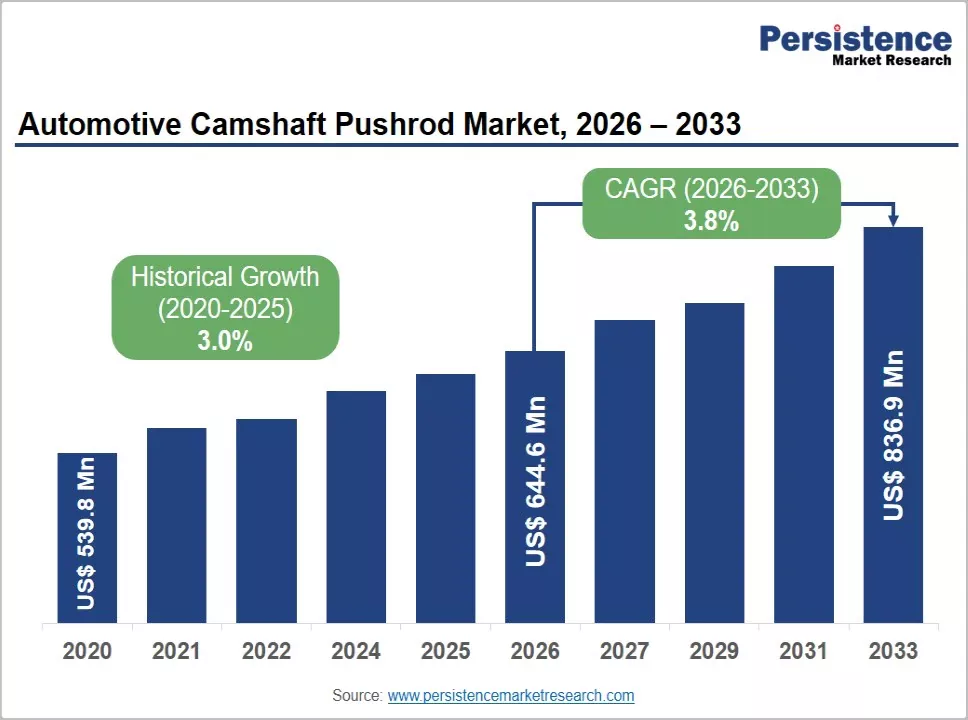
The global automotive camshaft pushrod market size is likely to be valued at US$644.6 million in 2026 and is expected to reach US$836.9 million by 2033, growing at a CAGR of 3.8% during the forecast period from 2026 to 2033, driven by continued demand for internal-combustion engine components across passenger cars, light commercial vehicles, and heavy commercial vehicles, particularly in regions where conventional powertrains remain widely deployed. The expanding vehicle aftermarket is driven by older vehicles remaining in service for longer periods.
Key Industry Highlights:
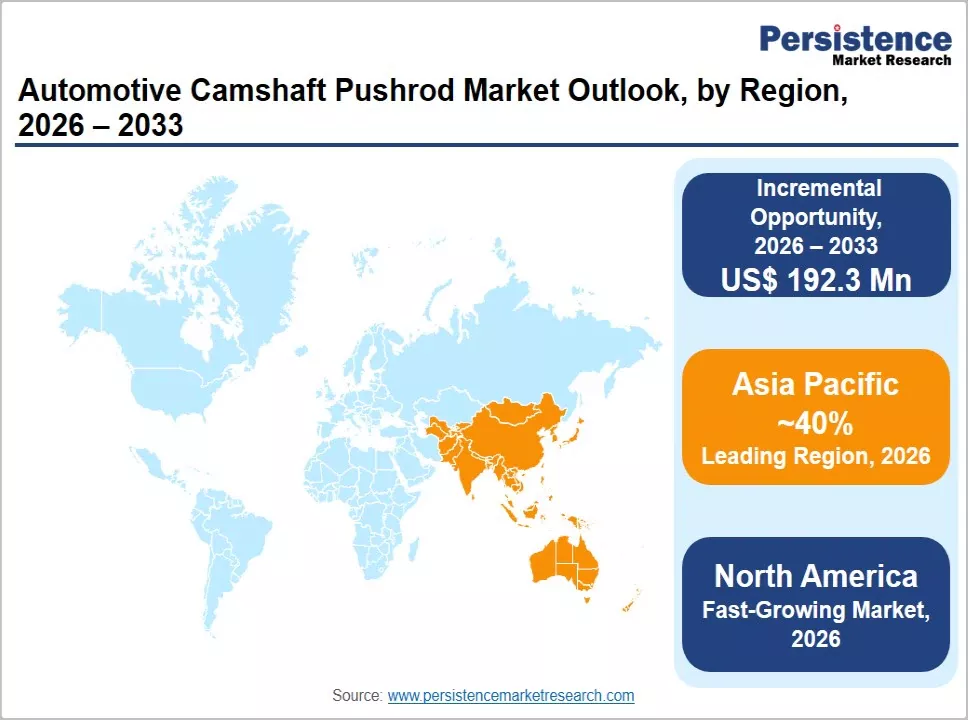
- Leading Region: Asia Pacific is anticipated to be the leading region, accounting for a market share of 40% in 2026, driven by high vehicle production, commercial-vehicle demand, localized manufacturing, and expanding aftermarket activity.
- Fastest-growing Region: North America is likely to be the fastest-growing region, supported by pushrod engine applications in trucks, performance vehicles, and the automotive aftermarket.
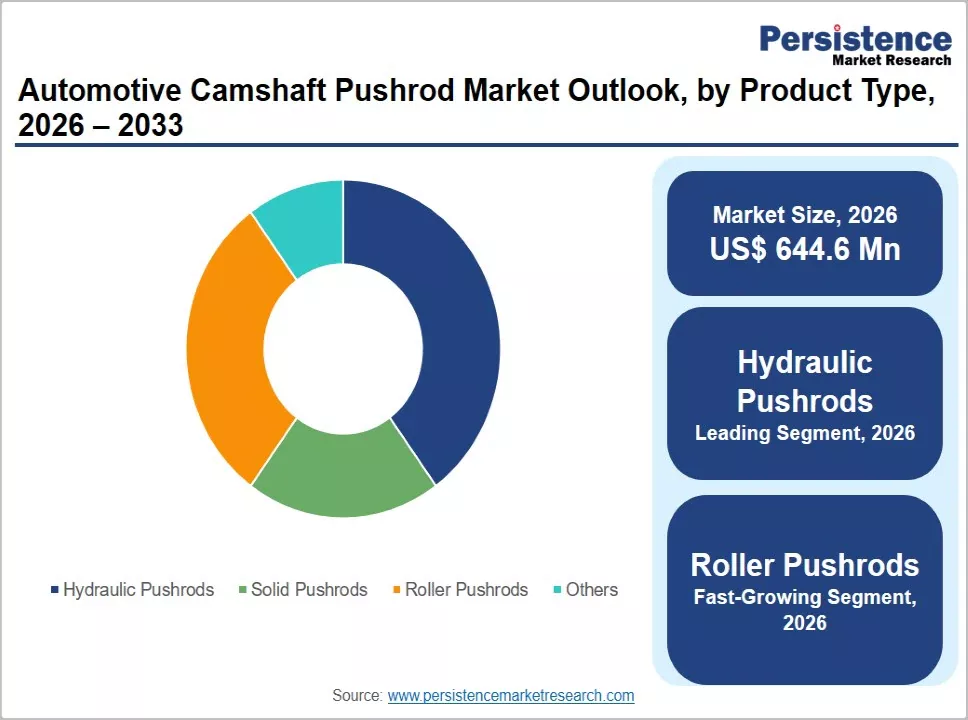
- Leading Product Type: Hydraulic pushrods are projected to represent the leading product type in 2026, accounting for 42% of the revenue share, for self-adjusting operation and broad OEM and aftermarket applications.
- Leading Vehicle Type: Passenger cars are anticipated to be the leading vehicle type, accounting for over 48% of the revenue share in 2026, supported by established pushrod engine applications across SUVs, sedans, and performance vehicles.
- Key Opportunity: Growing hybrid powertrains, lightweight and precision-engineered valvetrain technologies, expanding vehicle production, and replacement demand create opportunities for advanced automotive camshaft pushrod solutions.
DRO Analysis
Driver - Sustained Production of Pushrod-Equipped Light-Duty Trucks and Passenger Vehicles
Sustained production of pushrod-equipped light-duty trucks and selected passenger vehicles remains a key driver for the automotive camshaft pushrod Market. Pushrod valvetrains continue to serve applications where compact engine packaging, straightforward mechanical design, durability, and established manufacturing processes are valued. Demand is particularly relevant in truck-oriented powertrains and performance-focused vehicles that retain conventional internal-combustion engines.
Continued vehicle production generates original-equipment requirements for hydraulic, solid, and roller pushrods across different engine configurations. Replacement needs from vehicles already in operation support recurring component demand. These factors help maintain production volumes despite broader changes in powertrain technologies across major automotive markets.
The driver is reinforced by continued investment in internal-combustion engine refinement, where manufacturers and component suppliers focus on durability, friction management, weight reduction, and precise valvetrain operation. Hydraulic pushrods remain suitable for applications emphasizing reduced maintenance, while roller and solid designs address performance-oriented requirements. Commercial vehicles can also support demand because operators prioritize reliability and serviceability over rapid adoption of emerging propulsion architectures.
Restraint - Long-Term Shift toward Battery-Electric and Cam-Less Architectures
Battery-electric powertrains eliminate conventional engine valvetrain requirements, directly reducing potential demand for pushrods in new vehicles. As automakers expand electric platforms, engineering resources and capital are increasingly directed toward electric motors, batteries, power electronics, and software-defined vehicle systems. Meanwhile, cam-less or advanced valvetrain technologies can reduce reliance on traditional mechanical components in applicable internal-combustion engines. These technology transitions gradually narrow the pool of new vehicle applications available to pushrod suppliers, particularly in passenger cars.
Electrification is not expected to eliminate near-term replacement demand, as the large installed base of internal-combustion vehicles will continue to require maintenance throughout their service life. However, declining production of pushrod-equipped passenger vehicles may constrain future original-equipment opportunities and intensify competition among suppliers serving existing platforms. Manufacturers may therefore need to diversify into other engine components, performance products, and adjacent automotive systems while improving production efficiency across established pushrod programs.
Opportunity - Aftermarket Acceleration and Digital Direct-to-Consumer Channels
Aftermarket acceleration and digital direct-to-consumer channels create opportunities for pushrod manufacturers to reach vehicle owners, repair shops, engine builders, and performance enthusiasts more efficiently. Aging internal-combustion vehicle fleets can generate recurring replacement demand for worn or damaged valvetrain components, while engine rebuilding and restoration activities support specialized products. Online catalogs, vehicle compatibility tools, technical content, and direct ordering can broaden customer access beyond traditional distributor networks.
Digital channels also allow suppliers to present differentiated hydraulic, solid, and roller pushrods according to engine specifications, application requirements, and performance objectives. This can improve product visibility, shorten purchasing cycles, and support aftermarket expansion across geographically dispersed customer bases. The opportunity is strengthened by growing interest in customization, restoration, motorsports, and performance-oriented engine builds, where customers often require application-specific dimensions, materials, and valvetrain characteristics.
Manufacturers can use digital platforms to provide detailed specifications, installation guidance, compatibility information, and responsive technical support, helping reduce selection errors. Direct-to-consumer models can also generate useful demand insights that support inventory planning and product development for specialized pushrod variants. Partnerships with engine builders, repair networks, automotive communities, and online marketplaces can expand reach while maintaining brand visibility.
Category-wise Analysis
Product Type Insights
Hydraulic pushrods are expected to lead, accounting for 42% of revenue in 2026, due to their self-adjusting operation, compatibility, and broad use across conventional internal-combustion engines. They reduce the need for frequent valve-lash adjustments, making them suitable for passenger vehicles, light trucks, and replacement applications where consistent valvetrain operation is important. Their manufacturing base and availability through original-equipment and aftermarket channels further support demand.
Roller pushrods are likely to represent the fastest-growing segment, supported by demand for performance-oriented valvetrains, reduced friction, improved stability, and higher engine-speed capability. Their suitability for upgraded engines makes them attractive in motorsports, enthusiast vehicles, engine rebuilding, and specialized performance applications. Roller-based valvetrain systems can support aggressive camshaft profiles while maintaining controlled component movement, strengthening demand among performance-focused users.
Vehicle Type Insights
Passenger cars are projected to lead the market, capturing around 48% of the revenue share in 2026, supported by the installed base of conventional internal-combustion vehicles and continued demand for pushrod-based applications in selected sedans, coupes, SUVs, and performance models. Pushrod systems remain relevant where compact valvetrain packaging, durability, and established engine architectures provide practical advantages. Replacement activity also supports passenger-car demand because older vehicles require continued maintenance and component servicing throughout their operating lives.
Light commercial vehicles are likely to be the fastest-growing vehicle type, due to demand for durable and serviceable powertrains across pickups, vans, utility vehicles, and fleet applications. Operators often prioritize dependable engine operation, manageable maintenance, and established component availability, supporting demand for pushrod valvetrain parts in applicable internal-combustion platforms. Expanding commercial activity and replacement requirements can further increase aftermarket opportunities as vehicles remain in service for extended operating cycles.
Regional Insights
North America Automotive Camshaft Pushrod Market Trends
North America is likely to be the fastest-growing region, supported by continued production of gasoline and hybrid powertrains, particularly in pickup trucks, SUVs, and performance vehicles. Demand is also sustained by replacement and performance-engine markets. Eaton supplies valvetrain technologies for both overhead camshaft and overhead valve engines, including rocker arms, roller rocker arms, hydraulic lifters, and lash adjusters.
U.S. Automotive Camshaft Pushrod Market Trends
The U.S. is expected to dominate the regional market, accounting for approximately 80% of the market share in 2026. The U.S. maintains strong demand for pushrods through pickup trucks, SUVs, performance vehicles, and aftermarket engines. Domestic engine production continues to support valvetrain component demand. General Motors is preparing sixth-generation V-8 production at U.S. propulsion plants. Performance-engine applications also sustain camshaft and pushrod demand.
Canada Automotive Camshaft Pushrod Market Trends
Canada is likely to remain a significant market, accounting for approximately 20% of the regional market in 2026. The country is strengthening its engine manufacturing capabilities, supported by General Motors’ St. Catharines plant, which is involved in sixth-generation V-8 production for truck and SUV applications. This investment is expected to support demand for engine and valvetrain components in Canada.
Europe Automotive Camshaft Pushrod Market Trends
Europe is likely to be a significant market for automotive camshaft pushrods, due to demand for efficient combustion and hybrid engines, performance vehicles, commercial powertrains, and replacement components. Manufacturers are increasingly focusing on low-friction and precision-engineered valvetrain technologies. Schaeffler reported in August 2026 that its German facilities had produced eight billion finger followers and 160 million roller tappets, highlighting continued expertise in engine valvetrain components.
U.K. Automotive Camshaft Pushrod Market Trends
The U.K. is expected to remain a significant market for automotive camshaft pushrods, accounting for 15% of the European market in 2026. BMW’s ongoing technical development activities related to high-performance engines and vehicles are expected to support demand for specialized valvetrain components. The country’s strong motorsport and performance-engine applications will further sustain market opportunities, while hybrid powertrain development is set to create additional requirements for optimized engine components. These developments are expected to support continued demand for advanced camshaft and pushrod systems in the U.K.
Germany Automotive Camshaft Pushrod Market Trends
Germany is anticipated to dominate the regional market, accounting for around 37% of the Europe market share in 2026. Germany remains an important center for automotive engine engineering and precision components. Schaeffler continues producing advanced valvetrain components for efficient combustion and hybrid powertrains. Rolls-Royce Power Systems is also investing tens of millions of euros in new engine test benches in Friedrichshafen.
Asia Pacific Automotive Camshaft Pushrod Market Trends
The Asia Pacific region is anticipated to be the leading region, accounting for a market share of 40% in 2026. Its large-scale vehicle production, expanding engine manufacturing, hybridization, and growing automotive component localization support regional demand. India is attracting additional camshaft programs as manufacturers diversify supply chains. Precision Camshafts Limited has stated that it is investing in a greenfield facility for assembled camshafts and has benefited from programs being resourced from China to India.
China Automotive Camshaft Pushrod Market Trends
China is projected to dominate the regional market, holding around a 30% share of the market in 2026. China remains a major automotive manufacturing hub with substantial gasoline and hybrid engine production. Changan is expanding its automotive strategy around vehicles, components, and next-generation technologies. Hybrid and gasoline engines continue creating demand for advanced valve-timing and valvetrain components.
India Automotive Camshaft Pushrod Market Trends
India is expected to emerge as a significant market, accounting for approximately a 22% share in 2026. India is becoming increasingly important for localized camshaft manufacturing and engine-component sourcing. Precision Camshafts is expanding assembled-camshaft capacity through a new greenfield facility. The company has also benefited from sourcing programs moving from China to India. Engine demand from passenger vehicles, commercial vehicles, and hybrids supports component requirements.
Competitive Landscape
The global automotive camshaft pushrod market remains moderately fragmented, supported by demand for precision-engineered valvetrain components, fuel-efficient combustion systems, and durable powertrain technologies across passenger and commercial vehicles. Leading participants are expanding their product portfolios through advancements in camshafts, rocker arms, hydraulic lifters, and variable valve actuation systems.
Eaton, Schaeffler, and thyssenkrupp Automotive Technology are among the key players. The competitive landscape includes established global suppliers and specialized engine-component manufacturers competing on product precision, lightweight construction, friction reduction, thermal management, durability, and customized solutions for different engine architectures.
Key Industry Developments:
- In September 2026, General Motors introduced two new pushrod Small Block V8 engines for the 2027 GMC Sierra 1500, including a 5.7-liter engine producing 402 hp and a 6.6-liter engine delivering 481 hp and 501 lb-ft of torque.
Companies Covered in Automotive Camshaft Pushrod Market
- Comp Cams, Elgin Industries
- Melling Engine Parts
- Precision Camshafts Limited
- Edelbrock LLC
- Smith Brothers Pushrods
- Trend Performance
- Crower Cams & Equipment Co., Inc.
- Lunati Cams
- Ferrea Racing Components
- Howards Cams
- Johnson Lifters
Frequently Asked Questions
The global automotive camshaft pushrod market is projected to reach US$644.6 million in 2026.
Rising vehicle production, demand for high-performance engines, replacement components, and advanced low-friction valvetrain systems drive market growth.
The automotive camshaft pushrod market is expected to grow at a CAGR of 3.8% from 2026 to 2033.
Growing hybrid powertrains, engine-component localization, lightweight valvetrain technologies, and aftermarket demand create opportunities for camshaft pushrod manufacturers.
Comp Cams, Elgin Industries, Melling Engine Parts, Precision Camshafts Limited, and Edelbrock LLC are the leading players.


