




- Biotechnology
- Automated Sample Storage Systems Market
Automated Sample Storage Systems Market Size, Share, and Growth Forecast 2026 - 2033
Automated Sample Storage Systems Market by Product Type (Automated Compound Storage System, Automated Liquid Handling Systems), Sample (Biological, Compound Samples), End-user, and Regional Analysis, 2026 - 2033

Automated Sample Storage Systems Market Size and Trends Analysis
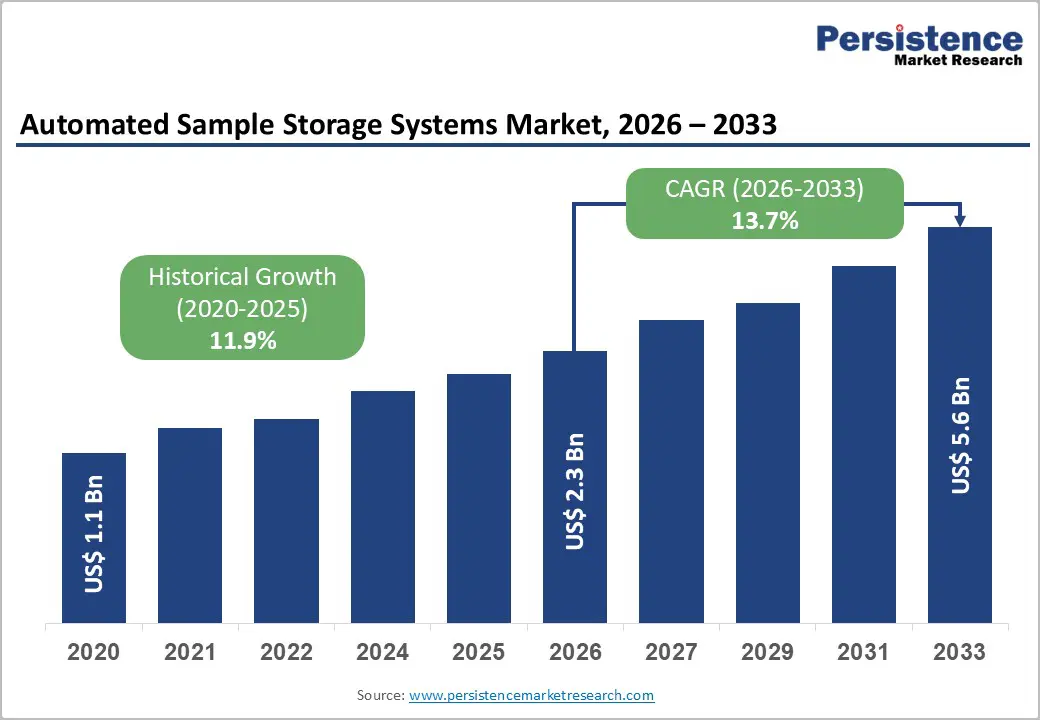
The global automated sample storage systems market size is likely to be valued at US$2.3 billion in 2026 and is expected to reach US$5.6 billion by 2033, growing at a CAGR of 13.7% during the forecast period from 2026 to 2033, driven by the ongoing expansion of biobanking and genomics programs that require long-term and high-integrity sample preservation.
Increasing adoption of laboratory automation in drug discovery and clinical research is further fueling demand for error-free and high-throughput storage solutions.
Key Industry Highlights:
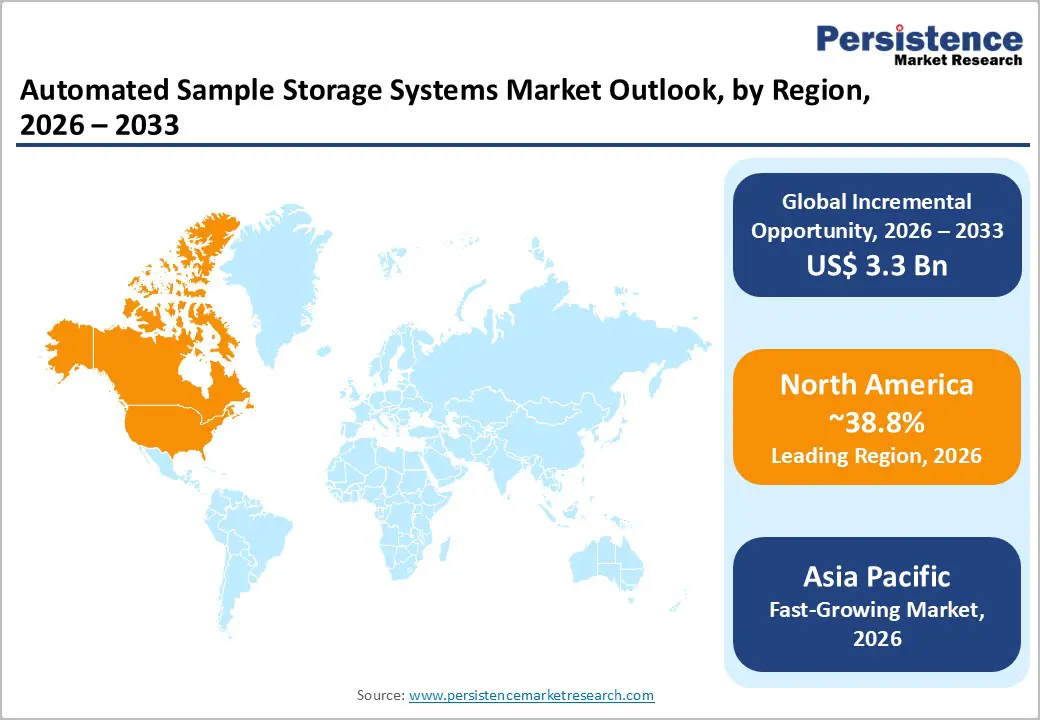
- Leading Region: North America, with about 38.8% share in 2026, owing to its large-scale biobanking infrastructure and early adoption of laboratory automation systems.
- Fast-growing Region: Asia Pacific, backed by rising government investments in biotechnology and expanding clinical research activity.
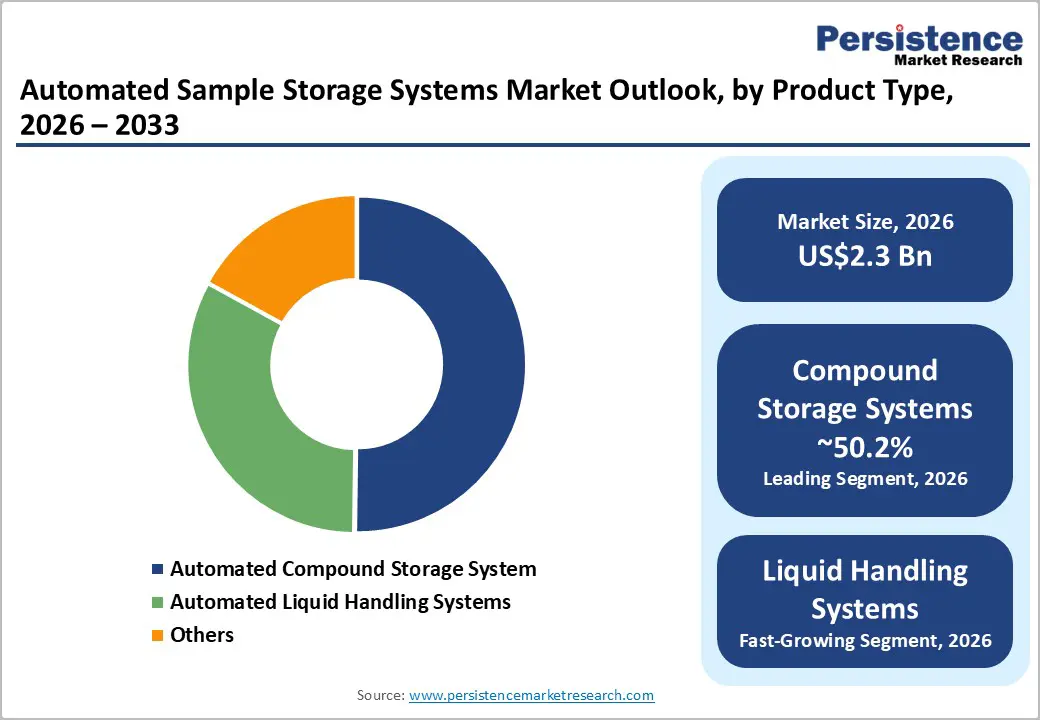
- Leading Product Type: Automated compound storage systems, approximately 50.2% share in 2026, as pharmaceutical companies manage massive compound libraries that require precise, high-density, and temperature-controlled storage.
- Dominant Sample: Compound samples, with a nearly 65.7% share in 2026, as they are central to drug discovery pipelines and are extensively used in screening and lead identification processes.
- New Product: At the Society for Laboratory Automation and Screening (SLAS) international event in February 2025, Azenta launched the BioArc Ultra. It is a new high-density and energy-efficient -80°C automated sample storage system capable of holding over 16,000 samples.
DRO Analysis
Driver - Rising Sample Throughput across Research Programs
Large-scale research initiatives are generating sample volumes that simply cannot be managed manually. The U.K. Biobank alone stores 15 million biological samples, including blood, urine, and saliva, in automated archives, with whole genome sequencing data now available for all 500,000 participants. Similarly, government-funded programs such as the National Institutes of Health (NIH) All of Us Research Program and Genome India are pushing significant growth in sample volumes.
It is further augmenting demand for expandable automated storage systems in laboratories. Drug discovery workflows add to this burden further, with high-throughput screening requiring thousands of compound samples to be retrieved, tracked, and processed daily. Manual handling at this scale is slow, error-prone, and labor-intensive, thereby making automation not a luxury, but a necessity.
Need to Protect Sample Quality through Stable Storage Conditions
Manual freezers are a bigger threat to sample integrity than many labs realize. When researchers work in batches, samples processed earlier are exposed to room-temperature environments longer, causing unequal degradation compared to those handled later. The science confirms the damage. A 2025 systematic review in PeerJ synthesizing 46 studies found that non-refrigerated samples showed 3.2 times more biomarker alterations than refrigerated samples after delays exceeding 24 hours.
More than 10 freeze-thaw cycles triggered severe degradation in 70% of biomarkers. Automated systems address this by eliminating unnecessary door openings and maintaining consistent internal temperatures. This helps in reducing pre-analytical variability that can compromise downstream research.
Restraint - Vulnerability to Cascading System Failures
A single malfunction in a centralized automated storage system can put an entire sample collection at risk. This is not a theoretical concern. An estimated 34,400 biobank samples were destroyed at the Karolinska Institutet in Sweden over Christmas 2023 when temperatures rose unnoticed across 16 cryogenic tanks, a loss representing decades of research material. The freezer in question was monitored by two separate alarms and an external temperature display, yet the facility still failed to detect the problem in time.
This illustrates that even multi-layered alert systems can miss a cascade of compounding failures. As per an article from XiltriX, compounding the problem, 76% of equipment failures statistically occur outside regular working hours, leaving labs with limited capacity to respond. For facilities housing irreplaceable specimens, this concentration of risk in one system remains a serious operational concern.
Opportunity - Shrinking Sample Access Times Through Speed-Optimized Retrieval
Fast retrieval is no longer just a convenience, but it is becoming a competitive differentiator. Vendors such as ASKION have engineered systems that deliver individual samples in under 30 seconds, while full rack retrieval can be completed in under 10 minutes using integrated pneumatics and routing carousels. This matters most in high-throughput drug discovery, where delays in compound access can stall screening pipelines.
In 2025, Azenta Life Sciences extended its automated storage capabilities to support large-scale clinical research collections, while the Mayo Clinic upgraded its robotic cryostorage systems to boost genomic clinical trials and oncology research. Both prioritize retrieval speed as a key operational requirement. As labs push toward fully walkaway workflows, the ability to access samples quickly without manual intervention is emerging as a primary selection criterion.
Next-Generation Hardware to Enable Safe and Smart Storage
Hardware innovation is making automated systems resilient and more deeply integrated into lab workflows. Hamilton's Verso platform features fully redundant refrigeration modules that maintain continuous operation even when a primary component fails, helping protect long-term storage conditions during unexpected hardware issues. The system also supports integration with Autonomous Mobile Robots (AMRs) for location-independent sample movement across rooms or floors.
On the incubator side, Thermo Fisher Scientific introduced a patent-pending automated door control in its Heracell VIOS AxD CO2 Incubator. It opens automatically when integrated into a centralized lab automation platform, enabling vessel loading and unloading through robotic control and supporting continuous cell therapy production. These hardware advances are reducing the manual touchpoints that compromise both sample integrity and throughput.
Category-wise Analysis
Product Type Insights
Automated compound storage systems are predicted to lead with a share of approximately 50.2% in 2026, as they address one of the key challenges in pharmaceutical research, i.e., managing and preserving millions of chemical compounds used in drug discovery. Large pharmaceutical companies and Contract Research Organizations (CROs) maintain vast compound libraries that must remain stable for years while being readily accessible for screening campaigns. Manual storage creates risks of sample degradation, contamination, and tracking errors. Automated systems solve these problems by controlling temperature, humidity, and retrieval processes with minimal human intervention.
Automated liquid handling systems are estimated to be the fastest-growing segment over the forecast period, as nearly every laboratory workflow involves liquid transfer. Drug screening, genomics, proteomics, PCR testing, cell culture preparation, and biomarker analysis all require precise dispensing of liquids. Even small pipetting errors can affect experimental outcomes, making automation highly valuable. A key advantage is accuracy and reproducibility. Automated systems can perform thousands of liquid transfers with consistent volumes and minimal variation. This is especially important in high-throughput screening programs where researchers evaluate thousands of compounds against biological targets.
Sample Insights
Compound samples are anticipated to dominate with a share of nearly 65.7% in 2026, as they form the foundation of modern drug discovery. Before a new medicine reaches clinical testing, researchers must screen large numbers of chemical compounds to identify molecules with therapeutic potential. Every screening campaign relies on access to well-characterized compound libraries. Another driver is the rise of structure-based drug design and virtual screening. Scientists now rely on large compound databases to identify promising molecules before laboratory testing begins. The availability of extensive compound libraries has become a competitive advantage for pharmaceutical firms.
Biological samples are expected to remain in the second position in 2026, as precision medicine, genomics, and biomarker research are becoming central to healthcare innovation. Unlike traditional drug discovery, which focuses primarily on chemical compounds, modern research depends on blood, tissue, DNA, RNA, stem cells, and other biological materials. These samples are important for understanding disease mechanisms and developing targeted therapies. Large-scale biobanking initiatives are a key growth driver. Governments, healthcare systems, and research organizations are building extensive biological sample repositories to support population health studies.
Regional Insights
North America Automated Sample Storage Systems Market Trends
North America is predicted to dominate in 2026 with a share of approximately 38.8%, as it has the world's most advanced pharmaceutical research & development infrastructure, large biobanking networks, and widespread adoption of laboratory automation. The region is home to leading industry players such as Thermo Fisher Scientific, Azenta Life Sciences, Hamilton, and Beckman Coulter, which boost technology deployment across research institutions and drug developers. Another important factor is the strong presence of large-scale genomics and precision medicine programs.
U.S. Automated Sample Storage Systems Market Trends
A share of nearly 67.4% is expected to be held by the U.S. in 2026 as it combines pharmaceutical innovation, government-funded biomedical research, and expanding precision medicine initiatives. Large research programs generate enormous volumes of biological samples that require secure and automated storage and retrieval systems. The country's growing cell and gene therapy sector is another driver. These therapies depend on strict chain-of-custody management and ultra-low-temperature storage. As more advanced therapies enter clinical development, laboratories are now replacing manual storage methods with automated platforms.
Asia Pacific Automated Sample Storage Systems Market Trends
Asia Pacific is anticipated to be the fastest-growing region in 2026 with a share of nearly 33.6%, as governments across the region are investing in biotechnology, genomics, pharmaceutical manufacturing, and healthcare research infrastructure. Several countries are building new research centers and biobanks from the ground up, creating high demand for modern automated storage technologies. The region is also becoming a prominent hub for drug discovery and clinical trials. Pharmaceutical companies are expanding their research & development operations in Asia Pacific due to the availability of skilled researchers, rising patient populations, and supportive government policies.
China Automated Sample Storage Systems Market Trends
China will likely lead Asia Pacific in 2026 with a share of around 34.2%, as it is benefiting from substantial government support for biotechnology and genomic research. The country has invested heavily in large-scale genomics programs, biobanks, and precision medicine initiatives. These projects require advanced systems capable of storing and retrieving millions of biological samples accurately. China's pharmaceutical industry is also moving from generic drug production toward innovative drug discovery. This shift is increasing the demand for compound libraries, biological repositories, and automated sample management platforms. Research organizations are handling larger and more complex sample collections than ever before.
India Automated Sample Storage Systems Market Trends
In 2026, India is projected to account for a share of approximately 19.6%, owing to increasing investments in biotechnology research, vaccine development, and genomic medicine. The country's research network has expanded significantly following large-scale healthcare and life sciences initiatives launched in recent years. Government programs focused on genomics and precision healthcare are encouraging institutions to build modern sample repositories. As research organizations generate large datasets and sample collections, automated storage systems are becoming essential for maintaining sample quality and accessibility.
Europe Automated Sample Storage Systems Market Trends
Europe will likely see decent growth over the forecast period, with a share of nearly 13.8% in 2026, backed by its well-established biotechnology sector, extensive biobanking networks, and continuous investment in medical research. Many countries have established national biobanks and collaborative research programs that depend on reliable sample preservation and management systems. The region also places significant emphasis on quality standards, sample traceability, and regulatory compliance.
Automated storage systems help laboratories meet these requirements while improving operational efficiency. Hence, adoption continues to rise across pharmaceutical companies, academic institutions, and healthcare research organizations.
Germany Automated Sample Storage Systems Market Trends
Germany will likely register a substantial share of approximately 33.7% in 2026, spurred by its advanced pharmaceutical industry, world-class research institutions, and superior laboratory automation culture. The country hosts several biotechnology clusters and research centers that routinely manage large biological and chemical sample collections. Local organizations have been early adopters of Industry 4.0 technologies, and this mindset extends into laboratory automation. Research facilities now use robotic storage systems to improve sample integrity and workflow efficiency.
U.K. Automated Sample Storage Systems Market Trends
A share of around 20.1% is predicted to be held by the U.K. in 2026, as it possesses one of the world's most established biobanking hubs. Organizations such as the U.K. Biobank have become global resources for medical research, creating continuous demand for advanced sample storage technologies. The country is also investing heavily in genomics, AI-supported healthcare research, and precision medicine. These initiatives generate large volumes of biological samples that require secure and long-term preservation. Consequently, demand for automated sample storage systems is anticipated to remain decent throughout the forecast period.
Competitive Landscape
The global automated sample storage systems market is moderately consolidated, with a small group of multinational laboratory automation companies controlling a significant share of revenue. The competitive landscape is led by key companies such as Azenta Life Sciences, Thermo Fisher Scientific, Hamilton Company, SPT Labtech, LiCONiC AG, Haier Biomedical, and Beckman Coulter. These firms have established dominant positions through broad product portfolios, global service networks, and long-term relationships with pharmaceutical companies, biobanks, and research institutions.
Technology development has become the primary competitive weapon. Vendors are now integrating AI, predictive maintenance, RFID/barcode tracking, cloud connectivity, and Laboratory Information Management System (LIMS) compatibility into their platforms. Companies are focusing on minimizing sample exposure during retrieval, improving storage density, and ensuring complete audit trails to satisfy stringent regulatory requirements in pharmaceutical and clinical research environments.
Key Industry Developments:
- In July 2025, Hamilton Company announced the acquisition of UK Robotics and Trisonic Discovery. The acquisition also incorporated Trisonic Discovery's acoustic dispensing technologies, including the A1 Acoustic Dispenser, to complement Hamilton's existing liquid handling platforms.
- In February 2026, Cryoport, Inc. announced the launch of the MVE Fusion 800 Series, the next evolution of MVE Biological Solutions' patented Fusion technology. This self-sustaining cryogenic freezer eliminates the requirement for a continuous liquid nitrogen supply, delivering reliability, safety, and sustainability in a compact footprint.
- In March 2025, Cryoport, Inc. announced the launch of MVE Biological Solutions' High-Efficiency 800 C, the latest addition to its next-generation High-Efficiency Series of cryogenic freezers. The HE 800 C combines ergonomic features and consistent performance in a compact size to meet the evolving needs of fertility clinics, biorepositories, and clinical laboratories.
Companies Covered in Automated Sample Storage Systems Market
- Thermo Fisher Scientific, Inc.
- Beckman Coulter, Inc. (Danaher)
- Hamilton Company
- Azenta US, Inc.
- MEGAROBO
- SPT Labtech Ltd
- LiCONiC AG
- MICRONIC
- ASKION GmbH
- Haier Biomedical
Frequently Asked Questions
The global automated sample storage systems market is projected to be valued at US$2.3 billion in 2026.
Key market trends include the integration of AI in laboratory workflows and rising demand for ultra-low-temperature storage.
Automated compound storage systems are expected to be the leading product type with a share of nearly 50.2% in 2026, as they enable quick and error-free retrieval of samples.
The automated sample storage systems market is expected to grow at a CAGR of 13.7% from 2026 to 2033.
Thermo Fisher Scientific, Inc., Beckman Coulter, Inc. (Danaher), and Hamilton Company are a few key market players.


