




- Medical Devices
- Automated Medical Washer Disinfector Market
Automated Medical Washer Disinfector Market Size, Share, and Growth Forecast 2026 - 2033
Automated Medical Washer Disinfector Market by Product Type (Floor Standing, Benchtop), Capacity (Small, Medium, Large), Chamber Type (Single, Multi-chambers), by End User (Hospitals, ASCs), and Regional Analysis, 2026 - 2033

Automated Medical Washer Disinfector Market Size and Trends Analysis
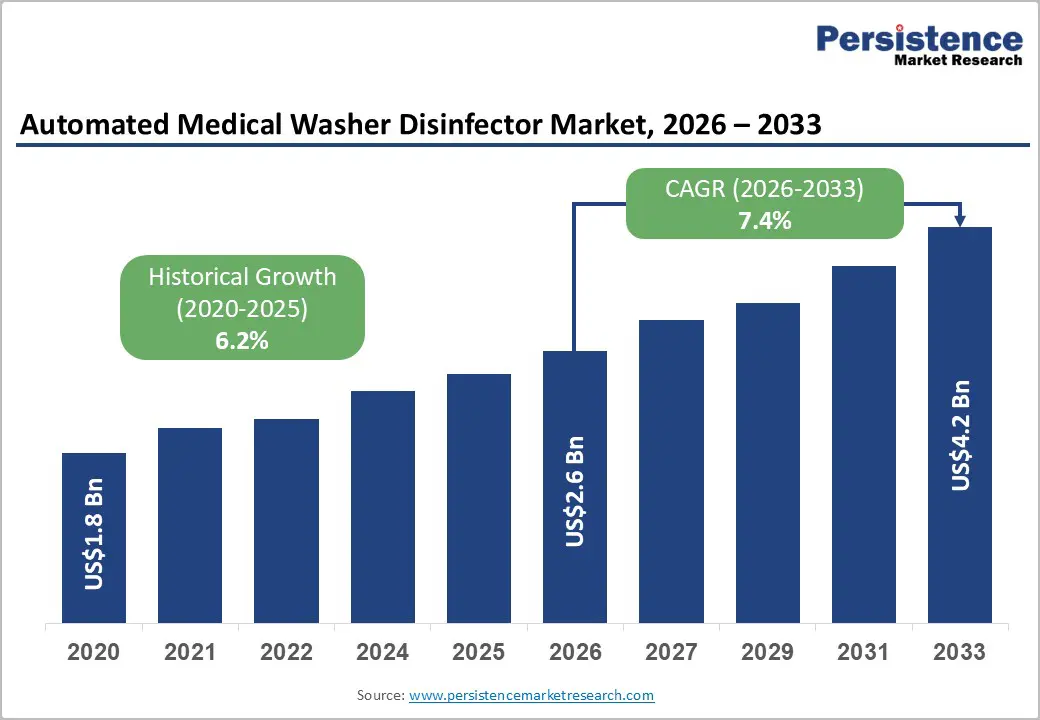
The global automated medical washer disinfector market size is likely to be valued at US$2.6 billion in 2026 and is expected to reach US$4.2 billion by 2033, growing at a CAGR of 7.4% during the forecast period from 2026 to 2033, driven by the rising volume of surgical and diagnostic procedures that require consistent instrument reprocessing across hospitals and outpatient settings.
Growth is further supported by strict infection prevention guidelines issued by government bodies, which emphasize validated and automated cleaning over manual methods.
Key Industry Highlights:
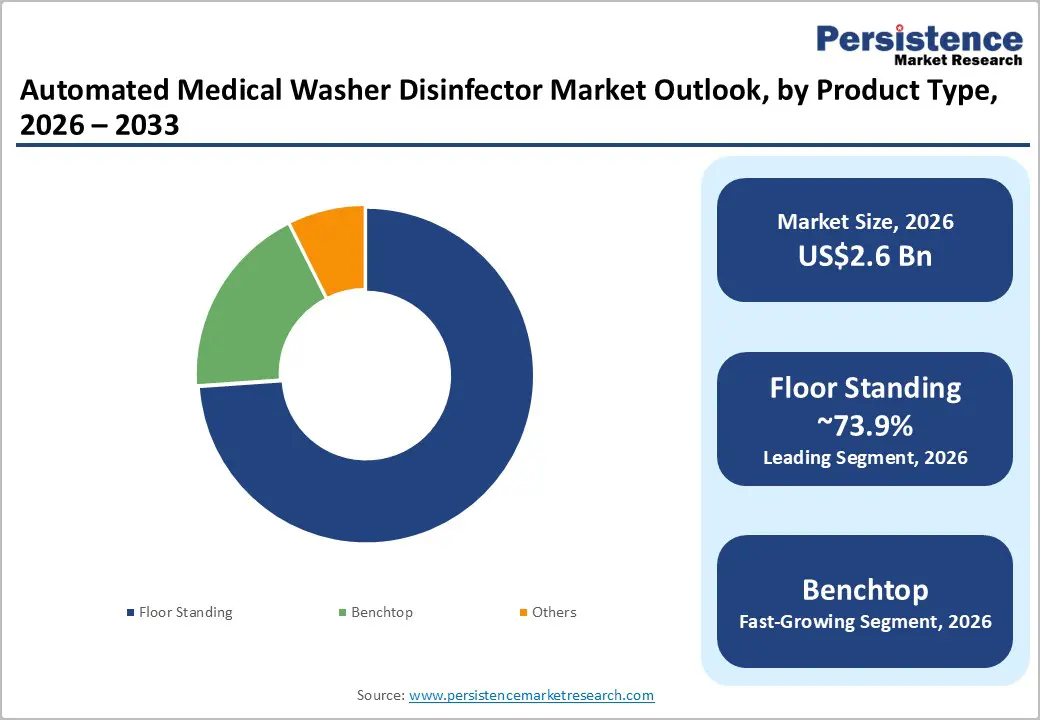
- Leading Product Type: Floor standing, approximately 73.9% share in 2026, as they deliver high-capacity processing required for bulk surgical instruments.
- Dominant End-user: Hospitals, with a nearly 45.6% share in 2026, as they support automation, conveyor integration, and continuous workflow in high-volume healthcare settings.
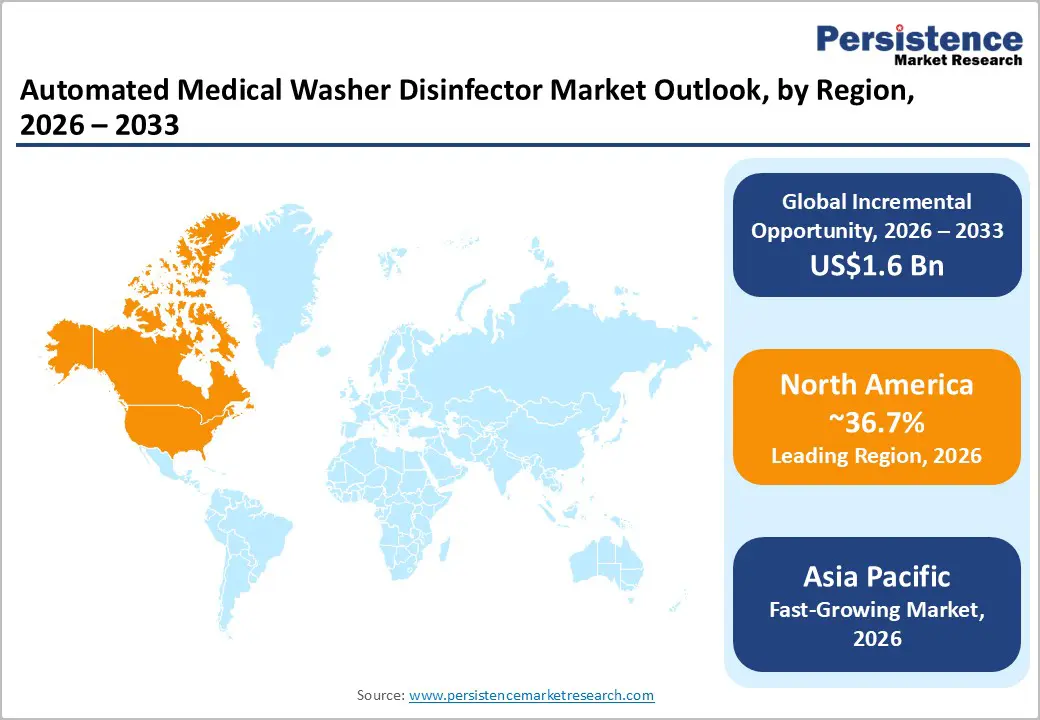
- Leading Region: North America, with about a 36.7% share in 2026, owing to strict infection-control regulations and the presence of multiple hospitals.
- Fast-growing Region: Asia Pacific, backed by rising surgical volumes and increasing adoption of automated reprocessing systems.
- Joint Venture: In September 2025, SteelcoBelimed entered into a strategic joint venture with iM Med in the U.K. to strengthen healthcare decontamination services. The partnership would help extend access to advanced reprocessing technologies and improve infection-prevention capabilities for healthcare providers.
DRO Analysis
Driver - Increasing Surgical Volumes
Surgical volumes have increased sharply, owing to an aging patient base and a high burden of chronic diseases. In Italy alone, total hip arthroplasty procedures rose by nearly 80% between 2001 and 2023, from about 68,000 to approximately 123,000 cases annually, according to a 2025 study published in the Journal of Orthopedics and Traumatology using Italy's National Hospital Discharge Record database.
In the U.S., the American College of Rheumatology reported in 2024 that over 1.3 million hip and knee replacement surgeries are performed each year, alongside hundreds of thousands of other elective and emergency procedures. This volume overwhelms manual reprocessing workflows. Central Sterile Supply Departments (CSSDs) simply cannot clean, inspect, and reassemble instruments fast enough between procedures without automated systems to maintain safe turnaround times. Owing to the aforementioned factors, the demand for automated medical washer disinfectors is estimated to skyrocket.
Strict Infection Control Standards
Regulatory pressure has made automated reprocessing less of an option and more of a requirement. The Joint Commission flagged sterilization and high-level disinfection as the single most frequently cited high-risk accreditation requirement in 2023, with the highest percentage of findings evaluated for immediate threat to health and safety.
In January 2024, The Joint Commission also introduced the Centralized Sterilization Services (CSS) Certification. It is a new two-year, on-site accreditation specifically designed for facilities that centralize or outsource their sterile processing operations. Automated washer disinfectors help hospitals meet these requirements by delivering cycle-validated and fully documented cleaning processes that are reproducible and auditable. These cannot be otherwise constantly achieved by manual methods.
Restraint - Long Processing Cycles May Create Operational Bottlenecks
Cycle time remains a key operational constraint for busy surgical departments. Standard washer disinfector cycles typically take between 30 and 60 minutes per batch. Even advanced single-chamber units such as the STERIS AMSCO 7052/7053HP, which can process instruments in as little as 16 minutes, are often lined up three to five machines deep in large facilities just to meet daily throughput demands.
The problem is most acute with high-value and low-inventory instrument sets such as endoscopes or robotic surgery tools, where hospitals may own only a few sets. Research published in 2024 found that Sterile Processing Department (SPD)-related delays can cost a single facility between US$6.75 million and US$9.42 million annually in lost chargeable operating room minutes. Until hospitals invest in large instrument inventories or multi-chamber systems, cycle time will likely remain a limiting factor in surgical scheduling and throughput.
Opportunity - Connected Devices to Enable Real-Time Oversight
IoT integration is shifting washer disinfectors from standalone machines into networked and data-generating assets. STERIS and Getinge have already embedded IoT sensors into select sterilization and washer disinfector models, including the STERIS AMSCO 600 and the Getinge GSS67F. These enable real-time operational tracking, analytics, and predictive maintenance alerts.
Remote monitoring also allows healthcare administrators to oversee multiple washer disinfectors across departments or facilities from a single platform, improving operational efficiency. This is mainly valuable for large hospital networks managing CSSDs across multiple sites. Instead of reacting to equipment failures that delay surgical schedules, facilities can proactively address maintenance issues before they affect patient care.
Instrument-Level Tracking to Transform Compliance Documentation
As regulatory scrutiny around reprocessing documentation intensifies, washer disinfectors that integrate with hospital IT systems and RFID tagging have a clear edge. Industry observers note that the growth story in this market is increasingly about how healthcare systems modernize how sterile reprocessing is documented, audited, and expanded, not just about replacing manual cleaning.
RFID-enabled tracking links each instrument set to a specific machine, cycle number, operator, and timestamp, thereby creating an unbroken chain of custody from the OR to the CSSD and back. The Joint Commission's new Centralized Sterilization Services Certification, launched in January 2024, specifically looks for standardized and evidence-based documentation of reprocessing workflows. This makes automated traceability a compliance enabler, not just an operational upgrade.
Category-wise Analysis
Product Type Insights
The floor standing segment is predicted to lead with a share of approximately 73.9% in 2026, as it can process large volumes of surgical instruments in a single cycle. Large hospitals and CSSDs handle hundreds of instruments, trays, and containers every day. These facilities require high-capacity systems that can operate continuously without affecting workflow. Floor-standing units are specifically designed for such demanding environments. They also support automated loading systems, conveyor integration, and advanced cycle customization, which improve productivity and reduce manual handling.
Benchtop is estimated to be the fastest-growing segment over the forecast period, as healthcare delivery is increasingly moving beyond large hospitals. Dental clinics, endoscopy centers, diagnostic laboratories, and ambulatory surgical centers demand automated instrument reprocessing. However, these often lack the space and budget for large floor-standing systems. Benchtop units provide a feasible solution by delivering validated cleaning and disinfection within a compact footprint.
End-user Insights
Hospitals are anticipated to dominate with a share of nearly 45.6% in 2026, as they perform the highest volume of surgical and diagnostic procedures. Every surgical instrument, anesthesia tool, container, and reusable device must undergo a validated cleaning and disinfection process before sterilization. This creates a constant demand for high-capacity washer disinfectors capable of handling heavy workloads throughout the day.
Ambulatory surgical centers (ASCs) are expected to remain in the second position in 2026 as more surgical procedures are being shifted away from hospitals and into outpatient settings. Developments in minimally invasive surgery, anesthesia, and post-operative care allow patients to undergo procedures and return home on the same day. This trend has significantly increased instrument reprocessing requirements in ASCs.
Regional Insights
North America Automated Medical Washer Disinfector Market Trends
North America is predicted to dominate in 2026 with a share of approximately 36.7%, owing to strict infection-control rules and high awareness of patient safety. Agencies such as the Centers for Disease Control and Prevention (CDC) and the U.S. Food and Drug Administration (FDA) require validated cleaning and disinfection of reusable medical devices. This pushes hospitals to adopt automated washer disinfectors instead of manual cleaning. The region also reports a notable burden of healthcare-associated infections.
The CDC has stated that on any given day, about 1 in 31 hospital patients in the U.S. has at least one Healthcare-Associated Infection (HAI). This creates constant pressure on hospitals to invest in reliable reprocessing systems.
U.S. Automated Medical Washer Disinfector Market Trends
A share of nearly 71.2% is expected to be held by the U.S. in 2026, spurred by increasing surgical volumes and regulatory focus on device reprocessing. According to the Agency for Healthcare Research and Quality, millions of surgeries are performed annually, including a rising number of outpatient procedures. Each procedure requires proper cleaning of reusable instruments, increasing the need for automated systems. Recent safety alerts from the FDA on endoscope reprocessing have also augmented demand. This has led hospitals and clinics to upgrade to automated washer disinfectors with validated cycles and digital documentation.
Asia Pacific Automated Medical Washer Disinfector Market Trends
Asia Pacific is anticipated to be the fastest-growing region in 2026 with a share of nearly 33.5%, as healthcare infrastructure is expanding at a fast pace. Governments across the region are investing heavily in hospital construction and modernization. For example, China’s Healthy China 2030 plan and India’s public health programs are increasing the number of hospitals and surgical facilities. This raises the demand for automated cleaning and disinfection systems.
China Automated Medical Washer Disinfector Market Trends
China will likely lead Asia Pacific in 2026 with a share of around 39.7%, owing to large-scale healthcare investments and domestic manufacturing strength. The government has been actively upgrading hospitals under national healthcare reforms. Public hospitals are being equipped with modern sterile processing units, which include automated washer disinfectors. Local companies such as Shinva Medical Instrument are playing a key role. These firms provide cost-effective systems that meet international standards, making adoption easier across mid-tier hospitals.
India Automated Medical Washer Disinfector Market Trends
In 2026, India is projected to account for a share of approximately 18.3%, backed by rising healthcare access and government-led hospital expansion. Programs such as Ayushman Bharat have increased patient inflow into hospitals, especially in tier 2 and tier 3 cities. This has increased the demand for proper infection-control systems, including washer disinfectors. The Ministry of Health and Family Welfare has also issued infection-control guidelines for hospitals, encouraging standardized cleaning of medical devices.
Private hospital chains such as Apollo and Fortis are investing in advanced sterile processing departments to meet international accreditation standards, including National Accreditation Board for Hospitals & Healthcare Providers (NABH) and Joint Commission International (JCI).
Europe Automated Medical Washer Disinfector Market Trends
Europe will likely see decent growth in the forecast period, with a share of nearly 14.2% in 2026, fostered by strict regulatory standards and a well-established healthcare sector. The region follows detailed sterilization and disinfection standards set by bodies such as the European Committee for Standardization. These standards require validated and documented cleaning processes, which support the use of automated washer disinfectors. Another factor is the aging population.
Older populations require more surgeries, especially orthopedic and cardiovascular procedures. This increases the volume of reusable instruments that need cleaning. Local hospitals also focus heavily on sustainability. Several new washer disinfectors are designed to reduce water and energy consumption, complying with EU environmental goals.
Germany Automated Medical Washer Disinfector Market Trends
Germany will likely register a substantial share of approximately 41.8% in 2026, backed by its advanced hospital infrastructure and strict hygiene laws. The Robert Koch Institute provides detailed infection-control guidelines that hospitals must follow. These guidelines emphasize validated cleaning and disinfection processes, which support the adoption of automated systems. Germany also has a high surgical volume and a superior network of public and private hospitals.
The country is home to key manufacturers such as MMM Group. Local production and technological expertise help maintain a prominent market position. Hospitals in Germany are also early adopters of digital sterilization tracking systems, which further boosts demand for advanced washer disinfectors.
U.K. Automated Medical Washer Disinfector Market Trends
A share of around 24.1% is predicted to be held by the U.K. in 2026, due to ongoing upgrades in hospital sterilization infrastructure. The National Health Service (NHS) has been investing in modernizing sterile services departments across hospitals. Various NHS trusts are replacing aging manual or semi-automated systems with fully automated washer disinfectors. Reports from the U.K. Health Security Agency highlights the importance of proper decontamination to prevent infection outbreaks. This has increased focus on compliance and traceability.
Competitive Landscape
The global automated medical washer disinfector market is moderately fragmented, with a handful of multinational leaders controlling premium hospital accounts. Several regional manufacturers compete on pricing, customization, and local service support. The market is led by key companies such as STERIS, Getinge, Steelco, Belimed, HOYA Corporation, Olympus, Shinva Medical Instrument, and MMM Group. Among these, STERIS and Getinge maintain dominant positions in large hospital sterile processing departments, supported by extensive service networks and broad infection-control portfolios.
Technology innovation has become a key differentiator. Leading manufacturers are investing in IoT-enabled washer disinfectors, automated cycle documentation, remote diagnostics, smart chemical dosing systems, and hospital software integration. Hospitals now require complete traceability for infection-control audits, pushing vendors to deliver connected platforms rather than standalone cleaning equipment.
Key Industry Developments:
- In December 2025, Getinge launched Automatiq, a next-generation sterile reprocessing automation system for Central Sterile Supply Departments (CSSDs). Automatiq combines a self-navigating mobile robot, an intelligent buffer workstation, and automated loaders compatible with Getinge's 8668 Washer-Disinfector and GSS67H Steam Sterilizer.
- In November 2025, Getinge launched the Aquadis 44 washer-disinfector to help hospitals reduce water, energy, and detergent consumption. The new system introduced adaptive water-filling technology that automatically adjusts water and detergent use according to load size.
- In September 2025, SteelcoBelimed extended its long-standing partnership with Sychem to improve the distribution and support of cleaning, disinfection, and sterilization technologies. The agreement strengthened SteelcoBelimed’s market presence in the healthcare and laboratory sectors by using Sychem’s local expertise and customer support capabilities.
Companies Covered in Automated Medical Washer Disinfector Market
- Steelco S.p.A
- STERIS
- Shinva Medical Instrument Co., Ltd.
- Getinge
- HOYA Corporation
- Olympus
- MELAG Medizintechnik GmbH & Co. KG
- Tuttnauer
- Ecolab Inc.
- Smeg
- Skytron, LLC
- Spire Integrated Solutions.
- SCHLUMBOHM Medizin-Labor-Technologie-Hamburg GmbH
- KEN Hygiene Systems
- MMM Group
Frequently Asked Questions
The global automated medical washer disinfector market is projected to be valued at US$2.6 billion in 2026.
The automated medical washer disinfector market is expected to reach US$4.2 billion by 2033.
Key market trends include the shift toward IoT-enabled washer disinfectors and digital cycle traceability.
Floor standing is expected to be the leading product type with a share of nearly 73.9% in 2026, as they support automation and continuous workflow in high-volume healthcare settings.
The automated medical washer disinfector market is expected to grow at a CAGR of 7.4% from 2026 to 2033.
Steelco S.p.A, STERIS, Shinva Medical Instrument Co., Ltd., and Getinge are a few key market players.


