




- Medical Devices
- Arthroplasty Market
Arthroplasty Market Size, Share, and Growth Forecast 2026 - 2033
Arthroplasty Market by Product Type (Hip Arthroplasty, Knee Arthroplasty, Shoulder Arthroplasty, Elbow Arthroplasty, Others), Technology (Traditional Arthroplasty, Others), Surgery Type (Primary Arthroplasty, Revision Arthroplasty), and Regional Analysis, 2026 - 2033

Arthroplasty Market Size and Trends Analysis
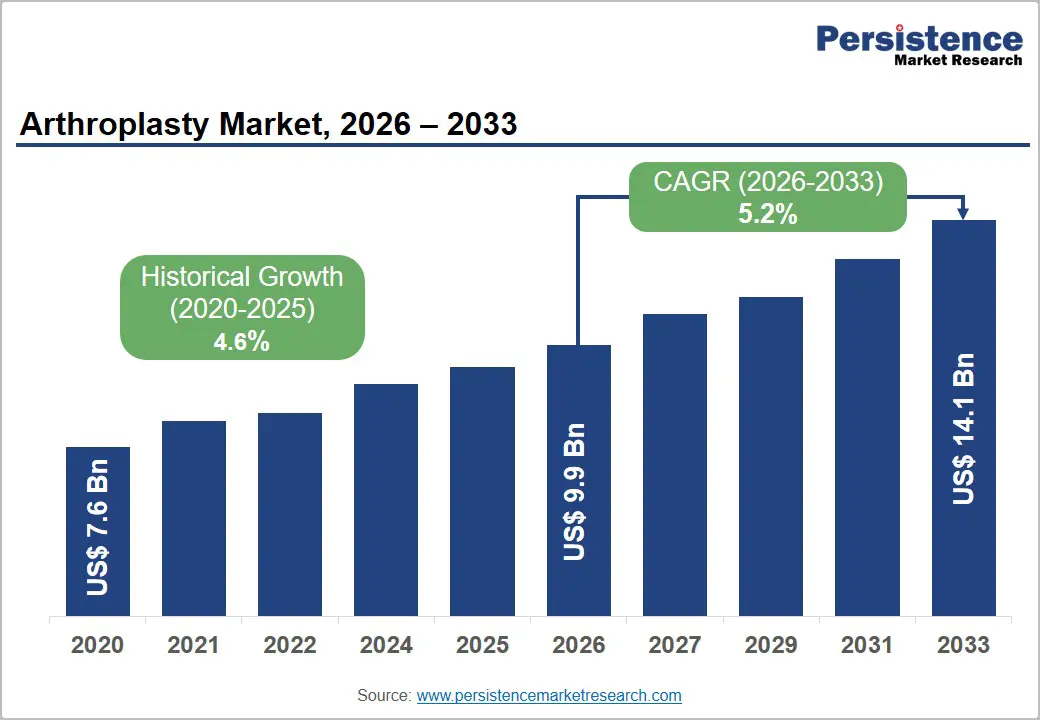
The global arthroplasty market size is likely to be valued at US$9.9 billion in 2026 and is projected to reach US$14.1 billion by 2033, growing at a CAGR of 5.2% during the forecast period from 2026 to 2033, driven by a rapidly aging global population, rising musculoskeletal disease burden, and expanding access to advanced surgical infrastructure.
According to the World Health Organization (WHO), musculoskeletal conditions are leading contributors to disability worldwide, affecting more than 1.71 billion people globally. These structural factors position arthroplasty as an essential and growing segment within the orthopedic medical devices landscape.
Key Industry Highlights:
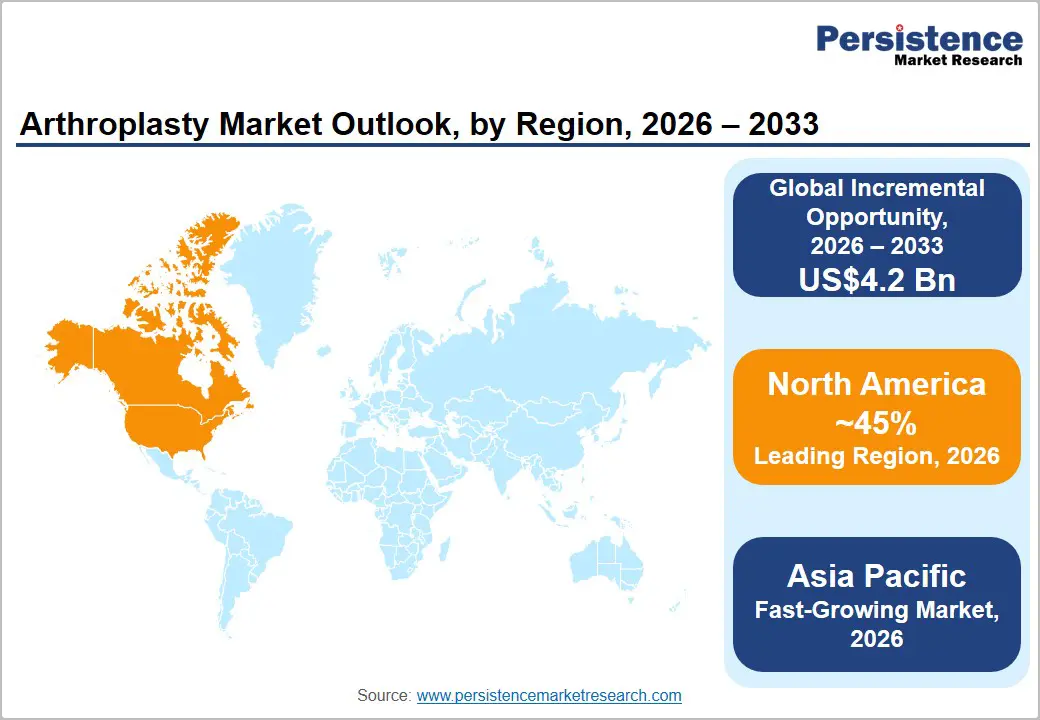
- Leading Region: North America is projected to dominate with approximately 45% market share in 2026, anchored by the U.S. with over 2.15 million annual joint replacement procedures.
- Fastest-growing Region: Asia Pacific is projected to grow at a CAGR of ~6.5% from 2026 to 2033, led by volume expansion in China, India, and Japan, supported by aging demographics and healthcare infrastructure investments.
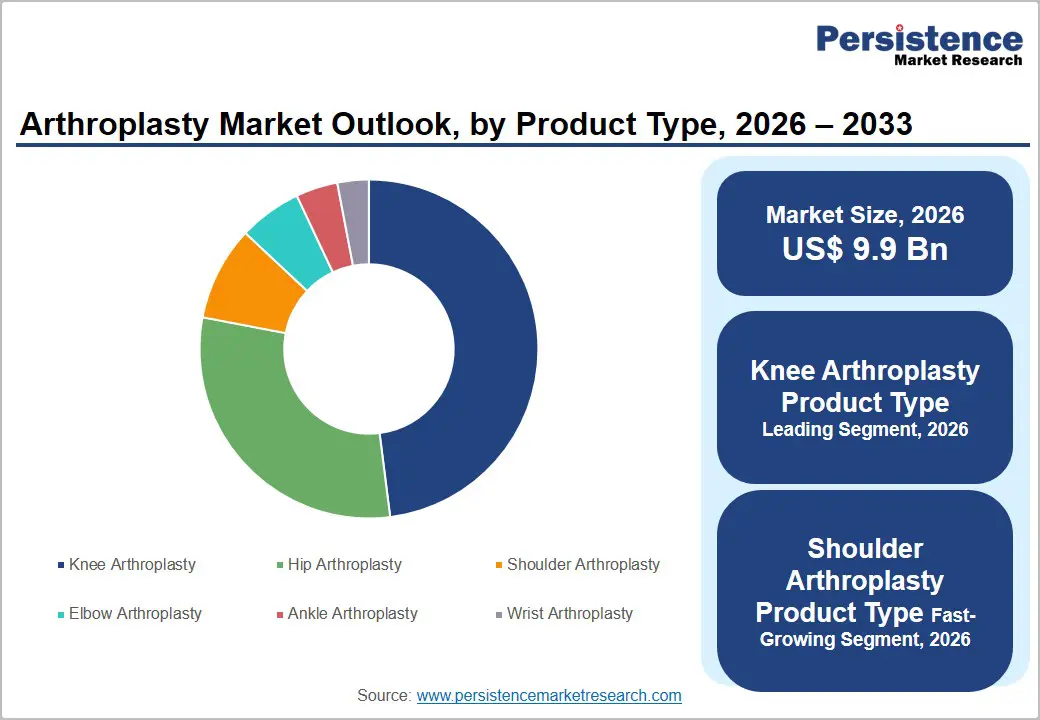
- Dominating Product Type: Knee arthroplasty is projected to dominate the arthroplasty market with over 48% revenue share in 2026, driven by the high prevalence of osteoarthritis and increasing joint replacement procedures worldwide.
- Fastest-growing Technology: Robotic-assisted arthroplasty is likely to be the fastest-growing technology segment, supported by growing demand for surgical precision, improved outcomes, and increasing adoption of robotic platforms.
- Leading Surgery Type: Primary arthroplasty is estimated to lead the surgery-type segment with around 84% market share in 2026, reflecting the high volume of first-time joint replacement procedures globally.
- Key Opportunity: The transition to ambulatory surgical centers (ASCs) presents the most significant near-term growth opportunity, with orthopedic volumes at ASCs growing at a CAGR of ~6.71% through 2030, driven by cost efficiency, ERAS protocols, and insurer incentives for outpatient joint procedures.
- In June 2026, Smith+Nephew reported the first robotic shoulder arthroplasty procedure performed globally using the CORI XT platform. The milestone highlighted the company's expansion of robotic-assisted surgery beyond knee reconstruction into shoulder arthroplasty, reflecting increasing adoption of robotics across joint replacement specialties.
DRO Analysis
Driver - Rising Prevalence of Arthritis and Musculoskeletal Disorders
The surging global burden of arthritis and related joint diseases is a primary structural driver. According to the U.S. Centers for Disease Control and Prevention (CDC), approximately 54 million adults in the U.S. were diagnosed with some form of arthritis. Globally, the Osteoarthritis Action Alliance estimates that osteoarthritis affects over 606.9 million people. The WHO projects the proportion of people aged 60 and above will rise from 12% in 2015 to 22% by 2050, significantly expanding the population susceptible to degenerative joint disease.
This demographic reality translates directly into rising procedural volumes. In the U.S. alone, hip arthroplasty volumes are expected to reach 572,000 annually by 2030, while knee replacement procedures could exceed 3.48 million by 2030. These projections confirm a durable, long-term demand trajectory for arthroplasty procedures across all major joint applications.
Restraint - High Procedural Costs and Reimbursement Pressure
The high cost of arthroplasty, spanning implant acquisition, theater time, anesthesia, and post-operative rehabilitation, remains a significant barrier, particularly in low- and middle-income countries where out-of-pocket healthcare expenditure is disproportionately high. In developed markets, reimbursement headwinds are also intensifying.
In the U.S., hospital reimbursement revisions have exceeded 44% in certain orthopedic categories, compelling procurement departments to renegotiate supplier contracts. These dynamics constrain manufacturers' pricing power and put downward pressure on margins, particularly for smaller companies without the scale advantages of market leaders such as Stryker or Zimmer Biomet.
Opportunity - Expansion into Ambulatory Surgical Centers (ASCs)
The ongoing transition of arthroplasty procedures from traditional inpatient hospitals to Ambulatory Surgical Centers (ASCs) is emerging as a key growth driver for the market. Advances in anesthesia techniques, Enhanced Recovery After Surgery (ERAS) protocols, and minimally invasive surgical approaches have made same-day discharge increasingly feasible for procedures that previously required extended hospital stays.
In line with this trend, Zimmer Biomet introduced its ZBX™ ASC-focused orthopedic platform at the 2025 AAOS Annual Meeting, while Stryker continues to align its commercial strategy with the expanding ASC landscape. Small joint arthroplasty procedures, including those involving the finger, wrist, toe, and ankle, are particularly well-suited to the ASC setting due to their shorter procedure times and faster recovery outcomes. Together, these clinical advancements and evolving care delivery models are creating substantial growth opportunities for arthroplasty manufacturers that offer products and solutions tailored to the ASC environment.
Category-wise Analysis
Product Type Insights
Knee arthroplasty is projected to lead the market, with over 48% of the total share in 2026, owing to the high prevalence of osteoarthritis, growing geriatric population, and increasing volume of total knee replacement procedures worldwide. It remains the most commonly performed joint replacement surgery and benefits from continuous technological advancements such as robotic-assisted surgery and customized implants.
Shoulder arthroplasty is expected to be the fastest-growing, with a CAGR of 5.5% from 2026 to 2033. Growth is driven by rising cases of rotator cuff arthropathy, fractures, and degenerative shoulder disorders, coupled with increasing adoption of reverse shoulder replacement systems. Improvements in implant design, surgical techniques, and long-term clinical outcomes are further encouraging procedure uptake globally.
Technology Insights
Traditional arthroplasty is expected to dominate the segment, accounting for 70% of market revenue in 2026, due to its widespread adoption, established clinical outcomes, and availability across healthcare facilities worldwide. Most joint replacement procedures are still performed using conventional surgical techniques because of lower equipment costs and extensive surgeon familiarity.
Robotic-assisted arthroplasty is expected to be the fastest-growing at a CAGR of 4.5% from 2026 to 2033. Increasing demand for surgical precision, improved implant positioning, shorter recovery times, and favorable clinical outcomes are accelerating adoption. Continued investments by major orthopedic companies in robotic platforms are further driving market expansion.
Surgery Type Insights
Primary arthroplasty is estimated to lead the segment, capturing around 84% of the market share in 2026, as it represents first-time joint replacement procedures performed for osteoarthritis, rheumatoid arthritis, and other degenerative joint disorders. The growing aging population and increasing prevalence of joint diseases continue to drive procedure volumes globally. Most knee, hip, and shoulder replacement surgeries fall under this category, making it the leading revenue contributor.
Revision arthroplasty is projected to be the fastest-growing segment with a CAGR of 6.5% from 2026 to 2033, due to the increasing number of aging implants requiring replacement, rising life expectancy of patients, and growing incidence of implant wear, loosening, and infection. As the installed base of joint implants expands, demand for complex revision procedures is expected to increase steadily.
Regional Insights
North America Arthroplasty Market Trends and Insights
North America is projected to dominate the arthroplasty market, capturing around 45% of the total global share in 2026. The region's dominance is driven by a rapidly aging population, a high prevalence of osteoarthritis and obesity, strong reimbursement coverage, and early adoption of advanced technologies such as robotic-assisted joint replacement and customized implants.
U.S. Arthroplasty Market Trends and Insights
The U.S. is expected to hold approximately 88% of the North America arthroplasty market share in 2026. The country's leadership is attributed to its large elderly population, high incidence of osteoarthritis, widespread insurance coverage through Medicare and private insurers, and rapid adoption of robotic-assisted orthopedic procedures.
Canada Arthroplasty Market Trends and Insights
Canada is estimated to account for approximately 12% of the North America arthroplasty market share in 2026. Growth is supported by an aging population, increasing prevalence of degenerative joint diseases, and government investments aimed at reducing surgical wait times. According to the Canadian Institute for Health Information (CIHI), 175,242 hip and knee replacement procedures were performed in Canada during 2024–2025, representing a 5.3% year-over-year increase and a 26.5% increase compared with pre-pandemic levels (2019–2020).
Europe Arthroplasty Market Trends and Insights
Europe is estimated to hold around 28% of the market share in 2026. The region's growth is driven by a rapidly aging population, increasing prevalence of osteoarthritis, favorable reimbursement systems, and strong public healthcare infrastructure. Countries across Europe perform a high volume of hip and knee replacement procedures annually, supported by widespread access to orthopedic care and growing adoption of robotic-assisted and minimally invasive joint replacement techniques.
Germany Arthroplasty Market Trends and Insights
Germany is anticipated to account for approximately 22–25% share of the Europe arthroplasty market in 2026, making it the region's largest contributor. The country performs one of the highest numbers of hip and knee replacement procedures in Europe due to its large elderly population, comprehensive statutory health insurance system, and advanced orthopedic care network.
U.K. Arthroplasty Market Trends and Insights
The U.K. is projected to hold approximately 15–18% share of the Europe market. Growth is supported by increasing osteoarthritis prevalence, expanding orthopedic treatment capacity, and continuous improvements in surgical techniques. According to the National Joint Registry (NJR), 263,865 joint replacement procedures were recorded in 2024, including 116,901 hip procedures and 134,652 knee procedures, highlighting the substantial procedural volume that drives demand for arthroplasty devices and services.
Asia Pacific Arthroplasty Market Trends and Insights
Asia Pacific is projected to be the fastest-growing regional market during the 2026 - 2033 forecast period. This growth is supported by a rapidly aging population, the increasing prevalence of osteoarthritis, rising healthcare spending, expanding access to orthopedic services, and the growing adoption of advanced joint replacement technologies.
China Arthroplasty Market Trends and Insights
China is projected to account for approximately 35–40% of the Asia Pacific arthroplasty market in 2026, making it the largest contributor in the region. Market growth is primarily driven by the country's rapidly aging population. According to China's Ministry of Civil Affairs and the National Committee on Ageing, China had 296.97 million people aged 60 years and above in 2023, representing 21.1% of the total population, including 216.76 million people aged 65 years and above.
India Arthroplasty Market Trends and Insights
India is projected to account for approximately 18% of the Asia Pacific arthroplasty market in 2026 and is expected to be one of the fastest-growing markets in the region. Growth is driven by a large patient population with osteoarthritis, increasing healthcare investments, greater awareness of joint replacement procedures, and expanding insurance coverage through government initiatives such as Ayushman Bharat. The growing adoption of robotic-assisted knee replacement surgery across public and private hospitals is enhancing surgical precision, accessibility, and patient outcomes.
Competitive Landscape
The global arthroplasty market is moderately consolidated. The four largest players, Zimmer Biomet, Stryker, DePuy Synthes (Johnson & Johnson MedTech), and Smith+Nephew, collectively command the majority of global revenue. Key competitive differentiators include robotic-assisted surgery ecosystems, clinical evidence breadth, product portfolio depth across joint applications, and established surgeon relationships. Market leaders are increasingly leveraging AI-guided surgical planning, 3D-printed patient-specific implants, and dedicated ASC-focused commercial platforms to strengthen their competitive positioning. Smaller and mid-tier competitors, including Integra LifeSciences, Exactech, and Conformis, are differentiating through specialization in niche anatomical applications and personalized implant solutions.
Strategic M&A activity is accelerating. Companies are pursuing tuck-in acquisitions to expand into faster-growing adjacencies such as shoulder and small joint arthroplasty. In August 2025, Zimmer Biomet announced a definitive agreement to acquire Monogram Technologies, adding AI-driven autonomous robotic capability to its platform. Clinical evidence investment remains a key growth lever, with all major players funding long-term registry outcome studies to support premium pricing and reimbursement access in regulated markets.
Key Industry Developments:
- In January 2025, Zimmer Biomet announced an agreement to acquire Paragon 28 for approximately US$1.1 billion. The acquisition was aimed at expanding Zimmer Biomet's orthopedic portfolio in foot and ankle reconstruction, strengthening its position across trauma, extremities, and joint replacement markets.
- In March 2025, Stryker unveiled the next generation of its Mako SmartRobotics platform at the AAOS 2025 Annual Meeting. The company introduced Mako Total Hip with Advanced Primary and Revision capabilities, including the first robotic hip revision application, while also advancing robotic solutions for hip, knee, spine, and shoulder arthroplasty procedures.
Companies Covered in Arthroplasty Market
- DuPuy Orthopedics, Inc.
- Stryker Corporation
- Zimmer Biomet
- Integra LifeSciences GmbH
- Smith and Nephew
Frequently Asked Questions
The global arthroplasty market is estimated to be valued at US$9.9 billion in 2026.
Aging demographics, rising healthcare expenditure, and the expansion of arthroplasty into ambulatory surgical settings are additional structural growth catalysts for the global market.
The arthroplasty market is projected to grow at a CAGR of 5.2% between 2026 and 2033.
Emerging markets in India, Southeast Asia, and Latin America represent untapped volume growth potential, while the rising demand for excisional arthroplasty from younger patient cohorts offers a durable new revenue stream.
Leading companies include DePuy Synthes (Johnson & Johnson MedTech), Stryker Corporation, Zimmer Biomet Holdings, Inc., Biomet, Inc., Smith+Nephew plc, and Integra LifeSciences GmbH.


