ID: PMRREP32804| 235 Pages | 5 Jan 2026 | Format: PDF, Excel, PPT* | IT and Telecommunication
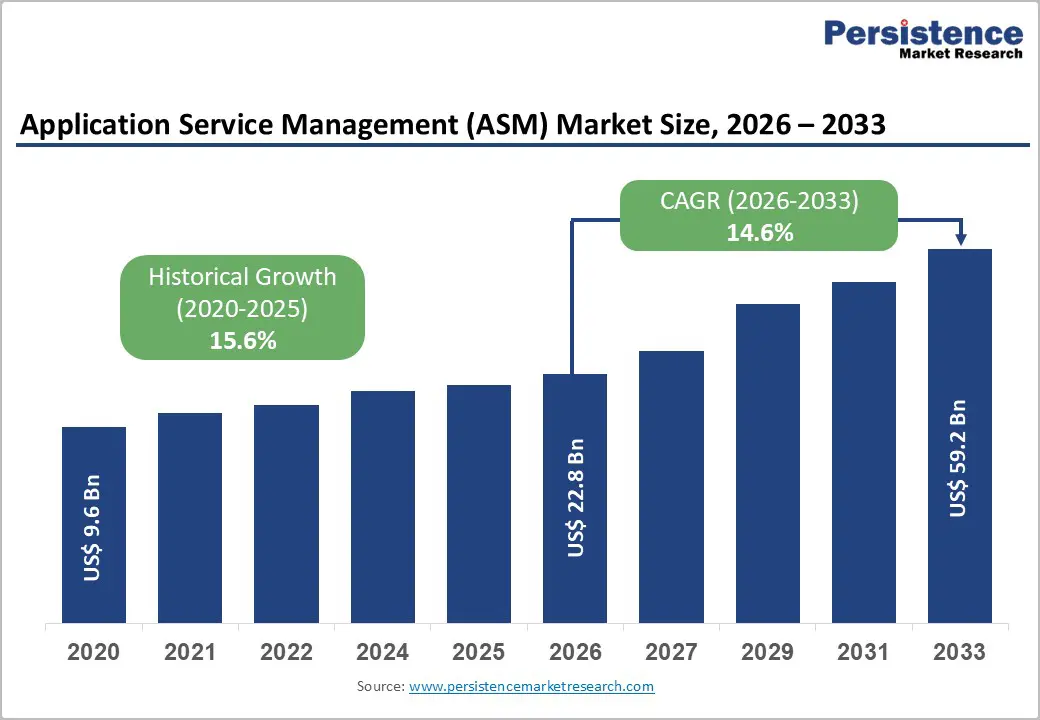
The global Application Service Management (ASM) market size is expected to be valued at US$ 22.8 billion in 2026 and projected to reach US$ 59.2 billion by 2033, growing at a CAGR of 14.6% between 2026 and 2033.
The ASM market is experiencing explosive growth driven by accelerating digital transformation initiatives, escalating cybersecurity threats requiring comprehensive application security frameworks, and enterprise urgency to modernize legacy systems constraining business agility. Organizations are increasingly recognizing that traditional application support models prove inadequate for managing complex, distributed, cloud-native application architectures characterized by rapid deployment cycles, microservices dependencies, and sophisticated threat landscapes. The convergence of DevSecOps adoption with Industry 4.0 technologies, artificial intelligence-driven automation, and Zero Trust security architectures is fundamentally transforming how enterprises manage application lifecycles, security postures, and operational performance, establishing ASM as strategic infrastructure rather than tactical IT function.
| Global Market Attributes | Key Insights |
|---|---|
| Market Size (2026E) | US$ 22.8 Billion |
| Market Value Forecast (2033F) | US$ 59.2 Billion |
| Projected Growth CAGR (2026-2033) | 14.6% |
| Historical Market Growth (2020-2025) | 15.6% |

Accelerated Digital Transformation and Cloud Migration Imperatives
Organizations globally are undertaking aggressive digital transformation initiatives to maintain competitive positioning, improve operational agility, and respond dynamically to evolving customer expectations in increasingly digital marketplaces. The proliferation of multi-cloud strategies, with average enterprises utilizing 2.02 cloud providers, creates unprecedented complexity managing application ecosystems spanning on-premises, hybrid, and fully cloud-native environments requiring integrated management approaches.
Cloud migration initiatives are accelerating globally with enterprises reporting that over 70% of organizations in Asia Pacific are projected to undergo digital transformation by 2030, creating massive demand for application modernization and integration services enabling seamless transitions from legacy infrastructure to cloud-native architectures. The Digital India initiative, European Union’s Digital Europe Program, and NextGenerationEU investments are catalyzing widespread application modernization across government agencies and enterprise organizations, establishing regulatory tailwinds supporting sustained ASM market expansion through forecast periods.
Rising Security Threats and Compliance Mandate Complexity
Web application security threats have proliferated dramatically with OWASP Top 10 vulnerabilities continuously evolving and zero-day exploits emerging at accelerating rates, creating persistent pressure on enterprises to maintain robust application security postures. Regulatory frameworks including GDPR, HIPAA, PCI DSS, SOC 2, and emerging standards like the European Union’s NIS2 Directive are mandating comprehensive compliance capabilities within application infrastructure, driving substantial investments in security-integrated development processes and continuous vulnerability assessment mechanisms.
DevSecOps adoption is accelerating with enterprises integrating security throughout software development lifecycles rather than treating security as post-deployment verification, requiring specialized application management frameworks and automation tools. The European Union Agency for Cybersecurity (ENISA) reported a 30% upsurge in modernization projects addressing compliance requirements in 2024, with Financial institutions in Europe leading adoption of enhanced security capabilities integrated into application management platforms. Organizations face exponential increases in attack surface areas through microservices proliferation, API expansion, and distributed infrastructure, necessitating continuous security monitoring and application-layer threat detection capabilities embedded within ASM platforms.
Talent Shortage and Skill Gap Constraints
The global market faces critical shortages of qualified professionals possessing expertise in advanced application modernization technologies, cloud-native architecture design, DevSecOps practices, and specialized platforms like Kubernetes, Terraform, and ServiceNow, constraining deployment velocity and forcing enterprises to pursue costly consulting engagements. Organizations report difficulty recruiting and retaining engineers qualified in emerging technology domains including artificial intelligence, machine learning operations (MLOps), and advanced security frameworks, creating dependency on external service providers and compressing enterprise margins through premium labor cost structures. Small and medium-sized enterprises face pronounced challenges accessing specialized talent for application modernization projects, creating competitive disadvantages relative to large enterprises with established talent acquisition and development programs capable of absorbing skill acquisition investments through economies of scale.
Implementation Complexity and Organizational Change Resistance
Application modernization projects introduce substantial organizational complexity requiring coordination across multiple business units, technology teams, and external service providers, with 40-50% of transformation initiatives experiencing delays or cost overruns due to inadequate change management and organizational resistance. Legacy system dependencies, interconnected business processes, and risk-averse organizational cultures create substantial barriers to rapid modernization, with enterprises often requiring years to complete comprehensive application portfolio transformations even with dedicated resources and external service provider support. Integration challenges between newly modernized applications and existing enterprise systems including ERP, CRM, and financial platforms frequently create operational disruptions, data inconsistencies, and performance degradation that undermine business case justifications and create organizational skepticism regarding additional modernization investments.
AI-Powered Automation and Intelligent Application Management
Generative AI and machine learning integration into ASM platforms represents transformational opportunity enabling dramatic efficiency improvements, cost reduction, and security enhancement throughout application lifecycle management. AI-driven code refactoring utilizing large language models can automatically analyze codebases, identify technical debt, and recommend architectural optimizations, reducing manual analysis time and improving code quality metrics with GenAI refactoring engines reportedly reducing code conversion time by up to 45%. Predictive maintenance capabilities powered by machine learning algorithms enable enterprises to identify potential application failures, security vulnerabilities, and performance degradation before production impact, reducing unplanned downtime by 30-38% and decreasing maintenance costs by approximately 25%.
AIOps platforms utilizing anomaly detection and automated root cause analysis can dramatically reduce Mean Time to Resolution (MTTR) for application incidents, with enterprises reporting MTTR reductions of 30% and increased operational efficiency through automation of routine troubleshooting and incident response procedures. Organizations are increasingly bundling AI-enhanced ASM services with application modernization and infrastructure management offerings, creating compelling value propositions that justify premium pricing while delivering measurable operational improvements justifying capital investments throughout multi-year transformation programs.
Expansion in BFSI and Healthcare Vertical Markets
Financial services and healthcare sectors face intense regulatory pressure, escalating cybersecurity threats, and urgent digitalization imperatives creating exceptional opportunities for ASM providers specializing in compliance-aligned, security-integrated application management. Banking institutions are undertaking comprehensive modernization of core systems to support real-time payments, advanced analytics capabilities, and emerging financial technologies, with BFSI sector expected to see 2.4× increase in application modernization spending by 2027 driven by regulatory compliance and competitive pressures.
Healthcare organizations are prioritizing application modernization to support telemedicine expansion, advanced clinical analytics, and Electronic Health Record (EHR) system integration, with FDA regulatory requirements mandating comprehensive security and interoperability capabilities integrated within application infrastructure. The global healthcare IT market is projected to reach US$ 600 billion by 2026, with substantial proportions allocated to application modernization and security infrastructure enabling secure patient data management and HIPAA-compliant system architectures. Specialized ASM providers offering domain expertise in healthcare compliance, financial regulatory frameworks, and vertical-specific application architectures are capturing premium market positions and commanding substantial consulting fees justifying continued investment in specialized capability development.
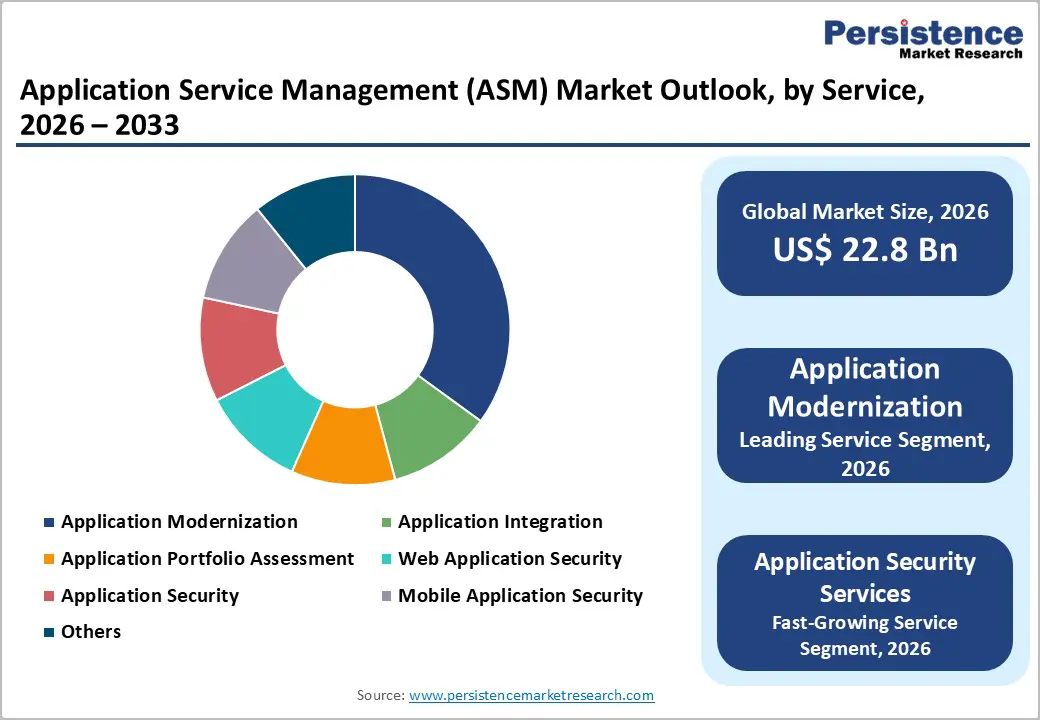
Application Modernization is the fastest-growing ASM service segment, projected to achieve a CAGR of 16.8% through 2033, capturing around 38% market share as enterprises prioritize transforming legacy systems to drive broader digital initiatives. Modernization reduces operational costs, enhances security, and improves business agility, enabling faster deployment cycles and system responsiveness. Strategies such as lift-and-shift, re-platforming, and refactoring optimize applications for cloud, hybrid, or multi-cloud environments.
Re-platforming and refactoring dominate as organizations seek efficiency and architectural improvements. Enterprises report modernization yields 25–40% faster deployment, 30–50% operational cost reduction, and 50%+ enhanced security. ASM providers deliver platform-agnostic, continuous modernization services, ensuring applications remain agile, secure, and scalable across diverse infrastructure while supporting cloud adoption, workload distribution, and integrated lifecycle management.
Large enterprises dominate the ASM market with approximately 72% share, managing extensive, complex application portfolios spanning hundreds of legacy and cloud-native systems. High operational complexity across security, compliance, performance, and integration demands sophisticated ASM solutions that smaller organizations cannot justify internally. These organizations maintain dedicated CIO offices, enterprise architects, and substantial IT budgets enabling adoption of premium ASM platforms providing comprehensive visibility, control, and automation.
With an average portfolio of 660 applications and annual SaaS spending of $284 million, large enterprises require services including portfolio rationalization, cost optimization, and integrated modernization. ASM providers differentiate by offering consolidated, end-to-end platforms delivering modernization, integration, security, and lifecycle management across distributed infrastructures, reducing vendor fragmentation and ensuring efficient enterprise-wide application governance.
The BFSI sector captures approximately 28% of the ASM market, driven by strict regulatory compliance, advanced cyber threats, and urgent modernization needs. Financial institutions are transforming legacy systems to support open banking, real-time payments, and digital-first customer experiences, migrating from monolithic architectures to microservices-based platforms. Compliance mandates such as Basel III, Dodd-Frank, and MiFID II, combined with emerging real-time payment regulations, require continuous security monitoring, audit-ready architectures, and integrated regulatory reporting.
ASM providers deliver specialized capabilities including Web Application Firewalls, API security, vulnerability management, and continuous application monitoring. Additionally, adoption of emerging technologies such as blockchain, AI, and IoT increases architectural complexity, making BFSI a high-value ASM segment requiring providers with deep domain expertise and decades of experience in financial services transformation.

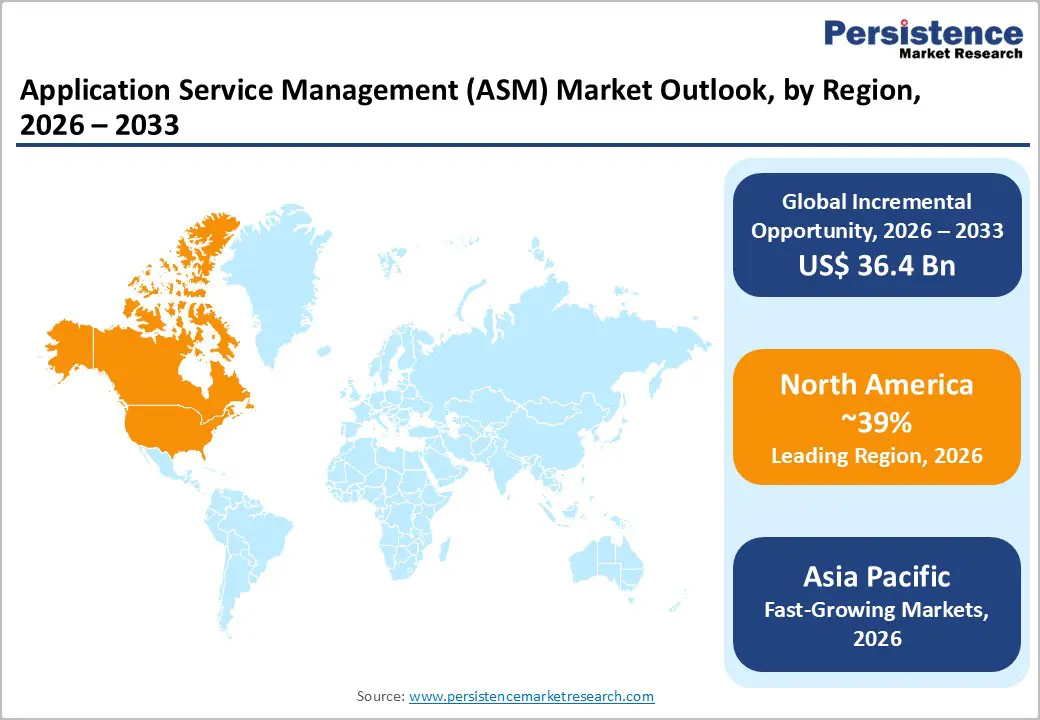
North America leads the global ASM market with approximately 39% regional share, driven by mature IT infrastructure, advanced technology adoption, and substantial enterprise technology budgets. The United States, supported by major technology corporations, financial institutions, and government agencies, spearheads digital transformation initiatives, with programs like the Modernizing Government Technology (MGT) initiative driving ASM adoption across federal departments. The presence of major ASM providers and system integrators ensures strong solution availability and innovation in the region.
Canadian enterprises are increasingly adopting multi-cloud strategies and Zero Trust security frameworks, creating demand for ASM services that address distributed infrastructure and compliance needs. High SaaS adoption, with enterprises operating over 660 applications on average, fuels requirements for Application Portfolio Management and SaaS rationalization. Combined, these factors establish North America as a hub for ASM innovation, supporting enterprise modernization, cost optimization, and regulatory compliance initiatives across private and public sectors.
Europe represents a mature ASM market shaped by stringent regulatory frameworks, advanced data protection mandates, and EU digital sovereignty initiatives. Germany, the UK, and France drive adoption through banking modernization, manufacturing digitalization, and government digital transformation projects. Compliance requirements such as GDPR and the NIS2 Directive create substantial demand for privacy-integrated, secure ASM solutions, making regulatory adherence a key adoption driver.
EU-funded programs like Digital Europe and NextGenerationEU provide significant investment toward public sector modernization, healthcare digitalization, and government service improvements. European enterprises also prioritize localized infrastructure and data residency guarantees, creating opportunities for regional ASM providers to differentiate offerings from U.S. technology companies. Combined, these regulatory, funding, and sovereignty considerations foster a robust European ASM ecosystem focused on secure, compliant, and scalable application management solutions across multiple industry verticals.
Asia Pacific is the fastest-growing ASM market, projected to reach 28% global share by 2033 with a CAGR of 17.3%, fueled by rapid digital transformation, cloud adoption, and government-driven modernization across China, India, Japan, and Southeast Asia. China’s Digital Silk Road and Made in China 2025 programs drive large-scale application modernization investments, while India’s Digital India initiative is expected to transform over 70% of enterprises by 2030, supporting a 24.13% CAGR growth.
ASEAN nations, including Vietnam, Thailand, Indonesia, and the Philippines, are expanding digital infrastructure, manufacturing capacity, and offshore service delivery, creating further opportunities for ASM providers. Japan continues to modernize hybrid legacy-cloud environments with advanced IT infrastructure. Aggressive government mandates, hyperscaler expansion, and accelerated cloud adoption contribute to a 20.3% CAGR in modernization investments, positioning Asia Pacific as the most dynamic and rapidly expanding ASM market globally.

The application service management market exhibits a moderately consolidated structure, with a group of large global providers complemented by specialized and regional firms. Competition is shaped by the breadth of service offerings, global delivery scale, and long-term enterprise relationships spanning multiple industries. Leading providers position themselves as end-to-end partners, combining application modernization, integration, security, and ongoing lifecycle management under unified service models. Strategic acquisitions remain a key growth lever, allowing providers to rapidly add digital, analytics, and industry-specific capabilities while expanding client access.
Differentiation increasingly centers on AI-driven automation, AIOps platforms, DevSecOps integration, and embedded security frameworks that address rising regulatory and cyber risk pressures. At the same time, hyperscale cloud platforms are intensifying competition by embedding management capabilities directly into cloud environments, challenging traditional service models. In response, service providers are emphasizing advisory-led engagements, domain expertise, and human-led transformation services, while niche players focus on specialized modernization and security use cases.
Key Market Developments
The global Application Service Management Market is expected to reach approximately US$ 22.8 billion in 2026.
Key drivers include digital transformation, cloud migration, rising cybersecurity threats, regulatory compliance requirements, and legacy system modernization.
North America is expected to lead the market with about 39% share during the forecast period.
The largest opportunity lies in AI-powered automation and intelligent application management reducing downtime, costs, and resolution times.
Major players include Cognizant, Accenture, IBM, HCL Technologies, Wipro, Tech Mahindra, Capgemini, Fujitsu, AWS, and Microsoft.
| Report Attributes | Details |
|---|---|
| Historical Data/Actuals | 2020 – 2025 |
| Forecast Period | 2026 – 2033 |
| Market Analysis Units | Value: US$ Mn/Bn, Volume: As Applicable |
| Geographical Coverage |
|
| Segmental Coverage |
|
| Competitive Analysis |
|
| Report Highlights |
|
Service
Enterprise Size
End Use Industry
Regions
Delivery Timelines
For more information on this report and its delivery timelines please get in touch with our sales team.
About Author