




- Technology
- Airport and Marine Port Security Market
Airport and Marine Port Security Market Size, Share, and Growth Forecast, 2026 – 2033
Airport and Marine Port Security Market by Infrastructure (Airport, Marine Port), Technology (Surveillance Systems, Physical Access Control Systems, Screening & Scanning Systems, Perimeter Intrusion Detection System, Network Access Control & Security, Real-Time Location Systems), Services (Facility& Asset Management, System Integration, Training & Consulting), and Regional Analysis for 2026-2033

Airport and Marine Port Security Market Share and Trends Analysis
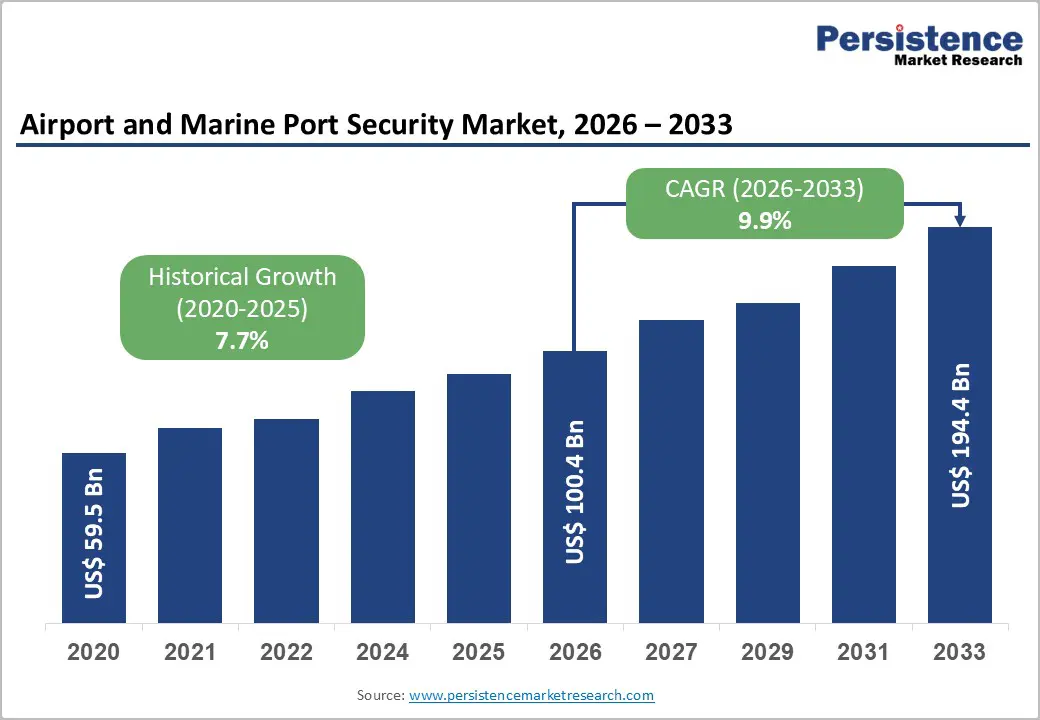
The global airport and marine port security market size is likely to be valued at US$ 100.4 billion in 2026, and is projected to reach US$ 194.4 billion by 2033, growing at a CAGR of 9.9% during the forecast period 2026−2033. Growth outlook reflects structural expansion in global air passenger traffic and maritime trade volumes, which increases exposure to terrorism, transnational crime, cyber intrusion, and smuggling risks. Governments and port authorities are prioritizing layered security frameworks aligned with standards issued by the International Civil Aviation Organization (ICAO) and the International Maritime Organization (IMO), reinforcing mandatory screening, surveillance, and access control modernization. Technological integration across biometric authentication, artificial intelligence-enabled video analytics, advanced cargo scanning, and network security platforms is strengthening threat detection accuracy while improving operational throughput.
Key Industry Highlights
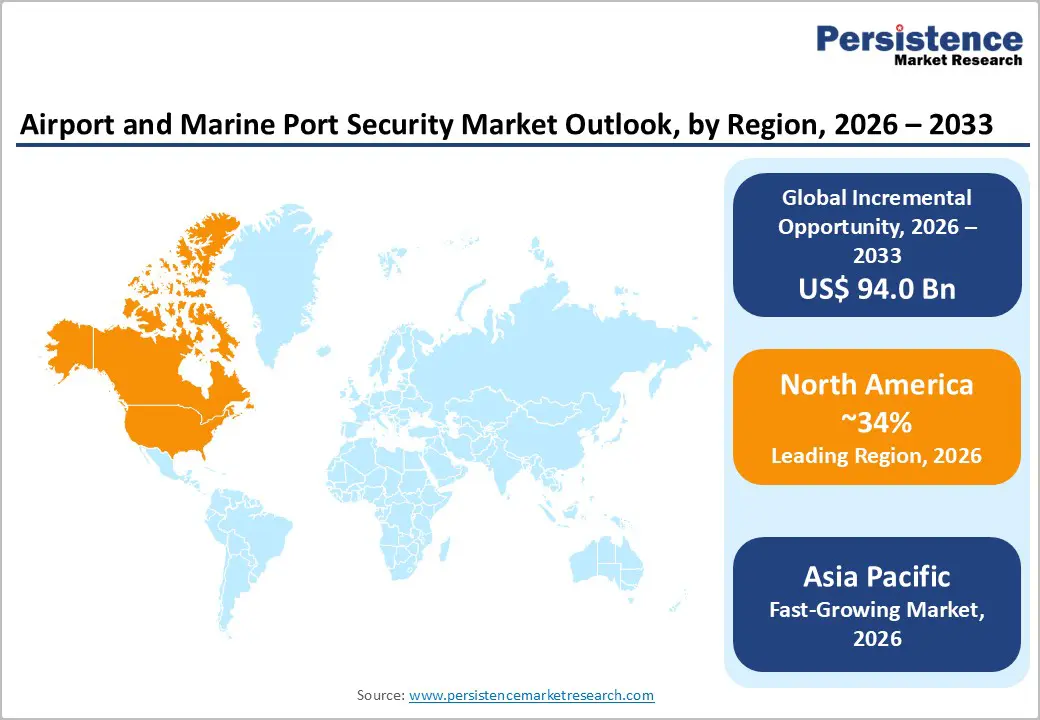
- Dominant Region: North America is projected to lead with about 34% market share in 2026, driven by strict federal security mandates and major transport hub investments.
- Fastest-growing Regional Market: Asia Pacific is forecast to be the fastest-growing market between 2026 and 2033, propelled by rapid airport expansion and advanced security technology adoption.
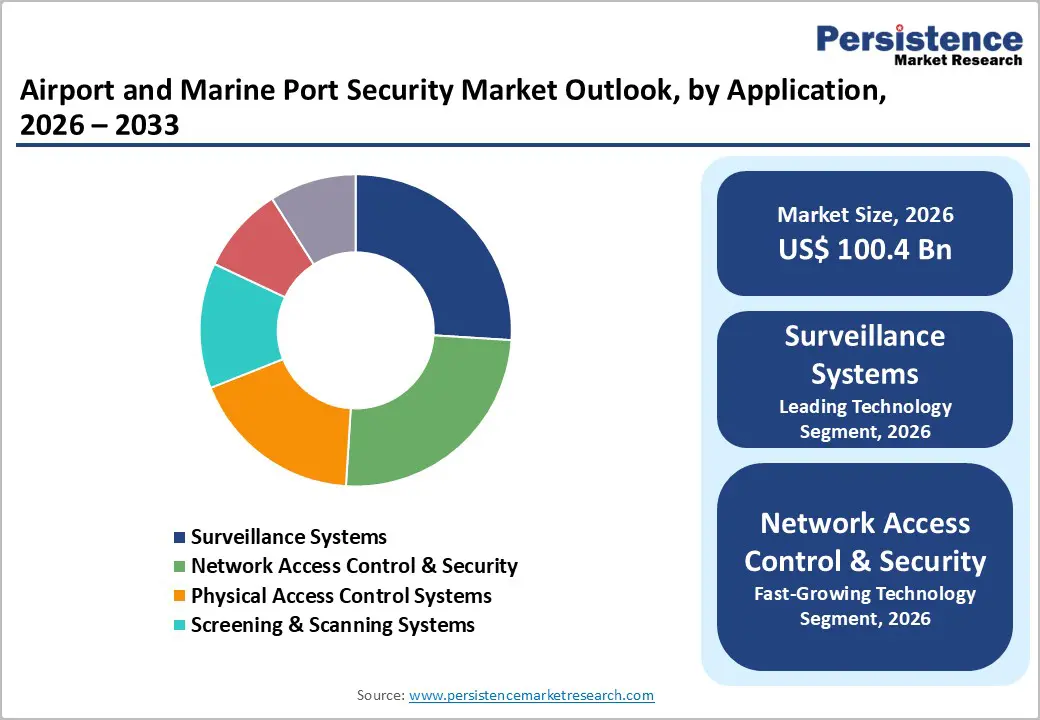
- Leading Technology: Surveillance systems are projected to hold roughly 26% revenue share in 2026, owing to regulatory monitoring mandates and AI-enabled command integration.
- Fastest-growing Technology: Network access control and security are expected to grow the fastest between 2026 and 2033, boosted by expanding digital interconnectivity.
| Key Insights | Details |
|---|---|
|
Airport and Marine Port Security Market Size (2026E) |
US$ 100.4 Bn |
|
Market Value Forecast (2033F) |
US$ 194.4 Bn |
|
Projected Growth (CAGR 2026 to 2033) |
9.9% |
|
Historical Market Growth (CAGR 2020 to 2025) |
9.1% |
Market Factors – Growth, Barriers, and Opportunity Analysis
Escalating Geopolitical Risk and Regulatory Enforcement
Heightened geopolitical volatility across trade corridors and aviation routes is intensifying risk exposure for critical transport gateways. Ongoing regional conflicts, sanctions regimes, and transnational security threats are elevating the probability of illicit trafficking, sabotage, and politically motivated disruption. On June 22, 2025, the U.S. Department of Homeland Security issued a National Terrorism Advisory System Bulletin highlighting a sustained threat environment targeting public infrastructure and border entry points, reinforcing federal emphasis on protective posture and vigilance. This 2025 federal action signals direct linkage between geopolitical instability and mandated security reinforcement at ports of entry. Transport authorities are therefore prioritizing advanced screening architecture, perimeter surveillance modernization, and intelligence-led risk assessment models to align with national security directives and international compliance frameworks.
Regulatory enforcement is expanding in scope and technical depth, driving capital allocation toward biometric verification, cargo inspection automation, and integrated command-and-control systems. Federal agencies such as U.S. Customs and Border Protection are advancing biometric entry–exit protocols and data-driven traveler vetting standards to strengthen identity validation and threat detection. These mandates require infrastructure upgrades, interoperability across databases, and continuous monitoring capabilities across air and maritime facilities. Compliance pressure from international maritime conventions, aviation security standards, and bilateral trade security agreements further elevates accountability expectations for operators.
Digital Transformation of Transportation Infrastructure
Modernizing core transportation infrastructure through digital technology directly enhances operational resilience, situational awareness, and real-time responsiveness, which drives growth in missions such as threat detection and incident management in airport and port environments. Government strategic plans emphasize upgrading digital infrastructure across modes to make systems more efficient and secure, enabling interoperable data flows and predictive analytics that improve decision-making under stress. For example, the U.S. Department of Transportation’s DOT IT Strategic Plan 2025–2029 explicitly describes a mission to unify and modernize information technology capabilities to strengthen safety, efficiency, and connectivity across the national transportation system, supporting future innovations and secure operations.
Major agencies are embracing advanced technologies such as cloud-native platforms, artificial intelligence, and automated data governance to create flexible, adaptive systems that enhance throughput while reducing critical failures. A 2025 report from an infrastructure planning body highlights that upgrading digital infrastructure is essential to support secure operations and adapt to emerging technologies, reflecting strategic emphasis on digital transformation as foundational rather than supplementary. Integrated digital systems reduce manual bottlenecks, provide real-time monitoring of assets and threats, and support rapid coordination across jurisdictions and modes. Public sector adoption of digital infrastructure not only improves operational clarity but also mitigates evolving risk vectors, including cybersecurity threats and complex multimodal coordination challenges that conventional analog systems struggle to address.
High Capital Intensity and Budgetary Constraints
Security infrastructure across airports and seaports requires substantial upfront investment in advanced screening equipment, perimeter surveillance systems, command-and-control platforms, cybersecurity architecture, and hardened physical assets. These systems involve complex procurement cycles, compliance validation, integration with legacy platforms, and multi-year lifecycle management commitments. Capital planning therefore extends beyond acquisition cost to include installation, calibration, software licensing, workforce training, and long-term maintenance contracts. Federal appropriations illustrate the scale of funding pressure. The U.S. Department of Homeland Security Fiscal Year 2025 Budget in Brief allocates US$ 11.8 billion for the Transportation Security Administration (TSA) to support screening operations, technology procurement, and personnel requirements, reflecting the magnitude of recurring expenditure tied to transportation security functions.
Budgetary constraints intensify at the state, municipal, and port authority levels, where infrastructure upgrades, terminal expansions, and environmental compliance projects compete for the same capital pools. Revenue streams derived from passenger facility charges, landing fees, cargo handling tariffs, and local tax mechanisms remain sensitive to traffic volatility and economic cycles. Long asset depreciation schedules further restrict financial agility, as prior investments continue to absorb capital through debt servicing and asset management obligations. Escalating labor costs for certified security personnel and technical specialists place sustained pressure on operating budgets, reducing available funds for new technology deployment.
Complex Regulatory Harmonization and Interoperability Challenges
Regulatory frameworks governing aviation and maritime operations are crafted by sovereign states and international bodies to address distinct national priorities, legal traditions, and security policies. Efforts to align these frameworks with global standards often require reconciling divergent procedural requirements, risk tolerance levels, and data protection norms across jurisdictions. This divergence complicates the establishment of common performance benchmarks and technical specifications for systems that must operate across borders, leading to mismatches in compliance obligations and reporting requirements.
Technical interoperability challenges stem from the integration of legacy systems with modern digital architectures. Airports and ports often maintain a mosaic of hardware and software platforms that were developed under different regulatory mandates and vendor specifications. Achieving interoperability between these heterogeneous systems requires not only standard communication protocols but also harmonized regulatory expectations regarding data sharing, security classification, and operational transparency. Collaborative initiatives such as global standards tests highlight the necessity of widely accepted frameworks to facilitate compatibility among diverse stakeholders.
Cyber-Physical Security Convergence and Managed Security Services
Convergence of cyber and physical security functions is reshaping protection strategies for critical infrastructure by breaking down traditional silos between digital and tangible threat defense frameworks. The U.S. TSA explicitly outlines that the increasing interconnection of operational technology (OT) systems, sensors, and networked devices creates a complex threat environment in which isolated approaches are insufficient; unified management enables visibility across both physical assets and cyber endpoints to detect, prevent, and respond to hybrid attacks that can trigger real-world disruption from a remote digital breach or vice versa. This integrated posture becomes increasingly relevant as regulatory and operational mandates push transportation operators to align security planning with both cyber risk and physical safety criteria in infrastructure funding and compliance processes.
Federal defense agencies are actively investing in these converged models, reflecting operational priorities that go beyond basic perimeter security. The Cybersecurity and Infrastructure Security Agency (CISA) reported blocking 2.62 billion malicious connections on federal civilian networks during 2025 efforts to secure critical infrastructure and maintain resilience against automated threats at scale, showcasing the volume and velocity of cyber risk that intersects with physical systems across networked environments.
Adoption of Smart Port and Smart Airport Initiatives
Smart infrastructure modernization unlocks real-time situational awareness and automated threat detection by connecting disparate systems across terminals and logistics precincts. For example, the U.S. TSA’s Biometrics Roadmap identifies that facial recognition and related digital identity tools can automate identity verification to improve security effectiveness and operational efficiency while handling over two million screened passengers per day in 2025 these technologies reduce manual screening bottlenecks and reduce opportunities for human error in identity checks, while enabling continuous monitoring of access points and alerts for anomalies. By supplanting legacy paper-based workflows with sensor-driven data streams, analytics platforms can prioritize resource deployment to emerging risks, integrate cybersecurity controls with physical systems, and enhance cross-domain threat intelligence.
Integration of IoT, AI, and automated surveillance in smart ecosystems aligns with government strategic objectives for resilient transportation networks. Such systems support predictive analytics that anticipates crowding, equipment failures, and irregular movements that could signal security breaches, enabling pre-emptive interventions rather than reactive responses. Centralized dashboards that aggregate data from cameras, access control readers, and border-control systems provide unified operational oversight that elevates risk awareness across air and maritime domains.
Category-wise Analysis
Technology Insights
Surveillance systems are likely to dominate with a projected 26% of the airport and marine port security market revenue share in 2026, due to their foundational role in enabling the continuous monitoring across terminals, runways, docks, and cargo yards. High-definition cameras integrated with artificial intelligence analytics enable anomaly detection, facial recognition, and behavioral analysis. Regulatory requirements mandate real-time video retention and audit trails, reinforcing baseline adoption. Surveillance infrastructure integrates with command centers, enabling coordinated response and evidence documentation. Broad application scope across perimeter, indoor, and maritime zones sustains dominant revenue contribution.
Network access control and security are expected to witness the fastest growth between 2026 and 2033, powered by increasing digital interconnectivity of operational technology systems and regulatory emphasis on cybersecurity resilience. Adoption of zero-trust architecture, encryption protocols, and endpoint authentication aligns with cybersecurity frameworks promoted by standards agencies. Expansion of cloud-based data exchange for cargo documentation and passenger processing increases vulnerability to intrusion, elevating demand for advanced intrusion detection and identity management platforms.
Services Insights
System integration services are slated to command an estimated 44% of the revenue share in 2026, driven by complexity of multi-vendor environments and requirement for unified command architecture. Airports and ports operate heterogeneous surveillance, screening, and access control systems requiring centralized interoperability. Integration services ensure compliance validation, workflow alignment, and real-time data synchronization across security layers. Large-scale modernization programs prioritize end-to-end integration to minimize operational disruption and optimize lifecycle performance. Integrated command platforms consolidate video management systems, perimeter intrusion detection, baggage screening data, and identity verification modules into a single operational interface. Such consolidation strengthens situational awareness, reduces response latency, and supports coordinated incident management.
The training and consulting segment is forecasted to be the fastest-growing end-user segment between 2026 and 2033, boosted by evolving threat profiles and regulatory audit requirements. Workforce preparedness influences system effectiveness and incident response capability. Consulting services support risk assessment, compliance alignment, and cybersecurity readiness. Increasing sophistication of biometric and artificial intelligence-enabled tools requires specialized operator training. Demand for continuous certification and simulation-based preparedness programs enhances recurring service revenue and strengthens institutional resilience. Scenario-based drills, red-team assessments, and tabletop exercises refine coordination among security, operations, and information technology teams.
Regional Insights
North America Airport and Marine Port Security Market Trends
North America is expected to dominate with an estimated 34% of the airport and marine port security market share in 2026, reflecting sustained capital allocation toward critical transportation infrastructure protection and institutionalized security governance frameworks across the United States and Canada. The United States drives primary revenue contribution due to expansive aviation networks, high containerized cargo throughput, and federally mandated security modernization under the TSA and Maritime Transportation Security Act frameworks. Large hub airports such as Hartsfield-Jackson Atlanta International Airport and major seaports, including the Port of Los Angeles operate within stringent compliance environments that require advanced screening, biometric authentication, and integrated command platforms.
Leadership position is further supported by concentration of global defense contractors, cybersecurity firms, and security technology integrators headquartered across the United States, alongside specialized infrastructure solution providers in Canada. Strong federal funding pipelines, homeland security grants, and structured public-private partnership models accelerate deployment of artificial intelligence-enabled surveillance, next-generation computed tomography scanners, and cyber-physical threat monitoring platforms. High operational complexity driven by international passenger volumes and cross-border trade corridors necessitates unified command architecture and interoperable data ecosystems.
Europe Airport and Marine Port Security Market Trends
Europe represents a structurally mature yet innovation-driven landscape for airport and marine port security, supported by harmonized regulatory architecture and cross-border coordination mechanisms. Security modernization is strongly influenced by frameworks issued by the European Union Aviation Safety Agency (EASA) and the European Maritime Safety Agency (EMSA), which establish standardized screening, risk assessment, and incident reporting protocols across member states. Major economies such as Germany, France, United Kingdom, Netherlands, and Italy operate dense aviation and maritime networks that demand interoperable surveillance and access control ecosystems. Strategic seaports including Rotterdam and Hamburg, along with high-traffic international airports, prioritize integrated command-and-control centers capable of aggregating biometric authentication, baggage screening intelligence, and perimeter intrusion alerts into unified dashboards.
Investment patterns reflect a balance between infrastructure resilience and sustainability alignment. Green port initiatives and carbon-neutral airport development programs increasingly embed smart security architecture into broader digital transformation agendas. Focus on intermodal transport connectivity across rail, air, and sea corridors requires synchronized threat monitoring across multiple transit nodes, encouraging scalable and modular system integration models. Public funding instruments under trans-European transport and security cooperation programs support research in artificial intelligence-driven anomaly detection and unmanned system countermeasures.
Asia Pacific Airport and Marine Port Security Market Trends
Asia Pacific is forecast to be the fastest-growing market for airport and marine port security between 2026 and 2033, driven by aggressive airport expansion programs, large-scale port capacity augmentation, and national infrastructure digitization strategies across China and India economies. Rapid urbanization and rising middle-class mobility are elevating passenger traffic and air cargo density, increasing pressure on authorities to deploy automated screening, biometric identity management, and integrated command platforms. Major maritime trade corridors connecting manufacturing hubs to global markets are undergoing smart port transformation initiatives incorporating sensor networks, artificial intelligence-enabled video analytics, and cybersecurity reinforcement layers.
Growth momentum is reinforced by modernization of secondary airports and regional ports that previously operated with limited digital infrastructure, creating a substantial greenfield opportunity for system integrators and managed security providers. Cross-border trade facilitation agreements and regional logistics integration frameworks are prompting standardized security benchmarks and interoperable data-sharing architectures. Increasing exposure to transnational smuggling networks, cyber intrusions, and unmanned aerial system threats is shifting investment focus toward predictive analytics, perimeter intrusion detection, and centralized monitoring hubs.
Competitive Landscape
The global airport and marine port security market structure reflects moderate consolidation with leading multinational defense and technology integrators accounting for significant revenue concentration. Tier-one players maintain diversified portfolios spanning surveillance, scanning, cybersecurity, and integration services. Regional specialists compete through customized solutions and cost efficiency. Competitive positioning centers on regulatory certification, interoperability capability, and lifecycle service strength. Companies such as Thales, Raytheon Company, Leidos, OSI Systems, Inc., Siemens AG, and Bosch Security Systems operate across multiple security layers, enabling bundled contracts that integrate perimeter monitoring, advanced imaging systems, command-and-control software, and managed cybersecurity frameworks.
Market competition increasingly revolves around system interoperability and digital ecosystem integration rather than standalone hardware sales. Leading participants differentiate through proprietary analytics platforms, artificial intelligence-enabled threat detection, and cyber-physical security convergence that connects operational technology with information technology environments. Regulatory accreditation across aviation and maritime domains strengthens eligibility for cross-border projects, while lifecycle maintenance agreements enhance recurring revenue stability. Strategic partnerships with airport authorities, port operators, and government agencies facilitate early involvement in modernization blueprints, positioning major integrators as long-term infrastructure collaborators.
Key Industry Developments
- In February 2026, India and Australia expanded maritime security cooperation by institutionalizing coast guard collaboration to strengthen maritime domain awareness, joint law enforcement, and coordinated responses to transnational threats in the Indo-Pacific.
- In February 2026, Somalia and Saudi Arabia signed a landmark maritime cooperation agreement focused on port development, maritime transport connectivity, and enhanced security along key Red Sea trade routes.
- In December 2025, India initiated the establishment of a statutory Bureau of Port Security (BoPS) under the Merchant Shipping Act, 2025 to centralize regulation of security at ports, vessels, and maritime facilities, mirroring the model of the Bureau of Civil Aviation Security to strengthen oversight and intelligence sharing for evolving threat environments.
Companies Covered in Airport and Marine Port Security Market
- Thales
- Raytheon Company.
- Leidos
- OSI Systems, Inc.
- Siemens AG
- Bosch Security Systems
- SAAB AB
- FLIR Systems Inc.
- Tyco International Ltd.
- HCL Infosystems Limited
Frequently Asked Questions
The global airport and marine port security market is projected to reach US$ 100.4 billion in 2026.
Rising cross-border passenger and cargo volumes, escalating terrorism and smuggling risks, stringent regulatory mandates, and rapid deployment of AI-enabled surveillance and cybersecurity technologies are driving the market.
The market is poised to witness a CAGR of 9.9% from 2026 to 2033.
Smart airport and smart port modernization programs, biometric and artificial intelligence integration, cybersecurity expansion, public–private infrastructure partnerships, and emerging economy capacity upgrades represent key market opportunities.
Some of the key market players include Thales, Raytheon Company, Leidos, OSI Systems, Inc., Siemens AG, Bosch Security Systems, SAAB AB, and FLIR Systems Inc.


