




- Aerospace & Defense
- Aircraft Inspection Drones Market
Aircraft Inspection Drones Market Size, Share, and Growth Forecast, 2026 - 2033
Aircraft Inspection Drones Market by Product Type (Fixed Wing, Multi-Rotor, Hybrid), Technology (Visual Inspection, Thermal Inspection, Others), Application (Structural Inspection, Surface Inspection, Others), and Regional Analysis for 2026 - 2033

Aircraft Inspection Drones Market Size and Trends Analysis
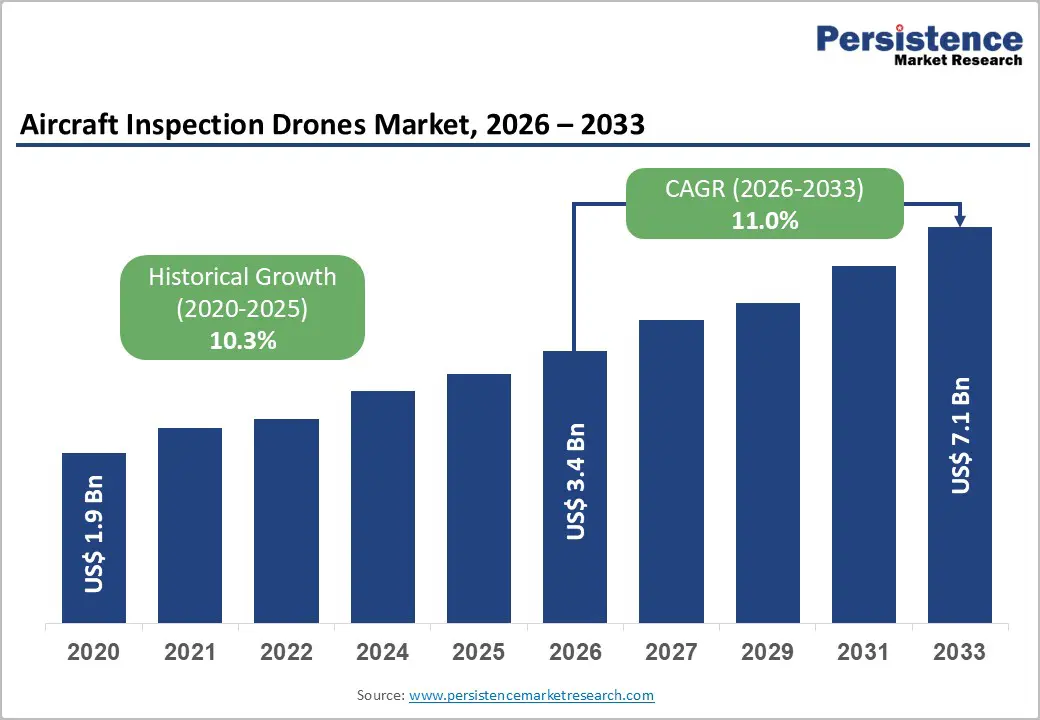
The global aircraft inspection drones market size is likely to be valued at US$3.4 billion in 2026 and is expected to reach US$7.1 billion by 2033, growing at a CAGR of 11.0% during the forecast period from 2026 to 2033, driven by the aviation industry's increasing focus on maintenance efficiency, safety compliance, and digital inspection technologies.
Advanced technologies such as artificial intelligence, machine vision, thermal imaging, LiDAR, and autonomous navigation are expanding drone capabilities for detecting structural defects and surface anomalies. Growth is supported by evolving aviation safety regulations, rising aircraft fleets, digitalization of maintenance operations, and increasing demand for predictive and data-driven aircraft inspection practices.
Key Industry Highlights:
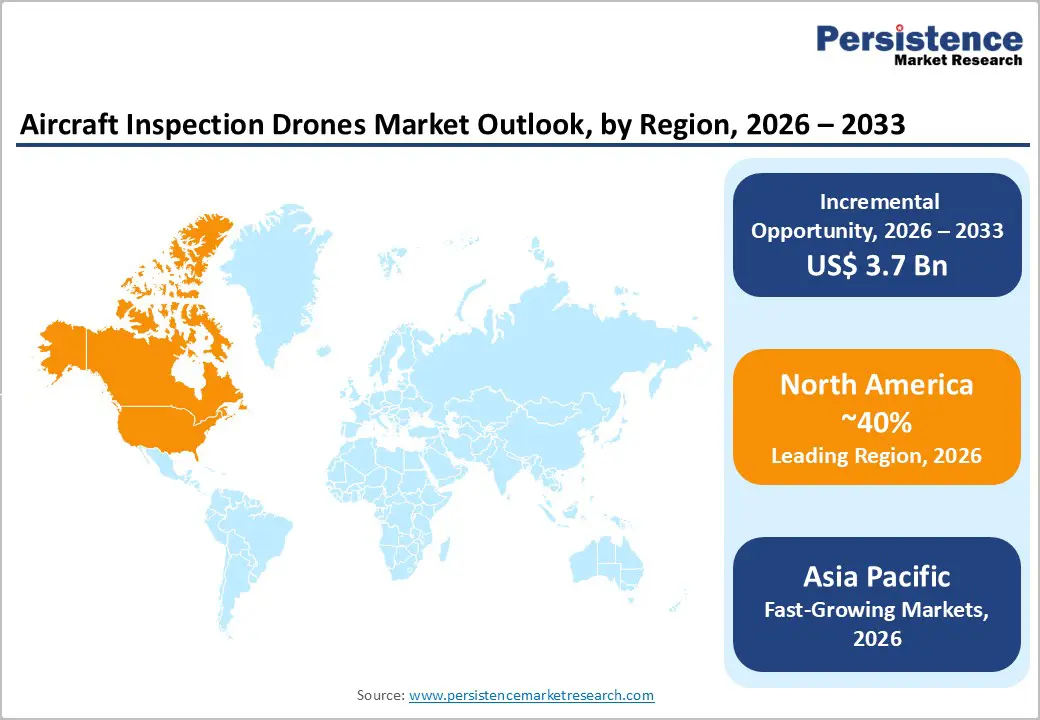
- Leading Region: North America is anticipated to be the leading region, accounting for a market share of 40% in 2026, driven by the large aircraft fleet owned by the U.S., supportive FAA regulations, and strong adoption of drone-based MRO inspection technologies.
- Fastest-growing Region: Asia Pacific is likely to be the fastest-growing region, supported by rapid aviation expansion, increasing aircraft deliveries, and growing adoption of drone inspection technologies.
- Leading Product Type: Multi-rotors are expected to dominate the product type segment in 2026, accounting for approximately 45% of market revenue, driven by their exceptional maneuverability and high-precision inspection capabilities.
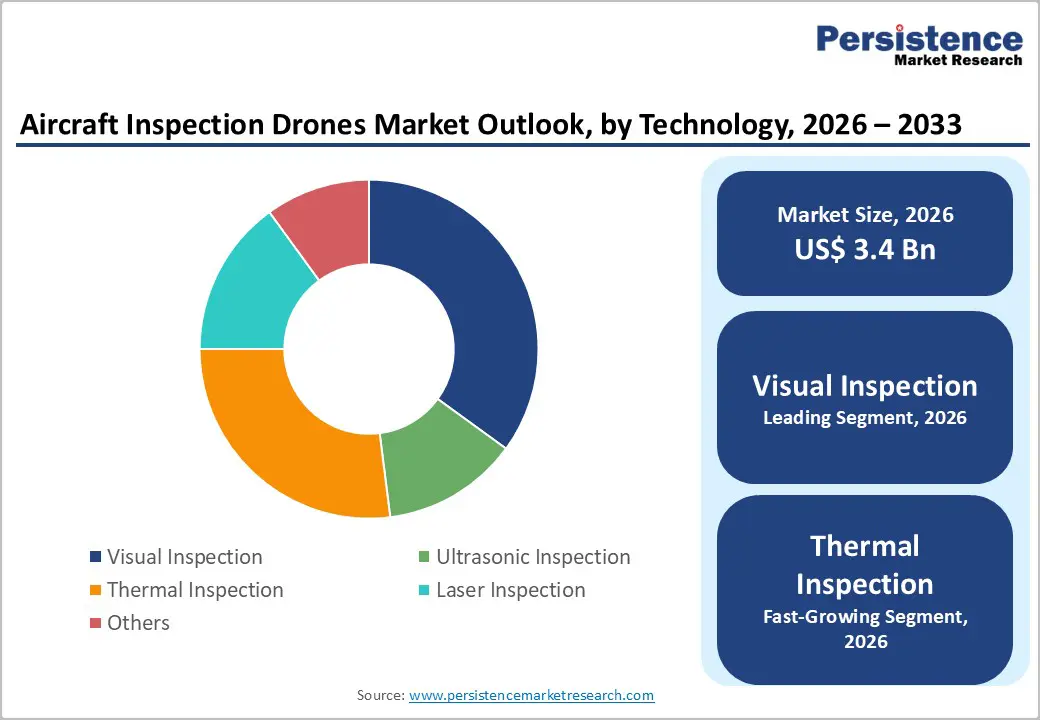
- Leading Technology: Visual inspection is anticipated to be the leading technology, accounting for over 50% of the revenue share in 2026, supported by its widespread adoption for routine aircraft inspections.
- Key Opportunity: The growing integration of autonomous drone inspection systems with AI-driven analytics, digital twins, and predictive maintenance platforms is creating significant opportunities to enhance aircraft safety, reduce downtime, and optimize aviation maintenance operations.
DRO Analysis
Driver - Technological Advancements in Sensors and AI Integration
Aircraft inspection drones are increasingly equipped with advanced sensing technologies, including high-resolution optical cameras, thermal imaging systems, LiDAR scanners, and ultrasonic sensors. These technologies enable the detection of cracks, corrosion, dents, loose fasteners, and other structural anomalies that may be difficult to identify through conventional manual inspections.
Improved sensor accuracy allows maintenance teams to collect comprehensive inspection data in less time while reducing aircraft downtime. The integration of multiple sensing modalities enhances inspection reliability, enabling operators to evaluate aircraft surfaces, components, and critical structures with greater precision and consistency across maintenance operations worldwide.
Artificial intelligence is transforming aircraft inspection workflows by automating image analysis, defect recognition, and maintenance reporting. AI-powered software can process thousands of inspection images rapidly, identifying potential issues and highlighting areas requiring assessment. This reduces dependence on manual image review while improving consistency and accuracy in maintenance decisions.
Restraint - Regulatory and Airspace Integration Challenges
Aviation authorities impose strict rules regarding drone operations near airports, aircraft hangars, and controlled airspace to ensure flight safety. Operators often require specialized certifications, flight permissions, and compliance with operational guidelines before conducting inspections. Regulatory differences between countries complicate deployment for multinational airlines and maintenance providers. These varying standards create operational complexities and increase implementation timelines.
Airspace integration challenges also affect large-scale adoption across commercial aviation environments. Airports must coordinate drone activities with existing air traffic management systems to avoid operational disruptions and safety risks. Concerns regarding cybersecurity, communication reliability, and interference with aviation equipment require additional safeguards and monitoring systems.
Opportunity - Technological Convergence with AI and Digital Twins
Inspection drones can capture detailed visual and sensor-based data that feeds directly into digital representations of aircraft assets. These digital twins provide real-time insights into structural conditions, maintenance history, and performance trends. By continuously updating virtual models with inspection findings, operators can monitor asset health more effectively and identify potential issues before they become critical.
This capability supports proactive maintenance strategies and improves operational efficiency throughout the aircraft lifecycle across commercial and defense aviation sectors. As digital transformation accelerates across the aviation industry, integration between drones, AI analytics, and digital twin platforms is expanding significantly.
Automated inspection data can be combined with predictive algorithms to forecast maintenance requirements, optimize resource allocation, and reduce unscheduled downtime. Airlines and MRO providers can leverage these technologies to improve decision-making, enhance regulatory compliance, and extend aircraft service life. The ability to create highly accurate digital records of inspections also strengthens documentation and audit processes.
Category-wise Analysis
Product Type Insights
Multi-rotor drones are expected to account for 45% of revenue in 2026, due to their exceptional maneuverability, hovering capability, and ability to operate safely in confined aircraft maintenance environments. These drones are highly suitable for close-range inspections of fuselages, wings, engines, landing gear, and tail sections where precision and stability are critical. For example, Donecle’s autonomous aircraft inspection drones utilize multi-rotor technology to perform detailed exterior aircraft inspections in maintenance hangars and airport environments.
Hybrid drones are likely to represent the fastest-growing segment, supported by their ability to combine the vertical takeoff and landing capabilities of multi-rotor systems with the extended flight endurance of fixed-wing platforms. This combination enables operators to inspect larger aircraft, airport infrastructure, and extensive maintenance facilities more efficiently than conventional drone platforms. For instance, several advanced hybrid UAV platforms developed for industrial inspections are being adapted for large-scale aviation inspection projects.
Technology Insights
Visual inspection is projected to lead the market, capturing around 50% of the revenue share in 2026, supported by its widespread use in routine aircraft maintenance and safety assessments. High-resolution cameras mounted on drones enable inspectors to capture detailed images of aircraft exteriors, including fuselage panels, wings, control surfaces, and engine structures. A notable example is that Airbus has utilized drone-based visual inspection systems to streamline aircraft maintenance procedures and improve inspection efficiency across commercial aviation operations.
Thermal inspection is likely to be the fastest-growing technology due to its ability to detect hidden defects that may not be visible through standard optical imaging. Increasing adoption of predictive maintenance strategies is encouraging airlines and MRO organizations to invest in thermal imaging solutions capable of identifying potential problems before they develop into significant maintenance concerns. For example, thermal imaging drones are increasingly used during composite aircraft inspections to identify hidden structural defects without requiring component disassembly.
Application Insights
Surface inspection is expected to account for 48% of revenue in 2026, due to the frequency and importance of exterior aircraft assessments. Airlines and maintenance providers regularly inspect aircraft surfaces to identify corrosion, dents, cracks, paint deterioration, lightning strike damage, and other visible defects that could affect safety and performance. For instance, Delta Air Lines has explored drone-assisted aircraft surface inspection technologies to improve maintenance efficiency and reduce aircraft turnaround times.
Structural inspection is likely to represent the fastest-growing segment, supported by airlines and aviation authorities placing greater emphasis on aircraft integrity, safety compliance, and predictive maintenance practices. Structural inspections focus on identifying cracks, fatigue damage, corrosion, and stress-related defects within critical aircraft components. For example, Boeing has assessed advanced drone-based inspection technologies to improve structural evaluations, streamline maintenance activities, and support more effective aircraft health monitoring.
Regional Insights
North America Aircraft Inspection Drones Market Trends
North America is anticipated to be the leading region, accounting for a market share of 40% in 2026, supported by advanced aviation infrastructure, a large commercial and military aircraft fleet, and widespread adoption of digital maintenance technologies. For example, Skydio has expanded its autonomous drone inspection capabilities for enterprise and industrial applications, supporting aviation operators seeking automated aircraft inspection workflows and enhanced operational efficiency.
U.S. Aircraft Inspection Drones Market Trends
The U.S. is expected to dominate the regional market, accounting for approximately 85% of the market share in 2026, driven by strong adoption, supported by the country's extensive commercial aviation sector and large MRO industry. Airlines continue investing in digital maintenance technologies to improve fleet availability. FAA initiatives supporting advanced drone operations are encouraging greater deployment across aviation environments. Aircraft operators increasingly utilize AI-enabled inspection systems for predictive maintenance programs.
Canada Aircraft Inspection Drones Market Trends
Canada is likely to be a significant market for aircraft inspection drones, holding approximately 15% of the market share in 2026, supported by growing investment in aviation technology and industrial drone applications. The country has a well-developed aerospace sector that supports innovation in inspection and maintenance technologies. Airlines and maintenance providers are exploring drone solutions to improve inspection efficiency and reduce operational costs. Transport Canada continues to support the safe integration of drones into commercial operations through evolving regulatory frameworks.
Europe Aircraft Inspection Drones Market Trends
Europe is likely to be a significant market for aircraft inspection drones in 2026, due to a strong aerospace manufacturing base, stringent aviation safety requirements, and increasing investment in smart maintenance technologies. For instance, Airbus has deployed drone-based aircraft inspection technologies as part of its efforts to modernize maintenance procedures and improve inspection accuracy across commercial aviation operations.
U.K. Aircraft Inspection Drones Market Trends
The U.K. is likely to be a significant market for aircraft inspection drones, with estimates for 20% of Europe market share in 2026, supported by aviation organizations' focus on improving operational efficiency and maintenance effectiveness. Airlines and MRO providers are integrating drone technologies into inspection workflows to reduce aircraft downtime. The country's aerospace sector remains highly innovative, supporting the development of advanced drone and AI solutions.
Germany Aircraft Inspection Drones Market Trends
Germany is anticipated to dominate the regional market, accounting for around 35% of the Europe market share in 2026, due to its strong aerospace manufacturing and engineering capabilities. The country hosts a significant concentration of aviation technology companies and research institutions. Aircraft maintenance organizations are increasingly adopting automated inspection systems to improve productivity and inspection quality. AI-powered analytics and digital maintenance platforms are gaining traction across the aviation sector.
Asia Pacific Aircraft Inspection Drones Market Trends
The Asia Pacific region is likely to be the fastest-growing region in aircraft inspection drones in 2026. Its expanding aviation fleets, increasing air passenger traffic, and growing investment in aerospace infrastructure. A notable example is Aerodyne Group, which has expanded its industrial drone services across Asia, supporting advanced inspection operations and digital asset management solutions for aviation and infrastructure sectors.
China Aircraft Inspection Drones Market Trends
China is projected to dominate the regional market, holding around a 30% share of the market in 2026, due to the rapid expansion of its aviation industry and strong domestic drone manufacturing capabilities. Airlines are increasingly investing in advanced maintenance technologies to support growing aircraft fleets. Government support for drone innovation and intelligent aviation systems continues to encourage market development. Domestic drone manufacturers are enhancing capabilities in autonomous navigation, AI analytics, and imaging technologies.
India Aircraft Inspection Drones Market Trends
India is expected to emerge as a significant market, accounting for approximately 22% share in 2026, due to expanding commercial aviation activities and increasing investment in aviation infrastructure. Airlines are focusing on operational efficiency and faster maintenance procedures to support fleet growth. The country's drone ecosystem is rapidly evolving, supported by innovation programs and domestic manufacturing initiatives.
Competitive Landscape
The global aircraft inspection drones market exhibits a moderately fragmented structure, driven by the presence of specialized drone manufacturers, aviation technology providers, autonomous inspection software developers, and aerospace companies focused on maintenance innovation.
With key leaders including DJI, Donecle, Airbus S.A.S., Skydio, Delair, Aerodyne Group, Parrot Drones SAS, Airobotics, and MIR Innovation, the market continues to witness growing innovation and product enhancement activities. These players compete through autonomous inspection capabilities, AI-powered defect detection, advanced imaging technologies, operational efficiency improvements, regulatory compliance support, and integration with digital maintenance platforms.
Key Industry Developments:
- In May 2026, Jet Aviation launched its automated drone and AI-powered aircraft inspection service in the United States, enabling digital exterior aircraft inspections for pre-purchase evaluations, insurance assessments, and warranty cases, and enhancing inspection accuracy and operational efficiency for aviation customers.
- In June 2026, WaiV Robotics expanded into the U.S. offshore market with the launch of its autonomous drone launch and recovery platform, enabling drones to automatically take off, land, and redeploy from moving vessels, enhancing offshore inspection, maintenance, and emergency response operations for energy and maritime operators.
Companies Covered in Aircraft Inspection Drones Market
- DJI
- MRO Drone Ltd.
- Donecle
- Airbus S.A.S.
- Blue Bear Systems Research Ltd
- Luftronix, Inc.
- Aircraft Inspection Drone
- MIR Innovation
- Airwing
- Intel Corporation
- Parrot Drones SAS
- Airobotics
- Aerodyne Group
- Delair
Frequently Asked Questions
The global aircraft inspection drones market is projected to reach US$3.4 billion in 2026.
Growing demand for faster, safer, and more cost-effective aircraft inspections, supported by advancements in AI, imaging sensors, and predictive maintenance technologies, is driving the aircraft inspection drones market.
The aircraft inspection drones market is expected to grow at a CAGR of 11.0% from 2026 to 2033.
Expanding adoption of AI-enabled autonomous drone inspections integrated with digital twin and predictive maintenance platforms across commercial, military, and MRO aviation operations presents a significant market opportunity.
DJI, MRO Drone Ltd., Donecle, Amfit Inc., and Airbus S.A.S. are the leading players.


