


- Executive Summary
- Global AI Shopping Assistant Market Snapshot, 2025 and 2032
- Market Opportunity Assessment, 2025 - 2032, US$ Bn
- Key Market Trends
- Future Market Projections
- Premium Market Insights
- End-user Developments and Key Market Events
- PMR Analysis and Recommendations
- Market Overview
- Market Scope and Definition
- Market Dynamics
- Drivers
- Restraints
- Opportunity
- Key Trends
- Macro-economic Factors
- Increasing Adoption of Voice and Conversational AI Technologies
- Rising Consumer Preference for Personalization and Convenience
- COVID-19 Impact Analysis
- Forecast Factors - Relevance and Impact
- Value Added Insights
- Technology Demand Analysis
- Regulatory Landscape
- Value Chain Analysis
- PESTLE Analysis
- Porter’s Five Force Analysis
- Global AI Shopping Assistant Market Outlook
- Key Highlights
- Market Volume (Units) Projections
- Market Size (US$ Bn) and Y-o-Y Growth
- Absolute $ Opportunity
- Market Size (US$ Bn) and Volume (Units) Analysis and Forecast
- Historical Market Size (US$ Bn) Analysis, 2019-2024
- Market Size (US$ Bn) Analysis and Forecast, 2025 - 2032
- Global AI Shopping Assistant Market Outlook: Technology
- Introduction / Key Findings
- Historical Market Size (US$ Bn) and Volume (Units) Analysis, By Technology, 2019 - 2024
- Market Size (US$ Bn) and Volume (Units) Analysis and Forecast, By Technology, 2025 - 2032
- Natural Language Processing (NLP)
- Computer Vision
- Machine Learning and Predictive Analytics
- Voice Recognition
- Others
- Market Attractiveness Analysis: Technology
- Global AI Shopping Assistant Market Outlook: Deployment Mode
- Introduction / Key Findings
- Historical Market Size (US$ Bn) Analysis, By Deployment Mode, 2019 - 2024
- Market Size (US$ Bn) Analysis and Forecast, By Deployment Mode, 2025 - 2032
- Cloud-based
- On-premises
- Hybrid
- Market Attractiveness Analysis: Deployment Mode
- Global AI Shopping Assistant Market Outlook: Application
- Introduction / Key Findings
- Historical Market Size (US$ Bn) Analysis, By Application, 2019 - 2024
- Market Size (US$ Bn) Analysis and Forecast, By Application, 2025 - 2032
- Product Discovery and Search
- Price Comparison and Deals
- Virtual Try-on
- Customer Support
- Checkout and Payments
- Others
- Market Attractiveness Analysis: Application
- Global AI Shopping Assistant Market Outlook: End-user
- Introduction / Key Findings
- Historical Market Size (US$ Bn) Analysis, By End-user, 2019 - 2024
- Market Size (US$ Bn) Analysis and Forecast, By End-user, 2025 - 2032
- E-commerce Platforms
- Retail Chains
- Consumer Electronics Brands
- Fashion and Apparel Retailers
- Grocery and Food Delivery Services
- Others
- Market Attractiveness Analysis: End-user
- Key Highlights
- Global AI Shopping Assistant Market Outlook: Region
- Key Highlights
- Historical Market Size (US$ Bn) and Volume (Units) Analysis, By Region, 2019 - 2024
- Market Size (US$ Bn) and Volume (Units) Analysis and Forecast, By Region, 2025 - 2032
- North America
- Europe
- East Asia
- South Asia and Oceania
- Latin America
- Middle East & Africa
- Market Attractiveness Analysis: Region
- North America AI Shopping Assistant Market Outlook
- Key Highlights
- Historical Market Size (US$ Bn) Analysis, By Market, 2019 - 2024
- By Country
- By Technology
- By Deployment Mode
- By Application
- By End-user
- Market Size (US$ Bn) Analysis and Forecast, By Country, 2025 - 2032
- U.S.
- Canada
- Market Size (US$ Bn) and Volume (Units) Analysis and Forecast, By Technology, 2025 - 2032
- Natural Language Processing (NLP)
- Computer Vision
- Machine Learning and Predictive Analytics
- Voice Recognition
- Others
- Market Size (US$ Bn) Analysis and Forecast, By Deployment Mode, 2025 - 2032
- Cloud-based
- On-premises
- Hybrid
- Market Size (US$ Bn) Analysis and Forecast, By Application, 2025 - 2032
- Product Discovery and Search
- Price Comparison and Deals
- Virtual Try-on
- Customer Support
- Checkout and Payments
- Others
- Market Size (US$ Bn) Analysis and Forecast, By End-user, 2025 - 2032
- E-commerce Platforms
- Retail Chains
- Consumer Electronics Brands
- Fashion and Apparel Retailers
- Grocery and Food Delivery Services
- Others
- Market Attractiveness Analysis
- Europe AI Shopping Assistant Market Outlook
- Key Highlights
- Historical Market Size (US$ Bn) Analysis, By Market, 2019 - 2024
- By Country
- By Technology
- By Deployment Mode
- By Application
- By End-user
- Market Size (US$ Bn) Analysis and Forecast, By Country, 2025 - 2032
- Germany
- France
- U.K.
- Italy
- Spain
- Russia
- Türkiye
- Rest of Europe
- Market Size (US$ Bn) and Volume (Units) Analysis and Forecast, By Technology, 2025 - 2032
- Natural Language Processing (NLP)
- Computer Vision
- Machine Learning and Predictive Analytics
- Voice Recognition
- Others
- Market Size (US$ Bn) Analysis and Forecast, By Deployment Mode, 2025 - 2032
- Cloud-based
- On-premises
- Hybrid
- Market Size (US$ Bn) Analysis and Forecast, By Application, 2025 - 2032
- Product Discovery and Search
- Price Comparison and Deals
- Virtual Try-on
- Customer Support
- Checkout and Payments
- Others
- Market Size (US$ Bn) Analysis and Forecast, By End-user, 2025 - 2032
- E-commerce Platforms
- Retail Chains
- Consumer Electronics Brands
- Fashion and Apparel Retailers
- Grocery and Food Delivery Services
- Others
- Market Attractiveness Analysis
- East Asia AI Shopping Assistant Market Outlook
- Key Highlights
- Historical Market Size (US$ Bn) Analysis, By Market, 2019 - 2024
- By Country
- By Technology
- By Deployment Mode
- By Application
- By End-user
- Market Size (US$ Bn) Analysis and Forecast, By Country, 2025 - 2032
- China
- Japan
- South Korea
- Market Size (US$ Bn) and Volume (Units) Analysis and Forecast, By Technology, 2025 - 2032
- Natural Language Processing (NLP)
- Computer Vision
- Machine Learning and Predictive Analytics
- Voice Recognition
- Others
- Market Size (US$ Bn) Analysis and Forecast, By Deployment Mode, 2025 - 2032
- Cloud-based
- On-premises
- Hybrid
- Market Size (US$ Bn) Analysis and Forecast, By Application, 2025 - 2032
- Product Discovery and Search
- Price Comparison and Deals
- Virtual Try-on
- Customer Support
- Checkout and Payments
- Others
- Market Size (US$ Bn) Analysis and Forecast, By End-user, 2025 - 2032
- E-commerce Platforms
- Retail Chains
- Consumer Electronics Brands
- Fashion and Apparel Retailers
- Grocery and Food Delivery Services
- Others
- Market Attractiveness Analysis
- South Asia & Oceania AI Shopping Assistant Market Outlook
- Key Highlights
- Historical Market Size (US$ Bn) Analysis, By Market, 2019 - 2024
- By Country
- By Technology
- By Deployment Mode
- By Application
- By End-user
- Market Size (US$ Bn) Analysis and Forecast, By Country, 2025 - 2032
- India
- Southeast Asia
- ANZ
- Rest of South Asia & Oceania
- Market Size (US$ Bn) and Volume (Units) Analysis and Forecast, By Technology, 2025 - 2032
- Natural Language Processing (NLP)
- Computer Vision
- Machine Learning and Predictive Analytics
- Voice Recognition
- Others
- Market Size (US$ Bn) Analysis and Forecast, By Deployment Mode, 2025 - 2032
- Cloud-based
- On-premises
- Hybrid
- Market Size (US$ Bn) Analysis and Forecast, By Application, 2025 - 2032
- Product Discovery and Search
- Price Comparison and Deals
- Virtual Try-on
- Customer Support
- Checkout and Payments
- Others
- Market Size (US$ Bn) Analysis and Forecast, By End-user, 2025 - 2032
- E-commerce Platforms
- Retail Chains
- Consumer Electronics Brands
- Fashion and Apparel Retailers
- Grocery and Food Delivery Services
- Others
- Market Attractiveness Analysis
- Latin America AI Shopping Assistant Market Outlook
- Key Highlights
- Historical Market Size (US$ Bn) Analysis, By Market, 2019 - 2024
- By Country
- By Technology
- By Deployment Mode
- By Application
- By End-user
- Market Size (US$ Bn) Analysis and Forecast, By Country, 2025 - 2032
- Brazil
- Mexico
- Rest of Latin America
- Market Size (US$ Bn) and Volume (Units) Analysis and Forecast, By Technology, 2025 - 2032
- Natural Language Processing (NLP)
- Computer Vision
- Machine Learning and Predictive Analytics
- Voice Recognition
- Others
- Market Size (US$ Bn) Analysis and Forecast, By Deployment Mode, 2025 - 2032
- Cloud-based
- On-premises
- Hybrid
- Market Size (US$ Bn) Analysis and Forecast, By Application, 2025 - 2032
- Product Discovery and Search
- Price Comparison and Deals
- Virtual Try-on
- Customer Support
- Checkout and Payments
- Others
- Market Size (US$ Bn) Analysis and Forecast, By End-user, 2025 - 2032
- E-commerce Platforms
- Retail Chains
- Consumer Electronics Brands
- Fashion and Apparel Retailers
- Grocery and Food Delivery Services
- Others
- Market Attractiveness Analysis
- Middle East & Africa AI Shopping Assistant Market Outlook
- Key Highlights
- Historical Market Size (US$ Bn) Analysis, By Market, 2019 - 2024
- By Country
- By Technology
- By Deployment Mode
- By Application
- By End-user
- Market Size (US$ Bn) Analysis and Forecast, By Country, 2025 - 2032
- GCC Countries
- Egypt
- South Africa
- Northern Africa
- Rest of Middle East & Africa
- Market Size (US$ Bn) and Volume (Units) Analysis and Forecast, By Technology, 2025 - 2032
- Natural Language Processing (NLP)
- Computer Vision
- Machine Learning and Predictive Analytics
- Voice Recognition
- Others
- Market Size (US$ Bn) Analysis and Forecast, By Deployment Mode, 2025 - 2032
- Cloud-based
- On-premises
- Hybrid
- Market Size (US$ Bn) Analysis and Forecast, By Application, 2025 - 2032
- Product Discovery and Search
- Price Comparison and Deals
- Virtual Try-on
- Customer Support
- Checkout and Payments
- Others
- Market Size (US$ Bn) Analysis and Forecast, By End-user, 2025 - 2032
- E-commerce Platforms
- Retail Chains
- Consumer Electronics Brands
- Fashion and Apparel Retailers
- Grocery and Food Delivery Services
- Others
- Market Attractiveness Analysis
- Competition Landscape
- Market Share Analysis, 2024
- Market Structure
- Competition Intensity Mapping By Market
- Competition Dashboard
- Company Profiles (Details - Overview, Financials, Strategy, Recent Developments)
- Amazon
- Overview
- Segments and Technology
- Key Financials
- Market Developments
- Market Strategy
- Microsoft
- IBM
- Apple
- Alibaba Group
- Baidu
- SAP SE
- Salesforce
- Shopify
- Oracle
- Walmart Labs
- eBay Inc.
- Pinterest (Shopping Lens)
- Clarifai
- ViSenze
- Syte AI
- Vue.ai
- TrueFit
- Farfetch
- Amazon
- Appendix
- Research Methodology
- Research Assumptions
- Acronyms and Abbreviations


- Hardware & Software IT Services
- AI Shopping Assistant Market
AI Shopping Assistant Market Size, Share, and Growth Forecast, 2025 - 2032
AI Shopping Assistant Market By Technology (NLP, Computer Vision), Deployment Mode (Cloud-based, On-premises), Application (Product Discovery and Search, Price Comparison and Deals), End-user, and Regional Analysis for 2025 - 2032
AI Shopping Assistant Market Size and Trends Analysis
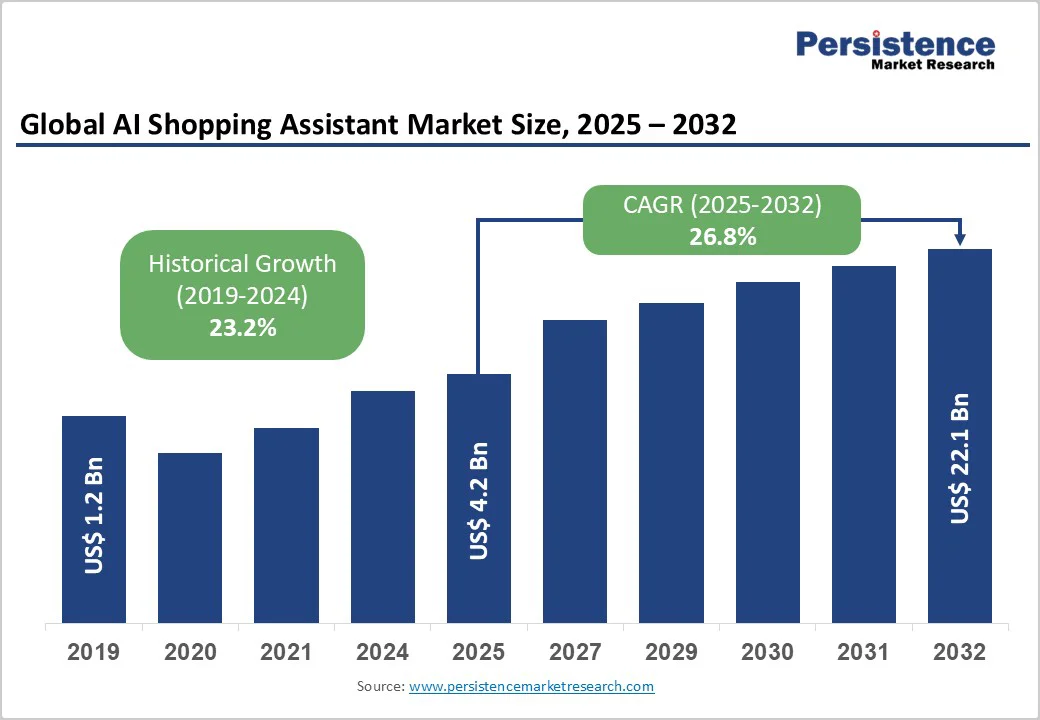
The global AI shopping assistant market size is likely to be valued at US$4.2 Billion in 2025 and is estimated to reach US$22.1 Billion in 2032, growing at a CAGR of 26.8% during the forecast period 2025 - 2032, driven by increasing demand for fast, personalized, and convenient online shopping experiences.
The surge in voice commerce shows how hands-free technology is changing buying behavior.
Key Industry Highlights
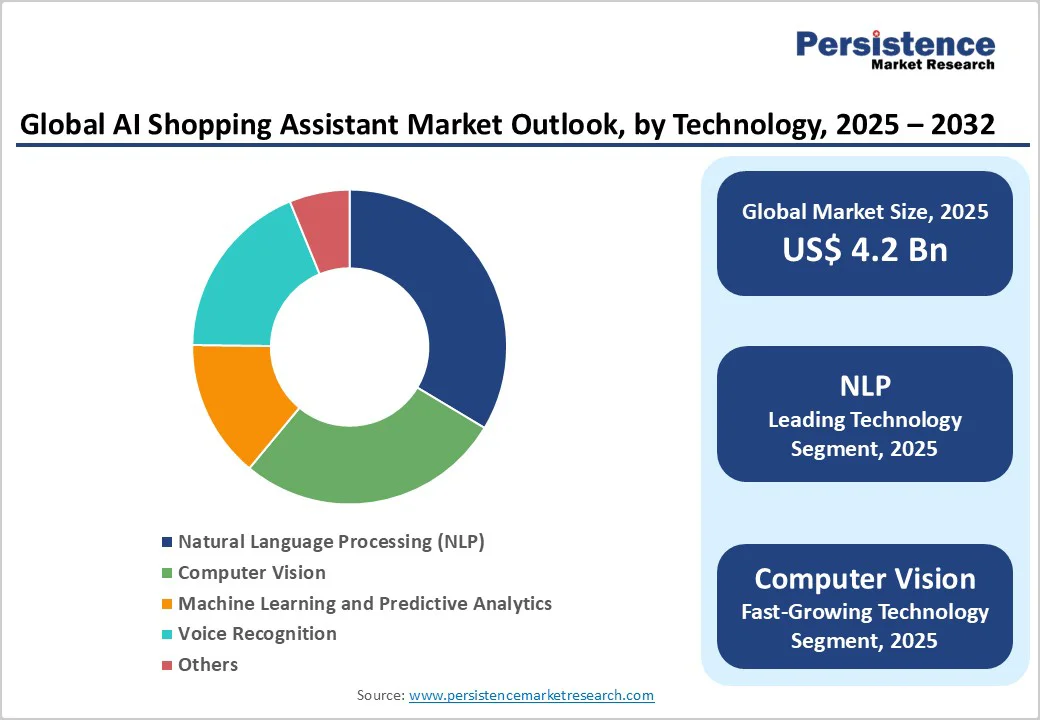
- Leading Technology: Natural language processing holds nearly 33.6% share in 2025, as it helps in understanding conversational language and context.
- Dominant Application: Product discovery and search, approximately 34.2% of the AI shopping assistant market share in 2025, since retailers use AI assistants to help users find products from vague or incomplete queries.
- Key End-user: E-commerce platforms accounted for about 39.6% of the market in 2025, managing massive product catalogs, making AI assistants essential for organizing and personalizing search results.
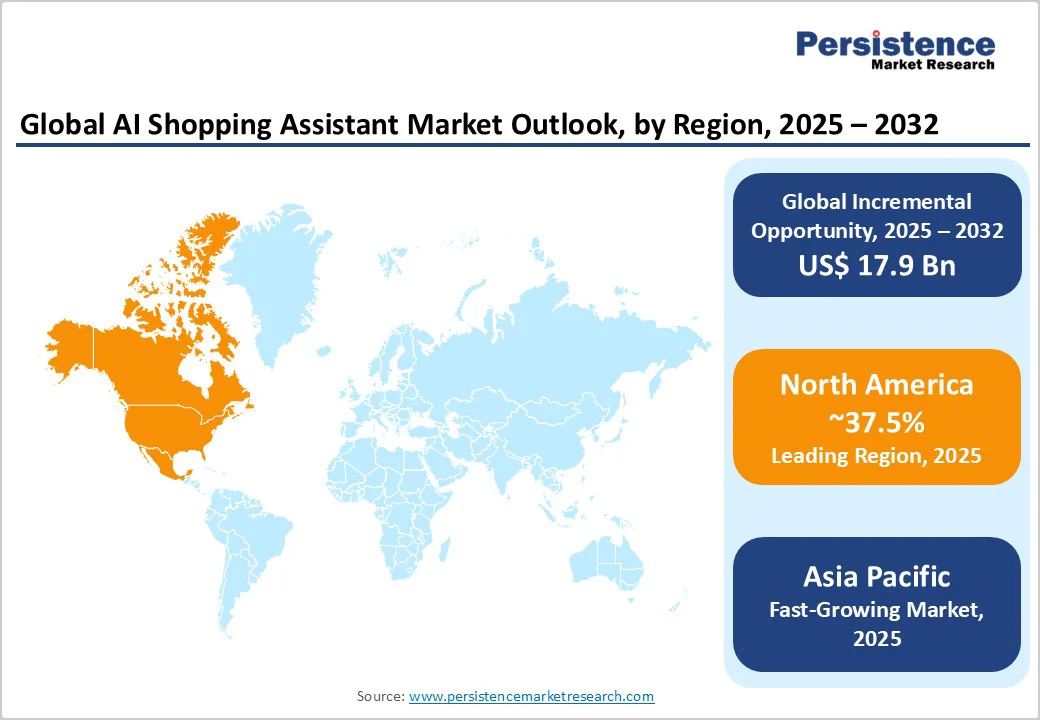
- Leading Region: North America, with about 37.5% share in 2025, backed by early adoption of conversational AI by retail giants such as Amazon, Walmart, and Target.
- Fastest-growing Region: Asia Pacific, bolstered by mobile-first shopping behavior and super app ecosystems.
- Recent Collaboration: OpenAI collaborated with PayPal to embed the latter’s digital wallet into the popular ChatGPT AI chatbot. The collaboration will allow users to use ChatGPT as their own personal AI-powered shopper.
| Key Insights | Details |
|---|---|
| AI Shopping Assistant Market Size (2025E) | US$4.2 Bn |
| Market Value Forecast (2032F) | US$22.1 Bn |
| Projected Growth (CAGR 2025 to 2032) | 26.8% |
| Historical Market Growth (CAGR 2019 to 2024) | 23.2% |
Market Factors - Growth, Barriers, and Opportunity Analysis
Growth Analysis - Fast Decision-making and Hands-free Convenience
AI shopping assistants are becoming popular as they simplify the product discovery process by instantly filtering through thousands of options to match user preferences. This reduces browsing time and helps shoppers make quick and confident purchase decisions. The addition of voice-based interfaces has further improved accessibility.
Users can now shop while driving, cooking, or performing other tasks. For instance, Amazon Alexa and Google Assistant have seen a rise in shopping-related commands, especially for household essentials and repeat purchases. This hands-free convenience is turning AI assistants into everyday shopping tools, enabling users to make purchases on the go without the need to navigate multiple screens or apps.
Immersive Product Visualization and Reduced Returns
AI shopping assistants integrated with Augmented Reality (AR) features are transforming online shopping by allowing customers to visualize products in their actual surroundings. Retailers such as IKEA and Wayfair have introduced AI-based AR assistants that let users virtually place furniture in their rooms before buying.
This visual preview reduces uncertainty about size, color, and fit- factors that often lead to product returns. According to Shopify’s 2024 report, AR-assisted shopping increased conversion rates by up to 30% while reducing return rates by 50%. As more brands adopt this feature, visual AI assistance is emerging as a key driver for consumer satisfaction and trust in online retail.
Barrier Analysis - Data Privacy Risks and Consumer Mistrust
AI shopping assistants rely heavily on collecting personal and payment data to deliver personalized recommendations, which often raises privacy and security concerns among consumers. Instances of chatbots leaking user information or generating unauthorized purchase suggestions have made shoppers wary of sharing sensitive data.
For example, a 2024 U.S. consumer study found that over 60% of users hesitated to connect payment details to AI-powered shopping tools due to potential misuse. Strict data protection rules in Europe have also increased compliance costs for retailers. Hence, companies deploying these assistants must strike a balance between personalization and user trust by ensuring transparent data handling and robust encryption.
Inaccurate Responses and Limited Context Understanding
Despite major developments in Natural Language Processing (NLP), AI shopping assistants still struggle to understand complex or nuanced queries, especially those involving regional slang, multi-product comparisons, or highly specific requests. This often results in irrelevant product recommendations or incomplete answers, pushing users back to manual search or human agents.
For instance, users of early beta versions of Amazon’s Rufus in 2024 reported inconsistent responses when searching for niche technical products. Such errors reduce user confidence and highlight that AI tools still require extensive human training, contextual fine-tuning, and retail-specific datasets to achieve reliability across diverse product categories and languages.
Opportunity Analysis - Automation of Customer Support and Purchase Management
AI shopping assistants can manage end-to-end customer interactions, from answering post-purchase queries to tracking deliveries and suggesting reorders, without human intervention. This automation not only reduces response times but also enables support teams to focus on complex or emotionally charged issues that require human judgment.
For instance, Walmart’s AI Super Agents now autonomously resolve most customer inquiries about returns and order status. Similarly, Shopify’s AI assistant Sidekick helps merchants manage inventory and recommend products for restocking. As natural language models become more context-aware, AI assistants are evolving from passive helpers into proactive retail partners capable of managing entire purchase cycles.
Integration with Voice and Connected Devices
The surging use of voice-activated technology presents a key growth avenue for AI shopping assistants. As smart speakers and voice-enabled smartphones become part of daily routines, shoppers are extensively using them for hands-free browsing and purchases.
In 2024, Google Assistant and Amazon Alexa recorded a rise in shopping-related voice queries, especially in categories such as groceries and home essentials. Retailers, including Tesco and Carrefour, have begun integrating their product catalogs with these assistants, enabling users to add items to their carts or reorder essentials with simple voice commands.
Category-wise Analysis
Technology Insights
NLP is estimated to dominate with approximately 33.6% of the share in 2025, as it allows users to communicate naturally, using everyday language, rather than rigid commands. This makes interactions intuitive and conversational. The use of large language models, including GPT-4 and Gemini, has further improved accuracy in handling complex shopping requests. By interpreting multi-step queries and personalizing results in real time, NLP has become the foundation for smooth, human-like shopping experiences.
Computer vision is gaining momentum as AI shopping assistants increasingly rely on image-based searches and visual recognition. Shoppers now upload pictures to find similar products, a feature widely popularized by Google Lens and Pinterest Lens. Zalando and Myntra use image recognition tools that identify clothing styles, colors, and patterns, making product matching far more precise than keyword-based searches.
Application Insights
Product discovery and search will likely account for around 34.2% of the share in 2025, since they directly improve customer convenience. Consumers often face decision fatigue when browsing large online catalogs, and AI-based discovery tools simplify this process through personalized recommendations and contextual search. This capability increases conversion rates while improving user satisfaction. As discovery is the first step in every shopping journey, it continues to dominate AI use cases in retail.
Virtual try-on technology has become a key AI application, bridging the gap between online and physical shopping. Fashion and beauty retailers use AR to let users preview products before purchasing. Sephora’s Virtual Artist and L’Oréal’s ModiFace, for instance, allow customers to test cosmetics digitally. This feature boosts consumer confidence, especially in high-return categories such as apparel and accessories.
End-user Insights
E-commerce platforms are poised to capture nearly 39.6% of the market in 2025, as they handle massive product inventories and daily customer interactions. These platforms use AI to personalize search results, optimize pricing, and automate customer service. The competitive nature of online retail pushes leading companies to improve user experience constantly, and AI assistants help reduce cart abandonment and increase conversion.
Fashion and apparel retailers are emerging as key end users of AI shopping assistants, as their customers rely heavily on visual appeal, fit, and style recommendations. These retailers use AI to deliver personalized styling advice, visual search, and virtual try-on experiences. For instance, H&M uses AI chatbots to suggest outfit combinations, while Nike employs AI to recommend shoe sizes based on past purchases.
Regional Insights
North America AI Shopping Assistant Market Trends
In 2025, North America is expected to lead with nearly 37.5% of the market share, as AI shopping assistants shift from experimental chatbots to full-scale commercial tools integrated into e-commerce ecosystems. Leading U.S. retailers such as Walmart and Amazon have built their own proprietary systems. Walmart’s Super Agents, launched in 2024, can manage real-time queries, recommend products, and even handle customer service tasks.
Target and Best Buy are also piloting voice and chat-based AI assistants to improve online and in-store experiences. In addition, Klarna’s AI-powered shopping assistant has gained traction in North America, reducing customer service workloads by over 60%. The region is seeing increased collaboration between AI developers and retailers, with OpenAI, Microsoft, and Google providing retail-specific AI models to deliver personalized shopping experiences.
Asia Pacific AI Shopping Assistant Market Trends
In the Asia Pacific, the use of AI shopping assistants is expanding steadily, pushed by mobile-first consumers and the dominance of super apps. China-based giants, including Alibaba and JD.com, have integrated AI assistants that provide product comparisons, live shopping support, and personalized recommendations based on user behavior. Alibaba’s Taobao Wenwen uses generative AI to answer customer questions and suggest products during live commerce sessions.
In Japan and South Korea, retailers are using AI chatbots LINE and KakaoTalk to connect directly with shoppers and handle order tracking or customized offers. Southeast Asian platforms such as Lazada and Shopee are adopting multilingual AI assistants to handle high-volume customer interactions, especially during big sale events. Also, India’s Flipkart and Myntra have started experimenting with AI-based fashion advisors that suggest outfits through conversational interfaces.
Europe AI Shopping Assistant Market Trends
In Europe, the focus is on ethical AI, transparency, and personalization within regulatory limits. Retailers are cautious but proactive in deploying AI shopping assistants that comply with GDPR and ensure data privacy. Klarna, based in Sweden, is leading the region’s innovation. Its AI assistant manages millions of daily interactions and is available in over 20 markets across Europe. Domestic retailers such as ASOS and Tesco are testing AI assistants that help shoppers with style recommendations and grocery planning, respectively.
France-based Carrefour has launched an AI chatbot integrated into its e-commerce site to provide recipe suggestions linked to available products. Modern consumers are also increasingly open to using AI shopping tools, provided they are transparent about data usage. Europe’s focus on responsible AI, language diversity, and cross-border e-commerce is shaping assistants that emphasize trust, cultural adaptation, and user control rather than aggressive upselling.
Competitive Landscape
The global AI shopping assistant market is becoming increasingly crowded, with leading tech players and retailers investing heavily to dominate this landscape. Amazon has taken a strong lead with its AI assistant Rufus, integrated into its shopping app in 2024, which helps users find, compare, and buy products using natural language.
These big players have a key advantage since they control large product databases, transaction data, and established user bases, allowing them to train smart models and personalize shopping experiences at scale.
Key Industry Developments
- In October 2025, Pinterest announced its plans to launch an AI-enabled shopping assistant that aims to suggest one’s next look. Users will be able to talk to the visual platform about what they are shopping for or searching for.
- In October 2025, Amazon introduced its Help Me Decide feature that uses AI to analyze one’s browsing history and preferences to recommend the right product for them with just one tap. This tool helps customers to quickly pick the right product.
Companies Covered in AI Shopping Assistant Market
- Amazon
- Microsoft
- IBM
- Apple
- Alibaba Group
- Baidu
- SAP SE
- Salesforce
- Shopify
- Oracle
- Walmart Labs
- eBay Inc.
- Pinterest (Shopping Lens)
- Clarifai
- ViSenze
- Syte AI
- Vue.ai
- TrueFit
- Farfetch
Frequently Asked Questions
The AI shopping assistant market size is projected to reach US$4.2 Billion in 2025.
Increasing demand for personalized shopping experiences and retailers’ growing emphasis on automating customer support are the primary drivers of market growth.
The AI shopping assistant market is poised to witness a CAGR of 26.8% from 2025 to 2032.
The use of multilingual AI tools and the rising emphasis on ethical AI are the key market opportunities.
Amazon, Google, and Microsoft are a few key market players.


