




- Technology
- Agentic AI Market
Agentic AI Market Size, Share, and Growth Forecast 2026 - 2033
Agentic AI Market by Component (Solutions, Services), Agent Architecture (Single-Agent Systems, Multi-Agent Systems), Technology (Machine Learning, Natural Language Processing, Deep Learning, Computer Vision, Others), Application (Customer Support, Sales and Revenue Operations, Marketing & Customer Engagement, Finance & Accounting, IT Operations, Data Analytics & Business Intelligence, Cybersecurity & Risk Operations, Others), End-User (Individual, Enterprises, BFSI, Retail and Consumer Goods, Others), and Regional Analysis for 2026 - 2033

Agentic AI Market Size and Trends Analysis
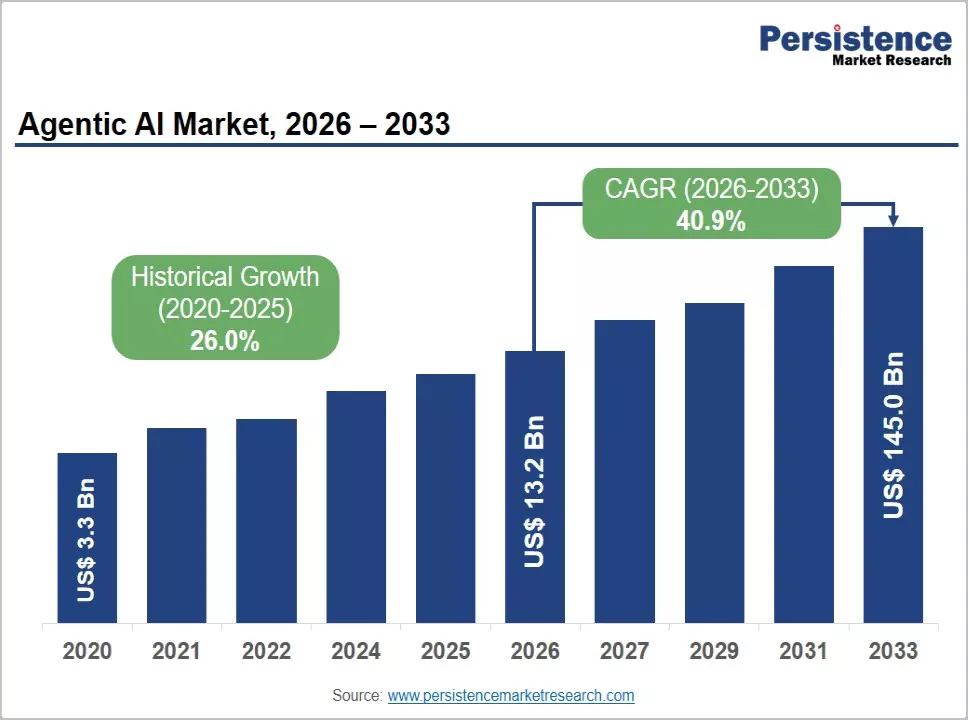
The global agentic AI market is expected to be valued at US$ 13.20 Billion in 2026 and is projected to reach US$ 145.53 Billion by 2033, growing at a CAGR of 40.9% between 2026 and 2033.
Autonomous AI systems capable of goal-directed reasoning, multi-step task execution, and real-time tool orchestration are expanding enterprise AI beyond conventional generative applications, driving greater investment in automated decision-making and workflow execution. Market growth reflects the convergence of maturing large language models (LLMs), rising demand for enterprise workflow automation, and expanding API-based infrastructure that enables AI agents to interact with business systems and digital tools.
Microsoft's 2024 commitment to embedding agentic capabilities across its Copilot ecosystem, including enterprise productivity, customer engagement, and DevOps, highlights the growing role of hyperscaler platforms in accelerating enterprise adoption of agentic AI.
Key Industry Highlights
- Leading Region: North America is likely to lead the market with around 40% share in 2026, supported by substantial hyperscaler infrastructure investments from Microsoft, Amazon, and Google, along with high enterprise cloud adoption rates.
- Leading Segment: Solutions represent the leading component, holding around 61% market share in 2026, reflecting enterprise buyers' preference for integrated, pre-certified agentic platforms over in-house development.
- Fastest-Growing Segment: NLP is the fastest-growing technology segment, driven by the expansion of voice and multimodal capabilities in frontier models. OpenAI's GPT-4o launch in 2024 expanded NLP-powered agentic applications into voice-driven customer service and multilingual knowledge workflows, supporting broader adoption across regions such as Asia Pacific and the Middle East.
- Key Market Opportunity: Organizations integrating explainable agent reasoning, auditable action logs, and EU AI Act-aligned conformity documentation can address growing governance requirements in regulated sectors, creating opportunities for vendors that combine compliance capabilities with agentic AI platforms.
Market Dynamics
Drivers - Enterprise Demand for Autonomous Workflow Orchestration
The productivity imperative driving enterprise AI investment is shifting from assisted generation toward autonomous execution. Agentic AI systems, characterized by iterative reasoning, dynamic tool calling, and goal decomposition, address limitations that robotic process automation (RPA) and conventional chatbots face in managing ambiguous, multi-step knowledge workflows without human intervention at each decision point. Salesforce reported in its Fiscal Year 2025 Annual Report that Agentforce deployments across its customer base reduced average case-handling time by measurable double-digit percentages, demonstrating the potential for measurable productivity gains and supporting enterprise procurement decisions based on ROI.
Large Language Model Infrastructure Investment by Hyperscalers
Sustained investment in foundation model infrastructure is strengthening the technology layer supporting agentic AI applications. Amazon Web Services (AWS) launched Amazon Bedrock Agents in 2023, enabling developers to build autonomous agents with memory, action groups, and knowledge-base retrieval through managed cloud infrastructure. Wider access to agent-building tools reduces technical barriers for enterprise and mid-market buyers, expanding adoption beyond organizations with dedicated in-house AI research teams.
Restraints - Hallucination Risk and Autonomous Decision Liability
Agentic AI systems increase the impact of LLM hallucinations because errors can propagate across multi-step task chains before human review. In regulated industries such as financial services, healthcare, and legal services, an erroneous autonomous action can result in compliance violations and material financial penalties. The European Union AI Act, which entered into force in August 2024, places certain AI systems used for autonomous decision-making in high-risk domains under strict conformity assessment requirements, increasing compliance considerations for enterprises deploying agentic workflows in these sectors.
Integration Complexity Across Legacy Enterprise Architectures
Effective agentic AI deployment requires reliable API connectivity with enterprise data systems, ERP platforms, CRM databases, and operational tools, many of which operate across fragmented or on-premises environments. Connecting agent frameworks such as LangChain and AutoGen with heterogeneous legacy systems can increase deployment costs, integration effort, and implementation timelines. Gartner identifies integration and data-readiness challenges as significant contributors to delayed enterprise AI projects, limiting adoption among mid-market organizations with constrained technical resources.
Opportunities - Rising Demand for Agentic AI In Financial Services Automation
The BFSI sector presents significant opportunities for agentic AI across compliance monitoring, fraud detection, and client onboarding workflows. Regulatory requirements spanning Basel III capital standards, Anti-Money Laundering (AML) directives, and Know Your Customer (KYC) mandates create continuous, rule-intensive workloads that align with autonomous multi-agent architectures. JPMorgan Chase has disclosed investments in AI-driven document processing and workflow automation, indicating that leading financial institutions are developing the technology and organizational infrastructure required for broader agentic AI adoption.
Agentic AI as the Next Layer Of The IT Operations Stack
The AIOps segment is gaining momentum as enterprises seek autonomous remediation of infrastructure incidents with less human-in-the-loop latency. Agentic systems capable of root-cause analysis, ticket triage, and self-healing actions extend conventional IT monitoring and alert-management capabilities across large-scale environments. ServiceNow's launch of Now Assist agentic capabilities in 2024, integrating AI-driven workflow resolution into the enterprise service management layer, highlights opportunities for vendors that embed agentic functionality into existing operational toolchains rather than requiring standalone deployments.
Category-wise Analysis
Component Insights
Solutions represent the leading segment, holding around 61.0% share of the agentic AI market in 2026. This leadership reflects enterprise buyers' preference for pre-integrated, deployment-ready platforms over custom-built implementations. Large financial institutions and technology companies increasingly procure end-to-end agentic platforms, such as Salesforce Agentforce and Microsoft Copilot Studio, that integrate agent orchestration, memory management, and tool calling within familiar enterprise interfaces, reducing internal engineering requirements and accelerating time-to-value.
Services represent the fastest-growing component segment, driven by rising demand for implementation, integration, and consulting services before and after enterprise platform deployment. As organizations transition from pilot projects to production-scale agentic AI, system integrators and professional services providers, including Accenture and Deloitte, which launched dedicated AI agent practice areas in 2024, are capturing demand for architecture design, change management, integration, and ongoing optimization.
Agent Architecture Insights
Multi-agent systems represent the dominant segment, accounting for 53.0% of the market share in 2026. Enterprise buyers favor multi-agent architectures because complex workflows spanning data retrieval, reasoning, code execution, and external API interaction often exceed the capabilities of a single autonomous agent. In financial services, multi-agent orchestration supports concurrent compliance checking, risk scoring, and client communication, with specialized sub-agents coordinating under a supervising orchestrator to manage complex workflows more effectively.
Single-agent systems represent the fastest-growing segment, fueled by the proliferation of developer-focused tools that simplify deployment for non-specialist users. OpenAI's release of the Assistants API in late 2023 enabled product teams at mid-market software companies to develop purpose-built autonomous agents for customer onboarding, internal knowledge retrieval, and other defined workflows, expanding access to agentic AI beyond organizations with extensive AI development capabilities.
Technology Insights
Machine learning is likely to be the leading technology segment, holding about 47.0% share of the agentic AI market in 2026. ML provides a foundational decision layer for agentic systems, supporting intent classification, context retrieval, action selection, and policy optimization. In IT operations, ML-powered platforms such as IBM's watsonx suite support real-time anomaly detection and automated remediation, using operational feedback to improve decision-making beyond the capabilities of static rule-based systems.
Natural language processing (NLP) represents the fastest-growing technology segment, driven by rapid advances in multimodal and conversational AI. OpenAI's release of GPT-4o in May 2024, combining text, voice, and image comprehension within a single model, expanded NLP's role as a primary human-agent interface, supporting agentic applications in voice-driven customer service and multilingual enterprise workflows at production scale.
Application Insights
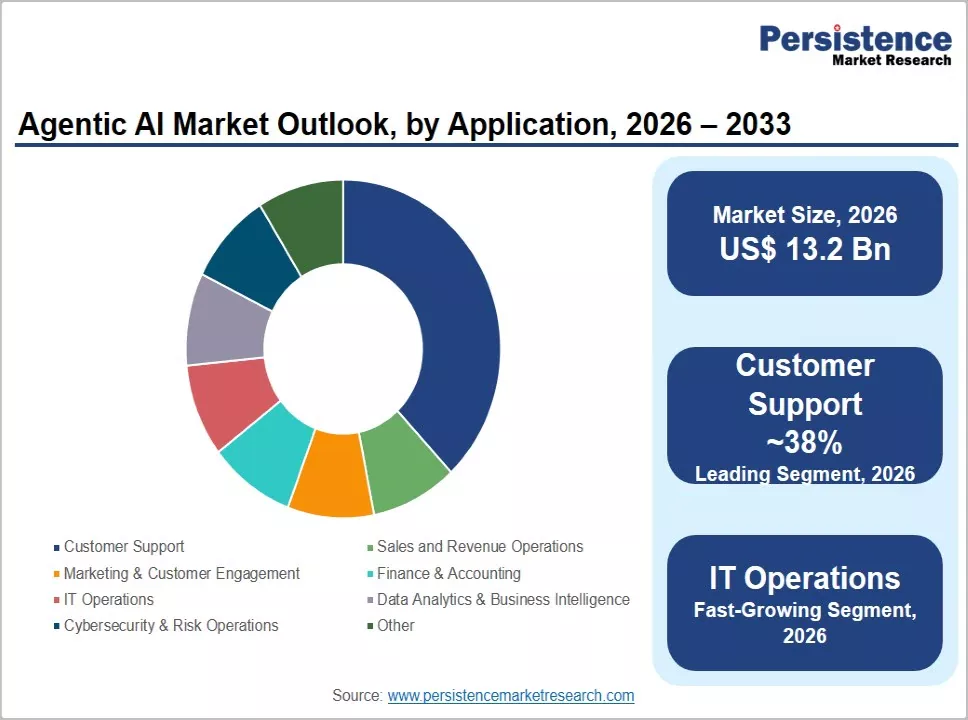
Customer support represents the leading application segment, accounting for 38.0% of the market share in 2026. Contact centers provide a high-volume and standardized environment for agentic deployment, with measurable performance indicators such as cost per resolution, first-contact resolution, and average handle time supporting clear ROI assessment. Telecommunications operators and e-commerce retailers are deploying agentic support systems for autonomous ticket resolution, order management, and escalation routing, with Klarna reporting in 2024 that its AI agent handled the equivalent workload of approximately 700 full-time agents across customer service interactions.
IT operations represent the fastest-growing application segment, driven by shortages of skilled site reliability engineers and increasing cloud infrastructure complexity. PagerDuty's agentic automation capabilities, expanded in its 2024 platform release, support autonomous incident triage and resolution across multi-cloud environments, helping reduce mean time to resolution for tier-one incidents while limiting the need for direct on-call engineer intervention.
End-User Insights
The BFSI segment is expected to dominate the market with around 24.0% share in 2026. Banks, insurers, and asset managers are leading adoption because high-volume transaction processing and complex compliance requirements provide clear use cases for agentic automation. Agentic AI applications at institutions such as Goldman Sachs support equity research summarization, regulatory filing preparation, and trade surveillance monitoring, targeting high-frequency, precision-intensive tasks where automation can reduce operational workload and processing costs.
Enterprises represent the fastest-growing end-user category, driven by the 2024 wave of enterprise AI platform launches from Workday, SAP, and Oracle, each embedding agentic capabilities into ERP and HCM workflows. Large multinational organizations are deploying autonomous agents for procurement approval chains, HR onboarding orchestration, and financial close automation, where defined workflows and measurable efficiency targets support internal investment decisions and broader deployment.
Regional Analysis
What Factors Drive North America’s Leadership in the Agentic AI Market?
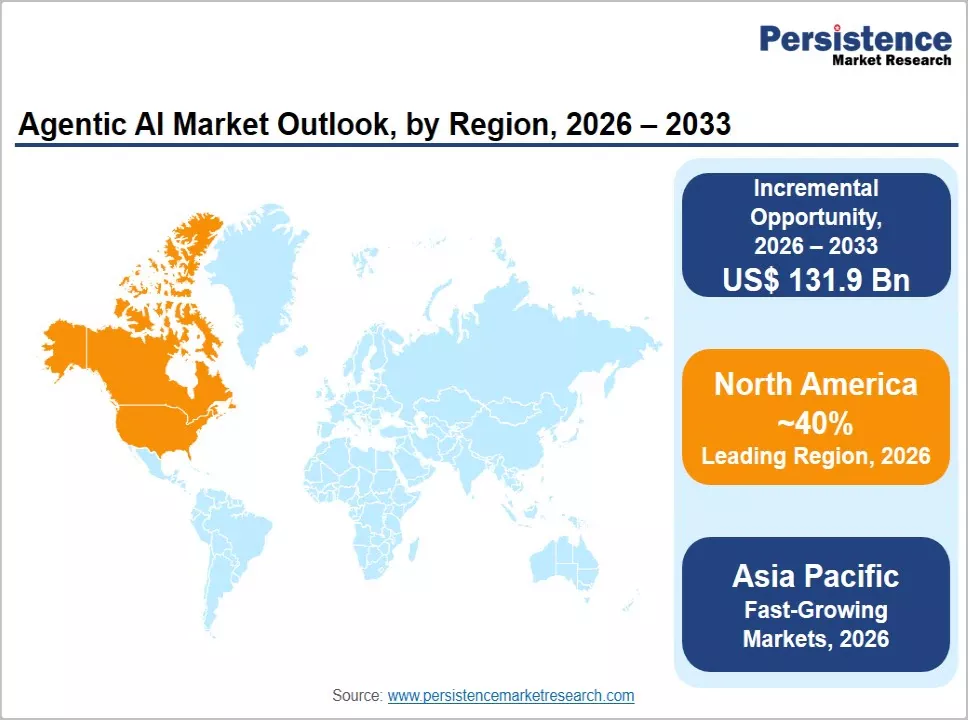
North America is expected to lead the global agentic AI market, holding around 40.0% share in 2026. The region benefits from a high concentration of foundation model developers, deep enterprise cloud adoption, and a mature venture capital ecosystem supporting agentic AI startups. The U.S. Executive Order on Safe, Secure, and Trustworthy AI, issued in October 2023, has influenced enterprise AI governance frameworks while maintaining a regulatory environment that supports continued commercial development and deployment.
U.S. Agentic AI Market Insights
The U.S. accounts for around 86.0% of North American market revenue. Demand is supported by hyperscaler R&D investment and Fortune 500 enterprise procurement, with technology, financial services, and healthcare among the key deployment sectors. The presence of leading agentic AI platform developers, including Anthropic, OpenAI, and Cognition AI, strengthens the domestic ecosystem by supporting both technology innovation and enterprise adoption through 2033.
Europe Agentic AI Market Trends And Insights
Europe is projected to hold nearly 18.0% share of the agentic AI market in 2026. Enterprises are increasingly deploying agentic AI within the compliance framework established by the EU AI Act, with Germany, the United Kingdom, and France collectively accounting for approximately 61% of regional demand. The European Commission's EUR 1 billion annual investment commitment to AI infrastructure under Horizon Europe supports the research, computing, and development ecosystem required for broader agentic AI deployment.
Germany Agentic AI Market Insights
Germany accounts for roughly 30.0% of European market revenue. Its established industrial automation base and high enterprise software adoption, supported by SAP's extensive domestic installed base, provide a strong foundation for agentic AI deployment across manufacturing and financial services. The German Federal Ministry for Digital and Transport's National AI Strategy, updated in 2023, continues to support AI adoption through public investment and dedicated SME digitalization programs.
U.K. Agentic AI Market Insights
The U.K. is anticipated to hold a significant share of the European market in 2026. Financial services and professional services firms, particularly across London's technology and financial ecosystem, are key demand drivers, deploying agentic systems for regulatory compliance, workflow automation, and client-facing applications. The UK AI Safety Institute, established in November 2023, supports the development of responsible AI deployment frameworks that enterprises are incorporating into procurement and governance processes.
France Agentic AI Market Insights
France is projected to hold a considerable share of the European agentic AI market in 2026. The French government's EUR 500 million AI investment package announced at the Paris AI Action Summit in February 2025 is supporting domestic AI development and enterprise adoption, particularly across public-sector and defense-related industries. Mistral AI's position as a European foundation model provider also strengthens the domestic AI ecosystem and supports demand from French enterprises prioritizing data sovereignty in agentic deployments.
Asia Pacific Agentic AI Market Trends And Insights
Asia Pacific represents the fastest-growing regional market, supported by government-led AI investment across China, India, and Japan and a large developer base building agentic applications for domestic and international enterprises. The region's scale in manufacturing, e-commerce, and financial services provides a broad range of workflows suitable for autonomous agent deployment, while expanding digital infrastructure supports enterprise adoption.
China Agentic AI Market Insights
China is expected to hold about 38.0% share of the Asia Pacific agentic AI market in 2026. Government-backed investment through the Ministry of Science and Technology's national AI development roadmap supports enterprise adoption across manufacturing automation and smart city applications. Baidu's ERNIE Bot and Alibaba Cloud's agent development tools are contributing to domestic ecosystem development, with continued advances in LLM capabilities supporting broader enterprise deployment.
Japan Agentic AI Market Insights
Japan is projected to hold a notable share of the Asia Pacific market in 2026. An aging workforce and persistent labor shortages are supporting demand for agentic AI across manufacturing, logistics, and customer service, where automation can address repetitive and labor-intensive workflows. SoftBank Group's announced investments in domestic AI infrastructure through 2025 are also supporting the development of computing capacity and AI services required for broader agentic AI deployment.
India Agentic AI Market Insights
India is anticipated to hold a substantial share of the Asia Pacific market in 2026. The country's 5.4 million-strong software engineering workforce, according to NASSCOM industry data, provides a large developer base for building and deploying agentic solutions across domestic enterprises and global IT services clients. The India AI Mission, launched in March 2024 with INR 10,372 crore in central government funding, is expanding compute and data infrastructure, supporting the country's growing role in the agentic AI ecosystem through the forecast period.
Competitive Landscape
The global agentic AI market is highly competitive. Hyperscalers, Microsoft, Google, and Amazon, compete on infrastructure depth, model access, and enterprise distribution, embedding agentic capabilities into existing platform contracts. Specialized platform vendors, Salesforce, ServiceNow, UiPath, and Workday, compete on workflow-specific depth and integration with established enterprise data estates. Pure-play AI developers, Anthropic, OpenAI, Cognition AI, and LangChain, compete on model capability and developer ecosystem reach.
Competitive advantage in this market accrues to organizations that combine model quality with enterprise-grade orchestration, memory management, and compliance tooling, capabilities that are difficult to replicate quickly and that create durable switching costs once embedded in production workflows.
Key Industry Developments
- June 2026: Microsoft announced the adoption of agentic AI, enabling developers to build and deploy secure, governed AI agents across enterprise workflows, supported by platforms including Copilot Studio, Agent 365, Azure DevOps, and Microsoft Foundry.
- September 2026: Hg extended its collaboration with Anthropic to deploy Claude’s agentic AI capabilities across its portfolio, with Hg Catalyst supporting implementation across software businesses and critical enterprise workflows.
- September 2026: Salesforce unveiled AIforce, a live interface layer that enables AI agents to access Salesforce data, workflows, business logic, permissions, and governance across platforms such as Claude and Slack, expanding enterprise agentic AI capabilities.
Companies Covered in Agentic AI Market
- Microsoft
- Salesforce
- Anthropic
- OpenAI
- ServiceNow
- IBM
- Amazon
- UiPath
- Cognition AI
- Workday
- LangChain
- Sierra
- SAP
- Oracle
Frequently Asked Questions
The global agentic AI market is expected to be valued at US$ 13.20 Billion in 2026 and is projected to reach US$ 145.53 Billion by 2033, expanding at a CAGR of 40.9%.
The proliferation of developer-accessible agent frameworks, such as those standardized by the Linux Foundation's emerging AI agent interoperability initiatives, and the operational cost pressure compelling enterprises to move beyond assisted AI toward fully autonomous task execution. Regulatory alignment under the EU AI Act is shaping governance-compliant deployment architectures across financial services and healthcare.
North America is likely to dominate the agentic AI market with a 40.0% share in 2026, driven by the world's highest concentration of foundation model developers and mature enterprise cloud adoption rates.
The key opportunity lies in regulated-sector deployment, particularly BFSI and healthcare, where agentic AI systems that combine autonomous task execution with auditable decision logs and EU AI Act-compliant conformity documentation can capture procurement budgets that open-source or invalidated alternatives cannot access.
Microsoft, Google, Salesforce, Amazon Web Services, and Anthropic are among the key players competing in the market.


