Aerosol Propellant Market Size, Share, and Growth Forecast 2026 - 2033

Aerosol Propellant Market by Product Type (Hydrocarbon Propellants – Propane, Butane, Isobutane; Compressed Gas Propellants – Nitrogen, Carbon Dioxide, Nitrous Oxide; Dimethyl Ether (DME); Hydrofluoroolefins (HFOs); Others), Application (Personal Care – Deodorants, Hair Sprays, Shaving Foams, Body Sprays; Household Products – Air Fresheners, Insecticides, Cleaning Sprays; Pharmaceutical – Metered Dose Inhalers (MDIs), Topical Sprays; Automotive & Industrial – Lubricants, Paints & Coatings, Adhesives; Food Products), by Regional Analysis, 2026 - 2033

ID: PMRREP36374
Calendar

March 2026

220 Pages

Author : Swapnil Chavan

Aerosol Propellant Market Size and Trend Analysis

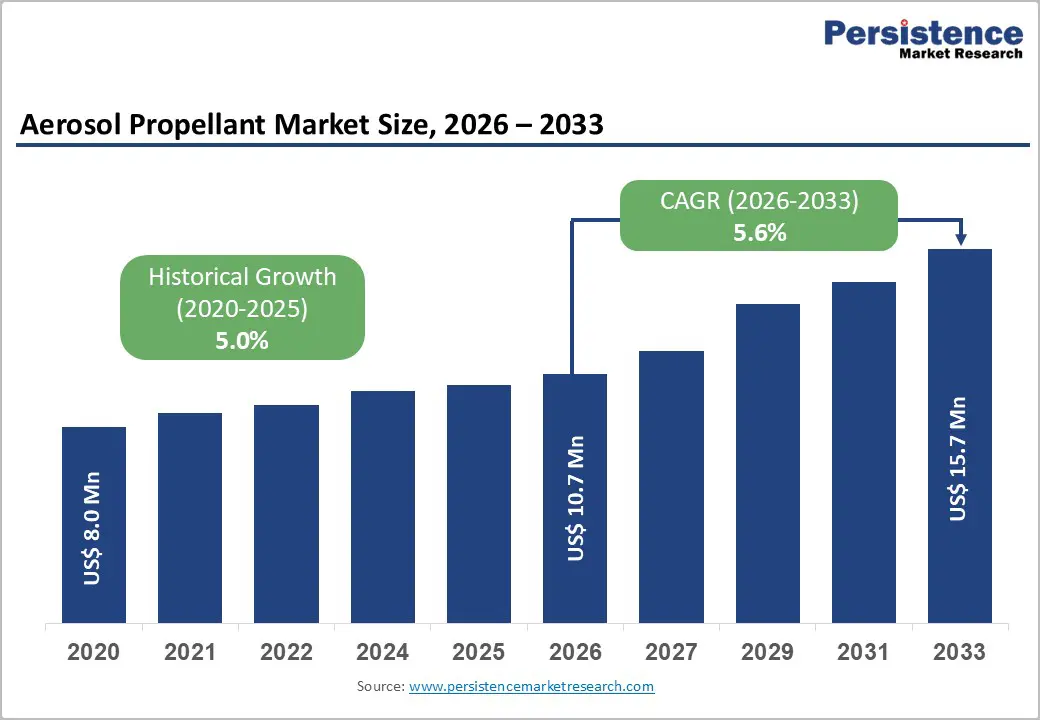
The global Aerosol Propellant market size is expected to be valued at US$ 10.7 billion in 2026 and projected to reach US$ 15.7 billion by 2033, growing at a CAGR of 5.6% between 2026 and 2033.

Sustained expansion of the global aerosol packaging industry, rising consumer spending on personal care and household products, and accelerating regulatory transition from high-GWP hydrofluorocarbons toward next-generation low-emission propellant alternatives are the core forces propelling consistent market growth. The global aerosol industry filled approximately 15 billion aerosol cans in 2022 according to the Aerosol Europe Association, with propellants serving as the fundamental functional component enabling product dispensing in every aerosol application. The phasedown of HFC propellants under the Kigali Amendment to the Montreal Protocol and the growing commercial adoption of Hydrofluoroolefin (HFO) propellants are reshaping product formulation across pharmaceutical, personal care, and industrial aerosol segments, simultaneously driving innovation investment and product premiumization.

Key Industry Highlights:

  • Leading Region: Europe commands approximately 34% of global Aerosol Propellant market revenue in 2025, anchored by the continent's 5.56 billion annual aerosol unit production and its position as the regulatory vanguard driving HFC-to-HFO propellant transitions ahead of global schedules.
  • Fastest Growing Region: Asia Pacific is projected to grow at a CAGR of 6.8% during 2026–2033, driven by India's aerosol industry growing at 12% annually, China's 3.2 billion unit production base, and ASEAN emerging as new aerosol manufacturing hubs serving domestic and export markets.
  • Dominant Segment: Hydrocarbon Propellants (propane, butane, isobutane) lead the global market with approximately 55% share in 2025, preferred for personal care, household, and automotive aerosols due to cost-effectiveness, broad formulation compatibility, and favorable vapor pressure profiles.
  • Fastest Growing Segment: The pharmaceutical segment is the fastest growing application, driven by WHO-reported respiratory disease burden affecting over 535 million people globally requiring Metered Dose Inhalers incorporating pharmaceutical-grade HFA and next-generation HFO propellants.
  • Key Opportunity: Kigali Amendment HFC phasedowns are creating a multi-billion-dollar opportunity for HFO propellant leaders Honeywell and Chemours, whose Solstice and Opteon platforms offer near-zero GWP alternatives with strong regulatory approval trajectories across pharmaceutical and specialty aerosol segments.
Key Insights Details

Aerosol Propellant Market Size (2026E)

US$ 10.7 Billion

Market Value Forecast (2033F)

US$ 15.7 Billion

Projected Growth CAGR (2026–2033)

5.6%

Historical Market Growth (2020–2025)

5.0% CAGR

Market Dynamics

Drivers - Global Aerosol Industry Expansion Driven by Personal Care and Household Product Demand

The sustained growth of the global personal care and household aerosol segments constitutes the most significant demand driver for the aerosol propellant market. According to the Aerosol Europe Association, personal care products including deodorants, hair sprays, and body sprays collectively account for over 38% of all aerosol units produced in Europe annually. Global deodorant and antiperspirant aerosol sales alone exceeded US$ 28 billion in 2023 according to the Cosmetic, Toiletry and Fragrance Association (CTFA). Each aerosol unit contains between 60–90% propellant by weight in hydrocarbon-based formulations, making propellant volume consumption directly proportional to aerosol production volumes. Rising middle-class disposable incomes across Asia Pacific, Latin America, and Africa are accelerating first-time aerosol product adoption, sustaining robust propellant demand growth through the forecast period.

Pharmaceutical Aerosol Demand Growth Driven by Respiratory Disease Burden and MDI Adoption

The expanding global burden of respiratory diseases and the critical role of Metered Dose Inhalers (MDIs) as first-line drug delivery devices are generating high-value demand for pharmaceutical-grade aerosol propellants. The World Health Organization (WHO) estimates that over 235 million people suffer from asthma globally, while Chronic Obstructive Pulmonary Disease (COPD) affects approximately 300 million people worldwide. MDIs require ultra-pure, pharmaceutical-grade HFA propellants, primarily HFA 134a and HFA 227ea, to deliver precisely metered drug doses directly to the respiratory tract. As global MDI unit volumes grow, driven by rising diagnosis rates, improved healthcare access in emerging economies, and new inhalable drug formulations, pharmaceutical propellant demand is expanding at an above-market growth rate, representing a premium value segment for propellant manufacturers.

Restraints - Regulatory Phasedown of HFC Propellants Under Kigali Amendment

The Kigali Amendment to the Montreal Protocol, ratified by over 155 countries, mandates an 80–85% reduction in HFC production and consumption by 2045 for developed nations, with developing countries following phased schedules. HFC propellants such as HFA 134a (GWP of 1,430) and HFA 227ea (GWP of 3,220) face progressive market restrictions. Manufacturers reliant on HFC-based pharmaceutical propellant revenues must invest in costly reformulation, regulatory re-approval, and new propellant qualification processes, creating a significant operational and financial burden particularly for mid-sized aerosol propellant producers.

Flammability and Safety Constraints Limiting Hydrocarbon Propellant Adoption in Certain Applications

Hydrocarbon propellants, principally propane, butane, and isobutane, are classified as flammable gases under UN GHS hazard classifications, imposing significant storage, transport, handling, and end-product labeling requirements. Aerosol products containing hydrocarbon propellants above defined concentration thresholds trigger ADR transport regulations and retail flammability warnings, limiting their applicability in pharmaceutical MDI formulations and restricting adoption in enclosed-space household and automotive spray applications. These safety constraints redirect formulators toward more expensive non-flammable alternatives, including compressed gases and HFOs, adding formulation cost and limiting hydrocarbon propellant penetration in premium application segments.

Opportunities - Commercial Expansion of Hydrofluoroolefin (HFO) Propellants as HFC Replacements

The progressive regulatory phasedown of high-GWP HFC propellants under the Kigali Amendment is creating a substantial commercial opportunity for Hydrofluoroolefin (HFO) propellant manufacturers. HFOs, particularly HFO-1234ze (GWP < 1) and HFO-1234yf (GWP of 4), offer near-zero global warming potential while maintaining the non-flammable, non-toxic performance characteristics required for pharmaceutical MDI and specialty aerosol applications. Honeywell International Inc. (Solstice propellant line) and The Chemours Company (Opteon propellant range) are the leading commercial producers of HFO propellants, having invested over US$ 900 million collectively in HFO production capacity expansion. The European Commission's F-Gas Regulation revision (2024) is accelerating HFC-to-HFO transitions in European aerosol manufacturing, creating first-mover advantages for HFO technology leaders through 2033.

Growing Adoption of Compressed Gas Propellants in Sustainable Aerosol Formulations

Compressed gas propellants, primarily nitrogen (N2), carbon dioxide (CO2), and nitrous oxide (N2O), are experiencing accelerating adoption as brands seek propellant systems with zero ozone depletion potential and negligible direct global warming contributions. The global sustainability agenda, amplified by growing consumer preference for environmentally responsible personal care and food products, is driving aerosol brands to reformulate using compressed gas propellants. The Compressed Gas Association (CGA) reports that CO2 as an aerosol propellant is gaining traction in food-grade spray applications, including whipped cream dispensers, edible oil sprays, and dry food coating systems, given its food-contact safety approvals under FDA GRAS status. Nouryon and Evonik have expanded compressed gas propellant offerings targeting food and cosmetic aerosol formulators seeking carbon-neutral compatible dispensing solutions, reflecting strong commercial momentum in this emerging segment.

Category-wise Analysis

Product Type Insights

Hydrocarbon Propellants, encompassing propane, butane, and isobutane, represent the dominant product type in the global aerosol propellant market, commanding approximately 55% of total market share in 2025. Hydrocarbons are the preferred propellant system for personal care, household, and automotive aerosol applications due to their favorable cost structure, excellent solvency properties, and broad compatibility with a wide range of active formulations. Isobutane is the most widely specified hydrocarbon propellant for deodorant and body spray applications due to its ideal vapor pressure profile and sensory characteristics. The European Aerosol Federation (FEA) reports that hydrocarbon propellants account for approximately 60% of all propellants used in European aerosol manufacturing. Hydrofluoroolefins (HFOs) are the fastest-growing propellant type, driven by the HFC phasedown timeline under the Kigali Amendment and surging pharmaceutical MDI reformulation demand.

Application Insights

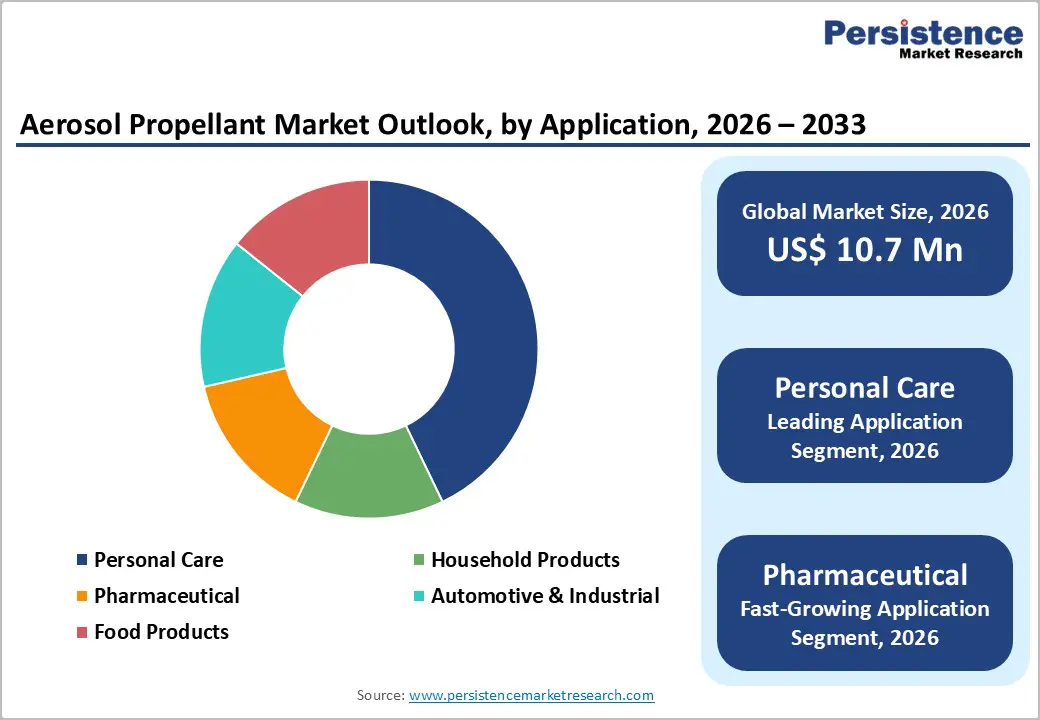
Personal Care is the dominant application segment in the global aerosol propellant market, accounting for approximately 40% of total revenue share in 2025. Deodorants, antiperspirants, hair sprays, shaving foams, and body sprays collectively represent the highest-volume aerosol application globally, with the Aerosol Europe Association confirming personal care as the single largest aerosol category by unit volume. Global deodorant and antiperspirant consumption continues to grow steadily, with the World Health Organization (WHO) citing improved hygiene awareness as a consistent driver of aerosol personal care product adoption across emerging economies. The penetration of aerosol deodorants in India, where aerosol deodorant usage has grown by over 12% annually, exemplifies the growth dynamic in developing markets. The Pharmaceutical segment is the fastest growing application, driven by rising MDI prescription volumes for respiratory disease management globally.
Regional Insights

North America Aerosol Propellant Market Trends and Insights

North America is the second largest regional market for aerosol propellants, characterized by a large, mature aerosol manufacturing base, stringent EPA Clean Air Act regulations governing aerosol VOC content, and a highly innovation-active propellant technology ecosystem. The Consumer Specialty Products Association (CSPA) reports that the U.S. aerosol industry fills approximately 3.9 billion aerosol units annually, making it the world's largest single-country aerosol market. Honeywell International Inc. and The Chemours Company, both headquartered in the U.S., are the global technology leaders in next-generation HFO propellant development, commanding significant first-mover advantages in the HFC transition.

The U.S. EPA's Significant New Alternatives Policy (SNAP) Program actively evaluates and approves propellant transitions, providing regulatory clarity for HFO adoption timelines. Arkema's U.S. manufacturing operations and AvantiGas supply networks support robust hydrocarbon propellant distribution across North American aerosol converters. Canada's growing personal care aerosol sector and Mexico's expanding household aerosol manufacturing, benefiting from nearshoring investment, are also contributing to sustained regional propellant demand growth through the forecast period.

Europe Aerosol Propellant Market Trends and Insights

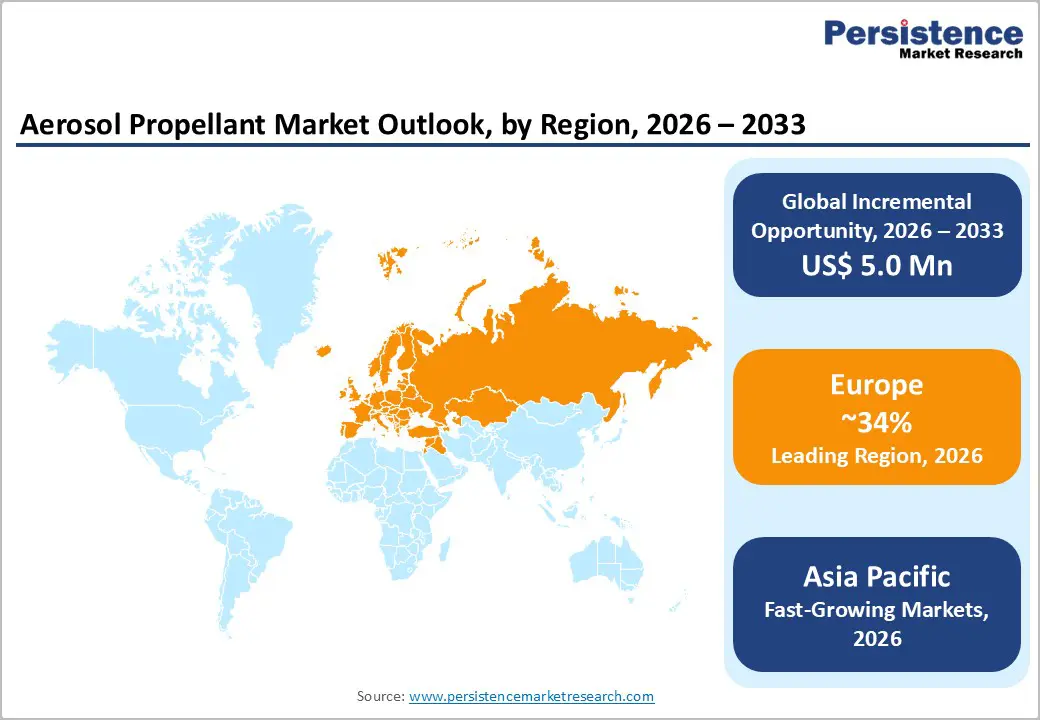
Europe is the leading regional market for aerosol propellants, commanding approximately 34% of global revenue share in 2025. The region's leadership is anchored by its large, sophisticated aerosol manufacturing industry and its position as the regulatory vanguard for propellant transition. The European Commission's revised F-Gas Regulation (2024) mandates accelerated HFC phasedowns, driving Europe's aerosol industry toward HFOs and hydrocarbon alternatives ahead of global schedules. Germany hosts some of Europe's largest aerosol filling operations and is a major consumer of hydrocarbon propellants for personal care and household aerosol production, while France leads in premium personal care aerosol formulation.

The United Kingdom's post-Brexit Chemical Regulations regime largely mirrors EU REACH, maintaining regulatory alignment on propellant standards. Harp International Ltd., one of Europe's leading independent hydrocarbon propellant suppliers, operates from the UK, serving British and European aerosol converters with bespoke hydrocarbon propellant blends. Spain's growing household and agricultural aerosol manufacturing sector is increasing regional propellant demand. The European Aerosol Federation (FEA) reported that European aerosol production reached 5.56 billion units in 2022, with Germany, France, Italy, and Spain as the four largest producing nations.

Asia Pacific Aerosol Propellant Market Trends and Insights

Asia Pacific is the fastest growing regional market for aerosol propellants, projected to register a CAGR of 6.8% during 2026–2033, driven by rapidly expanding personal care aerosol consumption in China, India, and ASEAN nations alongside growing pharmaceutical MDI manufacturing. China is the region's largest aerosol market, with domestic aerosol production exceeding 3.2 billion units annually, and major domestic propellant suppliers including Zhejiang Juhua Co., Ltd. competing alongside multinational players. The Mitsubishi Gas Chemical Company, Inc. supplies specialty propellant solutions to Japan's highly developed pharmaceutical and precision aerosol sectors.

India's aerosol industry is growing at over 12% annually according to the Aerosol & Allied Industries Association (AAIA), propelled by rising deodorant penetration, insecticide aerosol adoption, and expanding pharmaceutical MDI production. Bharat Petroleum Corporation Limited (BPCL) and Sara Chem India are key domestic propellant suppliers serving the rapidly expanding Indian aerosol filling industry. ASEAN countries including Indonesia and Vietnam are emerging as new aerosol manufacturing hubs, creating incremental propellant demand as contract filling operations relocate to serve both domestic and export markets.
Competitive Landscape

The global aerosol propellant market exhibits a moderately consolidated structure, particularly in the high-value fluorochemical segment, where a limited number of technologically advanced manufacturers dominate production and supply. In contrast, the hydrocarbon propellant segment remains relatively fragmented, with several regional LPG suppliers and specialty gas distributors serving aerosol manufacturers across different geographies. Market competition is largely shaped by technological capabilities, regulatory compliance expertise, and the ability to meet stringent purity and performance specifications required for pharmaceutical, personal care, and industrial aerosol applications.

Key business strategies among market participants include expanding production capacities for next-generation low-global-warming-potential propellants, strengthening supply networks near major aerosol filling hubs, and developing customized propellant blends for specialized applications. Companies are also increasingly investing in research and development to support industry transitions toward environmentally compliant propellants. Additionally, long-term supply agreements and collaborative technical support programs with aerosol manufacturers have emerged as important strategies to facilitate product reformulation, particularly in pharmaceutical inhalers and specialty aerosol products undergoing regulatory-driven transitions.

Key Developments

  • May 2025: Nouryon introduced Demeon® ReNu100, a bio-based dimethyl ether aerosol propellant produced from 100% renewable methanol, designed to deliver equivalent performance to conventional DME while reducing carbon footprint by up to 100% in personal care aerosol formulations.
  • August 2024: Unilever announced initiatives to reduce emissions from aerosol propellants under its Climate Transition Action Plan, targeting net-zero emissions by 2039 while increasing the use of low-GWP hydrocarbon propellants in personal care products where regulations permit.

Companies Covered in Aerosol Propellant Market

  • The Chemours Company
  • Arkema
  • Shell
  • Bharat Petroleum Corporation Limited (BPCL)
  • Honeywell International Inc.
  • National Gas Company
  • Orbia Fluor & Energy Materials
  • Evonik Industries AG
  • AvantiGas
  • Harp International Ltd.
  • Nouryon
  • Mitsubishi Gas Chemical Company, Inc.
  • Emirates Gas
  • Sara Chem India
  • Zhejiang Juhua Co., Ltd.
  • Mexichem (Orbia) Fluor
  • SRF Limited
Frequently Asked Questions

The global Aerosol Propellant market is expected to reach US$ 10.7 Billion in 2026 and is projected to grow to US$ 15.7 Billion by 2033 at a CAGR of 5.6% during 2026–2033.

The market is primarily driven by growing personal care aerosol usage, rising pharmaceutical inhaler demand, regulatory transition to low-GWP propellants, and increasing aerosol consumption in emerging economies.

Europe leads the global Aerosol Propellant market, supported by its strong aerosol manufacturing base and early transition toward environmentally compliant propellant technologies.

The key opportunity lies in the commercialization of hydrofluoroolefin (HFO) propellants as sustainable replacements for high-GWP HFC propellants.

Key companies in the market include Honeywell International Inc., The Chemours Company, Arkema, Harp International Ltd., AvantiGas, Nouryon, Orbia Fluor & Energy Materials, Evonik Industries AG, Bharat Petroleum Corporation Limited, and Mitsubishi Gas Chemical Company, Inc.

Global Aerosol Propellant Market Report Scope
Report Attribute Details

Historical Data / Actuals

2020 - 2025

Forecast Period

2026 - 2033

Market Analysis Units

Value: US$ Mn/Bn, Volume: As Applicable

Geographical Coverage

  • North America
  • Europe
  • East Asia
  • South Asia & Oceania
  • Latin America
  • Middle East & Africa

Segmental Coverage

  • Product Type
  • Application
  • Region

Competitive Analysis

  • The Chemours Company
  • Arkema
  • Shell
  • Bharat Petroleum Corporation Limited (BPCL)
  • Honeywell International Inc.
  • National Gas Company
  • Orbia Fluor & Energy Materials
  • Evonik Industries AG
  • AvantiGas
  • Harp International Ltd.
  • Nouryon
  • Mitsubishi Gas Chemical Company, Inc.
  • Emirates Gas
  • Sara Chem India
  • Zhejiang Juhua Co., Ltd.
  • Mexichem (Orbia) Fluor
  • SRF Limited

Report Highlights

  • Market Forecast and Trends
  • Competitive Intelligence and Share Analysis
  • Growth Factors and Challenges
  • Strategic Growth Initiatives
  • Pricing Analysis
  • Future Opportunities and Revenue Pockets
  • Market Analysis Tools
Market Segmentation

By Product Type

  • Hydrocarbon Propellants
    • Propane
    • Butane
    • Isobutane
  • Compressed Gas Propellants
    • Nitrogen
    • Carbon Dioxide
    • Nitrous Oxide
  • Dimethyl Ether (DME)
  • Hydrofluoroolefins (HFOs)
  • Others

By Application

  • Personal Care
    • Deodorants
    • Hair Sprays
    • Shaving Foams
    • Body Sprays
  • Household Products
    • Air Fresheners
    • Insecticides
    • Cleaning Sprays
  • Pharmaceutical
    • Metered Dose Inhalers (MDIs)
    • Topical Sprays
  • Automotive & Industrial
    • Lubricants
    • Paints & Coatings
    • Adhesives
  • Food Products

By Regions

  • North America
  • Europe
  • East Asia
  • South Asia & Oceania
  • Latin America
  • Middle East & Africa

Related Reports

  1. Executive Summary
    1. Global Aerosol Propellant Market Snapshot 2026 and 2033
    2. Market Opportunity Assessment, 2026-2033, US$ Mn
    3. Key Market Trends
    4. Industry Developments and Key Market Events
    5. Demand Side and Supply Side Analysis
    6. PMR Analysis and Recommendations
  2. Market Overview
    1. Market Scope and Definitions
    2. Value Chain Analysis
    3. Macro-Economic Factors
      1. Global GDP Outlook
      2. Global Personal Care Industry Growth Overview
      3. Global Hydrocarbons Market Growth Overview
      4. Global Hydrofluoroolefins Market Growth Overview
      5. Global Dimethyl Ether Market Growth Overview
      6. Other Macroeconomic Factors
    4. Forecast Factors – Relevance and Impact
    5. COVID-19 Impact Assessment
    6. PESTLE Analysis
    7. Porter's Five Forces Analysis
    8. Geopolitical Tensions: Market Impact
    9. Regulatory and Technology Landscape
  3. Market Dynamics
    1. Drivers
    2. Restraints
    3. Opportunities
    4. Trends
  4. Price Trend Analysis, 2020 – 2033
    1. Region-wise Price Analysis
    2. Price by Segments
    3. Price Impact Factors
  5. Global Aerosol Propellant Market Outlook: Historical (2020 – 2025) and Forecast (2026 – 2033)
    1. Key Highlights
    2. Global Aerosol Propellant Market Outlook: Product Type
      1. Introduction/Key Findings
      2. Historical Market Size (US$ Mn) and Volume (Tons) Analysis by Product Type, 2020-2025
      3. Current Market Size (US$ Mn) and Volume (Tons) Forecast, by Product Type, 2026-2033
        1. Hydrocarbon Propellants
          1. Propane
          2. Butane
          3. Isobutane
        2. Compressed Gas Propellants
          1. Nitrogen
          2. Carbon Dioxide
          3. Nitrous Oxide
        3. Dimethyl Ether (DME)
        4. Hydrofluoroolefins (HFOs)
        5. Others
      4. Market Attractiveness Analysis: Product Type
    3. Global Aerosol Propellant Market Outlook: Application
      1. Introduction/Key Findings
      2. Historical Market Size (US$ Mn) and Volume (Tons) Analysis by Application, 2020-2025
      3. Current Market Size (US$ Mn) and Volume (Tons) Forecast, by Application, 2026-2033
        1. Personal Care
          1. Deodorants
          2. Hair Sprays
          3. Shaving Foams
          4. Body Sprays
        2. Household Products
          1. Air Fresheners
          2. Insecticides
          3. Cleaning Sprays
        3. Pharmaceutical
          1. Metered Dose Inhalers (MDIs)
          2. Topical Sprays
        4. Automotive & Industrial
          1. Lubricants
          2. Paints & Coatings
          3. Adhesives
        5. Food Products
      4. Market Attractiveness Analysis: Application
  6. Global Aerosol Propellant Market Outlook: Region
    1. Key Highlights
    2. Historical Market Size (US$ Mn) and Volume (Tons) Analysis by Region, 2020-2025
    3. Current Market Size (US$ Mn) and Volume (Tons) Forecast, by Region, 2026-2033
      1. North America
      2. Europe
      3. East Asia
      4. South Asia & Oceania
      5. Latin America
      6. Middle East & Africa
    4. Market Attractiveness Analysis: Region
  7. North America Aerosol Propellant Market Outlook: Historical (2020 – 2025) and Forecast (2026 – 2033)
    1. Key Highlights
    2. Pricing Analysis
    3. North America Market Size (US$ Mn) and Volume (Tons) Forecast, by Country, 2026-2033
      1. U.S.
      2. Canada
    4. North America Market Size (US$ Mn) and Volume (Tons) Forecast, by Product Type, 2026-2033
      1. Hydrocarbon Propellants
        1. Propane
        2. Butane
        3. Isobutane
      2. Compressed Gas Propellants
        1. Nitrogen
        2. Carbon Dioxide
        3. Nitrous Oxide
      3. Dimethyl Ether (DME)
      4. Hydrofluoroolefins (HFOs)
      5. Others
    5. North America Market Size (US$ Mn) and Volume (Tons) Forecast, by Application, 2026-2033
      1. Personal Care
        1. Deodorants
        2. Hair Sprays
        3. Shaving Foams
        4. Body Sprays
      2. Household Products
        1. Air Fresheners
        2. Insecticides
        3. Cleaning Sprays
      3. Pharmaceutical
        1. Metered Dose Inhalers (MDIs)
        2. Topical Sprays
      4. Automotive & Industrial
        1. Lubricants
        2. Paints & Coatings
        3. Adhesives
      5. Food Products
  8. Europe Aerosol Propellant Market Outlook: Historical (2020 – 2025) and Forecast (2026 – 2033)
    1. Key Highlights
    2. Pricing Analysis
    3. Europe Market Size (US$ Mn) and Volume (Tons) Forecast, by Country, 2026-2033
      1. Germany
      2. Italy
      3. France
      4. U.K.
      5. Spain
      6. Russia
      7. Rest of Europe
    4. Europe Market Size (US$ Mn) and Volume (Tons) Forecast, by Product Type, 2026-2033
      1. Hydrocarbon Propellants
        1. Propane
        2. Butane
        3. Isobutane
      2. Compressed Gas Propellants
        1. Nitrogen
        2. Carbon Dioxide
        3. Nitrous Oxide
      3. Dimethyl Ether (DME)
      4. Hydrofluoroolefins (HFOs)
      5. Others
    5. Europe Market Size (US$ Mn) and Volume (Tons) Forecast, by Application, 2026-2033
      1. Personal Care
        1. Deodorants
        2. Hair Sprays
        3. Shaving Foams
        4. Body Sprays
      2. Household Products
        1. Air Fresheners
        2. Insecticides
        3. Cleaning Sprays
      3. Pharmaceutical
        1. Metered Dose Inhalers (MDIs)
        2. Topical Sprays
      4. Automotive & Industrial
        1. Lubricants
        2. Paints & Coatings
        3. Adhesives
      5. Food Products
  9. East Asia Aerosol Propellant Market Outlook: Historical (2020 – 2025) and Forecast (2026 – 2033)
    1. Key Highlights
    2. Pricing Analysis
    3. East Asia Market Size (US$ Mn) and Volume (Tons) Forecast, by Country, 2026-2033
      1. China
      2. Japan
      3. South Korea
    4. East Asia Market Size (US$ Mn) and Volume (Tons) Forecast, by Product Type, 2026-2033
      1. Hydrocarbon Propellants
        1. Propane
        2. Butane
        3. Isobutane
      2. Compressed Gas Propellants
        1. Nitrogen
        2. Carbon Dioxide
        3. Nitrous Oxide
      3. Dimethyl Ether (DME)
      4. Hydrofluoroolefins (HFOs)
      5. Others
    5. East Asia Market Size (US$ Mn) and Volume (Tons) Forecast, by Application, 2026-2033
      1. Personal Care
        1. Deodorants
        2. Hair Sprays
        3. Shaving Foams
        4. Body Sprays
      2. Household Products
        1. Air Fresheners
        2. Insecticides
        3. Cleaning Sprays
      3. Pharmaceutical
        1. Metered Dose Inhalers (MDIs)
        2. Topical Sprays
      4. Automotive & Industrial
        1. Lubricants
        2. Paints & Coatings
        3. Adhesives
      5. Food Products
    6. East Asia Market Size (US$ Mn) and Volume (Tons) Forecast, by , 2026-2033
  10. South Asia & Oceania Aerosol Propellant Market Outlook: Historical (2020 – 2025) and Forecast (2026 – 2033)
    1. Key Highlights
    2. Pricing Analysis
    3. South Asia & Oceania Market Size (US$ Mn) and Volume (Tons) Forecast, by Country, 2026-2033
      1. India
      2. Southeast Asia
      3. ANZ
      4. Rest of SAO
    4. South Asia & Oceania Market Size (US$ Mn) and Volume (Tons) Forecast, by Product Type, 2026-2033
      1. Hydrocarbon Propellants
        1. Propane
        2. Butane
        3. Isobutane
      2. Compressed Gas Propellants
        1. Nitrogen
        2. Carbon Dioxide
        3. Nitrous Oxide
      3. Dimethyl Ether (DME)
      4. Hydrofluoroolefins (HFOs)
      5. Others
    5. South Asia & Oceania Market Size (US$ Mn) and Volume (Tons) Forecast, by Application, 2026-2033
      1. Personal Care
        1. Deodorants
        2. Hair Sprays
        3. Shaving Foams
        4. Body Sprays
      2. Household Products
        1. Air Fresheners
        2. Insecticides
        3. Cleaning Sprays
      3. Pharmaceutical
        1. Metered Dose Inhalers (MDIs)
        2. Topical Sprays
      4. Automotive & Industrial
        1. Lubricants
        2. Paints & Coatings
        3. Adhesives
      5. Food Products
  11. Latin America Aerosol Propellant Market Outlook: Historical (2020 – 2025) and Forecast (2026 – 2033)
    1. Key Highlights
    2. Pricing Analysis
    3. Latin America Market Size (US$ Mn) and Volume (Tons) Forecast, by Country, 2026-2033
      1. Brazil
      2. Mexico
      3. Rest of LATAM
    4. Latin America Market Size (US$ Mn) and Volume (Tons) Forecast, by Product Type, 2026-2033
      1. Hydrocarbon Propellants
        1. Propane
        2. Butane
        3. Isobutane
      2. Compressed Gas Propellants
        1. Nitrogen
        2. Carbon Dioxide
        3. Nitrous Oxide
      3. Dimethyl Ether (DME)
      4. Hydrofluoroolefins (HFOs)
      5. Others
    5. Latin America Market Size (US$ Mn) and Volume (Tons) Forecast, by Application, 2026-2033
      1. Personal Care
        1. Deodorants
        2. Hair Sprays
        3. Shaving Foams
        4. Body Sprays
      2. Household Products
        1. Air Fresheners
        2. Insecticides
        3. Cleaning Sprays
      3. Pharmaceutical
        1. Metered Dose Inhalers (MDIs)
        2. Topical Sprays
      4. Automotive & Industrial
        1. Lubricants
        2. Paints & Coatings
        3. Adhesives
      5. Food Products
  12. Middle East & Africa Aerosol Propellant Market Outlook: Historical (2020 – 2025) and Forecast (2026 – 2033)
    1. Key Highlights
    2. Pricing Analysis
    3. Middle East & Africa Market Size (US$ Mn) and Volume (Tons) Forecast, by Country, 2026-2033
      1. GCC Countries
      2. South Africa
      3. Northern Africa
      4. Rest of MEA
    4. Middle East & Africa Market Size (US$ Mn) and Volume (Tons) Forecast, by Product Type, 2026-2033
      1. Hydrocarbon Propellants
        1. Propane
        2. Butane
        3. Isobutane
      2. Compressed Gas Propellants
        1. Nitrogen
        2. Carbon Dioxide
        3. Nitrous Oxide
      3. Dimethyl Ether (DME)
      4. Hydrofluoroolefins (HFOs)
      5. Others
    5. Middle East & Africa Market Size (US$ Mn) and Volume (Tons) Forecast, by Application, 2026-2033
      1. Personal Care
        1. Deodorants
        2. Hair Sprays
        3. Shaving Foams
        4. Body Sprays
      2. Household Products
        1. Air Fresheners
        2. Insecticides
        3. Cleaning Sprays
      3. Pharmaceutical
        1. Metered Dose Inhalers (MDIs)
        2. Topical Sprays
      4. Automotive & Industrial
        1. Lubricants
        2. Paints & Coatings
        3. Adhesives
      5. Food Products
  13. Competition Landscape
    1. Market Share Analysis, 2025
    2. Market Structure
      1. Competition Intensity Mapping
      2. Competition Dashboard
    3. Company Profiles
      1. The Chemours Company
        1. Company Overview
        2. Product Portfolio/Offerings
        3. Key Financials
        4. SWOT Analysis
        5. Company Strategy and Key Developments
      2. Arkema
      3. Shell
      4. Bharat Petroleum Corporation Limited
      5. Honeywell International Inc.
      6. National Gas Company
      7. Orbia Fluor & Energy Materials
      8. Evonik
      9. AvantiGas
      10. Harp International Ltd.
      11. Nouryon
      12. MITSUBISHI GAS CHEMICAL COMPANY, INC.
      13. Emirates Gas
      14. Sara Chem India
      15. Zhejiang Juhua Co., Ltd.
      16. Mexichem (Orbia) Fluor
      17. SRF Limited
  14. Appendix
    1. Research Methodology
    2. Research Assumptions
    3. Acronyms and Abbreviations

Research Methodology Framework for Market Research Excellence

At Persistence Market Research, we implement a comprehensive, validated, and multi-dimensional approachto market analysis that delivers actionable insights across complex market landscapes. Our methodology combines the analytical rigor of leading consulting firms with innovative research techniques, ensuring robust market assessments that guide strategic decision-making with confidence.

Core Research Philosophy

Our methodology is built on four foundational pillars:

Research Philosophy Image

At Persistence Market Research, our methodology is designed to transcend conventional market studies by combining analytical rigor, multi-source validation, and future-focused insights.

We integrate advanced research frameworks, robust data collection strategies, cutting-edge analytics, and innovative technologies to deliver a 360-degree view of complex markets.

We integrate advanced research frameworks, robust data collection strategies, cutting-edge analytics, and innovative technologies to deliver a 360-degree view of complex markets.

Each stage spanning from strategic scoping and hypothesis-building to competitive intelligence, quality validation, and actionable recommendations is engineered to provide clients with unmatched clarity, precision, and confidence in decision-making.

By embedding innovation and technology at the core, our approach ensures that insights are not only comprehensive but also predictive, empowering businesses to seize opportunities, mitigate risks, and achieve sustainable growth

Research Philosophy Image

Capturing Key Information and Events

During this phase, key research objectives focus on essential information and data points for assessing the market, including:

Research Philosophy Image

TAM-SAM-SOM Framework Implementation

We employ both top-down and bottom-up approaches to ensure accurate market sizing.

Top-Down Market SizingBottom-Up Market Sizing
Universe Definition: Total global/regional market identificationUnit Economics: Average transaction values, purchase frequencies, customer lifecycle
Segmentation Filters: Geographic, demographic, and behavioral constraintsCustomer Segmentation: Detailed buyer persona development and sizing
Market Share Analysis: Competitive landscape assessment and share allocationPenetration Analysis: Market penetration rates by segment and geography
Growth Rate Application: Historical trends and forward-looking growth assumptionsScaling Methodology: Extrapolation techniques with confidence intervals

Validation & Cross-Verification

  • Triangulation: Comparing top-down and bottom-up results for consistency
  • Sensitivity Analysis: Testing key assumptions and parameter variations
  • Peer Benchmarking: Comparison with analogous markets and industry benchmarks
  • Expert Review: External validation through industry specialist consultation

Research Philosophy Image

Forecasting & Projection Modeling

Our proprietary forecasting models incorporate multiple variables and scenarios.

Forecasting Components

  • Historical Trend Analysis: 10-year historical growth patterns and cyclical variations
  • Driver-Based Modeling: Economic indicators, demographic shifts, technology adoption
  • Scenario Planning: Base case, optimistic, and conservative projections
  • Monte Carlo Simulations: Probability-weighted outcomes and risk assessments

Model Validation

  • Back-Testing: Historical accuracy assessment over 3–5-year periods
  • Cross-Validation: Multiple modeling approaches for result comparison
  • External Benchmarking: Comparison with established market forecasts
  • Continuous Calibration: Quarterly model updates based on new data

Comprehensive Data Collection Strategy

Our secondary research phase establishes a robust knowledge base utilizing diverse, credible sources.

Secondary Data Sourcess

  • Industry Publications & Reports
  • Government & Regulatory Data
  • Financial Intelligence (filings & reports)
  • Academic Research & Digital Intelligence

Quality Assurance Protocol

  • Source credibility assessment and publication date validation
  • Data consistency checks across multiple sources
  • Bias identification and neutralization techniques
  • Information gap tracking for primary research prioritization

Research Philosophy Image

Primary Research Excellence

Our primary research methodology employs best-in-class techniques to capture unique market insights.

Quantitative Research Methods

  • Large-Scale Surveys: Statistically representative samples with 95% confidence intervals
  • Survey Methodology: Multi-channel deployment (online, telephone, in-person)
  • Question Architecture and Response Optimization

Qualitative Research Methods

  • Executive Interviews
  • Focus Groups
  • Expert Consultations

Quality Assurance & Validation Framework

Multi-Stage Validation Process

  • Source Verification and Consistency Testing
  • Outlier Detection and Bias Assessment
  • Peer Review Process and External Validation
  • Sensitivity Analysis and Confidence Intervals

Research Philosophy Image

Methodology Validation & Credibility

Our research methodology has been extensively validated through:

  • Academic Partnerships: Collaborations with top-tier business schools and research institutions
  • Client Success Stories: Documented case studies demonstrating research impact and ROI
  • Continuous Benchmarking: Performance comparison with leading global research firms

This comprehensive methodology framework positions Persistence Market Research at the forefront of market intelligence, combining the analytical sophistication of top-tier consulting firms with innovative research techniques. Our approach ensures that every market assessment delivers precise, actionable, and strategically valuable insights that drive business success in competitive market environments.

Ready to unlock your market potential? Contact our research experts to discuss how our validated methodology can transform your strategic decision-making with data-driven market intelligence.

Copyright © 2026 Persistence Market Research. All Rights Reserved

Connect With Us -