




- Specialty & Fine Chemicals
- 4-Chlororesorcinol Market
4-Chlororesorcinol Market Size, Share, and Growth Forecast, 2025 - 2032
4-Chlororesorcinol Market by Grade Type (Industrial Grade, Others), Application (Pharmaceuticals, Dyes & Pigments, Others), End-user (Cosmetics & Toiletries, Pharmaceutical Industry, Others), and Regional Analysis for 2025 - 2032

4-Chlororesorcinol Market Size and Trends Analysis
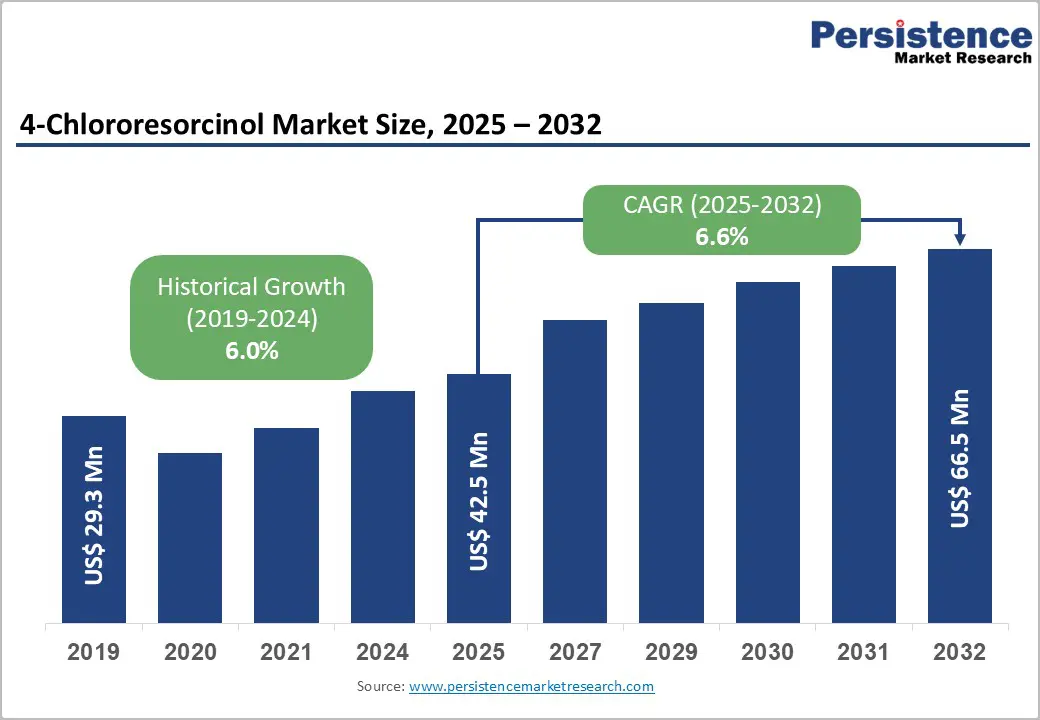
The global 4-chlororesorcinol market size is likely to be valued at US$42.5 million in 2025, expected to reach US$66.5 million by 2032, growing at a CAGR of 6.6% during the forecast period from 2025 to 2032, driven by the increasing prevalence of dye production, rising demand for intermediates in pharmaceuticals, and advancements in chemical synthesis.
The demand for stable colorants and effective coupling agents, especially within the textile industry, has substantially increased the use of 4-chlororesorcinol across a wide range of applications. Market growth is further supported by advancements in pharmaceutical- and cosmetic-grade formulations that meet rising preferences for high-purity and multifunctional ingredients. The growing use of 4-chlororesorcinol as a critical intermediate in hair dye formulations has become a major driver of growth in the personal care sector, shaping overall market trends.
Key Industry Highlights:
- Leading Region: North America, commanding a 42% market share in 2025, due to its strong presence of specialty chemical producers, advanced R&D capabilities, and strict quality standards supporting high-purity applications.
- Fastest-growing Region: Asia Pacific is the fastest-growing region, driven by the rapid expansion of chemical manufacturing, cost-efficient production capabilities, and rising demand for cosmetics, dyes, and pharmaceutical intermediates.
- Dominant Grade Type: Industrial grade, holding approximately 50% of the revenue share, due to cost-effectiveness in bulk production.
- Leading Application: Dyes & pigments, accounting for over 40% of market revenue, driven by color fastness needs.
- Leading End-user: Cosmetics & toiletries, contributing nearly 35% of market revenue, due to hair dye formulations.
| Key Insights | Details |
|---|---|
| 4-Chlororesorcinol Market Size (2025E) | US$42.5 Mn |
| Market Value Forecast (2032F) | US$66.5 Mn |
| Projected Growth (CAGR 2025 to 2032) | 6.6% |
| Historical Market Growth (CAGR 2019 to 2024) | 6.0% |
Market Factors - Growth, Barriers, and Opportunity Analysis
Rising Prevalence of Dye Production and Demand for Stable Colorants
The global rise in dye production is a key driver of demand for 4-chlororesorcinol. As sectors such as textiles, cosmetics, plastics, and coatings continue to grow, there is an increasing need for vibrant, durable, and high-performance colorants. Modern manufacturing focuses on consistent shades, enhanced fastness, and compatibility with diverse substrates. This trend fuels demand for intermediates that ensure stable color development and long-lasting visual appeal, even under harsh processing or environmental conditions.
Advances in formulation and application technologies further support the use of stable colorants. Manufacturers are seeking ingredients that resist fading, endure repeated washing, and retain their quality under UV exposure or heat, qualities essential for premium dyes and pigments. At the same time, the push for cleaner, more efficient production processes has increased reliance on intermediates that enable efficient synthesis and clearer color outcomes. The acceleration of global fashion cycles, the expansion of personal care applications, and the growing consumption of colored consumer goods are further driving market demand.
High Development and Purity Compliance Costs
The high costs associated with development and purity compliance of 4-chlororesorcinol pose a significant restraint on market growth. Producing high-purity intermediates requires specialized equipment, refined synthesis routes, and tightly controlled manufacturing environments to avoid contamination. Each stage, from raw material selection to final purification, demands precise monitoring, which adds to operational expenses. These requirements become even more demanding when intermediates are used in sensitive applications such as pharmaceuticals, cosmetics, and specialty formulations, where even minor impurities can affect safety, efficacy, or stability.
Regulatory compliance further elevates costs. Companies must meet strict guidelines set by environmental, safety, and product-quality authorities, which require extensive documentation, testing, validation, and periodic audits. Ensuring adherence to these standards often involves investing in advanced analytical systems, laboratory infrastructure, and skilled personnel. Continuous process optimization and waste-reduction measures are necessary to maintain compliance while minimizing environmental impact.
Innovation in Bio-Derived and Multifunctional Intermediates
Innovations in bio-based and multifunctional intermediates are reshaping the chemical industry, driven by demands for sustainability, efficiency, and high performance. Bio-based intermediates derived from renewable resources are rapidly gaining traction as industries shift away from petroleum-based materials to minimize environmental impact. These developments focus on improving yields, reducing carbon footprints, and enabling safer, greener synthesis pathways. With increasing regulatory pressures and a growing emphasis on sustainable supply chains, bio-based intermediates are becoming viable alternatives across pharmaceuticals, cosmetics, coatings, and specialty chemicals.
Multifunctional intermediates are also transforming product development by offering greater versatility and formulation flexibility. Their ability to serve multiple roles, such as stabilizers, reactive building blocks, or performance enhancers, reduces the need for additional additives, streamlining production and boosting cost efficiency. Progress in process engineering, catalytic technology, and precision chemistry enables the creation of intermediates with tailored properties to meet specific application requirements, enhancing the quality and performance of end products.
Category-wise Analysis
Grade Type Insights
The industrial-grade segment dominates the market, accounting for 50% of revenue in 2025. Its leadership is driven by cost-effectiveness, high-volume availability, and suitability for dye applications, particularly in textiles. Industrial-grade 4-chlororesorcinol, such as products from Zhengzhou Acme Chemical Co., Ltd., offers bulk reactivity and efficiency, making it a preferred choice for manufacturers. Products such as 4-Chlororesorcinol (CAS-95-88-5) Bulk Industrial Chemical and 4-Chloro Resorcinol Grade industrial chemical provide high-purity powder forms suitable for large-scale industrial processes at competitive prices, making them attractive for manufacturers seeking reliable and affordable intermediates in dye and chemical synthesis.
The cosmetic-grade segment is the fastest-growing, fueled by the demand for high-purity hair dyes and broader adoption in personal care applications. Cosmetic-grade 4-chlororesorcinol is formulated for mildness, making it suitable for skin contact. The trend toward hypoallergenic and gentler formulations is driving growth in North America and Europe. For example, Naturtint is marketed in these regions as a permanent hair dye that is plant-derived and free from harsh chemicals such as ammonia, parabens, and heavy metals. Its skin- and scalp-friendly formulation makes it less irritating to the skin and scalp, a key factor in the rising demand for cosmetic-grade intermediates.
Application Insights
The dyes and pigments segment leads the market, accounting for 40% of the share in 2025, driven by its pivotal role in color synthesis and strong compatibility with azo-based formulations. This segment benefits from high demand for vibrant, long-lasting colors across textiles, plastics, and specialty products. As industries increasingly prioritize richer shades and enhanced performance, the use of 4-chlororesorcinol in dye manufacturing continues to grow. For instance, Hangzhou Haichem Co., Ltd. highlights 4-Chloro Resorcinol (CAS 95-88-5) as a coupler in permanent hair dye formulations, where it reacts with other intermediates to produce consistent, vibrant reddish and brown tones.
The personal care segment is the fastest-growing, driven by rising hair-coloring trends and the expanding use of 4-chlororesorcinol in shampoos and treatment products. Its stability, formulation ease, and compatibility with modern cosmetic blends enhance product performance. As consumers increasingly seek effective, convenient, and long-lasting personal care solutions, adoption of this ingredient continues to accelerate. Products such as James Robinson Speciality Ingredients’ Jarocol 4CLR are marketed as oxidative hair dye bases for permanent and demi-permanent applications, highlighting the direct connection between 4-chlororesorcinol and contemporary personal care formulations.
End-user Insights
The cosmetics and toiletries segment dominates the market, accounting for 35% of revenue in 2025, primarily due to the widespread use of 4-chlororesorcinol in hair dyes and color-enhancing formulations. Growing consumer demand for vibrant, long-lasting beauty products reinforces this leadership. With strong appeal in personal care and increasing preference for high-performance cosmetic ingredients, this segment maintains a clear advantage. The use of 4-chlororesorcinol in mass-market products such as Schwarzkopf Palette Deluxe illustrates its role in generating substantial revenue within the cosmetics and toiletries sector.
The textile industry is the fastest-growing segment, driven by rising fabric production and the need for high-performance colorants. 4-Chlororesorcinol’s versatility, superior color-fixing ability, and excellent fastness make it ideal for durable dye formulations. Rising demand for vibrant, long-lasting textiles across apparel and home furnishings further boosts its adoption. Reactive dye series such as Remazol and Cibacron, widely used in cotton and cellulose dyeing, deliver excellent wash, light, and color fastness, underpinning textile quality and longevity and driving the growth of this segment.
Regional Insights
North America 4-Chlororesorcinol Market Trends
North America dominates the market, accounting for 42% of the share in 2025. The region’s steady growth is supported by a strong foundation in advanced chemical manufacturing, active research institutions, and high demand from the cosmetics, pharmaceuticals, and specialty chemicals sectors. Emphasis on product purity, regulatory compliance, and consistent performance drives the adoption of high-grade intermediates. Rising awareness of ingredient safety in personal care products, particularly hair-coloring and dermatology-focused formulations, further fuels market expansion. Manufacturers and end-users increasingly prioritize traceable, high-quality chemical inputs that meet strict safety and environmental standards.
The region is also shifting toward sustainable and efficient production methods, with companies implementing advanced process technologies, waste-reduction systems, and eco-friendly synthesis routes to comply with evolving regulations. Digitalization and automation in chemical manufacturing are enhancing quality control, reducing variability, and streamlining operations. Strong R&D capabilities support continuous innovation in formulations and applications, while stable supply chains, reliable transportation networks, and well-established industrial infrastructure sustain consistent demand across North America.
Europe 4-Chlororesorcinol Market Trends
The European market is driven by steady demand from the region’s advanced chemical, cosmetic, and pharmaceutical industries, underpinned by strict regulatory standards emphasizing product purity, safety, and sustainable production. Manufacturers and end-users in Europe increasingly prioritize high-quality intermediates for applications such as hair dyes, specialty formulations, and research-grade chemicals, fostering a consistent shift toward products with enhanced purity and reliable traceability. The region’s strong focus on environmental compliance further shapes market trends, encouraging greener synthesis methods, reducing hazardous byproducts, and investing in energy-efficient production technologies.
The growing adoption of digital process control and automation in chemical manufacturing improves consistency and minimizes operational risks. Europe’s emphasis on innovation supports ongoing R&D, particularly in advanced formulations for cosmetics and specialty materials. Rising consumer interest in clean beauty and dermatology-focused products further drives demand for high-performance intermediates such as 4-chlororesorcinol. The region also benefits from robust distribution networks and well-regulated supply chains, ensuring stable availability for industrial users and research institutions.
Asia Pacific 4-Chlororesorcinol Market Trends
Asia Pacific is the fastest-growing market for 4-chlororesorcinol, driven by expanding chemical manufacturing capacity and rising consumption across key end-use industries. Countries such as China, India, South Korea, and Japan are making significant investments in specialty chemical production, enabling faster, cost-effective, and large-scale output of intermediates such as 4-chlororesorcinol. The region’s rapidly expanding cosmetics and personal care sector, particularly hair coloring products, strongly supports demand for high-purity grades. Growth in pharmaceutical manufacturing is also notable, with regional companies increasingly utilizing advanced intermediates for API development and formulation research.
Manufacturers in the region are adopting improved synthesis processes to enhance purity while minimizing waste and production hazards. There is a clear shift toward greener and more efficient chemical routes to comply with tightening environmental regulations. Local producers increasingly focus on customized grades tailored to specific industrial applications and research needs. The Asia Pacific market also benefits from competitive pricing, robust supply-chain networks, and supportive government policies that encourage domestic specialty chemical production.
Competitive Landscape
The global 4-chlororesorcinol market is highly competitive, driven by a blend of global chemical manufacturers and niche specialty companies. In mature markets such as North America and Europe, key players, including Tokyo Chemical Industry and Yick-Vic Chemicals & Pharmaceuticals, leverage strong R&D capabilities, robust distribution networks, and long-term customer relationships to maintain leadership. Their focus on high-purity grades, stringent quality control, and advanced production technologies positions them strongly in pharmaceutical, cosmetic, and specialty chemical applications where consistency and traceability are essential.
In the Asia-Pacific region, Zhengzhou Acme Chemical Co., Ltd. captures significant market share through cost-efficient manufacturing, localized customer service, and flexible supply chain models tailored to fast-growing end-use industries. Regional players increasingly emphasize customized formulations and rapid-scale production to meet rising demand in hair dye formulations, intermediates, and chemical research applications. Innovation in purity enhancement, greener synthesis routes, and reduction of hazardous by-products is becoming a key differentiator. Companies are strengthening their competitive edge through strategic partnerships, acquisitions, and the adoption of sustainable manufacturing technologies.
Key Industry Developments
- In October 2025, Mitsubishi Chemical Corporation (JP) launched a new line of 4-Chlororesorcinol derivatives aimed at the cosmetics industry. This product line is designed to meet the increasing demand for high-performance ingredients in personal care formulations. The introduction of these derivatives reflects Mitsubishi's commitment to innovation and its strategic focus on expanding its footprint in the lucrative cosmetics market, which is expected to drive future growth.
- In September 2025, SABIC (SA) unveiled a new production facility in the Middle East dedicated to the manufacture of specialty chemicals, including 4-Chlororesorcinol. This facility is anticipated to bolster SABIC's production capacity and improve supply chain efficiency in the region. The strategic importance of this move lies in SABIC's ability to meet growing demand in emerging markets, thereby enhancing its market share and reinforcing its position as a leader in the specialty chemicals sector.
Companies Covered in 4-Chlororesorcinol Market
- Tokyo Chemical Industry
- Yick-Vic Chemicals & Pharmaceuticals
- BroadPharm
- HPC Standards GmbH
- Glentham Life Sciences
- Zhengzhou Acme Chemical Co., Ltd.
- Shijiazhuang Sdyano Fine Chemical Co., Ltd.
- Shanghai Hanhong Scientific Co., Ltd.
- Evans Fine Chem
- Shandong Ailike New Material Technology
- Merck KGaA
Frequently Asked Questions
The global 4-chlororesorcinol market is projected to reach US$42.5 million in 2025.
The rising prevalence of dye production and demand for stable colorants are the key drivers.
The 4-chlororesorcinol market is poised to witness a CAGR of 6.6% from 2025 to 2032.
Advancements in bio-derived and multifunctional intermediates are the key opportunities.
Tokyo Chemical Industry, Yick-Vic Chemicals & Pharmaceuticals, Glentham Life Sciences, Zhengzhou Acme Chemical Co., Ltd., and Merck KGaA are the key players.


