




- Specialty & Fine Chemicals
- Sodium Alginates Market
Sodium Alginates Market Size, Share, and Growth Forecast 2026 - 2033
Sodium Alginates Market by Product Grade (Food & Pharmaceutical, Technical), Function (Stabilizer, Thickener, Gelling Agents, Emulsifiers), End-use (Food & Beverage, Pharmaceutical, Cosmetics, Textile), and Regional Analysis for 2026 - 2033

Sodium Alginates Market Size and Trend Analysis
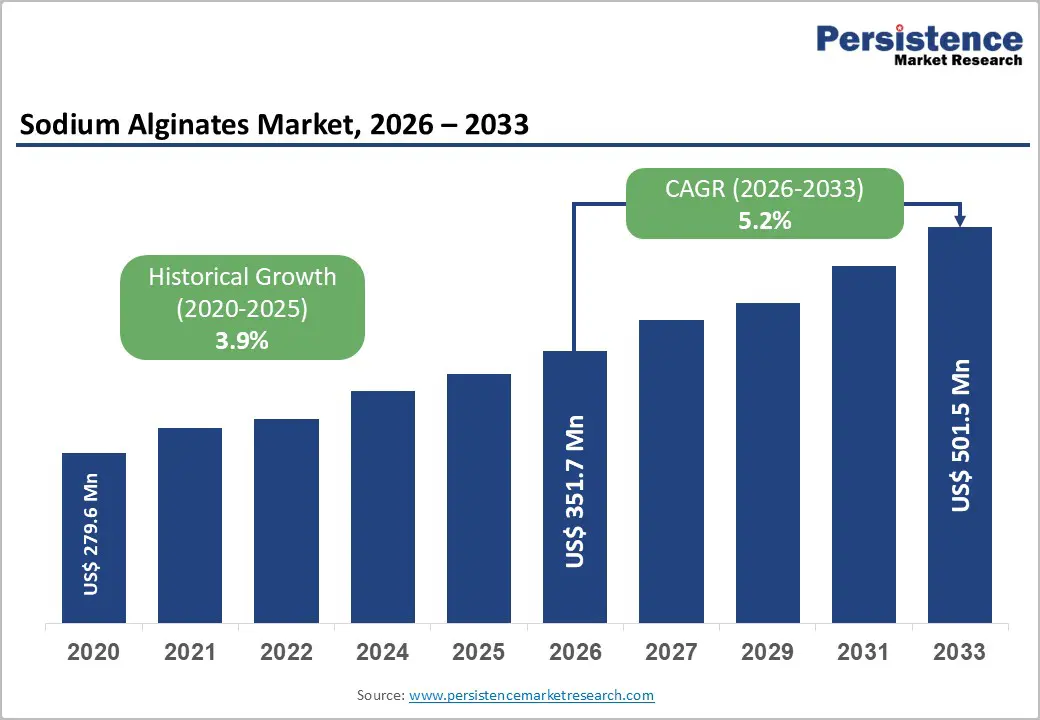
The global sodium alginates market size is supposed to be valued at US$ 351.7 million in 2026 and is projected to reach US$ 501.5 million by 2033, growing at a CAGR of 5.2% between 2026 and 2033.
Rising demand for natural, bio-based ingredients across food, pharmaceutical, and industrial sectors primarily drives this growth. Consumer preference for clean-label products is increasing the use of stabilizers and thickeners in processed foods, supported by regulatory shifts favoring natural alternatives over synthetic ones in Europe and North America. Expanding applications in pharmaceuticals for drug delivery and wound care, alongside the adoption of technical-grade materials in textiles, further accelerate growth amid sustainability trends.
Key Market highlights
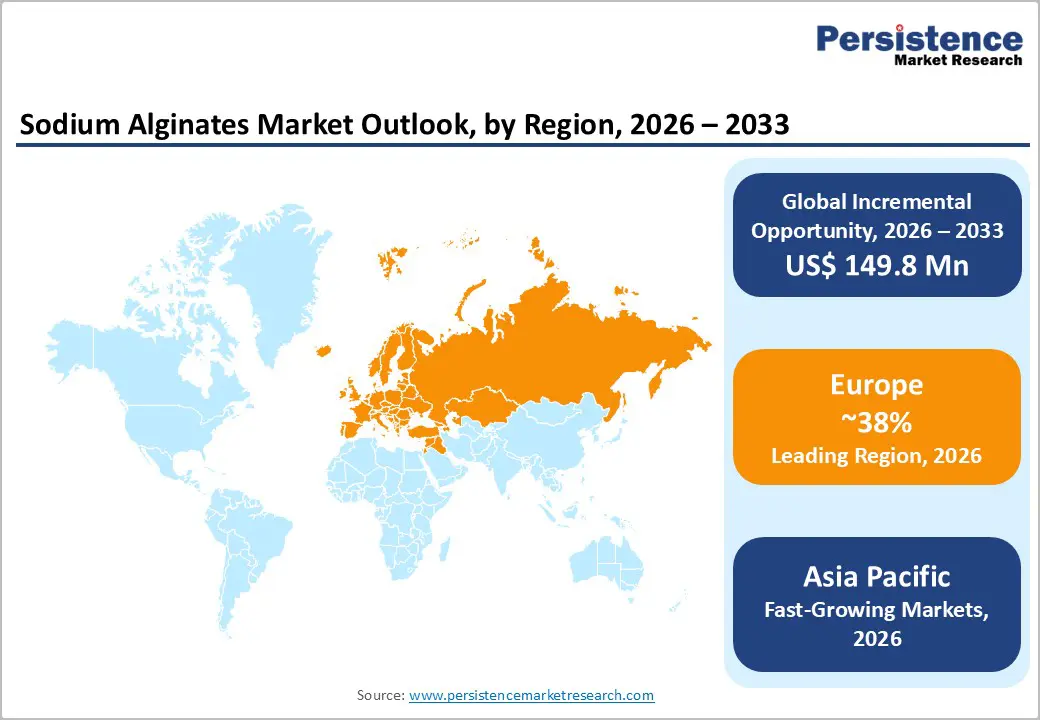
- Regional Leader: Europe dominates the sodium alginates market with the largest revenue share of 38%, driven by stringent regulatory frameworks supporting natural ingredients, substantial pharmaceutical research and development investments, and advanced biotechnology applications in countries including Germany, France, and the U.K.
- Fastest Growing Region: Asia Pacific emerges as the fastest-growing regional market, propelled by abundant seaweed resources in China, Japan, and coastal ASEAN nations, cost-competitive manufacturing infrastructure, expanding pharmaceutical industries, and government initiatives supporting marine biotechnology development.
- Leading Segment: The Food & Pharmaceutical product-grade segment leads with approximately 68% market share, supported by FDA GRAS classification, European Commission authorization under EC 1333/2008, extensive regulatory approvals that enable diverse applications, and continuous innovation in purification technologies.
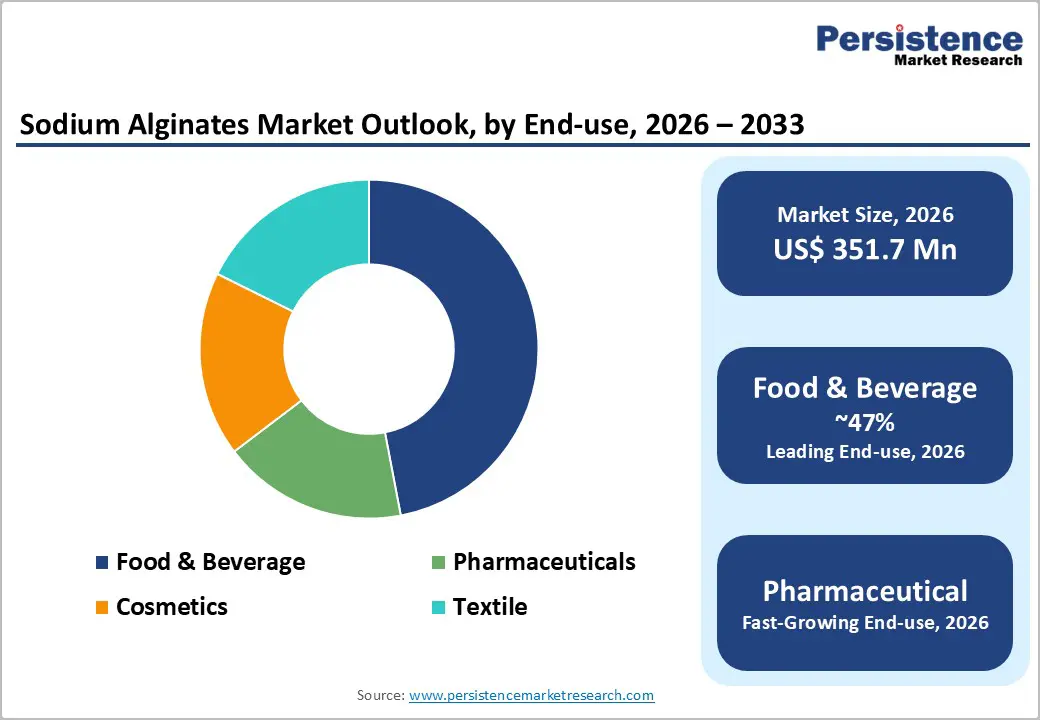
- Fastest-Growing Segment: The pharmaceutical end-use segment is projected to achieve a CAGR of approximately 6.8% through 2030, driven by expanding applications of advanced drug delivery systems, 3D bioprinting technologies, and tissue-engineering scaffolds for regenerative medicine.
- Key Market Opportunity: Sustainable packaging and biodegradable materials present transformative opportunities, with sodium alginate-based edible films and eco-friendly coatings gaining commercial viability supported by European Union regulatory initiatives targeting plastic waste reduction, addressing the estimated 8 million tonnes annual global seaweed consumption by industrial sectors seeking petroleum-based material alternatives.
| Key Insights | Details |
|---|---|
| Sodium Alginates Market Size (2026E) | US$ 351.7 Mn |
| Market Value Forecast (2033F) | US$ 501.5 Mn |
| Projected Growth CAGR (2026 - 2033) | 5.2% |
| Historical Market Growth (2020 - 2025) | 3.9% |
Market Dynamics
Drivers - Rising Demand for Natural Food Additives and Sustainable Packaging Solutions
The global food and beverage industry's shift toward natural, clean-label ingredients is significantly amplifying sodium alginate consumption, as manufacturers seek alternatives to synthetic additives. The European Commission (EC) lists alginic acid and its salts (E400-E404) as authorized food additives, reinforcing regulatory support for sodium alginate applications across diverse food categories. Brown seaweed farming, the primary source of raw material for alginate production, increased from 3.1 million tonnes in 1990 to 16.4 million tonnes in 2019 globally, according to FAO data, thereby improving raw material availability and stabilizing prices.
Concurrently, the gelling agents market, in which sodium alginate plays a key role, is expanding through applications in bakery products, dressings, beverages, and dairy products. Additionally, sodium alginate-based edible films and biodegradable packaging solutions are gaining traction, supported by EU initiatives to reduce single-use plastics.
Expanding Pharmaceutical and Biomedical Applications Driving Robust Demand
Sodium alginate has become an essential excipient in pharmaceutical formulations and advanced biomedical applications, significantly contributing to market expansion. The U.S. Food and Drug Administration (FDA) recognizes food-grade sodium alginate as Generally Regarded as Safe (GRAS) under Title 21 of the Code of Federal Regulations, permitting its use as an emulsifier, stabilizer, thickener, and gelling agent. In the pharmaceutical sector, alginate-based wound dressings exhibit superior healing properties by mimicking extracellular matrix structures, and this segment is projected to grow at an approximately 6.8% CAGR through 2030.
Furthermore, sodium alginate enables precise dosage control and customized drug release in advanced delivery systems, supporting tissue repair and regeneration. The biomaterials segment, including 3D bioprinting and tissue engineering, is anticipated to expand at 7.2% CAGR, driven by increasing adoption in regenerative medicine. Innovations such as ultrasound-assisted extraction improve yield and bioactivity, according to research journals, enabling high-purity pharmaceutical grades. This supports Gelling Agents Market synergies, with alginate's non-toxicity aiding oral and topical delivery, positioning it for high-margin growth amid an aging population.
Restraints - Raw Material Supply Variability
The sodium alginates market faces significant constraints due to the limited availability of brown seaweed, the essential raw material for alginate extraction. The growing commercial demand for brown seaweed across multiple industries, including food supplements, cosmetics, and biofuel production, has intensified competition for raw materials and created acute supply shortages. While China dominates seaweed production with approximately 5 million wet tonnes annually, primarily for kombu production, the diversified industrial applications of brown seaweed strain the dedicated supply for alginate manufacturing.
The cultivation and harvesting of specific brown algal species, such as Laminaria japonica, require specialized maritime conditions and extensive ocean-farming infrastructure, thereby limiting geographical expansion opportunities. These supply chain vulnerabilities result in price volatility and production uncertainties, constraining market growth potential for sodium alginate manufacturers.
Stringent Regulatory Frameworks Governing Food and Pharmaceutical Applications
Strict safety regulations governing sodium alginate's use in food and pharmaceutical applications impose substantial compliance burdens on manufacturers, impeding market expansion. Regulatory authorities, including the FDA, European Commission, and FAO's Codex Alimentarius Commission, enforce rigorous quality standards, purity specifications, and safety assessments for sodium alginate products. The approval processes for new alginate formulations in pharmaceutical applications require extensive clinical validation and biocompatibility testing, significantly extending product development timelines and increasing capital requirements.
In Europe and North America, acquiring permits for seaweed aquaculture remains particularly challenging for growers due to environmental regulations and maritime zoning restrictions, limiting regional raw material production capacity. These regulatory complexities create market entry barriers for new participants and restrict the operational flexibility of existing manufacturers in responding to evolving market demands.
Opportunity - Sustainable Packaging and Textile Innovation Driving Green Chemistry Adoption
The global shift towards circular economy principles presents significant opportunities for sodium alginate in eco-friendly packaging and textile processing. Sodium alginate-based edible coatings and biodegradable films offer sustainable alternatives to conventional petroleum-based materials, aligning with the EU's proposed packaging regulations for waste reduction. At Flinders University, researchers are developing seaweed-based coatings suitable for current production lines to address the high demand for seaweed in industrial sectors.
In textile manufacturing, sodium alginate acts as an eco-friendly thickening and binding agent for pigment printing, providing biodegradable options to traditional synthetic materials. The gelatin-alginate biopolymer binder shows excellent printability and color strength while enhancing UV protection and antibacterial properties in printed fabrics.
Emerging Biomedical and Regenerative Medicine Applications
Advances in biotechnology, combined with sodium alginate’s exceptional biocompatibility, are creating significant opportunities in advanced healthcare applications. Sodium alginate scaffolds are instrumental in enabling cutting-edge 3D bioprinting and cell encapsulation systems, with the biomaterials segment projected to grow at a 7.2% CAGR through 2030. Recent innovations in alginate-based wound dressings incorporate antimicrobial properties and controlled drug delivery, thereby addressing the expanding global wound care market, driven by aging populations and the prevalence of chronic diseases.
Furthermore, alginate hydrogels exhibit pH-responsive behavior for site-specific drug release, making them highly effective in oral delivery systems and for treating poorly soluble drugs. Pharmaceutical companies and research institutions are increasingly investing in alginate-based tissue engineering scaffolds and hybrid alginate-cellulose nanoparticle systems, offering promising solutions for sustained-release therapies in complex disease management.
Category-wise Analysis
Product Grade Insights
The food and pharmaceutical grade segment constitutes approximately 68% of the sodium alginates market, attributed to extensive regulatory approvals for food applications. The FDA recognizes sodium alginate as a GRAS substance, and the European Commission has authorized its use as a food additive. The pharmaceutical industry increasingly employs alginate-based excipients in controlled drug delivery systems, wound care, and tissue engineering, reinforcing the segment's dominance.
Food and pharmaceutical-grade sodium alginate undergoes rigorous purification to meet strict quality standards, including limits on heavy metals and microbiological content. Ongoing advancements in extraction and processing technologies enhance product purity and consistency, which are essential for applications in the gelling agents market and specialized pharmaceutical formulations requiring biocompatible materials.
Function Insights
The stabilizer function segment dominates sodium alginate applications, accounting for approximately 41% of market share due to its extensive use across food, pharmaceutical, and industrial sectors. Its superior stabilizing capability stems from forming protective colloids and preventing phase separation in emulsions, making it essential in dairy products, dressings, beverages, and pharmaceutical suspensions. Recognized by the FAO’s Codex Alimentarius Commission as an authorized stabilizer under good manufacturing practices, sodium alginate enjoys strong regulatory support.
In glaze and icing applications, it effectively prevents sugar crystallization and preserves texture during storage and temperature variations, outperforming alternative hydrocolloids. In pharmaceuticals, it ensures uniform distribution of active ingredients and safeguards sensitive biologics, extending to vaccines and protein therapeutics. Additionally, synergistic interactions with other hydrocolloids enable optimal rheology while supporting clean-label formulations.
End-user Insights
The food & beverage segment continues to lead the sodium alginate market, accounting for approximately 47% of the overall share. This dominance is attributed to alginate’s multifunctional properties as a stabilizer, thickener, gelling agent, and emulsifier across diverse food applications. Approved by the FDA for use in bakery products, dairy items, confectionery, beverages, and processed foods, sodium alginate offers extensive market penetration opportunities.
Leading producers, such as FMC Corporation, report widespread applications in ice creams, yogurts, fruit juices, dressings, and pet food, underscoring its versatility in addressing formulation challenges. The industry’s shift toward natural and clean-label ingredients further amplifies demand, as manufacturers replace synthetic additives while maintaining texture, stability, and shelf life. Additionally, its marine origin aligns with sustainability trends, particularly in premium and organic product categories.
Regional Insights
North America Sodium Alginates Market Trends
North America represents a mature and technologically advanced market for sodium alginates, with the U.S. leading regional consumption due to its well-established pharmaceutical and food processing industries. The U.S. FDA’s designation of food-grade sodium alginate as Generally Recognized as Safe (GRAS) under Title 21 CFR provides a strong regulatory framework supporting diverse applications.
High per capita healthcare expenditure across the region further drives demand for alginate-based solutions in advanced drug delivery systems, wound care, and biomedical applications. The presence of major players such as FMC Corporation, DuPont Inc., Cargill, Inc., and Ashland Inc. positions North America as a global hub for innovation. Additionally, growing investments in 3D bioprinting, regenerative medicine, and seaweed-based bioplastics underscore the region’s leadership in sustainable and high-value applications.
Europe Sodium Alginates Market Trends
Europe holds the largest share of the global sodium alginates market, with 38% share, driven by stringent quality standards and advanced applications in pharmaceuticals, food processing, and biotechnology. The European Commission’s authorization of alginic acid and its salts (E400-E404) under EC 1333/2008 ensures harmonized regulatory frameworks across member states, fostering market growth. Major economies such as Germany, France, and the U.K. exhibit strong demand supported by significant R&D investments in the pharmaceutical and food sectors.
Emphasis on natural and sustainable ingredients positions high-purity sodium alginate products as premium offerings. The region leads in biotechnology research for novel drug delivery systems and tissue engineering, while EU packaging regulations promoting recyclability accelerate the adoption of alginate-based biodegradable materials. Established pharmaceutical infrastructure and rigorous quality assurance further support premium pricing and value-added applications.
Asia Pacific Sodium Alginates Market Trends
Asia-Pacific is the fastest-growing regional market for sodium alginates, driven by large-scale manufacturing in China and Japan, rising convenience food consumption, and increasing adoption in textile applications. China dominates global seaweed production, harvesting approximately 5 million wet tonnes annually, supported by extensive Laminaria japonica cultivation on suspended ocean rope systems. Leading Chinese companies, including Qingdao Bright Moon Seaweed Group Co., Ltd., Qingdao Gfuri Seaweed Industrial Co., Ltd., and Zibo Wangfei Seaweed Tech. Co., Ltd., leverages vertical integration from cultivation to extraction and purification.
Japan maintains a strong position, producing 0.35 million tonnes of seaweed in 2019, with KIMICA Corporation emerging as a global leader in food and pharmaceutical-grade alginates. Competitive production costs, expanding pharmaceutical manufacturing in India, and ASEAN’s growing food industry position the Asia-Pacific for sustained growth in premium, high-purity alginate applications.
Competitive Landscape
The sodium alginates market demonstrates moderate consolidation, with leading multinational corporations and specialized regional producers shaping a competitive environment driven by technological innovation and strategic collaborations. Prominent companies such as FMC Corporation, DuPont Inc., Cargill, Inc., and KIMICA Corporation employ vertical integration strategies, ensuring quality control and supply chain reliability from seaweed sourcing to finished product development.
Market participants are actively pursuing growth through mergers and acquisitions, long-term raw material agreements with seaweed farmers, and investments in sustainable cultivation practices. Emerging business models emphasize circular economy principles, integrating biodegradable packaging, sustainable textile processing, and advanced drug delivery systems to meet evolving market and environmental demands.
Key Developments:
- June 2024: Handtmann introduced a proprietary ConProSachet system enabling industrial-scale production of edible alginate packets for cheese, jam, condiment fillings, and meat products. The system co-extrudes edible alginate sachets composed of sodium alginate derived from seaweed, offering complete biodegradability within weeks and representing significant innovation in sustainable food packaging technology.
- February 2024: CD BioSciences announced the development of improved-purity alginate products designed for scientific research applications, including drug delivery systems and tissue engineering studies. The company's newly released formulations guarantee superior performance in controlled-release applications and biomedical research through advanced purification and quality control processes.
- August 2024: CNX Therapeutics and Klaria secured regulatory approval for Sumatriptan Alginate, an innovative pharmaceutical formulation, in major European markets including Germany, Spain, and Italy. This approval demonstrates growing pharmaceutical regulatory acceptance of alginate-based formulations and expanding commercialization of advanced alginate drug delivery systems.
Top Companies in the Sodium Alginates Market
- FMC Corporation (Philadelphia, Pennsylvania, U.S.) stands as a global leader in specialty biopolymers with extensive alginate production capabilities spanning multiple continents through subsidiaries including FMC BioPolymer U.K. Limited, FMC Agricultural Products International AG (Switzerland), and FMC Chemicals KK (Japan). The company's diversified product portfolio addresses applications across food processing, pharmaceuticals, agricultural chemicals, and industrial sectors, with alginate derivatives utilized in bakery items, dressings, beverages, ice creams, yogurts, and specialized pharmaceutical formulations.
- KIMICA Corporation (Tokyo, Japan) operates as a specialized global producer focused exclusively on alginates for the food and pharmaceutical industries, with strategic production facilities in Japan and Chile ensuring proximity to key seaweed harvesting regions. The company's concentrated business model enables deep expertise in alginate chemistry, application development, and customer technical support, positioning KIMICA as a preferred supplier for demanding pharmaceutical applications requiring rigorous quality specifications.
- Cargill, Inc. (Minneapolis, Minnesota, U.S.) leverages its position as a diversified agricultural and food ingredients multinational to integrate alginate products within comprehensive hydrocolloid portfolios serving global food and beverage manufacturers. The company's extensive distribution network, technical application capabilities, and financial resources enable market penetration across multiple product categories and geographical regions.
Companies Covered in Sodium Alginates Market
- FMC Corporation
- DuPont Inc.
- Cargill, Inc.
- KIMICA Corporation
- Brenntag AG
- Qingdao Gfuri Seaweed Industrial Co., Ltd.
- Ashland Inc.
- J. Rettenmaier & Söhne GmbH
- Qingdao Bright Moon Seaweed Group Co., Ltd.
- Zibo Wangfei Seaweed Tech. Co., Ltd.
- Marine Biopolymers Limited
- Algaia
- SNAP Natural & Alginate Products Pvt. Ltd.
Frequently Asked Questions
The global sodium alginates market is projected to reach US$ 501.5 Mn by 2033, expanding from US$ 351.7 Mn in 2026 at a compound annual growth rate of 5.2% during the forecast period, driven by increasing pharmaceutical applications, food industry demand, and sustainable packaging adoption.
Key growth drivers include expanding pharmaceutical and biomedical applications with alginate-based drug delivery systems growing at 6.8% CAGR, rising consumer demand for natural food additives supported by FDA GRAS classification, increased brown seaweed production from 3.1 million tonnes to 16.4 million tonnes globally per FAO data, and sustainable packaging initiatives aligned with European Union regulatory frameworks.
The Food & Pharmaceutical grade segment leads the market with approximately 68% share, benefiting from extensive regulatory approvals, including FDA Title 21 CFR GRAS designation and European Commission EC 1333/2008 authorization, supporting widespread applications across food stabilization, pharmaceutical formulations, and biomedical technologies.
Europe maintains the largest regional market share for sodium alginates, driven by stringent quality standards, substantial pharmaceutical research and development investments, advanced biotechnology applications in Germany, France, and the United Kingdom, and regulatory emphasis on natural ingredients in healthcare and food sectors.
Significant opportunities include emerging biomedical applications with 3D bioprinting and tissue engineering segments projected to grow at 7.2% CAGR through 2030, sustainable packaging solutions with alginate-based biodegradable films addressing European Union plastic waste reduction initiatives, and textile industry adoption of eco-friendly alginate binders.
Major market participants include FMC Corporation, KIMICA Corporation, Cargill, Inc., DuPont Inc., Brenntag AG, and Algaia SA, collectively commanding substantial market shares through vertical integration, technological innovation, and strategic partnerships with seaweed suppliers.


