




- Nutraceuticals & Functional Foods
- Natural Health Supplements Market
Natural Health Supplements Market Size, Share, and Growth Forecast 2026 - 2033
Natural Health Supplements Market by Product Type (Vitamins, Minerals, Herbal Supplements, Probiotics, Omega Fatty Acids, Others), Form (Tablets, Capsules, Powders, Others), Application (Immunity, Bone & Joint Health, Digestive Health, Heart Health, General Wellness), Sales Channel (Hypermarkets/Supermarkets, Drug & Specialty Stores, Online Retail, Others), and Regional Analysis, 2026 - 2033

Natural Health Supplements Market Share and Trends Analysis
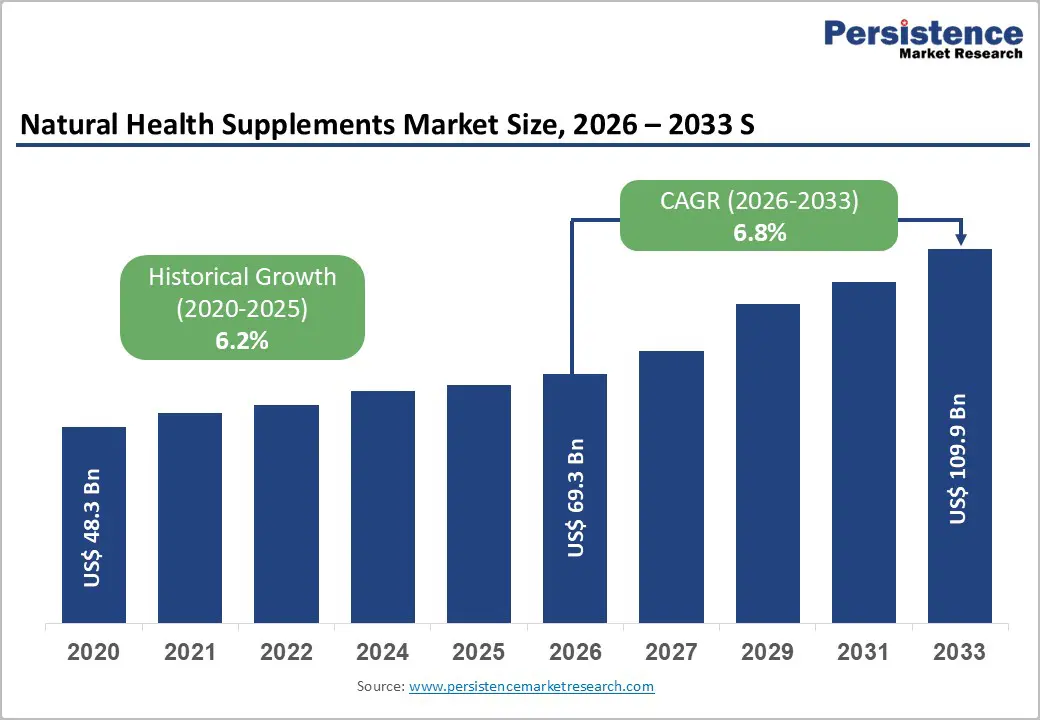
The global natural health supplements market size is expected to be valued at US$ 69.3 billion in 2026 and projected to reach US$ 109.9 billion by 2033, growing at a CAGR of 6.8% between 2026 and 2033.
The market expansion is driven by three primary factors: increasing consumer health consciousness fueled by rising chronic diseases and sedentary lifestyles, aging populations, particularly baby boomers (projected to reach 83.7 million by 2050), seeking preventive healthcare, and accelerating e-commerce penetration, enabling greater product accessibility. Scientific research validation, with over 40,000 peer-reviewed studies on supplement efficacy, continues to build consumer confidence and market credibility across global regions.
Key Market Highlights
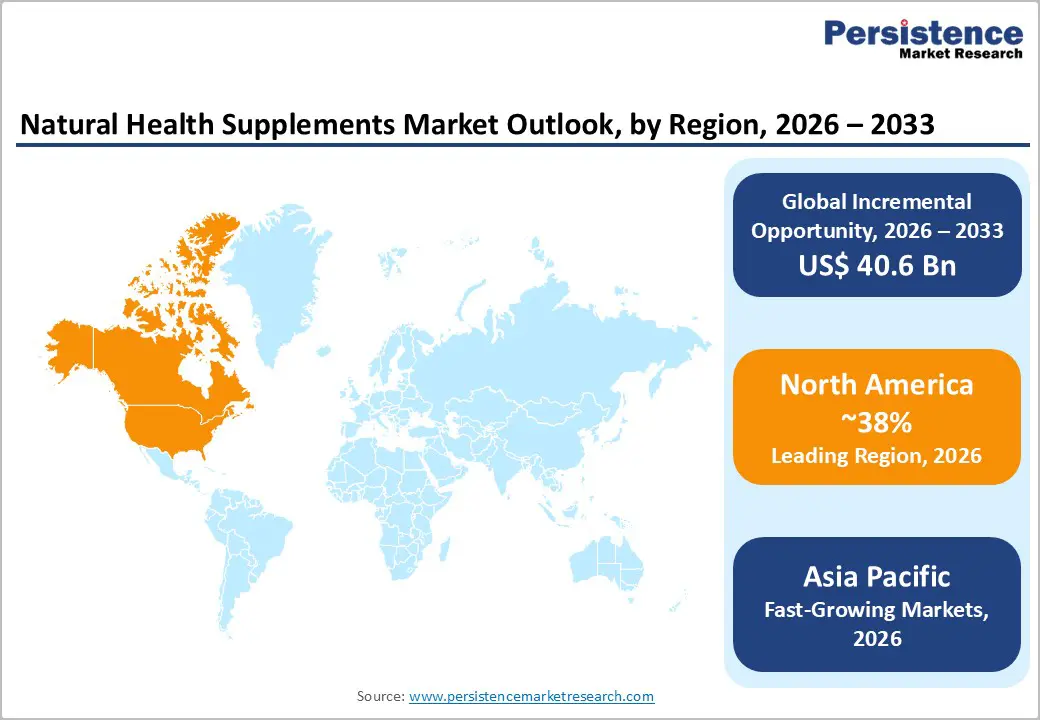
- North America leads the global natural health supplements market with 38% market share in 2025, driven by mature consumer awareness, advanced regulatory frameworks, and established e-commerce infrastructure that enable direct-to-consumer distribution and subscription models, reaching affluent, health-conscious demographics across diverse supplement categories.
- Asia Pacific is the fastest-growing regional market, expanding at a CAGR exceeding 9.7%, driven by aging populations in China and Japan, rising middle-class disposable incomes in India and Southeast Asia, and government policy support for integrating traditional medicine into national healthcare systems.
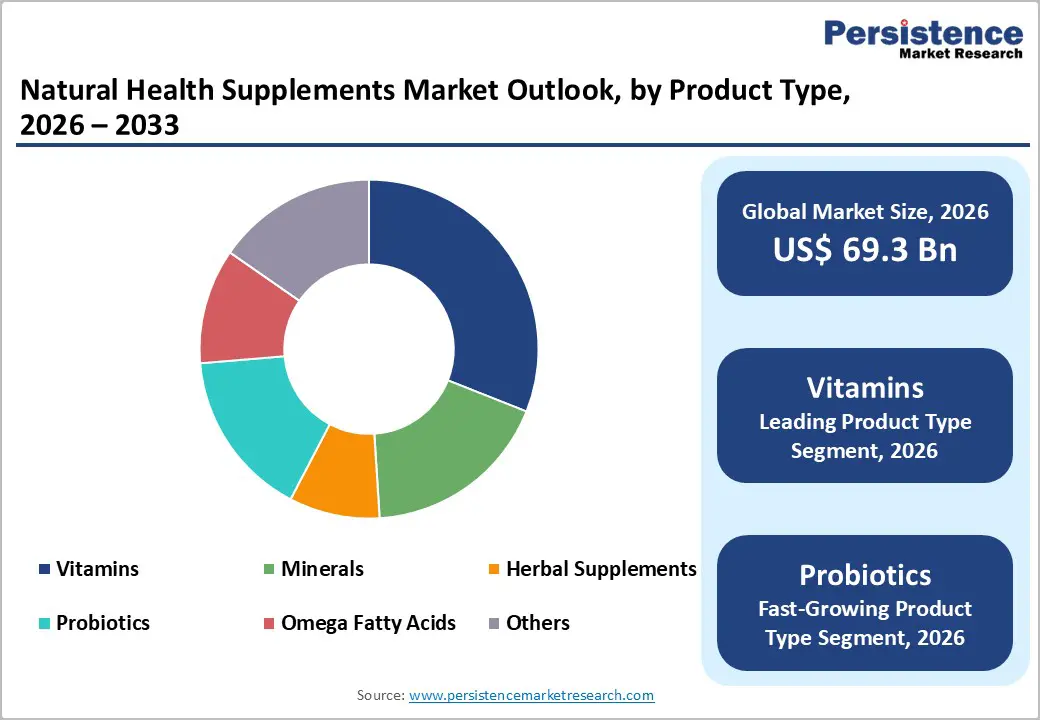
- Vitamins command the dominant product category with 31% market share in 2025, reflecting historical market leadership, extensive scientific substantiation, widespread consumer familiarity, and a global distribution infrastructure spanning hypermarkets, specialty retailers, and e-commerce platforms.
- Probiotics represent the fastest-growing segment, with a CAGR exceeding 10%, driven by scientific validation of the gut microbiome's influence on digestive, immune, and mental health, coupled with innovative delivery systems, including advanced encapsulation technologies that enable targeted colonic release and extended shelf stability.
- Personalized nutrition and digital health integration create substantial market opportunities, enabling genetically informed, microbiome-optimized supplement solutions that leverage artificial intelligence recommendation engines, wearable health monitoring, and biomarker analysis for customized wellness interventions that address individual metabolic requirements.
| Key Insights | Details |
|---|---|
| Market Size (2026E) | US$ 69.3 billion |
| Market Value Forecast (2033F) | US$ 109.9 billion |
| Projected Growth CAGR (2026 - 2033) | 6.8% |
| Historical Market Growth (2020 - 2025) | 6.2% |
Market Dynamics
Drivers - Increasing Consumer Health Consciousness and Preventive Healthcare Adoption
Rising awareness of preventive healthcare solutions is fundamentally transforming consumer supplement purchasing patterns. According to recent market analysis, 60% of Americans report taking one or more dietary supplements regularly, with particular emphasis on preventive wellness applications. This shift reflects broader societal trends toward proactive health management rather than reactive disease treatment. The aging demographic across developed markets has intensified this trend, as individuals aged 65 and above increasingly adopt supplementation regimens to support bone health, cardiovascular function, and cognitive wellness. In emerging markets like India and China, growing middle-class populations with rising disposable incomes are discovering the benefits of supplements, contributing to regional market growth at significantly higher rates than in developed economies.
E-Commerce Expansion and Direct-to-Consumer Distribution Models
Digital retail transformation represents a critical growth lever for the natural health supplements market. E-commerce penetration in the supplements category is expanding rapidly, with subscription models and personalized nutrition platforms gaining significant traction. Online retail channels eliminate geographical barriers, allowing remote consumers access to specialized products previously available only in urban specialty stores. This distribution democratization particularly benefits direct-to-consumer brands, bypassing traditional retail intermediaries and capturing higher margins. Furthermore, digital platforms enable data-driven personalization, allowing companies to recommend targeted supplement combinations based on individual health profiles and microbiome analysis, enhancing customer lifetime value and market penetration in developing regions.
Restraints - Regulatory Complexity and Compliance Burden Across Regions
The dietary supplement sector operates under fragmented, region-specific regulatory frameworks that significantly increase operational complexity and market entry costs. The Food and Drug Administration (FDA) under the Dietary Supplement Health and Education Act (DSHEA) requires adherence to current good manufacturing practices (cGMP), imposing substantial quality assurance expenditures. The FDA annually issues dozens of warning letters addressing labeling violations, unsubstantiated health claims, and manufacturing noncompliance, creating financial risk and brand damage for non-compliant manufacturers. In the European Union, herbal supplements must comply with European Food Safety Authority (EFSA) guidelines, which require safety and efficacy substantiation, while China's National Medical Products Administration (NMPA) and Japan's regulatory frameworks require extensive documentation and testing protocols. These divergent requirements necessitate parallel regulatory development, registration processes, and documentation maintenance, substantially limiting market participation for smaller companies lacking compliance infrastructure.
Misleading Marketing Claims and Consumer Skepticism
Persistent skepticism regarding supplement efficacy remains a significant market restraint, primarily driven by historically misleading marketing practices and unsubstantiated health claims. Despite regulatory tightening, certain market participants continue to make exaggerated benefit claims, eroding consumer trust in legitimate supplement providers. This consumer skepticism disproportionately impedes market growth, despite scientific validation from peer-reviewed research, as potential customers hesitate to invest in products associated with fraudulent claims. Additionally, high-profile contamination incidents, counterfeit product proliferation, and inconsistent quality standards across manufacturers amplify hesitation among health-conscious consumers seeking trustworthy supplement sources. The psychological impact of previous market exploitation creates significant sales friction, particularly among emerging market consumers with limited access to product verification mechanisms.
Opportunities - Probiotic Supplements and Gut Microbiome Innovation
Pet probiotic supplements represent the fastest-growing segment within the natural health supplements market, with a projected CAGR exceeding 10% during the 2026-2033 forecast period. Scientific evidence elucidating the gut microbiome's influence on digestive health, immune function, mental wellness, and metabolic regulation has driven exceptional demand for probiotic supplements. Market valuation for specialized probiotic formulations reached approximately US$ 15 billion in 2025, with projections of expansion to US$ 32.6 billion by 2033. Recent innovations in delivery systems, including advanced encapsulation technologies enabling extended shelf stability and targeted colonic release, alongside the development of novel microbial strains with enhanced efficacy, are generating significant market opportunities. Major industry players, including Nestlé Health Science and DSM-Firmenich, are investing substantially in microbiome research collaborations and synbiotic product development, recognizing the substantial opportunity in personalized probiotic solutions aligned with individual microbiome compositions and health objectives.
Personalized Nutrition and Digital Health Integration
The convergence of nutrigenomics, microbiome analysis, wearable health monitoring, and artificial intelligence-enabled recommendation engines is creating an unprecedented opportunity for customized supplement solutions. Consumers increasingly reject one-size-fits-all supplement approaches, preferring genetically-informed, microbiome-optimized, and lifestyle-personalized nutritional interventions. Companies leveraging advanced biomarker analysis, stress-monitoring technologies, and real-time health tracking can develop targeted supplement regimens that address individual metabolic requirements, absorption patterns, and health objectives. This personalization premium supports higher product pricing and enhanced customer loyalty, creating compelling financial incentives for market participants. The Asia Pacific region, particularly India and China, with combined populations exceeding 2.7 billion, represents a substantial opportunity for affordable, personalized supplement solutions that address region-specific nutritional deficiencies and traditional wellness paradigms.
Category-wise Analysis
Product Type Insights
Vitamins represent the dominant product category within the natural health supplements market, commanding approximately 31% market share in 2025. This leadership position reflects historical market establishment, widespread consumer familiarity, and regulatory frameworks specifically designed for vitamin formulations. Vitamin supplementation addresses fundamental nutritional gaps resulting from modern dietary patterns characterized by processed foods, limited micronutrient diversity, and reduced consumption of fresh produce. Scientific substantiation for specific vitamins, particularly Vitamin D, exceeding 30% share of the vitamin segment, Vitamin C for immune support, and B-complex formulations for energy metabolism, provides a robust consumer confidence foundation. The vitamin segment benefits from established distribution infrastructure spanning hypermarkets, specialty retailers, and e-commerce platforms, ensuring convenient consumer accessibility. Growth within this category reflects expansion into specialized formulations, including high-potency combinations, sustained-release technologies, and chelated mineral forms addressing absorption optimization and targeted health applications.
Form Insights
Tablets represent the leading supplement form, capturing dominant market share through established consumer familiarity, cost-effective manufacturing processes, and extended shelf stability. However, emerging form innovations, including powders, liquid formulations, gummies, and effervescent tablets, are capturing increasing market share as manufacturers address consumer convenience preferences and taste acceptability concerns. Powder formulations enable greater ingredient flexibility, higher concentration levels, and customizable dosing, particularly appealing to fitness-conscious consumers and individualized nutrition advocates. Gummy formats, specifically targeting younger demographics and individuals with difficulty swallowing tablets, have transitioned from novelty to a mainstream market category, demonstrating particular strength in the immunity and vitamin supplementation segments. These form innovations reflect market maturation toward consumer-centric product development prioritizing convenience, palatability, and functional benefits over traditional standardized formats.
Application Insights
General wellness remains the leading application category as consumers prioritize preventive health maintenance and overall vitality enhancement over treating specific conditions. This leadership reflects consumer preference for sustainable, non-pharmaceutical approaches to optimizing health and reducing risk of chronic diseases. The digestive health application segment demonstrates exceptional growth trajectory, driven by increasing recognition of gut microbiome significance in overall wellness and rising prevalence of functional gastrointestinal disorders. Immunity-focused supplements gained substantial market prominence following pandemic-driven awareness of respiratory health and immune resilience, transitioning from seasonal to year-round consumption. Bone and joint health applications command a growing share, reflecting aging population dynamics and athletic population emphasis on musculoskeletal function maintenance, while emerging heart health applications leverage extensive cardiovascular research substantiation and aging population disease prevalence.
Sales Channel Insights
E-commerce channels are the fastest-growing distribution segment, with growth substantially exceeding that of traditional retail channels. Online retail penetration particularly benefits from improved logistics infrastructure, subscription model adoption, consumer preference for home delivery, and comparative price transparency enabling consumer optimization. Hypermarkets and supermarkets maintain significant market share through established consumer traffic, convenient co-location with other shopping activities, and visual product examination, enabling consumer purchasing confidence. Drug and specialty stores serve premium market segments, emphasizing professional consultation and quality assurance verification, maintaining stable market share among health-conscious, ingredient-conscious consumer demographics. Online retail competitive advantages include extensive product selection, international sourcing capability, subscription convenience enabling recurring purchase automation, and targeted digital marketing enabling consumer education, positioning digital channels for accelerating share expansion during the 2026-2033 forecast period.
Regional Insights
North America Natural Health Supplements Market Trends and Insights
North America leads the natural health supplements market, driven by strong consumer awareness, high healthcare spending, and a well-established preventive health culture. The Food and Drug Administration (FDA) plays a crucial role in ensuring product safety and quality, boosting consumer confidence. Rising demand for immunity-boosting, digestive health, and personalized nutrition products continues to support market growth. Additionally, increasing adoption of plant-based and clean-label supplements reflects shifting consumer preferences toward natural and organic solutions. The presence of major companies such as Abbott Laboratories, Herbalife Nutrition, and Amway further strengthens regional leadership through continuous product innovation and strong distribution networks. E-commerce expansion and subscription-based supplement models are also accelerating accessibility, making North America a mature and innovation-driven market.
Asia Pacific Natural Health Supplements Market Trends and Insights
Asia Pacific is emerging as the fastest-growing region in the natural health supplements market, driven by rising health awareness, increasing disposable incomes, and a growing focus on preventive healthcare. Countries like China, India, and Japan are witnessing strong demand for herbal, Ayurvedic, and traditional supplements, driven by deep-rooted cultural acceptance. Rapid urbanization and changing lifestyles have led to higher consumption of vitamins, probiotics, and immunity-boosting products. Government initiatives supporting traditional medicine systems and expanding nutraceutical regulations are further fueling market growth. Additionally, the rise of e-commerce platforms and digital health awareness campaigns is improving product accessibility across urban and semi-urban areas. Local companies like Dabur India Ltd and Patanjali Ayurved are leveraging traditional formulations, making Asia Pacific a dynamic and high-potential market.
Competitive Landscape
The natural health supplements market is highly competitive, characterized by a mix of global corporations, regional players, and niche brands focusing on specific health needs. Companies compete on product innovation, quality, pricing, and strong branding, with increasing emphasis on clean-label, organic, and plant-based formulations. The market also sees rising competition from direct-to-consumer and e-commerce channels, enhancing accessibility and consumer engagement. Regulatory compliance and certifications play a crucial role in gaining consumer trust.
Key Developments:
- In February 2025, SFI Health™ EMEA announced that Equazen® products will be soon available in Portugal. Equazen® is a reputable international brand that provides nutritional products based on science to promote cognitive performance and brain health.
- In January 2025, Java Burn introduced a new natural health supplement by blending the benefits of clean ingredients with the simplicity of coffee. When combined with a morning brew, the formula effectively addresses several health issues like poor metabolism, low energy, and stubborn weight. The supplement contains camellia sinensis, vitamin B12, green tea extract, chlorogenic acid, L-carnitine, vitamin B6, L-theanine, and chromium.
- In September 2024, Bonafide Health, LLC and Otsuka Pharmaceutical Co., Ltd. launched a plant-based supplement called Thermella to contribute to women’s health during menopause. Spirulina extract, decaffeinated green tea extract, and curcumin extract are among the plant-based ingredients found in Thermella.
Companies Covered in Natural Health Supplements Market
- Amway
- Herbalife Nutrition
- Abbott Laboratories
- Nestlé Health Science
- Glanbia plc
- Danone S.A.
- BASF SE
- Nature's Sunshine Products
- Nu Skin Enterprises
- Swanson Health Products
- Dabur India Ltd
- Patanjali Ayurved
- Nature's Bounty
- Pharmavite
- Garden of Life
- dsm-firmenich
- Lallemand Health Solutions
Frequently Asked Questions
The global natural health supplements market is expected to be valued at US$ 69.3 billion in 2026, representing substantial expansion from US$ 48.3 billion in 2020, reflecting compounded annual growth driven by increasing consumer health consciousness, aging demographics, and e-commerce accessibility improvements across developed and emerging markets.
The market is primarily driven by increasing consumer health consciousness emphasizing preventive healthcare over reactive disease treatment, aging populations particularly baby boomers numbering approximately 75 million in North America seeking healthy aging solutions, rising chronic disease prevalence requiring preventive intervention, e-commerce expansion enabling product accessibility in remote regions, and scientific substantiation of supplement efficacy through 40,000+ peer-reviewed studies building consumer confidence in supplement effectiveness and safety.
North America leads the global market with 38% market share in 2025, driven by mature consumer awareness, elevated health consciousness, established regulatory frameworks administered by the Food and Drug Administration (FDA) under the Dietary Supplement Health and Education Act (DSHEA), sophisticated e-commerce infrastructure, and affluent consumer demographics prioritizing preventive health and wellness investments across diverse supplement categories.
Personalized nutrition and digital health integration represent the most significant market opportunity, leveraging nutrigenomics, microbiome analysis, wearable health monitoring, and artificial intelligence-enabled recommendation engines to create customized supplement solutions addressing individual metabolic requirements, absorption patterns, and health objectives, supporting premium pricing and enhanced customer loyalty while enabling targeted market penetration in Asia Pacific region with populations exceeding 2.7 billion.
The market is dominated by multinational corporations including Nestlé Health Science, Abbott Laboratories, Danone S.A., and BASF SE controlling 45-50% of developed market share through established distribution networks and research capabilities, while regional players including Dabur India Ltd and Patanjali Ayurved demonstrate competitive strength in Asian markets through localized manufacturing and traditional medicine integration, with emerging direct-to-consumer brands capturing growing share through digital-first strategies and influencer engagement.


